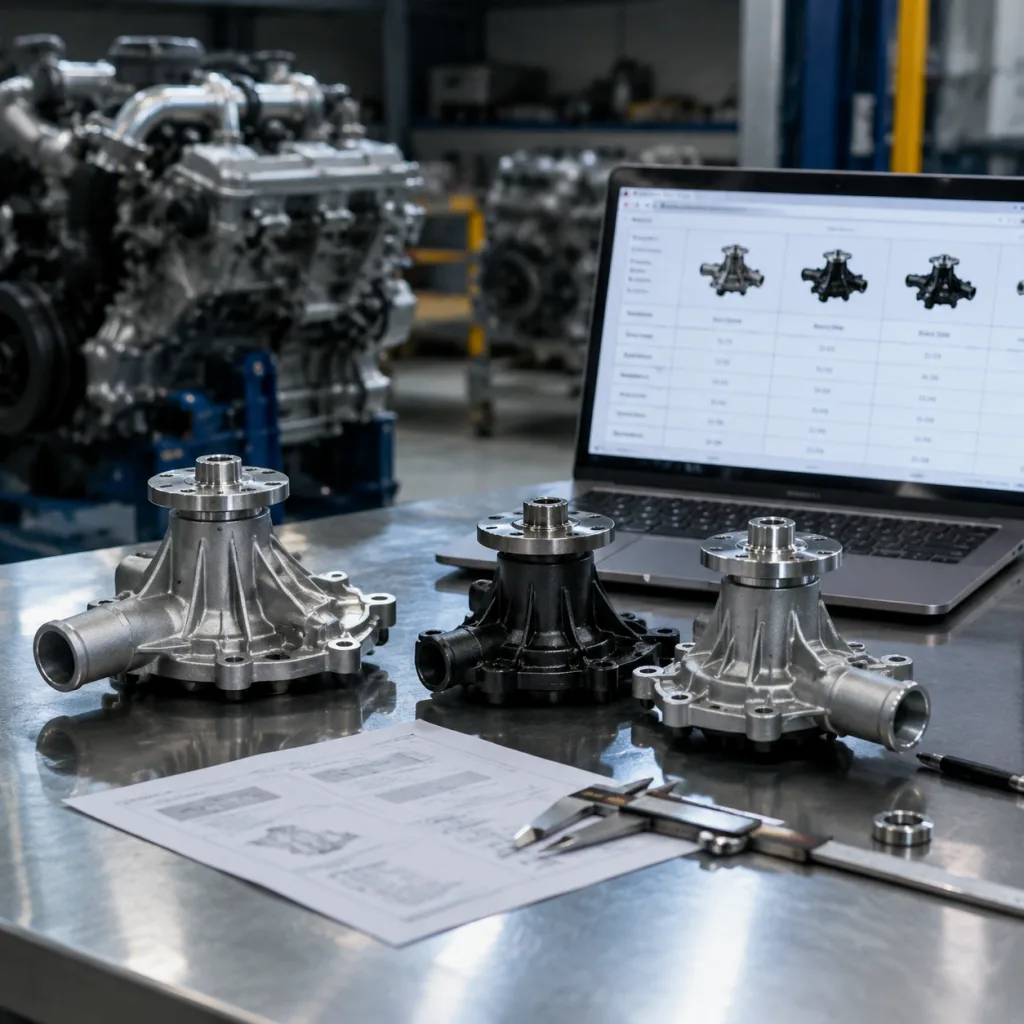
Water pump specifications decide whether a pump fits, seals, and survives in service. For procurement teams, the real question is not just flow or pressure; it is whether the mounting pattern, pulley offset, impeller design, shaft runout, seal material, bearing type, coolant compatibility, MOQ, unit price bands, and lead time all line up. Small deviations in bolt-hole tolerance, gasket-face finish, or outlet clocking can trigger installation issues and warranty claims. That risk shows up across passenger car, light commercial, and industrial engine programmes where OE-equivalent dimensions are expected but supplier data is often thin. Driventus is an independent aftermarket manufacturer; brand names are referenced for fitment only. We support B2B buyers who need consistent part control, validated dimensions, and traceable production. If you are comparing pump variants for a platform, start with the dimensional drawing, then verify the material stack, inspection criteria, and cross-reference against OE `06A107065` where applicable.
The spec sheet test: what buyers must see
A useful spec sheet should answer four questions fast: will it fit, will it perform, what can break, and what does it cost at volume? For engine water pumps, the minimum data set should include:
OE or aftermarket cross-reference, such as `OE 06A107065` where applicable
Engine code, model year range, and drive layout
Mounting flange pattern and bolt-hole count
Overall depth, pulley offset, and impeller diameter
Inlet/outlet diameter, hose clocking, and gasket-face geometry
Shaft diameter, bearing type, seal type, and shaft end play limit
Housing material, impeller material, and gasket material
Rotation direction, if the design is direction-sensitive
Test method, sample size, and inspection criteria
MOQ, target annual volume, and requested lead time
A simple drawing with nominal dimensions is not enough for procurement. Ask for the tolerance band on critical faces, the flatness of the sealing surface, the maximum permissible shaft end play, and the acceptable pulley runout. Those values determine whether the part seals after installation, keeps belt alignment stable, and passes incoming inspection. As a rule, buyers should insist on a controlled revision code for every drawing and a change note whenever material, seal, bearing, or machining process changes.
Critical dimensions: where fitment usually fails
The most common sourcing errors come from assuming one pump matches another because the engine family is the same. In practice, the flange and outlet geometry often vary by model year, emissions package, accessory drive layout, or thermostat housing design.
Parameter
Why it matters
Typical procurement check
Practical acceptance target
Mounting flange thickness
Affects belt line and bracket clearance
Compare against OE drawing or sample part
Match nominal within ±0.20 mm unless OE drawing states tighter control
Pulley offset
Prevents belt tracking issues
Measure from datum face to pulley centreline
Keep within ±0.30 mm, then verify with belt alignment on fixture
Impeller diameter
Influences circulation capacity
Confirm against casting and rotor drawing
Match OE nominal and verify vane count/profile
Shaft length
Controls bearing load and seal position
Check with a calibrated depth gauge
Hold within ±0.15 mm on critical stack-up parts
Bolt-hole PCD
Determines installation fit
Verify against engine front cover pattern
Hole position error should not exceed ±0.25 mm typical production control
Outlet angle
Affects hose routing and clamp access
Match to vehicle packaging constraints
Hold angle within ±2° unless hose routing is highly constrained
Gasket face flatness
Reduces coolant leakage
Require flatness data on the sealing face
Common buyer target: ≤0.05 mm across the sealing land
Shaft runout
Impacts bearing life and noise
Inspect on dial gauge at the specified datum
Often targeted at ≤0.03 mm TIR for quality-controlled programs
End play
Indicates bearing pack stability
Measure axial movement under defined load
Common target: ≤0.10 mm, with tighter control for premium applications
</tr></thead><tbody> </tbody></table>For tight-fit applications, buyers should also specify dimensional inspection sampling, CPK target if the supplier runs capability studies, and the acceptance criterion for concentricity between the shaft and impeller. If the pump runs on a serpentine belt, pulley runout should be checked as part of incoming quality control. For launch orders, request a first-article report that records at least 10 critical dimensions and identifies the measurement equipment used.
Material stack and build choices
Material choice affects corrosion resistance, cavitation behaviour, noise, and bearing life. The construction should be documented clearly enough for supplier comparison, warranty analysis, and claim handling.
Common material options
Housing: cast aluminium, cast iron, or powder-coated metal housing
Impeller: stamped steel, cast aluminium, composite polymer, or sintered metal in some designs
Shaft: hardened steel with corrosion-resistant surface treatment
Bearing: sealed double-row ball bearing or equivalent heavy-duty bearing set
Seal: carbon-ceramic face seal or equivalent coolant-compatible seal system
Gasket: paper, composite fibre, rubber-coated metal, or formed-in-place sealing design
Typical buyer checks by material
Ask for the alloy or polymer grade, not just the generic material class
Confirm whether the impeller is press-fit, welded, molded, or crimped to the shaft
Verify the seal face pair and whether the seal is rated for extended-life coolant chemistry
Confirm bearing grease type, temperature rating, and noise class if disclosed
Ask whether the housing uses coating, passivation, or corrosion protection on machined faces
For buyers in salt-corrosion, hot-climate, or high-duty environments, ask whether the pump has undergone coolant exposure testing and whether the bearing grease specification is documented. If the application uses modern extended-life coolant, confirm compatibility with OAT, HOAT, or silicate-containing formulations before release. Driventus supports custom manufacturing when a platform needs a revised material stack, different coating system, or non-standard outlet geometry. For procurement, that conversation should start with a sample or drawing plus the monthly demand forecast so tooling, material selection, and price tier can be aligned early.
Validation and standards: what actually reduces risk
Procurement teams should request traceable test evidence, not only a catalogue description. A credible water pump offer should state how the part was validated, what acceptance values were used, and which standards or internal methods applied.
Relevant references often include:
`IATF 16949:2016` for automotive quality management
`ISO 9001:2015` for controlled production systems
`REACH (EC) No 1907/2006` for chemical compliance in the EU
`ECE R-83` where the pump is part of emissions-related engine system validation
`SAE J2527` for environmental durability context when relevant to component testing
Common checks include leak test, shaft load test, bearing noise check, burst margin, pressure hold, thermal cycling, and salt-spray or coolant aging where the application demands it. For procurement, the key is not the test name alone but the acceptance criteria. Ask for test pressure, hold time, coolant type, temperature range, cycle count, and whether the sample was tested at room temperature or elevated temperature. That allows a direct comparison between suppliers and reduces ambiguity during sample approval.
A practical supplier pack should include the following for each part number:
Test report with date, lot number, and sample count
Dimensional inspection sheet with critical-to-fit dimensions highlighted
Material declaration for all wetted parts
Process flow or control plan summary for machined, pressed, and sealed features
Traceability format for batch, carton, and production date
Non-conformance procedure for leaks, noise, and dimensional drift
Driventus documents production under an audited quality system and can support buyers who need lot traceability, dimensional reports, sample validation, and controlled revision handling.
Comparison workflow: how to screen variants without confusion
Two pumps can share the same engine family and still differ in ways that matter. The cleanest way to compare variants is to use a shortlist based on fitment, then confirm the engineering data and commercial terms.
1. Match the OE cross-reference and engine code. 2. Confirm flange pattern, depth, and outlet position. 3. Compare impeller style, vane count, and shaft support design. 4. Review seal and bearing construction. 5. Check packaging constraints against the vehicle front-end layout. 6. Validate against a physical sample before mass order. 7. Confirm quotation terms, including MOQ, price breakpoints, and lead time.
If your team manages multiple vehicle lines, build a comparison matrix with OE number, dimensions, material set, test status, MOQ, and annual forecast. That makes it easier to separate true equivalents from near matches. It also helps when you source across regions, because catalogue descriptions can vary even when the mechanical package is similar.
For commercial planning, buyers should also ask for a price ladder. A typical structure is sample price, trial-order price, 1,000-piece price, and 5,000-piece or annual-contract price, because the unit cost usually changes once machining setup, packaging, and freight consolidation are spread across volume. As a rule, lower MOQ often carries a higher unit price, while longer lead times may reduce cost if the supplier can batch raw material and machining runs.
A practical comparison sheet should include:
Quoted unit price at 100, 500, 1,000, and 5,000 pieces
MOQ for stocked and made-to-order versions
Standard lead time in days for sample, pilot, and mass production
Packaging method and carton quantity
Incoterms, if freight is part of the comparison
Revision status and whether tooling ownership is disclosed
Before release, ask the supplier for a complete documentation pack. For water pumps, the most useful items are:
Dimensional drawing with tolerances
Material declaration for housing, impeller, seal, and gasket
Sample inspection report with critical measurements
Test summary for leak, noise, endurance, and pressure hold verification
Packaging specification for export handling
Lead time, MOQ, and revision control status
Price break table by quantity
Warranty term and claim procedure
To keep the order actionable, buyers should define the commercial and technical acceptance criteria together. A useful purchase-order note can state the target OE reference, required annual volume, first order quantity, acceptable lead time window, and whether samples must be approved before bulk production. If the launch date is fixed, specify the latest acceptable ship date and ask the supplier to confirm whether production is from stock, scheduled batch, or new tooling.
For buyers evaluating multiple sources, the fastest way to remove uncertainty is to request an engineering sample against the target OE reference, then compare it against your incoming inspection criteria. If a non-standard outlet angle, impeller profile, housing finish, or package label is required, request a quote with the target engine code, annual volume, sample photos, and desired MOQ so the factory can confirm feasibility, price tier, and lead time before tooling or release.
Frequently asked questions
Focus on mounting dimensions, pulley offset, outlet orientation, shaft and bearing design, seal material, flatness, runout, end play, and the test method used to verify leakage and durability.
Match the OE cross-reference, then verify flange pattern, depth, hose connections, pulley line, and dimensional tolerances against a sample or drawing before ordering volume.
Sample or pilot orders usually have a higher unit price and lower MOQ, while production pricing improves at 500, 1,000, and 5,000 pieces. Lead time is typically shorter for stock items and longer for made-to-order or revised designs, so buyers should request a written schedule tied to the approved revision.
Yes. We can provide drawings, inspection data, commercial terms, and compliance documents aligned with `IATF 16949:2016`, `ISO 9001:2015`, and relevant market requirements.
If you need a controlled quote, drawing review, MOQ/price comparison, or sample comparison, send your target reference and annual volume through /contact.html.