Connecting Rod BMW Replacement: OE-Equivalent Sourcing
A connecting rod BMW replacement must match the original part on geometry, mass class, material condition, and big-end bore behaviour. For procurement teams, the main risk is not only fitment failure but also imbalance, noise, and premature bearing wear after installation. That is why replacement sourcing should start with the OE reference, then verify centre-to-centre length, pin bore, crank journal bore, cap location, and total weight window before approval. Driventus is an independent aftermarket manufacturer; brand names are referenced for fitment only. Our approach is to support OE-equivalent replacement with dimensional control, batch traceability, and validation testing aligned to IATF 16949:2016 and ISO 9001:2015. For buyers comparing suppliers, the practical question is whether a rod can be installed without rework and can survive the same duty cycle expected from the original application. This article covers what to check before ordering, how replacement quality is verified, and where to route sourcing enquiries through our catalog, quality system, and custom manufacturing team.
What an OE-equivalent replacement must match
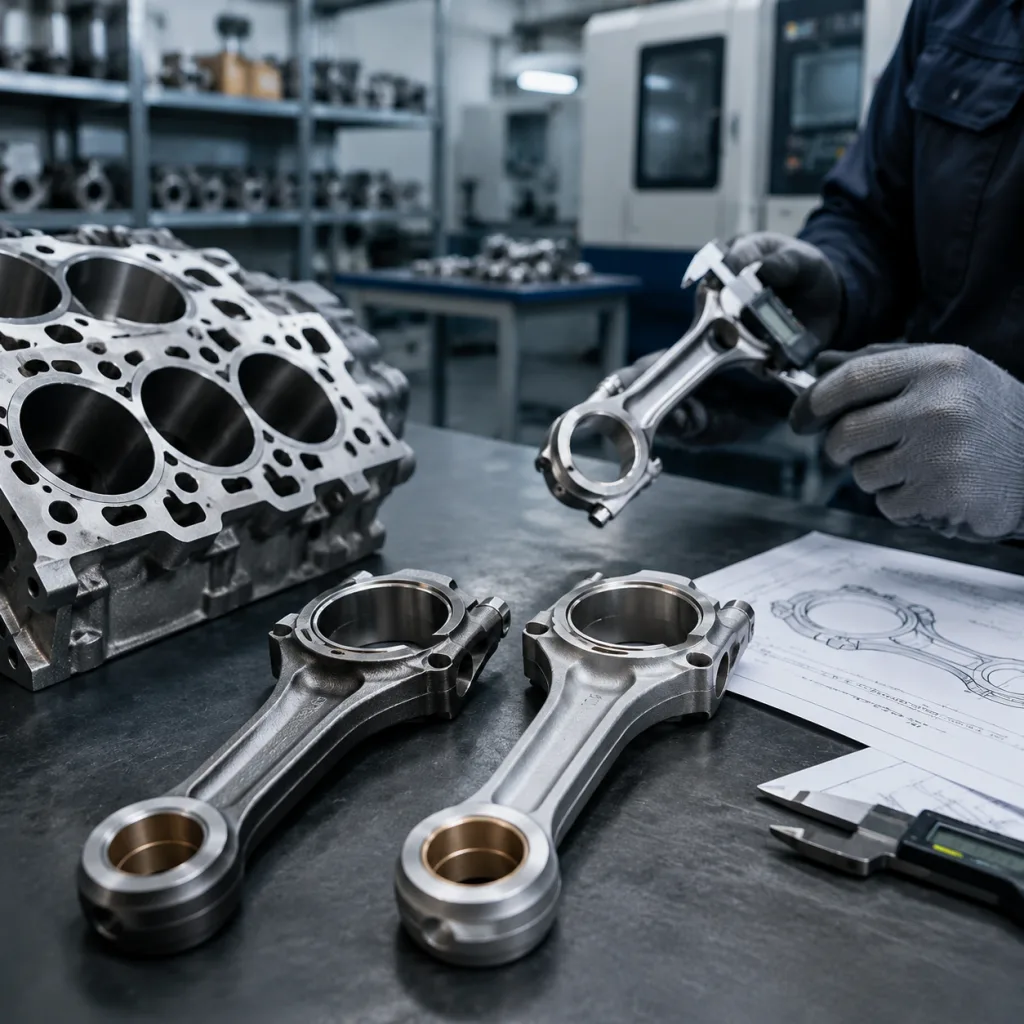
For a connecting rod BMW replacement, the minimum requirement is dimensional equivalence to the OE part, not just a similar shape. A correct replacement should match the following points within the stated drawing tolerance or approved engineering window:
Check item
Typical buyer target
Procurement note
Centre-to-centre length
OE nominal ±0.02 mm
Controls deck height, compression ratio, and piston position
Big-end bore after torquing
OE nominal ±0.01 mm
Must be checked with cap, bolts, and final torque applied
Big-end roundness
≤0.005 mm
Limits bearing edge loading and oil-film disruption
Small-end bore
OE nominal +0.005 / -0.000 mm
Protects pin fit while avoiding fretting
Centerline parallelism
≤0.03 mm per 100 mm
Reduces piston side-load and skew
Beam straightness
≤0.05 mm
Helps prevent drag and secondary vibration
Rod-to-rod weight spread
≤2 g within a set
Supports balance without excessive grinding
Small-end to big-end mass split
Match OE weight class
Keeps dynamic balance close to the original assembly
Bolt specification
OE thread, length, and stretch spec
Incorrect fastener data can cause cap separation
</tr></thead><tbody> </tbody></table>If the original part number is available, buyers should cross-check OE 06A107065-style references only when the keyword or catalog listing already cites them. Do not assume interchangeability across engine codes with similar displacement. For release, ask for the finished-part drawing, torque condition, and measured values from the same lot you intend to buy.
Why dimensional match matters more than appearance
Connecting rods can look similar while differing in strength, mass distribution, or cap machining. That matters in replacement sourcing because the part must survive the same load path as the original assembly.
Key failure risks from poor interchange control include:
Big-end ovality after torquing, which changes bearing clearance by more than 0.01 mm
Incorrect centre distance, which can shift piston position enough to affect quench and compression
Excess mass variation across a set, which adds balancing time and can push vibration outside the acceptable window
Cap mismatch, which can lead to fretting, bolt relaxation, or local heating at the parting face
Poor surface finish at the pin bore, which accelerates wear and can create a noticeable cold-start knock
For fleet and workshop customers, the replacement part should be validated as an assembly unit, not as a loose forging only. If a rod is sold as OE-equivalent, ask for the dimensional report, hardness range, and process route used for the finished part. A supplier that cannot state the final bore size, torque state, and mass tolerance is not ready for controlled procurement.
How Driventus validates replacement rods
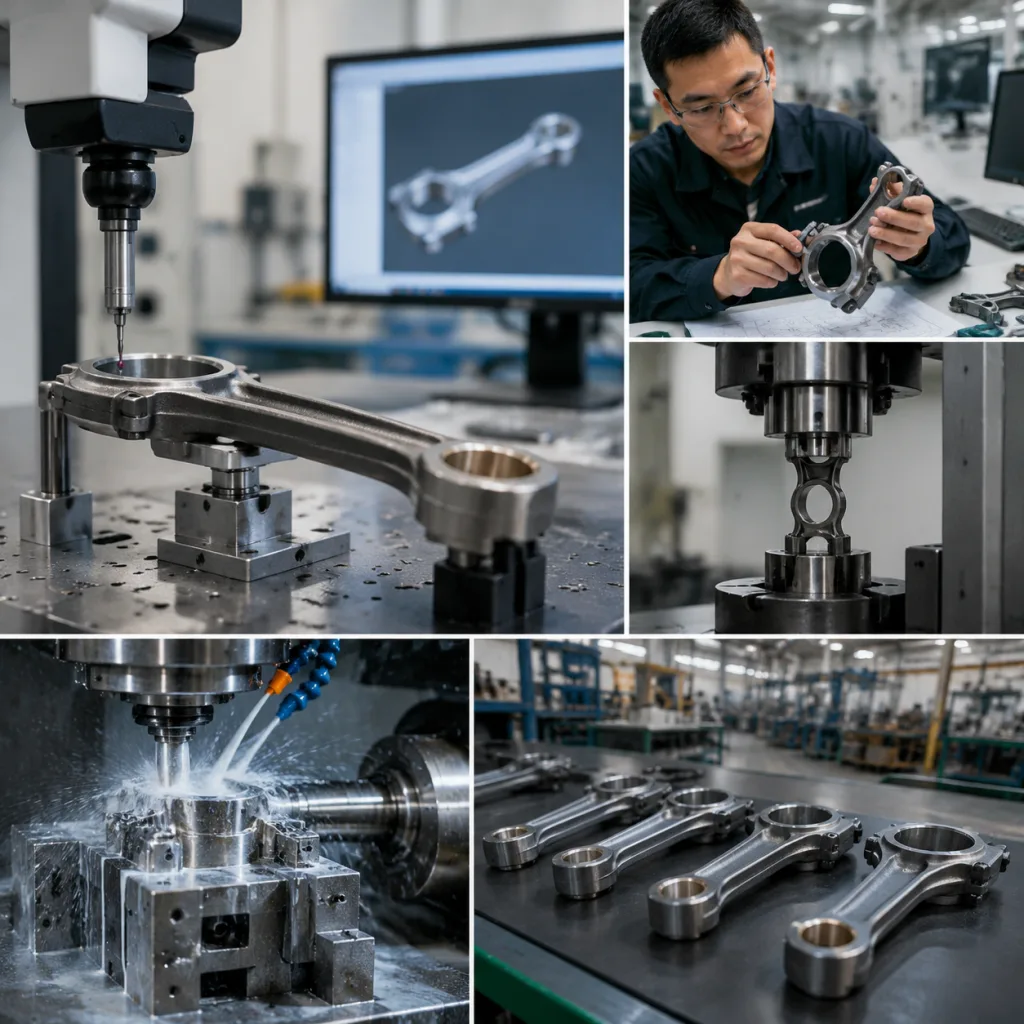
Driventus uses controlled manufacturing and inspection steps to keep replacement parts consistent from batch to batch. Our process is designed for procurement review, incoming inspection, and workshop fitment control.
H3: Typical validation points
Material verification against approved specification, typically by heat number and spectrometer check
Machining checks for both bore concentricity and face parallelism using calibrated gauges
Bolt torque and clamp-load verification where applicable, with recorded torque angle or stretch method
Weight matching within the defined set tolerance, usually checked as single-piece and matched-pair values
Surface inspection for cracks, burrs, or tool marks under visual and magnified inspection
Final packaging traceability by lot and production date, tied to the batch inspection record
Quality oversight is governed by our quality system, and custom development or non-standard variants can be handled through custom manufacturing. For buyers comparing suppliers, ask whether the factory can provide inspection records, sample approval, and lot traceability before mass release. Where requested, we can also support PPAP-style documentation, dimensional reports, and controlled sample submission for first-article approval.
What buyers should request before ordering
A replacement purchase is easier to approve when the supplier supplies technical evidence up front. For category managers and sourcing engineers, the standard request pack should include:
1. OE reference or confirmed application list, including engine code and model year range 2. Finished drawing or dimensional report with nominal values and tolerance bands 3. Material and heat-treatment summary, including hardness range and process condition 4. Bolt specification, tightening method, and whether bolts are torque-to-yield or reusable 5. Mass data for single rod and matched set, ideally with allowable spread in grams 6. Packaging and labelling details, including carton quantity, inner pack, and barcoding format 7. Lead time, MOQ, and sample availability, plus whether the first order can be mixed by part number
If you are consolidating multiple engine families, compare the rod against the rest of the rotating assembly, especially piston, pin, and bearing specifications. A rod that is dimensionally correct but mass-matched poorly can still create balancing work at the engine builder stage. Driventus supports B2B supply for aftermarket distributors, OEM / Tier-1 programmes, and repair networks through our catalog. For planning, ask for sample lead time separately from mass-production lead time, because the two are often different by several weeks.
Replacement buying checklist for procurement teams
Use the checklist below before release to purchase:
Confirm engine code, displacement, and OE application, not just model name
Verify the rod is supplied as a finished part, not an unfinished forging
Request dimensional conformity for both bores, centre length, and cap alignment
Check whether the supplier can provide inspection data for every batch and not only random samples
Review packaging to prevent transit damage to machined surfaces, threads, and bearing faces
Confirm REACH (EC) No 1907/2006 compliance where required, plus any destination-market labelling needs
Ask for the applicable test route, traceability method, and final acceptance criteria
Clarify MOQ, sample charge, and whether small trial orders can be credited against mass production
For import teams, this is also the point to check documentation, carton labelling, and country-specific compliance needs. If the application is performance-sensitive or the engine is being rebuilt after damage, request a sample evaluation before full release. A practical release gate is to approve only after you have the dimension report, a photo of the marked lot, and a confirmed ship date that fits your rebuild schedule.
When to escalate to custom production
Standard replacement is suitable when the OE geometry and load class are known. Custom production is the better route when the part is obsolete, the engine variant is region-specific, or the customer requires a non-standard material or weight target.
Use custom development when:
OE stock is no longer available
The application requires a revised rod length or end diameter
A fleet customer wants a controlled replacement window
You need packaging, labelling, or kitting to a specific warehouse system
You need a tighter weight target, such as a ±1 g matched set, for engine rebuild consistency
Where a project needs an engineered match rather than a simple stock item, Driventus can support custom manufacturing with technical review and production planning. For a quick route to application matching, use request a quote and include the engine code, OE reference, target annual volume, preferred Incoterm, and required lead time. Where the project is urgent, send the target ship week and acceptable MOQ window so the commercial team can quote the most realistic supply path.
Frequently asked questions
Yes, when the application data and dimensional requirements are clear. We focus on OE-equivalent fitment, finished-part inspection, and batch traceability for B2B buyers.
Send the engine code, OE reference if available, required quantity, target market, preferred tolerance window, and any special packaging needs. Photos and a sample drawing help speed review.
Yes. If the OE part is discontinued or the specification must be adapted, we can review a custom route with drawing confirmation, sample approval, and validation planning.
If you are sourcing a replacement rod programme, send the engine reference, quantity target, and required tolerance window for review through /contact.html.