A water pump leak is not a single defect category. For a distributor, fleet repair network, or sourcing engineer, it can mean a weak seal, a damaged gasket path, a contaminated cooling system, poor workshop practice, or a batch-control problem that will become expensive after the shipment is split across markets.
That is why a “water pump leak water pump” claim should be treated as evidence to classify, not as proof to accept automatically. The visible coolant tells only part of the story. The buying decision depends on where the coolant appears, when the leak starts, how the system was filled and pressurised, and whether similar units from the same lot show the same pattern.
This article is written for procurement teams assessing leaking engine coolant pumps before they replace stock, block a supplier, or approve warranty compensation. It moves from symptom sorting to failure-mode review, return inspection, manufacturing controls, sourcing specifications, and commercial claim handling. Driventus manufactures engine cooling components in Taizhou, Zhejiang, under IATF 16949:2016 and ISO 9001:2015 systems for B2B customers in export markets. Driventus is an independent aftermarket manufacturer; brand names or OE references are used only for fitment identification.
Start With the Leak Pattern, Not the Claim Label
A return note that says “water pump leak water pump” is too vague to support a warranty decision. The first question is not whether coolant is present. It is where, when, and under what pressure.
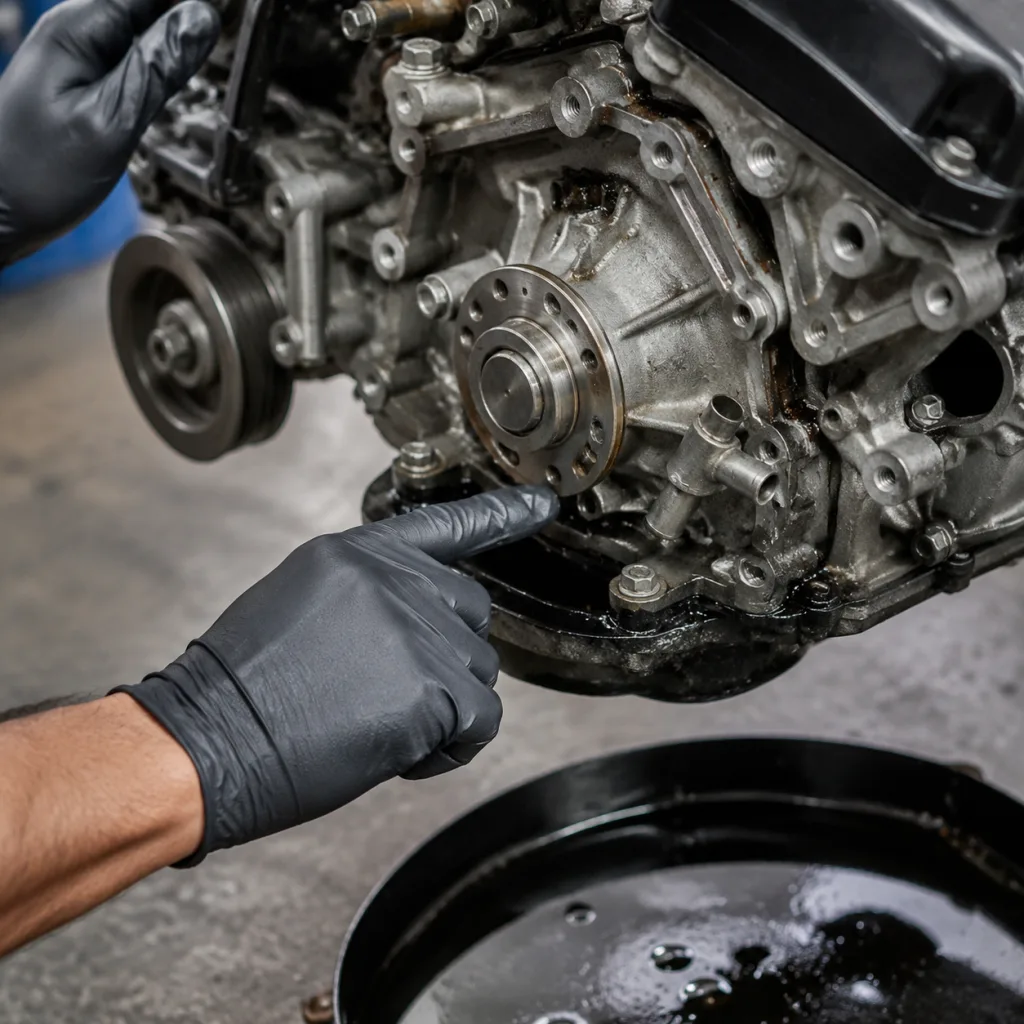
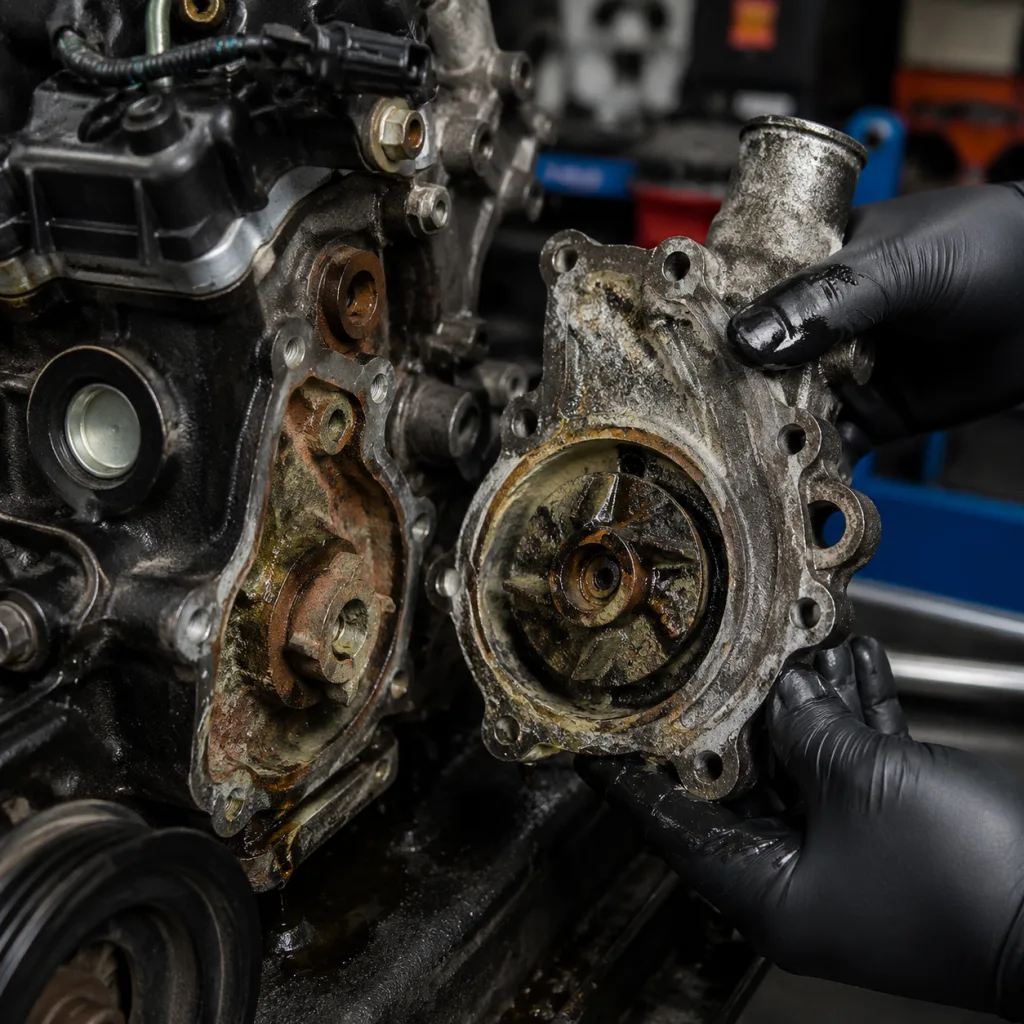
A dry stain at the weep hole can appear during mechanical seal run-in after early heat cycles. That is different from continuous wet leakage, a drip under pressure, or coolant that returns after the pump has been cleaned. A flange leak that starts immediately after installation points in another direction again: gasket compression, bolt load, surface condition, or housing flatness.
Observed condition
What it may indicate
What to check first
Light dry residue at weep hole
Seal run-in or minor evaporated seepage
Clean, retest, record mileage and pressure condition
Wet coolant from weep hole
Mechanical seal wear, contamination, dry running, shaft movement
Seal area, coolant condition, radial and axial shaft play
Flow condition, impeller clearance, radiator restriction, bleeding process
</tr></thead><tbody> </tbody></table>For importers and repair-chain buyers, standardise evidence before debating responsibility. Require the engine code, installation mileage, coolant type, pressure-test result, belt condition, installation date, and whether the leakage appeared during the first heat cycle or after service mileage. Ask for photos before cleaning. Capture the weep hole, flange, hose necks, pulley face, bolt areas, and dried coolant tracks.
Pressure data matters. A leak visible only at 0.9-1.4 bar may not have the same cause as a leak seen at idle. Record the cap rating, ambient conditions where relevant, and whether the coolant returned after the part was wiped clean. This turns a generic complaint into a classified defect record.
Failure-Mode Map: Product, Vehicle System, or Installation?
Most coolant pump disputes become messy because all leakage is grouped together. A better review separates three buckets: product, vehicle system, and installation. Each bucket needs different evidence.
Product-related failure modes include mechanical seal defects, incorrect ceramic or carbon seal-face finish, bearing axial movement, shaft surface defects, casting porosity, inaccurate gasket dimensions, and unstable machining of sealing surfaces. The useful procurement evidence is not opinion; it is lot traceability, dimensional data, leak-test records, and comparison across returned samples. Typical buyer targets for stable aftermarket programmes include shaft seal-journal runout at or below 0.03 mm TIR and flange flatness within 0.05 mm, with bore and press-fit control held to drawing tolerance and no visible scoring.
If three pumps from the same SKU and lot show the same pressure-only leak at the same casting area, escalate. If one pump has seal leakage after contaminated coolant exposure, do not treat the whole batch as suspect without more evidence.
Vehicle-system causes are common and often missed. Aged coolant can carry abrasive particles. Wrong coolant chemistry can attack seal materials. Electrochemical corrosion, blocked radiators, trapped air, failed pressure caps, oil contamination, scale, sludge, and cavitation can all shorten seal life. REACH (EC) No 1907/2006 may be relevant when reviewing chemical substances used in gaskets, coatings, and packaging for EU supply, but it does not replace the vehicle’s coolant specification. A 50/50 ethylene-glycol mix is common; the required corrosion package and refill concentration still depend on the application.
Installation-related causes include reused or damaged mating surfaces, uneven bolt tightening, incorrect gasket placement, excess sealant entering the pump, dry running before coolant fill, belt over-tension, pulley misalignment, and incorrect belt routing. Timing-belt-driven pumps are especially sensitive because poor belt tension can overload the bearing and later show up as weep-hole leakage. Accessory-belt-driven pumps can suffer similar stress from pulley misalignment.
Use timing as a clue, not a verdict. Leakage during the first heat cycle often points to flange sealing or installation practice. Leakage after 5,000-20,000 km makes seal wear, coolant condition, and bearing load more likely. For repeat claims, request at least three failed units from the same SKU where possible and compare coolant condition, torque history, pressure-test results, and batch codes before blocking stock.
Return-Part Triage: A Practical Inspection Sequence
A distributor does not need a full laboratory process for every returned pump. It does need a repeatable sequence that prevents guesswork and makes supplier comparisons fair.
1. Confirm fitment. Record application, engine displacement, engine code, production year range, and the cross-reference used for ordering. 2. Separate immediate from mileage failure. Immediate leakage suggests gasket, casting, hose-neck, or mating-surface issues. Leakage after use more often suggests seal wear, bearing load, coolant contamination, or system pressure problems. 3. Photograph before cleaning. Include the weep hole, flange, hose necks, pulley, gasket path, bolt holes, and any dried coolant tracks. 4. Pressure-test the cooling system. Confirm whether leakage occurs at operating pressure, during heat cycling, or after shutdown. A practical workshop test is 0.9-1.4 bar for 2-5 minutes, matched to cap rating where possible. 5. Check shaft movement. Radial movement above about 0.10-0.15 mm, or detectable axial end play beyond roughly 0.05 mm, is usually a reject signal for aftermarket programmes unless the OE drawing states otherwise. 6. Read the gasket imprint. Uneven witness marks suggest flange distortion, wrong tightening sequence, contamination, or a mismatched gasket. 7. Check flange and housing flatness. Use a straightedge and feeler gauge. Many buyers target 0.05 mm or less across the sealing face on small to medium passenger-car pumps. 8. Review coolant condition. Rust, oil contamination, scale, sludge, incorrect mixture, or abrasive debris can explain early seal distress. 9. Inspect pulley and belt conditions. Over-tension, misalignment, damaged pulleys, and incorrect routing can overload the bearing. 10. Retain the sample. Do not disassemble the pump before supplier review unless the agreed claim process allows teardown.
Defect coding makes the data usable. Avoid “leak” or “bad pump” as the only return reason. Use codes such as WEP for weep-hole seepage, FLG for flange leak, PRS for pressure-only leak, BRG for bearing noise or play, and CNT for contamination. Add mileage and batch code to each record.
This simple discipline helps analysts separate early-life installation problems from repeat production issues. Driventus can support distributor-level analysis through batch traceability, dimensional review, and test records when customers source from our catalog or request part-family data.
Spec Deep-Dive: The Controls That Prevent Leakage Before Shipment
A low water pump price is not meaningful if the process behind it is weak. Leakage performance depends on casting integrity, machining stability, seal handling, bearing control, assembly discipline, and final verification. Buyers should ask how the part is controlled, not only whether it “passed inspection.”
Critical controls include:
Casting inspection: porosity, shrinkage, cracks, hose-neck defects, and sealing-surface flaws.
Mechanical seal checks: material pairing, spring load, face flatness, surface finish, storage condition, and visual damage.
Bearing specification: radial clearance, grease, noise class, seal type, load rating, and operating-temperature range.
Shaft and pulley interface control: runout and press-fit retention. A common target is ≤0.03 mm TIR at the seal journal with no looseness.
Impeller clearance: enough clearance to avoid housing contact while maintaining flow. Buyers should request a nominal clearance band rather than a single unsupported dimension.
Gasket verification: material, thickness, dimensional accuracy, and compression under specified torque. For many passenger-car pumps, small-fastener torque may fall around 8-12 N·m, but the engine drawing or service manual is the authority.
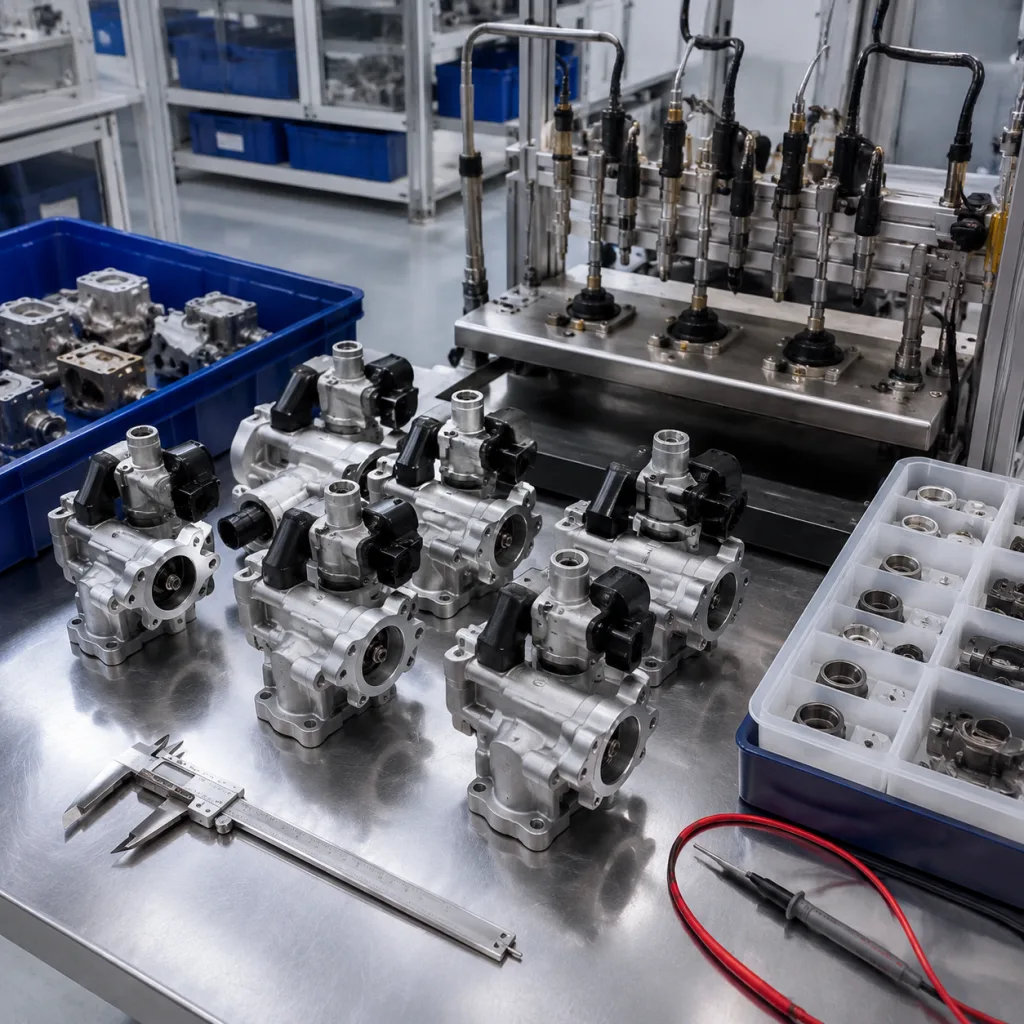
Leak testing: 100% testing or validated sampling depending on programme risk. A typical factory leak test is 0.8-1.2 bar for 30-60 seconds with zero visible leakage or unacceptable pressure decay.
Traceability: lot coding for castings, seals, bearings, gaskets, impellers, and final assembly.
Final release checks: rotation feel, noise, visual inspection, label accuracy, and packaging audit.
Driventus operates under IATF 16949:2016 and ISO 9001:2015, with APQP, PPAP, control plans, and corrective-action processes available for suitable B2B programmes. Buyers can review our quality system when evaluating supplier controls for cooling system components.
For private-label or engineered programmes, request process capability data on critical dimensions, not only pass/fail statements. If packaging, gasket material, impeller configuration, bearing specification, or documentation must change, custom manufacturing can be assessed against the application, annual volume, and validation plan.
One caution is important: no aftermarket supplier should claim vehicle manufacturer approval unless formal approval exists. A practical audit should confirm inspection frequency, seal-face storage controls, grease shelf-life control, calibration of the leak-test station at least once per 12 months, and how nonconforming parts are contained.
Replacement and Buying Specification: When the Pump Must Go
Replace the pump when wet coolant continues from the weep hole after run-in, the flange cannot seal under pressure, bearing play is present, the shaft feels noisy or rough, or the impeller cannot maintain flow. Also consider replacement during timing-belt service when the pump is belt-driven and access labour is high. In fleet work, replacing the pump during the belt job is often cheaper than paying for the same front-engine teardown later.
For sourcing, do not rely on catalogue photos. Two pumps can look identical externally while using different seal materials, bearings, impellers, gaskets, and machining tolerances. Put the replacement requirement in writing.
Specification item
What buyers should define
Fitment reference
OE-style cross-reference format where applicable, such as OE 06A… or OE 11251… conventions, without implying brand approval
Housing material
Aluminium alloy grade and heat-treatment status where relevant
Machining
Critical dimensions for bearing bore, gasket face, mounting holes, and pulley interface; common buyer targets include ≤0.05 mm flange flatness and ≤0.03 mm TIR at the shaft seal journal
Impeller
Metal or engineered polymer, blade count, diameter, clearance target, and flow expectation where specified
Mechanical seal
Material pairing, face finish target, coolant compatibility, and storage requirements
Bearing
Load rating, noise control, grease specification, clearance, seal design, and pulley-load suitability
Gasket
Material, thickness, compression behaviour, and included installation notes
Testing
Leak-test pressure, hold time, rotation check, dimensional inspection, and traceability; avoid accepting “tested” without method details
Packaging
Individual protection, gasket retention, label format, carton strength, and palletisation requirement
Compliance
IATF 16949:2016, ISO 9001:2015, REACH (EC) No 1907/2006 where applicable
</tr></thead><tbody> </tbody></table>Define warranty evidence requirements before the first shipment. Minimum evidence should include photos, mileage, coolant type, defect code, pressure-test result, return timing, and batch code. This avoids arguing over incomplete claims months later.
Commercial parameters should also be clear. Stocked catalogue parts may have a MOQ of 50-100 units per SKU. Private-label or carton-customised orders often start at 200-500 units per SKU. Sample lead time is commonly 7-14 days, while normal production lead time is often 30-45 days after order confirmation. Special packaging, tooling, or first-article validation can add 2-6 weeks. Price usually steps down at 100, 500, 1,000, and 5,000 units depending on casting, seal, bearing, and packing costs.
Compare landed cost, not just ex-works price. Repeat labour claims can erase a small unit-price advantage quickly.
Importer and Repair-Chain Scenario: What Happens After the First Batch Claim?
Consider a common scenario. A repair chain reports several coolant leaks from the same water pump SKU. The first instinct may be to stop sales and demand credit. Sometimes that is correct. Often it is premature.
A disciplined response protects both sides:
Within 24-48 hours: supplier acknowledges the claim and requests structured evidence: photos, mileage, installation date, coolant type, pressure-test result, defect code, and batch number.
Within 3-5 business days: buyer and supplier agree on interim containment. This may mean holding remaining stock, checking the same SKU in warehouse inventory, or separating one lot from another.
Within 10-15 business days: for legitimate batch concerns, the supplier provides an 8D or corrective-action response covering suspected cause, affected range, containment, verification, and preventive action.
The cost of poor handling is not just the pump. Leak complaints create replacement labour, second shipment cost, customer-service time, claim administration, inventory quarantine, and lost technician trust. For importers, one unresolved batch can spread across several markets before the pattern is visible. For repair chains, one comeback can damage confidence in the whole repair, not only the component.
Before committing to volume, ask a supplier for:
Current IATF 16949:2016 and ISO 9001:2015 certificate scope.
Product range by engine family, not only a part-number spreadsheet.
Test method summary for leakage, rotation, and dimensional inspection.
Traceability from incoming components to finished assembly.
Export carton and palletisation approach, including drop-test logic where applicable.
MOQ, sample availability, production lead time, and private-label options.
Warranty process, including evidence requirements, returned-sample handling, response timing, and corrective-action format.
Export experience for EU, UK, US, Canada, Australia, and Brazil documentation needs.
Driventus supplies engine and powertrain components to aftermarket distributors, OEM/Tier-1 projects, and multi-location repair chains in more than 60 countries. Buyers comparing water pump programmes can request a quote with target references, annual demand, packaging requirements, and inspection expectations. For faster quoting, include annual forecast, first-order quantity, target incoterm, label language, carton count, and whether you need white box, colour box, or customer-branded packaging.
Frequently asked questions
No. Leakage can result from a seal defect, casting issue, coolant contamination, incorrect installation, belt over-tension, pulley misalignment, trapped air, or system overpressure. Review photos, mileage, coolant information, pressure-test results, and batch traceability before assigning responsibility. First-heat-cycle leakage is often installation or flange related, while leakage after several thousand kilometres is more often seal, coolant, or bearing related.
Collect application data, part reference, installation date, mileage, coolant type, pressure-test result, photos before cleaning, gasket condition, pulley or belt observations, and whether leakage started immediately or after service. If possible, also record cap rating, test pressure, and whether shaft play exceeded about 0.10-0.15 mm radial or 0.05 mm axial.
Yes, for suitable B2B volumes and applications. Driventus can assess private-label packaging, catalogue coverage, gasket inclusion, material requirements, and validation needs under documented quality processes. Feasibility depends on part family, MOQ, tooling status, documentation requirements, and whether the requested specification can be supported with stable process control. Sample lead time is typically 7-14 days and production lead time is commonly 30-45 days after order confirmation, subject to volume and packaging complexity.
If you are reviewing coolant pump leakage claims or sourcing an OE-equivalent water pump range, share your target references, volumes, and inspection requirements. Contact Driventus to discuss supply options at /contact.html