RoHS Testing for Crankshaft Procurement
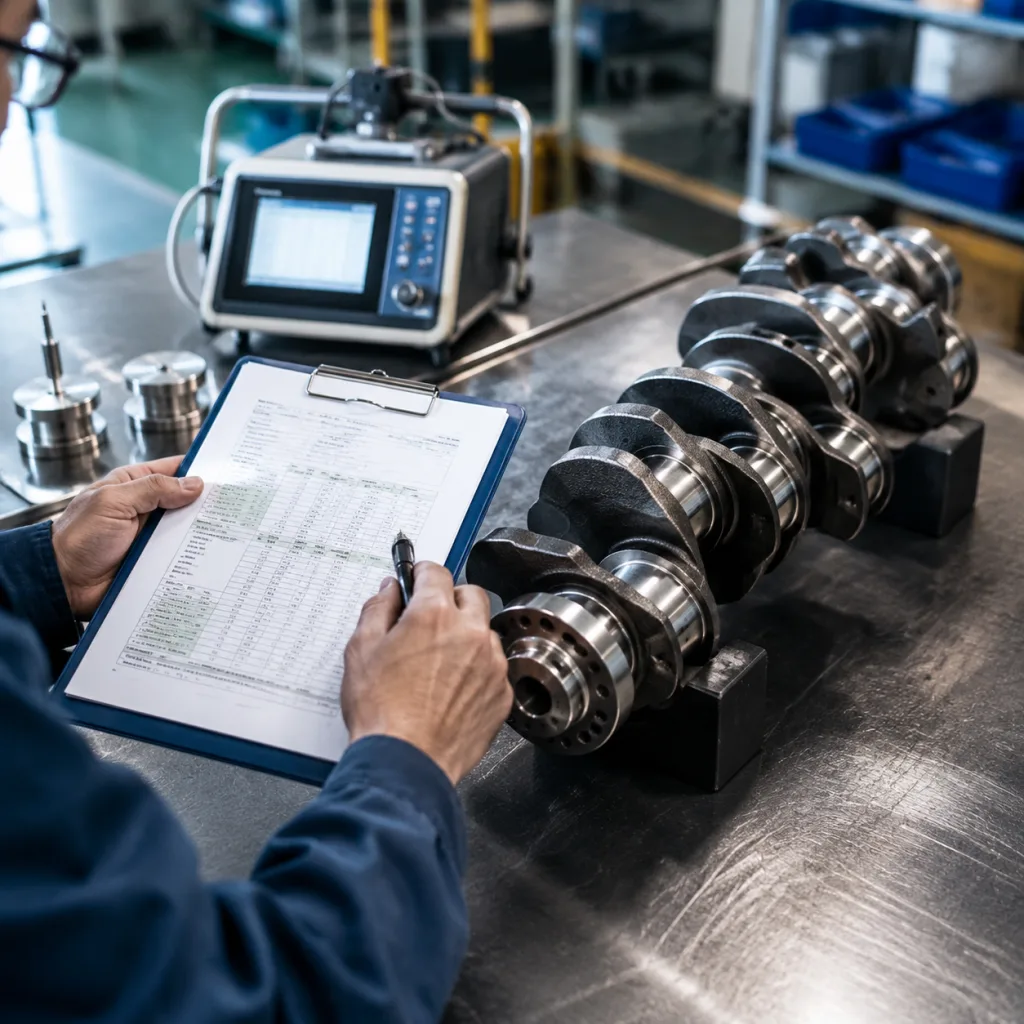
RoHS compliance is not the first risk most buyers associate with crankshafts. The part is usually a forged steel, cast iron, or ductile iron engine component, not an electronic assembly. Still, RoHS testing for crankshaft procurement becomes relevant when the crankshaft enters an EU, UK, or customer-controlled compliance file: engine assemblies, service kits, hybrid platforms, generator sets, tenders, or packaged aftermarket programs. Treat it as a defined verification task, not a generic certificate request. The buyer must decide which homogeneous materials are in scope, which limits apply, how samples are traced, and what changes force retesting. That decision affects quotation validity, MOQ, lab cost, lead time, and shipment release. Driventus manufactures crankshafts and related engine components in Taizhou, Zhejiang, under IATF 16949:2016 and ISO 9001:2015 controls. Driventus is an independent aftermarket manufacturer; brand names are referenced for fitment identification only.
Decision Gate: Does This Crankshaft Need RoHS Evidence?
Start with the product file, not the part shape. Directive 2011/65/EU, known as RoHS, restricts hazardous substances in electrical and electronic equipment placed on the EU market. The UK operates a related regime. A standalone replacement crankshaft for a conventional combustion engine is normally assessed differently from a PCB, sensor, actuator, or ECU. But crankshaft suppliers still receive RoHS requests when the part sits inside a larger customer bill of materials or technical compliance file.
Use this decision sequence during RFQ review:
1. Where will the final product be sold? EU, UK, and customer-specific export programs often trigger restricted-substance documentation. 2. Is the crankshaft supplied alone or inside a controlled kit or assembly? Engine assemblies, generator sets, hybrid powertrain modules, test rigs, public-sector tender kits, and service packs may require evidence for every supplied material. 3. Who owns the compliance file? Tier-1 customers and importers may impose RoHS evidence even when the crankshaft itself is not electrical equipment. 4. What exactly is in scope? Base metal only is a different task from base metal plus plugs, coating, oil, VCI paper, plastic sleeve, carton, labels, and pallets. 5. What type of evidence is acceptable? A supplier declaration, XRF screening, and third-party laboratory testing are not interchangeable.
Most RFQs reference the standard RoHS maximum concentration values in homogeneous materials: 0.1% by weight, or 1,000 mg/kg, for lead, mercury, hexavalent chromium, PBB, PBDE, DEHP, BBP, DBP, and DIBP; and 0.01% by weight, or 100 mg/kg, for cadmium. If the customer applies tighter internal limits, those limits must be stated before quoting.
The common failure is vague wording. “RoHS required” can mean three different prices and three different lead times depending on whether the lab tests only the steel or every material shipped with the part. Write the scope directly into the RFQ. Include the crankshaft forging or casting, machined surfaces, plugs, dowels, balance components, corrosion-preventive oil, VCI materials, cartons, labels, pallets, and any fasteners if they are supplied. Also state whether reports must be less than 12 months old, show numerical values instead of only “pass,” and remain valid for repeat shipments until a material or process change occurs.
Failure Modes: Where a Crankshaft Program Usually Creates RoHS Risk
For crankshafts, the base metal is often the least surprising material. That does not mean it can be ignored. Leaded alloys, legacy stock, substitute castings, and undocumented purchased parts can still create compliance problems. The higher-risk points are usually small, temporary, or outsourced: coatings, plugs, corrosion protection, labels, packaging, and older chemical processes.
Review the full route, not only the drawing material line:
- Base material: forged steel, cast iron, ductile iron, or micro-alloy steel. Require heat number traceability and chemical composition records. Typical grades may include 42CrMo, 40Cr, 45 steel, QT700-series ductile iron, or customer-specified equivalents. The RoHS report must match the approved grade and production route, not a similar part.
- Heat treatment and surface hardening: nitriding, induction hardening, fillet rolling, stress relief, quenching, or subcontracted thermal processes. Record the furnace batch, quench media, nitriding compound where applicable, and subcontractor lot.
- Surface treatment: phosphate coating, black oxide, anti-rust film, passivation, or other corrosion-protection layers. Hexavalent chromium risk is mainly tied to chromate conversion, passivation, or legacy coating chemistry.
- Inserted and purchased parts: oil gallery plugs, dowel pins, threaded inserts, keys, and balance weights. These parts can carry more compliance risk than the crankshaft body because they come from separate suppliers.
- Temporary protection: anti-rust oil, VCI paper, plastic sleeves, caps, bags, desiccants, and export packaging. Ask for product name, supplier, SDS/TDS, batch number, and phthalate or SVHC declarations where relevant.
- Marking materials: ink stamps, paint dots, adhesive labels, protective films, cleaning residues, and label adhesives. In a kit program, even the plastic bag and label may fall inside the customer scope.
RoHS should also be coordinated with REACH Regulation (EC) No 1907/2006. They are different frameworks. A RoHS report does not automatically satisfy a REACH SVHC declaration. In practice, European importers often request both before shipment or supplier approval.
A useful RFQ clause is: “Supplier shall provide RoHS evidence to the agreed scope and REACH SVHC declaration for all supplied items, including packaging in direct contact with the product, before mass production release.” That single sentence prevents a common dispute: the buyer expects the kit to be covered, while the supplier tested only the metal shaft.
Step-by-Step: Run RoHS Testing Without Breaking the Launch Schedule
A controlled workflow lets buyers compare suppliers on evidence instead of certificate wording. It also keeps testing from becoming a last-minute shipment block.
1. Define the tested article. Identify the crankshaft model, drawing revision, material grade, surface treatment, included accessories, and packaging. If an OE-format reference such as OE 06A107065 or OE 11251… is used, treat it only as a fitment cross-reference. It is not restricted-substance evidence. State the target limits, such as 1,000 mg/kg for lead and 100 mg/kg for cadmium, unless the customer specification is stricter.
2. Collect the BOM and process route. The supplier should list the base metal, heat treatment, surface finishing, purchased plugs, coatings, corrosion-prevention materials, labels, and packaging items. Separate the quote for “base crankshaft only” from “crankshaft plus packaging and accessories” because each homogeneous material can add laboratory cost and time.
3. Choose representative samples. Samples should come from serial production or pilot production using the approved route. A pre-production piece made with temporary oil, a substitute plug, or different packaging may produce a report that cannot support later shipments. For a new program, buyers often reserve 2–5 pilot pieces: one for laboratory preparation, one retained by the supplier, and one retained by the buyer or inspection agent.
4. Use the right laboratory method. XRF screening is effective for rapid detection of many restricted elements in metals. It is not a universal answer. Confirmatory methods may be required for substances XRF cannot determine reliably. Reports should identify test standards or methods, detection limits, sample preparation, units, and measured values. Common references include IEC 62321-series methods: XRF screening; ICP-OES or ICP-MS for metals after digestion; UV-Vis or ion chromatography for hexavalent chromium where applicable; and GC-MS for phthalates and brominated flame retardants.
5. Tie the report to production traceability. A useful report references the part number, lot number, heat number, production date, inspection batch, or other traceable identifier. A generic report with no link to the route is weak evidence during customer audits or import checks. At minimum, connect the lab sample to the heat number, work order, treatment batch, anti-rust oil batch, and packing date.
6. Check exemptions before relying on them. RoHS exemptions exist for specific applications, but they must be current, applicable, and accepted by the customer. Do not rely on “we have always used this material.” If an exemption is claimed, require the exemption number, expiry status, material affected, measured concentration, and written customer approval.
7. Set retest triggers. Changes in steel source, casting supplier, coating chemistry, anti-rust oil, plug supplier, packaging, subcontractor, or process route should trigger a compliance review. Depending on the customer requirement, that review may mean a declaration update, new laboratory testing, or formal approval.
8. Build the file before release. The compliance pack usually includes test reports, supplier declarations, material certificates, process records, and internal inspection data. Driventus can align this documentation through its quality system for customer audits and purchasing reviews. For repeat orders, define whether the pack is issued per shipment, per lot, annually, or only after engineering change.

Document Pack Comparison: What to Ask for Before the PO
Do not chase RoHS documents after the goods are packed. At that stage, the correct sample may no longer be available, packaging may already be fixed, and the anti-rust oil batch may be difficult to prove. Put the document requirement into the RFQ and confirm what is supplied with each lot. For a new custom crankshaft, include laboratory cost and sampling time in the quotation discussion.
Use this comparison table when evaluating suppliers from China, Europe, or other sourcing regions.
| Document | What to verify | Procurement note |
|---|---|---|
| RoHS test report | Substance list, test method, measured result, laboratory name, sample description, test date, reporting limit | Confirm the sample matches the approved route and customer scope; numerical mg/kg values are stronger than pass/fail only |
| Material certificate | Steel or casting grade, heat number, chemical composition, supplier batch | Link the certificate to crankshaft lot traceability and drawing revision |
| Process control plan | Heat treatment, machining, grinding, cleaning, surface treatment, corrosion protection | Check whether coatings, oils, plugs, and subcontracted processes are included |
| Supplier declaration | Statement of conformity to the agreed customer scope | Useful for the file, but not a substitute for testing when testing is specified |
| REACH declaration | SVHC status for materials, coatings, oils, labels, and packaging | Often required by EU importers alongside RoHS evidence; request the current SVHC-list basis |
| IATF 16949:2016 / ISO 9001:2015 certificates | Validity, issuing body, address, and site coverage | Confirm the audited site is relevant to the supplied part |
| Packaging specification | VCI paper, plastic bags, cartons, pallets, labels, and corrosion-prevention method | Packaging may be inside the customer compliance scope for kits and export tenders |
| Change-control record | Rules for material, supplier, chemical, process, and packaging changes | Prevents old certificates being used for new production conditions |