A warped cylinder head is often identified after overheating, coolant loss, head gasket failure, or unexplained compression variation. For fleet operators, engine rebuilders, repair chains, and parts distributors, the cost decision extends beyond the machine-shop invoice. It affects vehicle downtime, comeback risk, gasket and bolt consumption, warranty exposure, and whether a replacement cylinder head or broader engine component package should be sourced instead. This warped cylinder head repair cost guide gives buyers a practical way to price diagnosis, machining, exchange units, and new aftermarket supply using measurable inspection data, MOQ and lead-time assumptions, and repair-versus-replacement thresholds. Driventus is an independent aftermarket manufacturer; brand names are referenced for fitment only.
Typical Cost Elements in Head Repair
Repair cost depends on engine layout, aluminium or cast-iron construction, valve count, cam carrier design, access time, local labour rates, and the number of defects found after cleaning. Procurement teams should separate inspection, machining, consumables, logistics, and risk allowances instead of comparing only a headline resurfacing price.
Often the largest line item: 4–8 labour hours on simple inline engines, 10–18+ hours on transverse V engines or chain-driven layouts
Cleaning and crack inspection
Hot wash, ultrasonic cleaning where available, dye penetrant, magnetic-particle inspection for suitable ferrous parts, pressure testing
Should be completed before machining approval; typical pressure-test specs are 2–4 bar for 20–30 minutes, subject to engine design
Resurfacing
Controlled material removal to restore flatness and gasket-compatible surface finish
Many aluminium heads only need a 0.05–0.15 mm clean-up cut; confirm minimum head height before authorising any cut
Valve train work
Valve seats, guides, seals, hydraulic lash components, cam journals, springs, retainers, and threaded holes
Can exceed replacement cost when more than 25–40% of valves, guides, or seats need correction
Consumables
Head gasket, torque-to-yield bolts, coolant, oil, filters, seals, sealants, ancillary gaskets, timing components if disturbed
Quote as a complete repair kit; torque-to-yield bolts should not be reused unless the service procedure explicitly allows it
Downtime and rework allowance
Bay occupancy, lost service capacity, warranty return handling, repeat diagnostics, towing or recovery
For fleets, calculate downtime per vehicle-day; for repair chains, calculate bay blocking and repeat labour exposure
</tr></thead><tbody> </tbody></table>As a working benchmark, buyers often see light resurfacing and inspection quoted at a small fraction of a complete repair, while valve work, crack repair attempts, timing-chain access, and repeat cooling-system repairs drive most overruns. A practical approval rule is to release machining only after the shop confirms flatness deviation, required cut depth, final head height, crack-test result, and valve-train condition.
For imported aftermarket supply, landed replacement cost should include unit price, export packaging, inland and ocean/air freight, customs duty, bank fees, inspection, inventory carrying cost, and defect-handling process. MOQ and pricing should be modelled by demand band: sample orders or mixed trial cartons carry the highest unit cost; 50–100 pieces per SKU can support distributor launch stock; 300–500 pieces per SKU usually improves casting, machining, packaging, and freight amortisation. Buyers reviewing our catalog can compare cylinder head-related engine components with gasket, bolt, water pump, piston, and crankshaft supply where a wider rebuild scope is required.
Symptom to Cause: Confirm the Failure Mode
A warped head is a geometry problem, but it is rarely the first event in the failure chain. It commonly follows overheating, uneven clamping load, detonation, cooling-system blockage, corrosion, incorrect coolant chemistry, or previous incorrect installation. A structured diagnostic walkthrough reduces unnecessary machining and helps prevent repeat failure after refit.
Common symptom-to-cause map:
Coolant loss with no external leak: possible combustion leakage into the cooling system, cracked casting, porous area, liner movement, or head gasket breach.
White exhaust smoke after warm-up: coolant may be entering the combustion chamber; confirm with pressure decay, leak-down, or borescope evidence before condemning the head.
Oil-coolant contamination: possible gasket failure, oil cooler leak, liner sealing issue, timing-cover leak path, or casting porosity depending on engine design.
Low compression on adjacent cylinders: likely gasket fire-ring failure, local head distortion between cylinders, block-deck irregularity, or bolt-load loss.
Overheating after repair: blocked radiator, weak water pump, trapped air, thermostat malfunction, incorrect fan control, restricted hoses, collapsed hose liner, or poor coolant flow.
Repeated gasket failure: rough surface finish, excessive head material removal, poor block flatness, incorrect bolt torque, wrong gasket thickness, unclean bolt holes, or uncorrected overheating source.
Testing should start with non-invasive checks, then move to disassembly only when the evidence supports it. Cooling-system pressure testing normally uses the cap-rated pressure or the service-manual value and should hold with minimal decay over 10–20 minutes. Cylinder leak-down results should be recorded by cylinder; many workshops treat under 10–15% as healthy, 15–25% as marginal, and over 25–30% as requiring investigation, but engine-specific data takes priority. Compression readings should be compared across cylinders rather than judged in isolation; a spread above roughly 10–15% is a useful trigger for deeper checks.
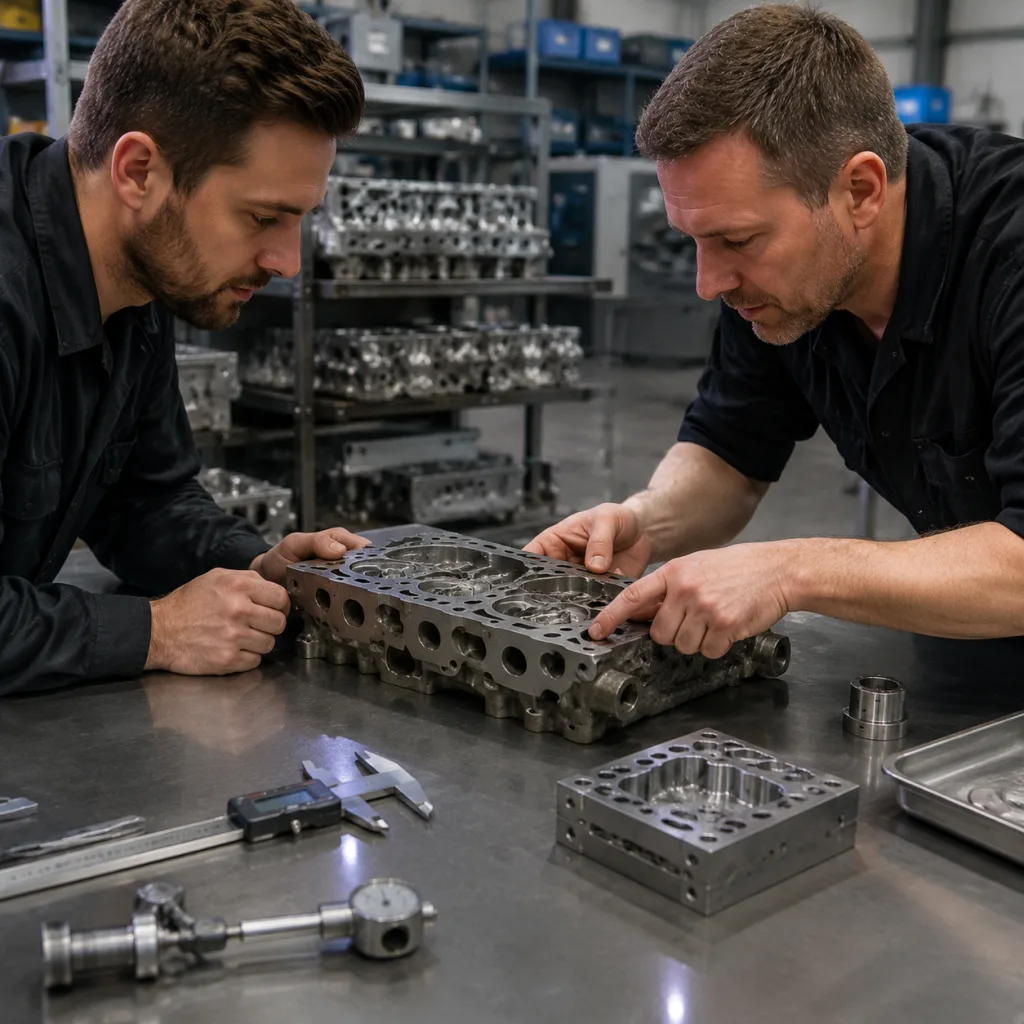
After removal, the cylinder head should be cleaned before flatness and crack inspection. Measuring a dirty gasket face can mislead the decision because carbon, sealant, corrosion, and gasket residue distort straightedge and feeler-gauge readings. Require photos of the fire-ring areas, coolant passages, bolt holes, and cam journals before machining, then retain the test sheet with pressure-test pressure, duration, temperature if heated, and inspector sign-off.
Inspection Limits and Machining Decisions
The central cost decision is whether the head can be machined within safe dimensional limits. Maximum allowable warpage, minimum cylinder head height, surface roughness, cam bore alignment, valve recession, and gasket thickness options must come from the engine maker’s service data or a controlled internal specification. A universal flatness value should not be applied across different engine families, materials, or gasket designs.
A practical inspection sequence is:
1. Clean the gasket face using plastic scrapers, approved solvents, and non-aggressive pads that avoid removing base metal. 2. Check overall flatness with a certified precision straightedge and feeler gauges in length, width, and diagonal directions. 3. Measure local distortion around fire rings, coolant passages, oil feed holes, and narrow bridge areas between cylinders. 4. Confirm minimum head height at multiple datum points before specifying any resurfacing cut. 5. Inspect cam journals and cam carrier alignment, especially on overhead-cam aluminium heads where distortion can bind the cam even after the deck is flat. 6. Pressure test or crack test where overheating was severe, coolant contamination is present, or the casting history is unknown. 7. Verify surface finish against gasket type, especially multi-layer steel gaskets that require controlled roughness. 8. Recheck valve seat condition, guide wear, stem protrusion, spring installed height, valve protrusion or recession, and threaded-hole integrity before final cost approval.
Indicative inspection targets used in many buyer specifications include flatness checks with 0.03–0.05 mm feeler gauges for short spans and 0.05–0.10 mm for full-length checks, subject to the engine maker’s limit. MLS gaskets commonly require a smoother controlled finish, often around Ra 0.4–1.2 µm, while some composite gaskets tolerate a rougher finish. Typical resurfacing equipment should be able to control cut depth in 0.01 mm increments, with final head height recorded to 0.01 mm. These values are not universal release limits; they are RFQ placeholders until the exact engine code and gasket technology are confirmed.
Relevant quality references for controlled manufacturing and inspection include IATF 16949:2016 and ISO 9001:2015. Chemical and material compliance for exported replacement components may also need REACH (EC) No 1907/2006 review where applicable to supplied articles and substances. Driventus operates under an IATF 16949:2016 and ISO 9001:2015 certified quality system, with dimensional inspection, material traceability, and process controls used across engine and powertrain components.
When machining is usually justified
Machining may be justified when cracks are absent, cam alignment remains within tolerance, material removal stays above minimum head height, valve train wear is manageable, and the expected repair cost remains below the replacement threshold agreed by the buyer. It is most suitable where the root cause of overheating has been identified, the block deck also meets flatness requirements, and the total required cut does not force a non-standard gasket thickness or timing correction.
When replacement is usually safer
Replacement is often safer when the head is cracked, heavily corroded, previously machined beyond limit, distorted through the cam tunnel, or paired with multiple valve train defects. It is also preferred when machine-shop lead time exceeds the vehicle’s service target, when service-level penalties apply, or when downtime cost is higher than the price difference between machining and a stocked replacement unit.
Repair Versus Replacement Cost Comparison
A reliable warped cylinder head repair cost guide should compare total repair economics, not only resurfacing. The lowest initial invoice can become more expensive if it increases comeback risk, delays vehicle return, or leaves the buyer responsible for disputed warranty evidence.
Decision factor
Machine existing head
Source replacement head or assembly
Upfront parts cost
Lower if only gasket, bolts, fluids, and light machining are needed
Higher if supplied complete with valves, springs, seals, or cams
Labour predictability
Variable after teardown, cleaning, and inspection
More predictable when supplied ready to install with defined inspection records
Downtime
Depends on machine-shop queue, crack-test result, valve work, and rework needs
Depends on stock position, inspection release, order consolidation, and freight lead time
Technical risk
Higher if overheating was severe, corrosion is present, or previous repair history is unknown
Lower when dimensions, pressure testing, assembly condition, and surface finish are controlled
Warranty exposure
Shared between installer, machine shop, and parts supplier, which can complicate claims
Easier to document when supplied as a controlled component set with batch traceability
Best fit
Low-mileage head with minor distortion and clean valve train condition
High-mileage, cracked, over-machined, fleet-critical, or repeat-failure application
</tr></thead><tbody> </tbody></table>For distributors and repair-chain procurement teams, a threshold model is useful. A common rule is to replace when inspection, machining, valve work, consumables, and expected downtime reach 60–75% of the landed cost of a controlled replacement head. For vehicles under service-level agreements, many buyers use a stricter 50–60% threshold because one extra day in the bay can offset the saving from machining.
Lead-time logic should be explicit. Local diagnosis and machining may be fastest when a trusted shop can inspect, pressure test, resurface, and return the head within 24–72 hours. Replacement is usually faster when the SKU is already in local stock. Imported replenishment should be planned by lane: air freight may support urgent 5–10 day replenishment but raises unit cost; sea freight commonly requires 25–45+ days depending on port pair, customs clearance, and consolidation schedule. For launch orders, add 2–4 weeks for sample approval, fitment confirmation, packaging validation, and inspection documents before bulk release.
The comparison should also consider core availability, batch demand, return logistics, and whether a complete assembly reduces installer variability. A bare head may be commercially attractive where workshops already control valve train transfer and setup. An assembled head may be better for networks that need consistent turnaround times and fewer workshop-level decisions. Where a standard catalog item does not cover the application, Driventus can support custom manufacturing for engine components using buyer drawings, samples, material specifications, or agreed OE part-number cross-references such as OE 06A… or OE 11251… when supplied by the customer. No vehicle manufacturer approval or endorsement is implied.
Procurement Checklist for Lower Comeback Risk
Cost control depends on clear technical requirements at the quotation stage. Buyers should ask suppliers and machine shops for documented limits rather than informal statements that a head is “skimmed”, “pressure tested”, or “good”. The aim is to make inspection evidence repeatable across branches, suppliers, and claim reviews.
Recommended RFQ and inspection checklist:
Engine code, displacement, fuel type, emission market, production year range, and OE or cross-reference numbers supplied by the buyer.
Vehicle application, installation volume, expected monthly demand, target stock cover, and required replenishment lead time.
Cylinder head material, valve count, camshaft arrangement, timing layout, injector or glow-plug interfaces, and gasket type.
Required supply scope: bare head, assembled head, gasket set, bolts, seals, timing kit, water pump, or full engine repair kit.
Flatness, minimum head height, surface finish, pressure-test pressure and duration, and crack-inspection method.
Valve seat, guide, stem seal, cam journal, cam cap, spring installed height, and threaded-hole inspection requirements.
Material certificate, casting specification, heat-treatment condition, or hardness range where required by the buyer.
Dimensional inspection report for critical interfaces, dowel holes, oil feeds, coolant passages, cam bores, and machined gasket faces.
Packaging requirements for gasket surfaces, cam journals, dowel areas, threaded ports, sensors, and protruding studs.
Warranty handling procedure, claim evidence requirements, response time, return-routing rules, and credit or replacement timing.
Compliance expectations including IATF 16949:2016, ISO 9001:2015, and REACH (EC) No 1907/2006 where applicable.
Add commercial fields to the RFQ so the engineering decision can be priced correctly: MOQ by SKU, mixed-container or mixed-carton rules, sample price, tooling or fixture charge if any, price break at 50, 100, 300, and 500 pieces, Incoterms, payment terms, inspection level, and validity period. For slow-moving SKUs, ask whether the supplier can consolidate cylinder heads with gaskets, water pumps, pistons, crankshafts, or turbochargers to reduce freight per unit. For fast-moving SKUs, set minimum local stock equal to expected monthly demand multiplied by lead time in months, plus a safety factor for claims and seasonal overheating peaks.
Multi-location repair chains should also standardise diagnostic evidence. Photos of the gasket face, straightedge readings, coolant test results, torque sequence records, bolt replacement evidence, and replaced cooling-system parts help distinguish part defects from installation or system causes. For distributors, this documentation reduces disputes between importer, installer, and machine shop.
Driventus supplies engine and powertrain components from Taizhou, Zhejiang, exporting to more than 60 countries. Product categories include pistons, crankshafts, gaskets, water pumps, turbochargers, and related engine components. Buyers can review engine components or send application data to request a quote.
How to Estimate the Total Programme Cost
For a distributor or repair network, unit price is only one line in the model. A complete estimate should include diagnostic labour, removal and installation, outsourced machining, consumables, freight, inventory buffer, rejected-core handling, warranty rate, average downtime, and administration time for claims. This is especially important when the same engine family is serviced across several branches or countries.
A simple cost model can use the following formula:
Total repair cost = diagnosis + labour + machining + consumables + logistics + downtime allowance + warranty allowance
For replacement programmes, use:
Total replacement cost = landed component cost + labour + consumables + logistics + inventory carrying cost + warranty allowance
Use quantities, not only percentages. Example input fields include labour hours, hourly rate, machining quote, valve-work allowance, gasket-and-bolt kit price, coolant and oil cost, freight per unit, average downtime days, cost per downtime day, expected comeback rate, and repeat-labour cost. For imported supply, landed component cost should be built from ex-works or FOB price, inland transport, export packaging, ocean or air freight, insurance, duty, customs broker fees, bank charges, incoming inspection, and warehouse handling.
The two numbers should be compared against technical risk, not treated as a purely financial calculation. A repaired head that passes flatness but has marginal cam alignment may still create oil-control, noise, timing, or premature valve-train issues. A replacement component with weak packaging, incomplete inspection, or unclear fitment data can also create avoidable cost. The procurement objective is not to choose machining or replacement every time, but to define when each route is technically justified, commercially repeatable, and easy to document.
For larger programmes, buyers can add probability-weighted failure rates to the model. If a repair route saves 80 per unit but increases comeback probability by 3 percentage points, and each comeback costs 600 in repeat labour, recovery, administration, and customer support, the expected penalty is 18 per unit before reputational or SLA costs. If replacement reduces cycle time by two days and downtime is valued at 100–200 per vehicle-day, the higher landed component cost may be justified even when the part invoice is higher.
This warped cylinder head repair cost guide should therefore be used with engine-specific service data, documented inspection results, supplier quality evidence, and a commercial model that reflects MOQ, stock cover, freight mode, and lead time. Driventus is an independent aftermarket manufacturer; brand names are referenced for fitment only.
Frequently asked questions
No. Resurfacing is only suitable if cracks are absent, minimum head height remains within limit, cam alignment is acceptable, valve train wear is controllable, and the required surface finish can be achieved. Engine-specific service data should define allowable material removal, gasket requirements, and any cam-carrier alignment checks.
Unexpected cost often comes from crack testing, valve seat and guide work, cam journal damage, damaged threads, repeat cooling-system faults, delayed machine-shop capacity, and replacement of torque-to-yield bolts, gaskets, fluids, seals, timing parts, and ancillary components that were not included in the first estimate.
Many repair chains use both routes. Local machining suits minor distortion and low-risk repairs where inspection results are clear and turnaround is 24–72 hours. Stocked replacement heads are useful for high-volume engine families, strict turnaround targets, severe overheating cases, repeat gasket failure, or applications where downtime cost exceeds the price gap.
If you are comparing machining, replacement heads, or complete engine repair kits, share the engine application, target MOQ, annual volume, required supply scope, and lead-time target with Driventus. Start a technical sourcing discussion at /contact.html