Stretched Timing Chain and Timing Belt Kit Diagnosis
A stretched timing chain or degraded timing belt can shift valve timing long before the vehicle becomes a no-start or suffers internal engine damage. For distributors, importers and repair-chain buyers, the challenge is broader than workshop diagnosis. It also includes the quality of the replacement programme: belt tooth profile, chain pitch, tensioner response, guide wear, pulley runout, hardware selection and packaging traceability all influence warranty exposure.
This procurement-focused guide connects common service complaints—cold-start rattle, cam/crank correlation faults, rough idle, belt noise and oil contamination—to replacement kit requirements. It explains how chain elongation differs from belt wear, what should be inspected before replacement, and which supplier documents help reduce repeat failures. It also gives practical numbers for tolerance review, batch control, MOQ planning, price build-up and lead-time discussion. Driventus is an independent aftermarket manufacturer; brand names and OE references, where used, are for fitment identification only.
How timing stretch shows up in service
Timing systems can fail in different ways, yet the first workshop complaint often sounds similar: noise on start-up, unstable idle, weak acceleration, misfire codes or camshaft/crankshaft correlation faults. A search for a stretched timing chain timing belt kit usually comes from this mixed symptom set, even though chain-driven and belt-driven engines require different inspection methods.
Common field symptoms include:
Cold-start rattle for 1–3 seconds: often associated with chain tensioner bleed-down, worn guide rails, chain elongation or delayed oil pressure. If the noise disappears after oil pressure rises, record oil grade, oil level, filter type and ambient temperature before condemning the kit.
Cam/crank correlation DTCs: timing deviation may exceed the ECU’s learned correction range, especially on engines with variable valve timing. Many ECUs flag faults when cam position is several crank degrees outside the learned window; a one-tooth belt error can be far larger than normal adaptation.
Rough idle and low-speed hesitation: valve timing may be retarded, unstable or outside the expected adaptation window. Compare requested versus actual cam angle and note whether deviation is steady or oscillating.
Whine, chirp or slap from the timing cover: belt tension error, pulley bearing wear, guide contact or misalignment may be present. A new belt that whines immediately after installation is often over-tensioned or running on a rough pulley surface.
Oil contamination around the belt drive: oil attacks many rubber compounds, softens belt surfaces and can lead to tooth shear or tracking problems. Replace leaking cam, crank, oil-pump or VVT seals before fitting a new belt.
Metal or plastic debris in the timing case: guide rail, sprocket, pulley or tensioner wear may already be advanced. Debris should trigger a full-kit repair and oil-pickup inspection where the engine design makes that risk plausible.
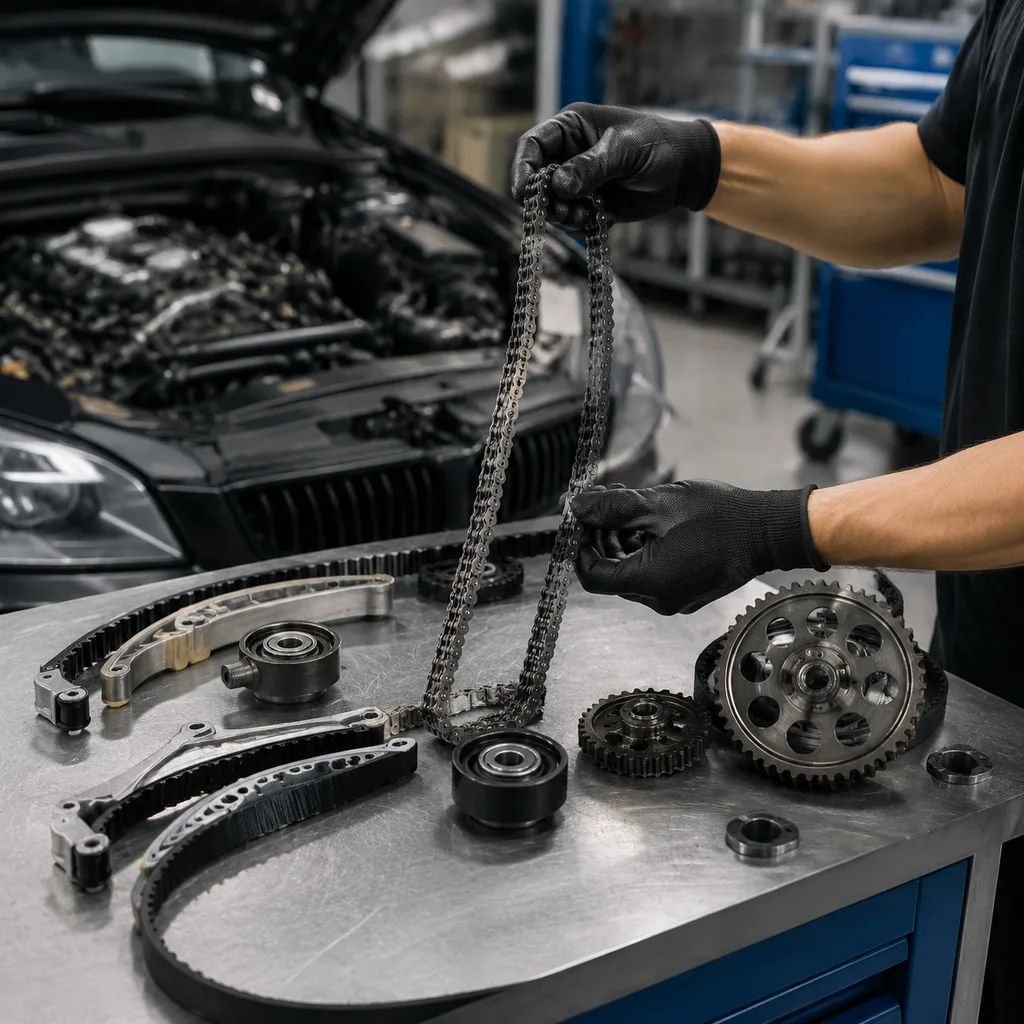
A timing chain normally “stretches” because pins, bushes and contact surfaces wear; it is not usually elastic elongation of the metal plates. In workshop terms, chain elongation of about 0.5–1.0% can already be enough to affect cam phasing on sensitive engines, but the acceptable limit must be taken from the engine procedure. A timing belt normally loses reliability through tooth wear, cord fatigue, heat ageing, pulley misalignment, incorrect tension or contamination. The replacement decision should therefore cover the complete drive system, not only the belt or chain that is easiest to see.
Symptom-to-cause diagnostic matrix
Before ordering replacement parts in volume, it is useful to separate chain elongation from belt-kit, installation and accessory-related causes. The same complaint may point to different root causes depending on engine design, mileage, oil history, previous repair quality and whether the engine is interference or non-interference.
Tooth flank wear, pulley misalignment, incorrect belt width
Belt tracking, pulley runout, cover interference
Oil-soaked belt
Not applicable on chain-only systems
Seal leak degrading belt compound and tooth fabric
Cam/crank seals, cover gasket, oil pump or VVT leaks
Intermittent misfire at idle
Chain slack affecting cam timing or VVT control
Incorrect belt timing, tension loss, worn pulley
Mechanical timing, adaptation values, oil feed to actuator
</tr></thead><tbody> </tbody></table>Use numbers wherever possible. Record rattle duration in seconds, oil pressure at idle and 2,000 rpm where accessible, cam deviation in degrees, belt tracking offset in millimetres, tensioner pointer position, and pulley runout. As a practical review point, visible belt walk of more than 1 mm from the normal track, rough bearing feel, grease leakage, blue heat marks or pulley face scoring should be treated as a root-cause clue rather than a cosmetic finding.
When a vehicle population includes both chain-driven and belt-driven engines, category managers should keep separate warranty codes for chain elongation, belt tooth failure, tensioner leakage, pulley seizure, guide wear, oil contamination and installation error. This improves supplier feedback and prevents a genuine installation or service issue from being reported as a product design problem. For fleet or repair-chain data, require the workshop to attach mileage, installation date, photos and part batch code to each claim; without those four fields, failure trend analysis becomes unreliable.
Inspection steps before replacement
For a repair chain, fleet operator or warranty team, the inspection process must be repeatable. A timing complaint should not be closed simply by replacing the most visible component. The following sequence helps technicians capture evidence before the timing cover is opened and preserves useful information for procurement teams.
1. Read diagnostic data before disassembly. Record DTCs, freeze-frame data, camshaft adaptation values, misfire counters and oil-pressure warnings. Clear data only after the baseline has been saved. Where the scan tool allows it, export before-and-after cam/crank correlation data. 2. Confirm service history. High mileage, extended oil-change intervals, wrong oil grade, previous partial repairs and missed belt intervals all increase timing-drive risk. Note the replacement interval used in the local market, not just the nominal catalogue interval. 3. Check external leaks. Oil or coolant entering the timing cover can shorten belt life, contaminate pulleys and degrade tensioner seals. A new kit fitted onto an unresolved leak should be excluded from normal parts warranty. 4. Inspect tensioner position. Excessive plunger extension on a chain tensioner or an out-of-range belt tensioner pointer indicates wear, incorrect installation or loss of control force. Measure plunger projection with a vernier caliper and photograph the scale when possible. 5. Check guides, rails and pulleys. Look for grooving, cracking, seized bearings, flange contact, plastic debris, uneven belt tracking and signs of overheating. Spin idlers by hand after removal; roughness, notchiness or axial play is enough to reject the component. 6. Verify sprocket and crank pulley condition. Worn teeth, damaged keyways, rubber damper failure or crank pulley runout can damage a new chain or belt quickly. Check runout with a dial indicator where access permits; many procurement specifications use pulley radial or axial runout limits around 0.05–0.15 mm depending on diameter and design. 7. Use correct locking tools. Paint marks are not a substitute for controlled crankshaft and camshaft positioning, especially on engines with floating sprockets or variable valve timing. Torque-to-yield bolts should not be reused unless the service data explicitly permits it. 8. Document findings for warranty review. Photographs of tensioner position, belt tracking, guide damage, oil leakage and timing marks help distinguish product failure from contamination or installation error. Keep the removed belt, tensioner and idlers together until the claim is closed.
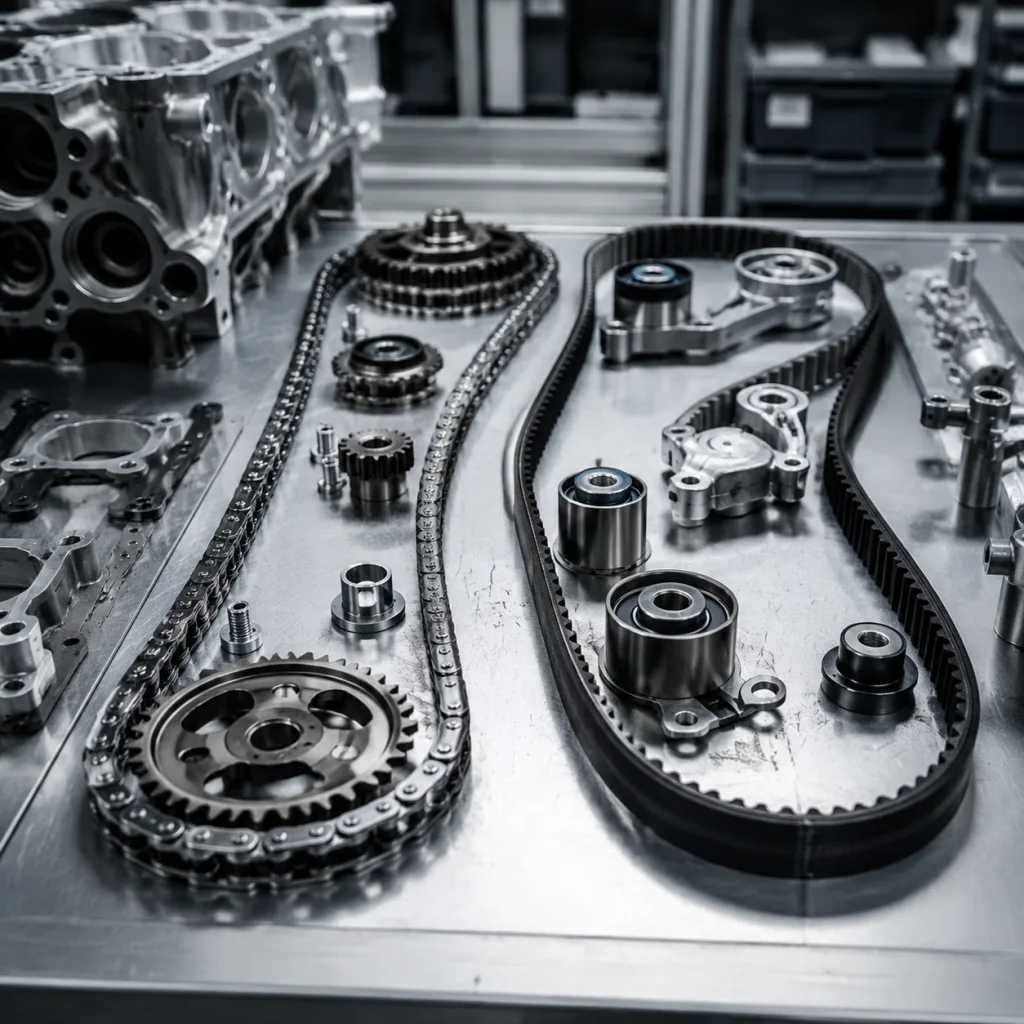
For belt-driven systems, buyers should specify kits that include the belt, tensioner, idler pulleys and installation hardware where the service procedure requires replacement bolts. Water pumps should be included only for applications where the pump is driven by the timing belt or where the market expects a pump-inclusive kit. For chain-driven systems, a complete kit may include chain, guides, tensioner, sprockets, seals and fasteners depending on application. A practical inspection form should include pass/fail fields for leaks, locking-tool use, torque method, tension setting, pulley condition and batch-code capture.
Replacement kit specification for procurement teams
A robust timing belt kit specification should be based on measurable characteristics, application data and documented process control rather than a generic part description. Driventus supplies timing components within its wider engine range; buyers can review our catalog or the engine product group at /products/engine-components.html.
Typical specification points for a belt kit include:
Tooth profile matched to the application drawing, sample confirmation or OE cross-reference where supplied. Define tooth pitch, tooth count, belt length and belt width rather than relying only on an interchange number.
Belt tensile cord material, rubber compound family and tooth fabric construction identified in the technical file. HNBR-type compounds are commonly specified for higher-temperature applications, while other compounds may be acceptable for older platforms if validated.
Belt length, width, tooth count and marking layout controlled against the approved specification. Typical buyer-side dimensional checks include belt width tolerance around ±0.3 mm and printed mark position controlled to the drawing.
Tensioner bearing material, grease type, seal design and operating temperature range defined. A common target range for engine-bay timing components is approximately -40°C to 120°C continuous exposure, with higher short-term resistance depending on design.
Pulley outside diameter, bore diameter, width, surface finish and runout controlled by inspection plan. For many idlers, bore tolerance, bearing press-fit, OD tolerance, surface roughness and radial runout are more important than catalogue appearance.
Fastener grade, coating and replacement requirement specified when bolts, studs or nuts are included. State whether bolts are 8.8, 10.9 or application-specific, and whether threadlocker patches, washers or single-use stretch bolts are supplied.
Installation sheet, service cautions and torque-reference policy aligned with the target market. If torque values are not printed for liability reasons, the insert should direct technicians to current vehicle service data.
Lot number traceability on carton labels, inner packaging and, where practical, component labels. A workable code links production date, line, inspection lot and packaging batch.
Fitment references controlled by application data, not by brand endorsement or implied vehicle-maker approval.
For chain kits, additional controls include chain pitch, plate thickness, pin hardness, guide rail material, wear-surface finish, tensioner leakage rate, check-valve performance and sprocket tooth geometry. As review targets, buyers commonly ask for chain pitch measurement over a defined number of links, pin and plate hardness records, guide material identification, sprocket runout and tooth-profile checks. If a buyer provides a generic cross-reference such as an OE-style number, the supplier should confirm dimensional and application match without claiming vehicle manufacturer approval.
For commercial planning, MOQ depends on whether the kit is existing, semi-custom or fully private label. Existing catalogue kits are typically planned by carton or pallet quantity; private-label cartons, inserts and barcodes usually require higher MOQ because packaging materials, artwork approval and line changeover must be absorbed. Price should be built from belt or chain cost, tensioner and bearing content, included hardware, water pump if applicable, packaging, inspection level, certification documents and Incoterms. Lead time is usually shortest for stocked kits, longer for mixed BOM assembly, and longest for new tooling, new labels or validation samples. Driventus can also support custom manufacturing for private-label kits, adjusted packaging, regional application ranges, distributor-specific bills of materials and export-ready carton labelling.
Quality controls that reduce repeat failures
Timing-drive parts operate in a demanding environment: oil mist, high temperature, cyclic load, vibration and limited installation tolerance. Procurement teams should therefore request evidence beyond a sales drawing or catalogue image. A good supplier file shows how the part is produced, inspected, packed and traced after shipment.
Relevant quality and compliance references include IATF 16949:2016 for automotive quality management, ISO 9001:2015 for quality management systems and REACH (EC) No 1907/2006 for chemical substance control in the European market. These standards do not prove fitment by themselves, but they help structure supplier process control, corrective action and material declarations.
A practical supplier file should contain:
Production control plan and incoming material inspection records, including steel, rubber compound, cord, bearing, spring, plastic guide and fastener checks as applicable.
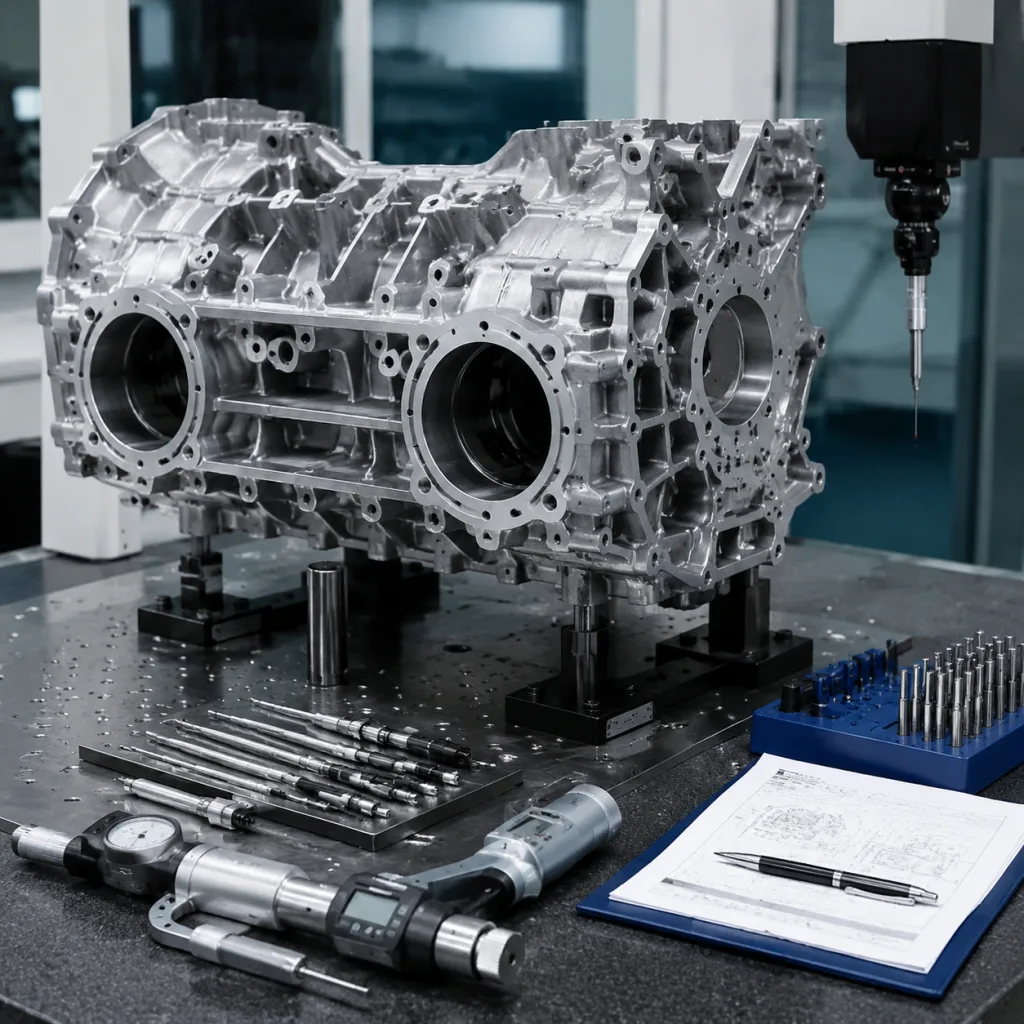
Dimensional inspection report for belt width, tooth count, pulley bore, pulley runout and critical chain dimensions. Critical dimensions should show nominal value, tolerance, measured result, sample size and inspection tool.
Hardness or material test records for sprockets, pins, plates, springs or fasteners where applicable. For chain and sprocket parts, heat-treatment records and case-depth or hardness trend data are more useful than a single certificate with no batch link.
Bearing noise, rotational torque or end-play checks for idlers and tensioners. Sampling should increase for new suppliers, new tooling, first orders and batches with process changes.
Rubber, cord or fabric specification controls for belts, including ageing or heat-resistance criteria when available. Buyers should ask whether test pieces are retained and how long batch samples are stored.
Tensioner function checks such as damping, return force or leakage rate depending on design. Hydraulic tensioners should be checked for controlled leak-down rather than simply for visible external leakage.
Endurance, bench or validation summary relevant to the part family and risk level. For high-volume programmes, request a validation plan that covers speed cycling, thermal exposure, contamination sensitivity and installation-tension variation.
Packaging drop-test results or transport-protection method for export cartons. Heavy kits with water pumps or sprockets should use internal dividers or formed trays to prevent pulley impact and seal damage.
Traceability format linking batch number, production date, inspection record and component source. The same code should be readable on the outer carton after warehousing and transport.
Driventus operates under a documented quality system with IATF 16949 and ISO 9001 certification. For importers and repair-chain buyers, the value is not only the certificate. It is the ability to trace one field complaint back to a production batch, inspection record and component source, then use that evidence to decide whether the issue is product-related, installation-related or caused by external contamination. A useful agreement also defines claim response time, evidence required, credit/replacement rules and whether destructive analysis is permitted on returned parts.
When to replace the complete kit, not a single part
A single belt, chain or tensioner can be appropriate for controlled scheduled service when the surrounding components are known to be within specification. Problem-driven repairs are different. If a stretched chain has worn guide rails, a new chain on damaged guides will not restore correct load distribution. If a belt has tracked off-centre because of an idler bearing, water-pump pulley or alignment issue, a belt-only repair leaves the root cause in place.
Replacement of the full kit is recommended when any of the following are present:
Timing deviation or a cam/crank correlation fault is confirmed.
Tensioner travel is near its limit or the tensioner pointer is outside the specified window.
Pulley bearing roughness, leakage, wobble, seizure marks or noise is detected.
Belt shows tooth cracking, oil swelling, edge fray, glazing, missing teeth or abnormal dust.
Chain guides show grooves, broken plastic, missing material or heat damage.
Sprocket teeth are hooked, sharp, pitted or visibly uneven.
The engine is already open and labour cost exceeds the incremental cost of replacing the remaining wear parts.
A vehicle population has recurring warranty claims after partial repairs.
For B2B programmes, kit completeness should match the service procedure and commercial expectations in the target market. EU, UK, North American, Australian and Brazilian distributors may require different packaging languages, barcode formats, warranty inserts, application files or private-label carton layouts. A practical range can be structured in three levels: belt-only for price-sensitive scheduled service, standard kit with belt/tensioner/idlers/hardware, and premium kit with water pump, seals or additional single-use bolts where the application requires them.
The commercial rule is to compare claim risk against incremental kit cost. If a pulley or tensioner failure can destroy the belt and create an engine-damage claim, saving a few dollars on a partial kit is usually false economy. For import planning, ask suppliers to quote each BOM level separately, state MOQ by part number and by packaging style, and show lead time for first order, repeat order and urgent replenishment. Driventus is an independent aftermarket manufacturer; brand names are referenced for fitment only.
Frequently asked questions
Not usually. Chain elongation is mainly wear at pins and bushes. A timing belt may lose timing accuracy through tooth wear, cord fatigue, incorrect tension, heat ageing or contamination, but it is not normally described as metal-chain stretch.
For scheduled maintenance, both options may be needed. For problem repairs involving noise, tracking issues, contamination or timing faults, a full kit with tensioner, idlers and required hardware reduces repeat failure risk. Quote belt-only, standard kit and premium kit separately so price, MOQ and warranty exposure can be compared.
Request drawings or critical dimensions, material information, inspection reports, certification scope under IATF 16949:2016 and ISO 9001:2015, packaging specification, traceability format, application cross-reference data, MOQ by packaging option and lead time for samples, first order and repeat orders.
If you are building a timing belt kit range or investigating timing-drive warranty returns, share your application list, target markets, required kit level and annual forecast with Driventus. You can [request a quote](/contact.html).