How to Verify Camshaft Phaser Quality for Sourcing
Camshaft phasers are high-risk sourcing items because small errors in vane geometry, oil leakage, lock-pin timing, oil cleanliness or surface finish can lead to start-up rattle, timing deviation, diagnostic trouble codes and warranty returns. For procurement teams, fitment is only the starting point. The supplier must also prove repeatable hydraulic response, dimensional control, material conformity, cleanliness and traceability across production lots. This guide explains how to verify camshaft phaser quality before supplier approval, during incoming inspection and after pilot supply. It is written for distributors, OEM service programmes, Tier-1 buyers and repair-chain procurement teams comparing independent aftermarket sources. Driventus is an independent aftermarket manufacturer; brand names are referenced for fitment only. Buyers can review related engine components in [our catalog](/products.html) and use this checklist when qualifying new camshaft phaser suppliers.
Define the Fitment and Functional Requirements First
A camshaft phaser is not a simple sprocket. It is a hydraulic actuator with a rotor, stator, vane chambers, seals, locking mechanism, oil-control interfaces and, in some designs, return springs. Before any sample is tested, confirm the engineering boundary conditions that define how the part should behave on the engine.
Minimum sourcing data should include:
Engine family, displacement, camshaft position and valve timing system type
Intake or exhaust application, because phaser angle range and locking position may differ
Chain or belt drive interface, tooth profile, pitch and timing mark position
Oil feed configuration, filter screen requirement and control valve interface
Target phasing angle, default lock position and lock-release oil pressure
Material specification for stator, rotor, hub, fasteners and friction surfaces
OE part-number cross-reference format where available, for example OE 06A… or OE 11251…
Do not approve a part based only on external appearance. Two phasers may share a bolt pattern and tooth count but differ in chamber volume, vane stop angle, rotor clearance or lock-pin calibration. Those differences can change camshaft response time, increase start-up noise and trigger engine control faults.
For new programmes, procurement should request a dimensional drawing, application list, sample inspection report and change-control process. If the drawing is buyer-owned, the supplier should confirm capability against the controlled print rather than substituting its own interpretation. If the supplier provides the design, the drawing should still identify critical-to-function features, inspection datums and revision history.
Check Materials, Machining and Dimensional Control
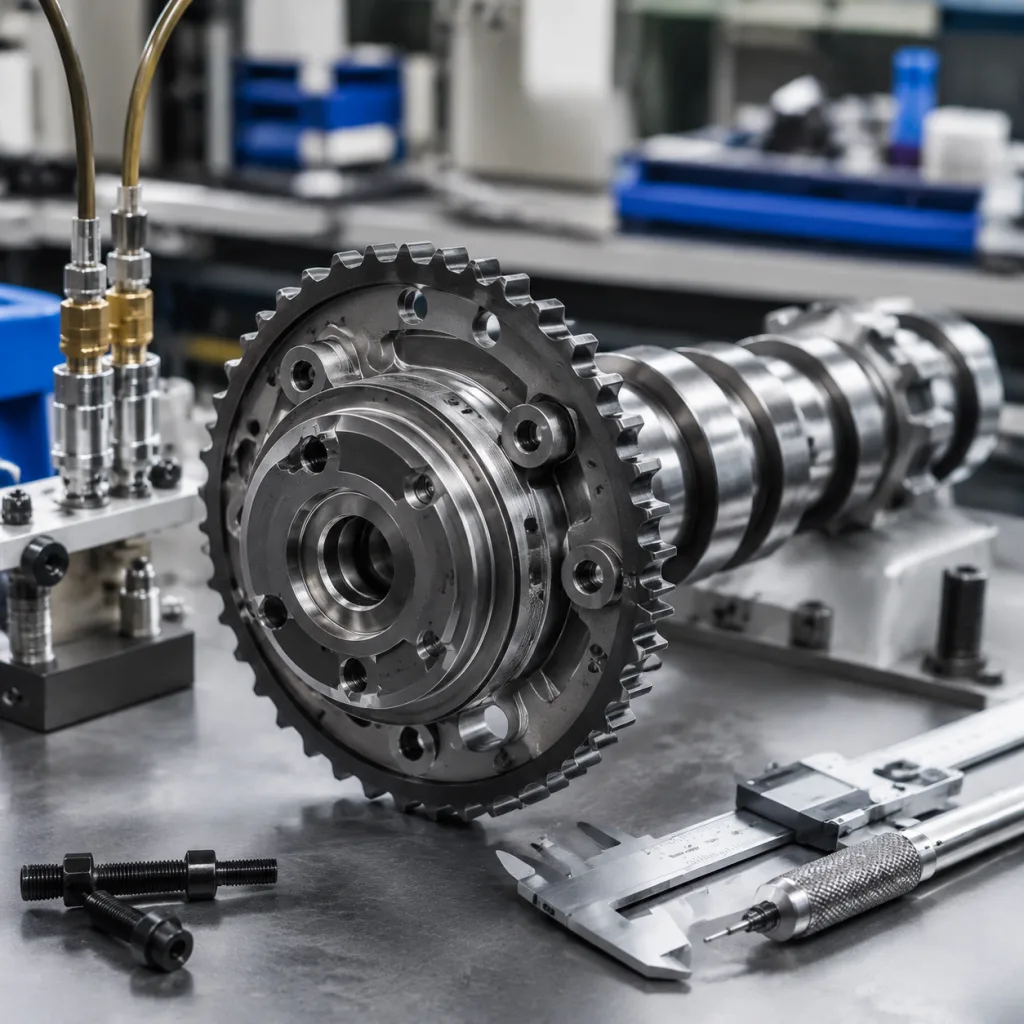
A core step in how to verify camshaft phaser quality is separating visible condition from measurable control. Visual inspection can find burrs, dents, corrosion, contamination and poor surface treatment, but it cannot confirm oil sealing, angular accuracy or response under pressure.
Use a controlled inspection plan for first-article samples and incoming lots:
Verification point
Typical method
Procurement relevance
Tooth count and pitch
Profile projector, CMM or gear gauge
Prevents chain or belt mismatch
Timing mark and indexing
Fixture check, CMM
Confirms correct cam timing reference
Mounting bore and bolt circle
CMM, plug gauge, thread gauge
Confirms assembly fit
Mounting face runout
Dial indicator, CMM
Reduces wobble and drive noise risk
Rotor-to-stator clearance
CMM, air gauge, controlled teardown
Affects leakage and response
Vane chamber finish
Roughness tester, visual magnification
Reduces leakage and wear
Lock-pin bore and pin diameter
Pin gauge, CMM
Controls start-up lock and noise
Surface hardness
Rockwell or microhardness test
Supports wear resistance
Cleanliness
Particle count, wash test
Reduces oil-control valve blockage
</tr></thead><tbody> </tbody></table>For cast, forged or sintered parts, review material certificates, heat-treatment records and hardness results against the specification. For machined faces that seal oil pressure, require actual surface finish data instead of accepting a general “machined” statement. Where chemical substances are relevant to the EU supply chain, request material declarations aligned with REACH (EC) No 1907/2006.
Dimensional capability should be shown with measured results, not only nominal values. For repeat business, ask for control-plan characteristics, gauge calibration status and capability studies on critical dimensions. A supplier operating under IATF 16949:2016 and ISO 9001:2015 should be able to connect drawings, inspection records, nonconformance handling and corrective actions within one documented system.
Verify Hydraulic Function and Locking Behaviour
Camshaft phaser performance depends on controlled oil movement. A part can pass static measurement and still fail in service because of internal leakage, delayed lock release, poor oil filling, unstable return or excessive variation between cycles.
Bench Tests to Request
A competent supplier should be able to perform functional testing on each production lot or on a statistically defined sampling plan. Exact limits depend on the application, but the test categories are consistent:
Leakage test: Measures internal oil leakage at defined pressure, temperature and oil viscosity conditions.
Lock-pin engagement: Confirms the phaser holds the default position before oil pressure releases the lock.
Lock release pressure: Confirms the pin releases within the specified oil-pressure band.
Angular travel: Verifies the actual phasing range against the engineering requirement.
Response time: Measures advance and retard speed under controlled pressure and flow.
Return stability: Checks repeatability after cycling and confirms the unit returns to the intended position.
Noise or rattle screening: Identifies abnormal lock, vane or spring behaviour that could create NVH complaints.
The buyer should request test reports that state the test medium, pressure, temperature, viscosity or equivalent oil grade, cycle count, acceptance criteria and sample size. A report that only says “function OK” is not sufficient for technical sourcing because it gives no evidence of margin or repeatability.
For validation supply, ask for endurance data. Camshaft phasers experience repeated pressure pulses, torsional vibration and oil-temperature variation. Endurance testing should include cycling across relevant pressure ranges, thermal exposure and post-test leakage comparison. If the part is supplied for emission-sensitive applications, confirm that the vehicle system remains capable of meeting applicable regulatory requirements such as UNECE R83 or US EPA-related vehicle certification obligations. The phaser itself is not certified alone, but its timing accuracy can affect the complete engine system.
Audit the Supplier’s Quality Evidence
A useful quality review links the component to the manufacturing process. Buyers should look beyond a certificate PDF and confirm how the supplier controls variation from raw material through final test.
Key documents to request include:
IATF 16949:2016 and ISO 9001:2015 certificates from an accredited certification body
Process flow diagram covering casting, forging or sintering, machining, cleaning, assembly and testing
PFMEA for hydraulic leakage, locking failure, burrs, tooth-form error, incorrect timing index and contamination
Control plan with defined special characteristics and inspection frequency
MSA evidence for gauges used on critical dimensions and functional checks
Initial sample inspection report and, where required, PPAP package
Lot traceability rules for material batch, machining date, assembly line, operator or station and final test result
Corrective action examples for previous nonconformities
Driventus maintains a documented quality system for engine and powertrain components. For camshaft phasers, the most relevant audit questions are practical: which features are measured, how often they are checked, what happens when a part fails and whether the same data can be traced after shipment.
If procurement teams require buyer-specific geometry, packaging or validation plans, custom manufacturing should include controlled drawings, inspection agreements, sample approval stages and change notification rules. No supplier should change oil passages, spring force, tooth hardening, surface treatment, lock-pin specification or seal material without written approval when those features are part of the agreed specification.
Use a Receiving and Pilot-Lot Checklist
Incoming inspection should be risk-based. For a new supplier or new part number, inspect more characteristics, run functional checks and retain reference samples. After stable supply is proven, the plan can shift toward periodic audit testing while keeping controls for critical features.
Recommended pilot-lot checklist:
1. Confirm packaging label, part number, batch number and production date. 2. Compare external geometry, timing marks and product marking with the approved master sample. 3. Inspect for burrs, chips, rust, dents, blocked oil passages and machining debris. 4. Measure tooth profile, bolt holes, bore diameter and mounting face runout. 5. Check lock-pin engagement before applying oil pressure. 6. Perform leakage, lock-release and angular travel testing on sampled units. 7. Review test report values against agreed acceptance criteria, not against a generic pass/fail note. 8. Retain one approved sample and one complete test record for traceability. 9. Install pilot parts only after dimensional and functional release. 10. Track field feedback by batch, engine application and installation date, not only by part number.
For distributors and repair-chain buyers, batch-level data is essential. A return described as “noisy phaser” is difficult to analyse if installation date, engine application, oil condition, mileage and batch number are missing. Require clear product marking or packaging traceability so suspected issues can be isolated without blocking unrelated stock.
This is also the point to compare commercial terms with quality risk. A lower unit price is not useful if the supplier cannot provide consistent lock-release pressure, contamination control, replacement analysis or warranty support.
Common Red Flags Before Approval
Several warning signs indicate that a camshaft phaser supplier may not be ready for long-term B2B supply.
Watch for these issues:
No functional test limits for leakage, lock release, angular travel or response time
No traceability from finished goods to material batch, machining date and assembly date
Drawings that omit critical hydraulic surfaces, timing index points or vane chamber dimensions
Certificates that do not match the manufacturing site or product scope
Samples that differ from production packaging, marking or finish
Inability to explain cleaning controls for machining chips, abrasive particles and blocked oil passages
No formal change-control procedure for materials, tooling, test method or production location
Warranty answers based only on installation error without teardown evidence or batch review
A robust supplier should be able to explain likely failure modes and show how they are prevented. The buyer’s objective is not to create unnecessary paperwork; it is to confirm that the same camshaft phaser design can be produced repeatedly, tested objectively and traced if a problem occurs.
For sourcing teams comparing how to verify camshaft phaser quality across several suppliers, use the same checklist for every factory. Standardised comparison makes technical gaps visible and prevents approval decisions based only on quoted price, sample appearance or delivery promise.
Frequently asked questions
Hydraulic function testing is usually the most important because it verifies leakage, lock release, angular travel and response under controlled oil pressure. Dimensional inspection is still required, but a phaser can be dimensionally acceptable and fail under hydraulic load.
For OEM, Tier-1 and structured aftermarket programmes, IATF 16949:2016 is strongly preferred because it supports automotive process control, risk management, traceability and corrective action discipline. ISO 9001:2015 alone may be acceptable for lower-risk supply, depending on buyer policy and validation scope.
Yes, Driventus can review buyer-supplied OE cross-references such as OE 06A… or OE 11251… for fitment identification. Driventus is an independent aftermarket manufacturer; brand names are referenced for fitment only.
If you are qualifying a camshaft phaser supplier, Driventus can provide drawings, sample inspection data and manufacturing feedback for review. To discuss fitment lists, validation scope or pricing, [request a quote](/contact.html).