Sourcing connecting rods for Acura applications is a technical purchasing decision, not only a price comparison. Wholesale buyers need confidence in dimensional control, material traceability, heat-treatment consistency, machining accuracy, and export-ready documentation. A rod that loses big-end geometry after machining, uses unverified material, or arrives without usable batch records can create warranty exposure across multiple repair channels.
This guide outlines how Driventus supports connecting rod Acura wholesale programmes for distributors, importers, engine parts wholesalers, repair networks, and remanufacturers in North America, Europe, Australia, Brazil, and other export markets. It explains the fitment data buyers should prepare, the manufacturing controls that affect repeatability, and the commercial terms typically reviewed before a sample order, audit, or long-term supply agreement. Driventus is an independent aftermarket manufacturer; Acura, Honda, and other brand names are referenced for fitment identification only.
Wholesale fitment scope and buyer use cases
Acura engine coverage often overlaps with Honda-family platforms, but procurement teams should treat every programme by engine code, displacement, production range, pin diameter, big-end bore, rod length, bearing specification, and market version. A model name by itself is not enough for a reliable quotation or interchange decision. The preferred starting point is a cross-reference file that includes engine code, buyer part number, sample drawings where available, and any OE-style reference format supplied by the buyer for fitment matching.
Common buyer profiles include:
Aftermarket distributors building inventory for engine rebuilders
Wholesalers consolidating piston, ring, bearing, gasket, and connecting rod kits
Multi-location repair chains standardising approved repair parts
Private-label importers requiring packaging, barcode, and carton specifications
Engine remanufacturers needing stable batch quality over repeat orders
Driventus supplies connecting rods as part of its wider engine component range. Buyers can review related product families in our catalog and the engine-specific section at /products/engine-components.html. For new Acura coverage, Driventus uses a controlled sample, drawing, and cross-reference confirmation process before volume production so that the quoted item matches the intended engine application rather than only a broad vehicle description.
Key specifications to confirm before quotation
A connecting rod quotation should be built around measurable data. If a buyer provides only a vehicle model and year range, the supplier should request further identification before confirming interchange. Acura applications may vary by sales market, engine revision, crankshaft journal size, piston pin arrangement, bearing shell design, and production period.
Typical specification data requested for connecting rod Acura wholesale enquiries:
Item
Procurement check
Why it matters
Centre-to-centre length
Drawing value and tolerance
Controls compression height relationship and deck clearance
Big-end bore
Finished bore after cap assembly and bolt tightening
Affects bearing crush, oil clearance, and crank journal fit
Small-end bore
Floating or press-fit pin type
Determines piston pin compatibility
Big-end width
Measured at thrust faces
Controls side clearance on the crankshaft
Small-end width
Measured against piston boss design
Helps confirm piston and pin assembly compatibility
Fastener type
Bolt size, grade, seating style, and torque method
Influences clamp load, cap retention, and fatigue performance
Material
Forged steel or specified alloy grade
Affects fatigue strength, machinability, and durability margin
Weight range
Batch tolerance and balancing target
Reduces variation in the rotating and reciprocating assembly
Surface treatment
Shot peening or equivalent process if specified
Improves fatigue resistance when correctly controlled
Marking and traceability
Buyer reference, lot code, or production mark
Supports warehouse control and claim investigation
</tr></thead><tbody> </tbody></table>For wholesale programmes, Driventus normally asks for original samples, buyer drawings, validated cross-reference data, or a combination of these inputs. If the buyer uses an internal reference such as an OE-style number, it should be clearly marked as a fitment reference and not as a claim of vehicle manufacturer approval. This distinction protects both parties and keeps catalogue, packaging, and customs documentation aligned with independent aftermarket supply practices.
Manufacturing controls for repeatable rod geometry
Connecting rods carry alternating tensile and compressive loads at high engine speed. Their production route must control grain flow, heat treatment, bore geometry, cap alignment, fastener seating, and surface condition. A low unit price does not offset inconsistent big-end roundness, poor parallelism, incorrect bolt clamping, or unstable machining after heat treatment.
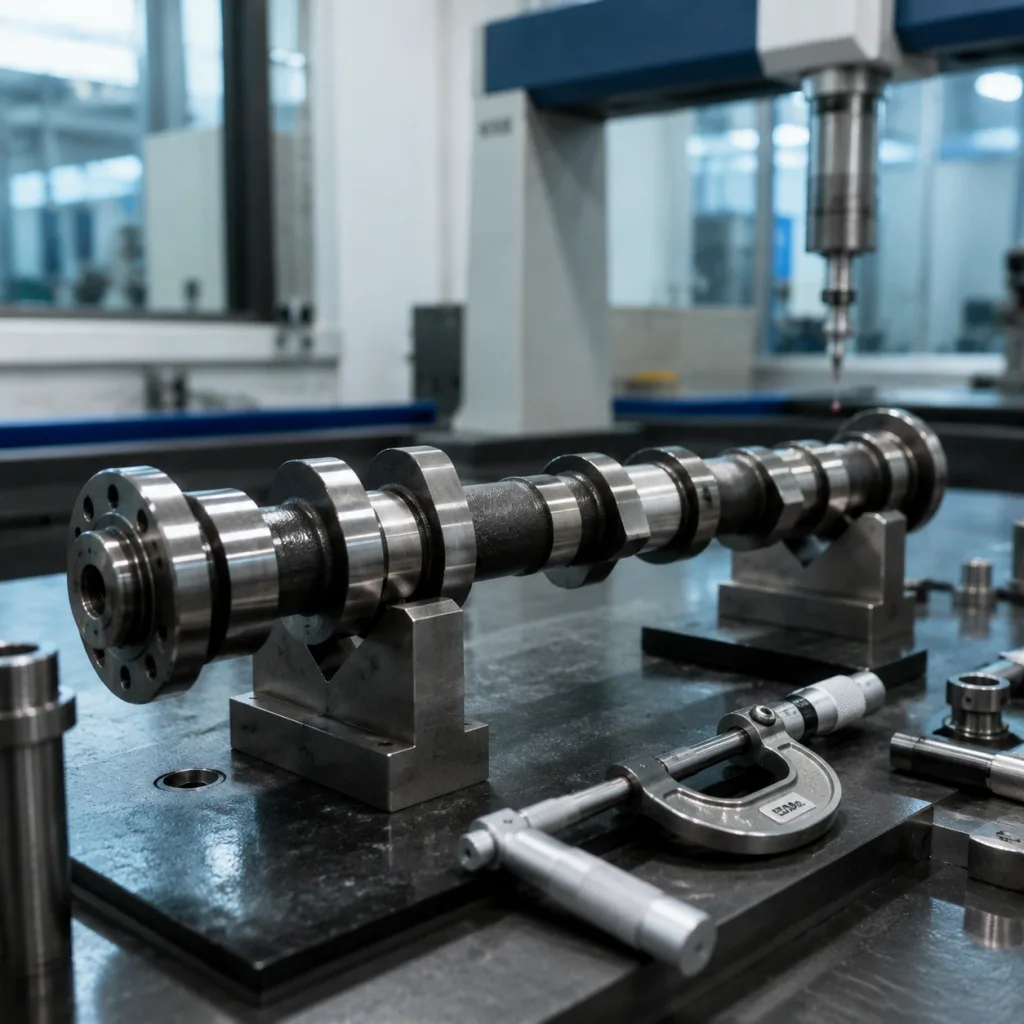
Driventus uses controlled process planning for forged and machined engine components. Production steps for connecting rods typically include material verification, forging or blank preparation, heat treatment, shot blasting or surface preparation where required, CNC rough machining, cap separation or cap machining depending on design, bolt installation, precision boring and honing, surface finishing, cleaning, inspection, preservation, and packing.
Important control points include:
Material certificates linked to production lots
Chemical composition or supplier material verification where required
Hardness checks after heat treatment
Big-end and small-end bore measurement using calibrated gauges
Roundness, cylindricity, and bore size checks after final honing
Parallelism and twist inspection across the rod body
Bolt thread inspection and clamp-load related checks where applicable
Visual, magnetic particle, or other defect inspection according to the agreed control plan
Cleanliness control before packing to reduce contamination risk in engine assembly
Batch traceability from raw material to final carton
The company’s quality system is structured around IATF 16949:2016 and ISO 9001:2015. These standards do not by themselves prove the performance of a specific part number, but they provide a framework for process control, corrective action, traceability, calibration, record retention, and production approval discipline. For B2B buyers, the practical value is consistency: each repeat order should be produced to the same confirmed specification, inspected with controlled equipment, and shipped with records that support incoming quality checks.
Testing, documentation, and compliance expectations
For importers and category buyers, a reliable supply file should contain more than a price sheet. A supplier should be able to provide inspection records, material documentation, packing specifications, traceability data, and a defined response process for nonconforming material. These records help the buyer manage incoming inspection, catalogue approval, warehouse release, and warranty investigation.
Typical documents for a wholesale connecting rod programme include:
Dimensional inspection report for trial samples
Material certificate or chemical composition report
Hardness test report
Process flow chart and control plan where required
Appearance and packaging approval records
Part marking or label approval where buyer references are used
Lot traceability report for shipped batches
Corrective action report format for any quality issue
REACH (EC) No 1907/2006 declaration where applicable for EU supply chains
Packing list, commercial invoice, and export documentation aligned with the agreed Incoterms
For buyers serving regulated markets, documentation should be retained in a format that supports incoming inspection and warranty analysis. Connecting rods are internal engine components and are not certified under emissions regulations such as ECE R-83 by themselves. However, dimensional, material, or machining failures can affect engine durability, oil clearance, noise, and customer claims. The practical compliance focus is therefore process evidence, batch control, repeatability, and accurate aftermarket fitment representation.
If a buyer requires private-label packaging or application-specific development, Driventus can review drawings, samples, labelling rules, carton requirements, and testing plans through its custom manufacturing service. Early review of these requirements prevents delays after samples have already been produced.
MOQ, lead time, and audit readiness
Commercial terms depend on application demand, tooling status, material availability, packaging format, inspection level, and whether the item is an established part number or a new development. For existing coverage, MOQ is usually lower than for a new forging, modified design, or buyer-exclusive programme. For a new Acura connecting rod programme, procurement teams should separate sample lead time, tooling time, pilot production, mass production, and transit time instead of treating the project as one delivery date.
Indicative sourcing framework:
Stage
Typical buyer action
Supplier output
RFQ review
Send application list, annual volume, drawings, samples, and target market
Feasibility check and quotation basis
Technical confirmation
Confirm dimensions, material expectations, marking, and packaging
Specification review and open-question list
Sample confirmation
Approve dimensions, appearance, marking, and packaging
Trial samples and inspection report
Pilot order
Place limited production order
Batch records, packing review, and shipment feedback
Volume order
Confirm forecast and release schedule
Production plan and export documents
Supplier audit
Review process, calibration, traceability, and corrective actions
Audit evidence and improvement plan if needed
</tr></thead><tbody> </tbody></table>Buyers should discuss factory audit access before placing a long-term supply contract. Useful audit topics include incoming material control, heat treatment records, gauge calibration, machining capability, final inspection sampling, nonconforming product control, corrective action timing, warehouse traceability, and export packing. Driventus supports remote document review and on-site audit arrangements for qualified B2B customers, subject to schedule, safety rules, and confidentiality controls.
A practical purchasing plan also considers inventory risk. Acura applications may have uneven demand by market, so buyers often combine initial trial quantities with forecast-based replenishment. This allows catalogue expansion while keeping stock exposure under control.
How to structure a wholesale RFQ
A complete RFQ reduces avoidable revisions and prevents incorrect interchange. For connecting rod Acura wholesale projects, procurement teams should provide a structured data sheet rather than a text-only enquiry. The more precise the input, the easier it is to compare quotations on quality, documentation, packaging, and landed cost rather than on unit price alone.
Recommended RFQ checklist:
Target engine codes and market coverage
Vehicle application range, if used, supported by engine details
Annual forecast and first-order quantity
Required packaging: neutral, private label, or bulk service pack
Any OE-style cross-reference supplied by the buyer, clearly marked for fitment only
Sample availability and whether destructive testing is permitted
Drawing format, revision level, and critical characteristics
Material, heat treatment, or surface treatment requirements if specified
Required inspection report format and sampling level
Marking, barcode, carton label, and pallet requirements
Destination port and preferred Incoterms
Compliance declarations required by the destination market
Warranty handling process and claim evidence requirements
This approach helps the supplier confirm whether an existing part can be used or whether new development is needed. It also gives the buyer a more accurate comparison between quotations. If two suppliers quote different prices but only one includes dimensional reports, traceability, controlled packaging, and audit-ready records, the lower initial price may not represent the lower total landed risk.
For a current programme or new coverage list, buyers can request a quote with application data, expected volume, destination market, packaging preference, and any available samples. Driventus will review feasibility, documentation needs, MOQ, and sample timing before confirming the quotation basis.
Frequently asked questions
Provide engine code, application range, target annual volume, drawings or samples if available, packaging requirements, destination, and any buyer-supplied cross-reference. Model year alone is usually not enough to confirm interchange.
Yes. Driventus can review neutral or private-label packaging, carton marks, barcode requirements, and batch traceability needs for qualified B2B buyers. Packaging approval should be completed during the sample or pilot order stage.
No. Driventus is an independent aftermarket manufacturer; brand names are referenced for fitment only. Any OE-style number is used only as a cross-reference to help buyers identify the required application.
Send your application list, target volume, destination market, and documentation requirements for review. Driventus will confirm feasibility, MOQ, sample timing, and quotation details at /contact.html