A camshaft phaser for Porsche applications is not a generic timing component. It has to locate accurately on the camshaft, meter oil consistently, hold vane sealing under hot operating conditions, and return reliably after repeated start-stop and load cycles. For distributors, repair-chain buyers and sourcing engineers, the practical question is not simply whether a lower-cost replacement is available. It is whether the part is a true camshaft phaser Porsche OE equivalent in fit, hydraulic function, durability and documentation.
This guide explains how Driventus specifies and validates Porsche-fit camshaft phasers for aftermarket and private-label supply. It covers interface dimensions, material and machining controls, hydraulic response, end-of-line testing, release documentation and commercial sourcing checks. Driventus is an independent aftermarket manufacturer; Porsche and other brand names are referenced for fitment identification only.
What OE-equivalence means for a Porsche-fit camshaft phaser
For procurement, OE-equivalence should be defined with measurable requirements rather than marketing language. A replacement phaser must install without modification, maintain the correct cam timing authority, seal oil pressure across the vane chambers, and survive the operating environment expected in the target engine family. It does not mean vehicle manufacturer approval, and it should not be presented as such unless formal authorization exists.
For Porsche-fit applications, buyers normally verify three areas before release:
Hydraulic function: advance and retard travel, response time under controlled oil temperature, internal leakage, locking-pin release and return behaviour.
Durability: vane wear, spring preload retention, locking pin operation, surface hardness, coating stability and resistance to oil degradation by-products such as varnish and sludge.
The most useful supplier conversations start with a shared benchmark: an approved drawing, a master sample, or a customer-controlled measurement file. Without that reference, “OE-equivalent” can be interpreted too broadly, creating risk in installation, noise performance or diagnostic behaviour.
Driventus manufactures timing and engine components for B2B supply, including phaser assemblies within the wider engine-component range shown in our catalog and engine components. Porsche application references are used only to identify fitment. Driventus is an independent aftermarket manufacturer; brand names are referenced for fitment only.
Critical dimensions and functional checks
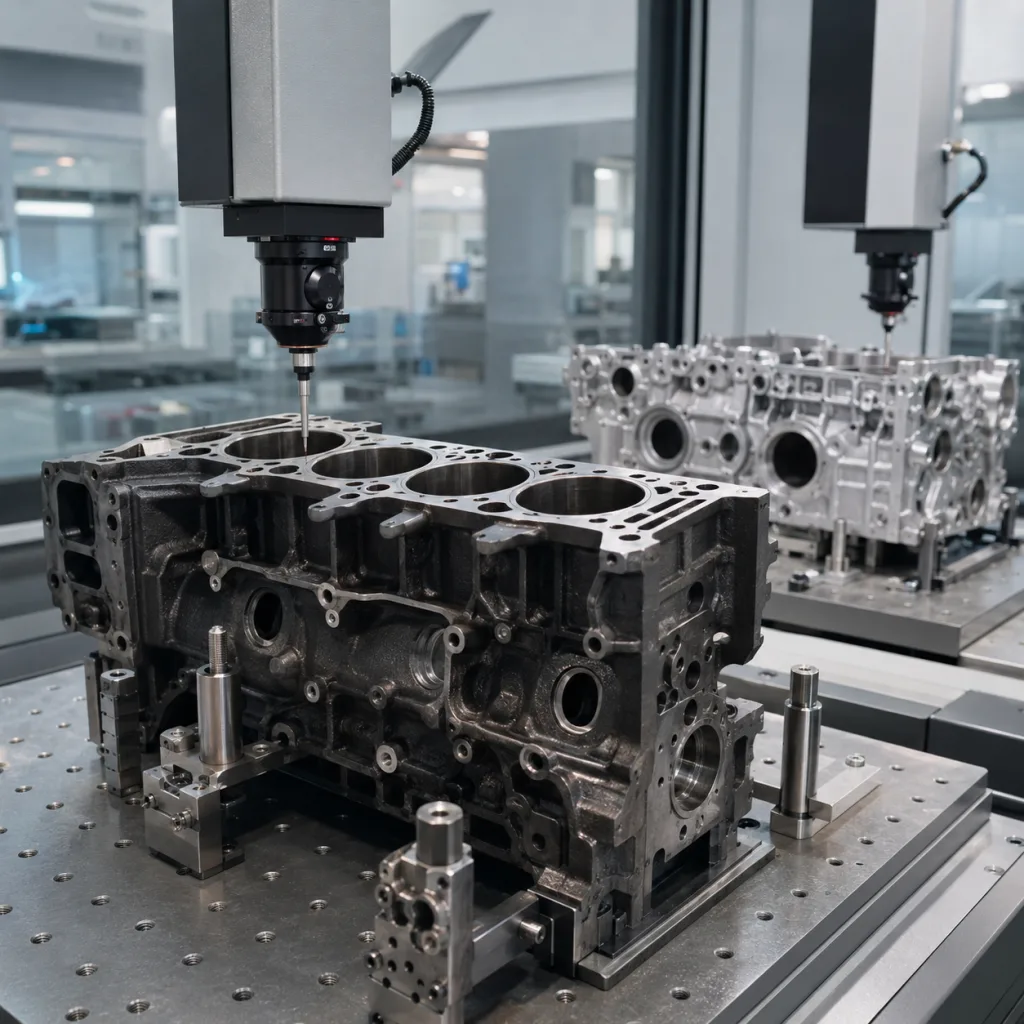
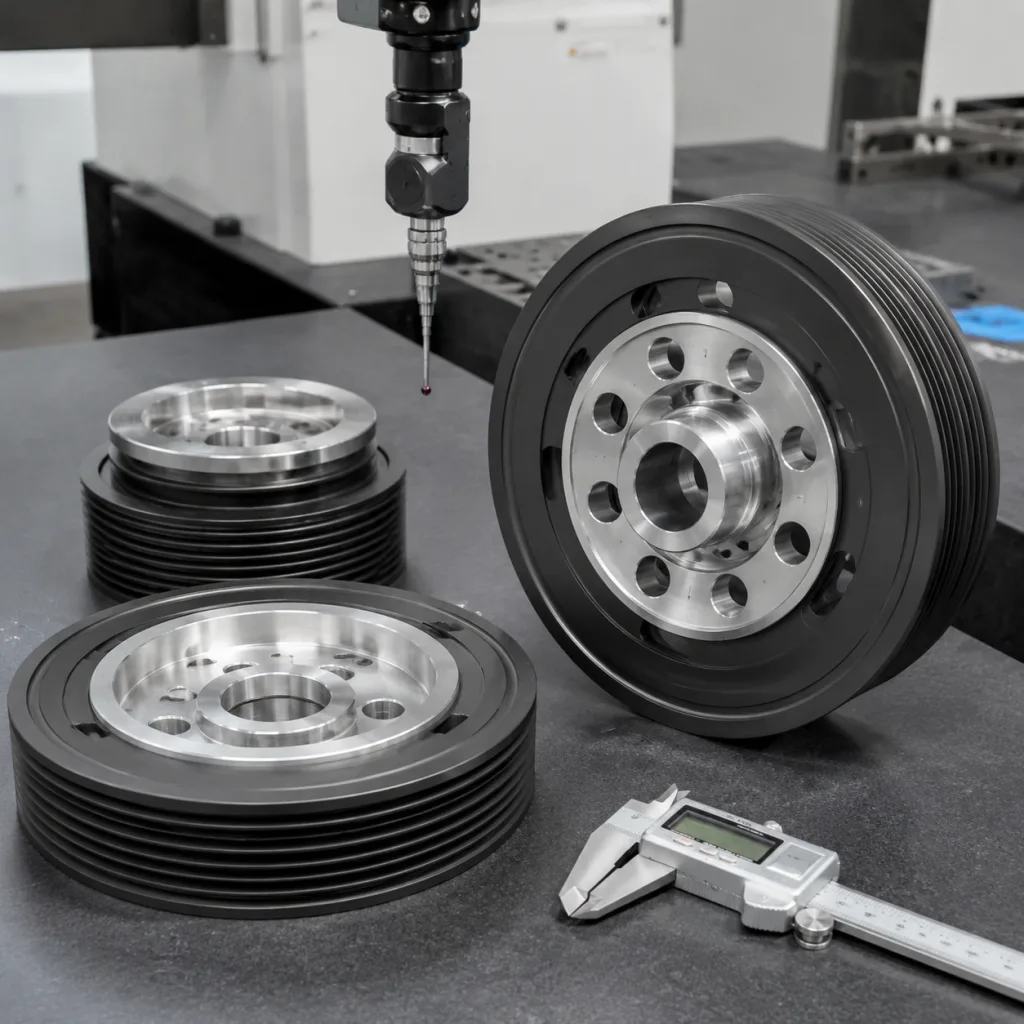
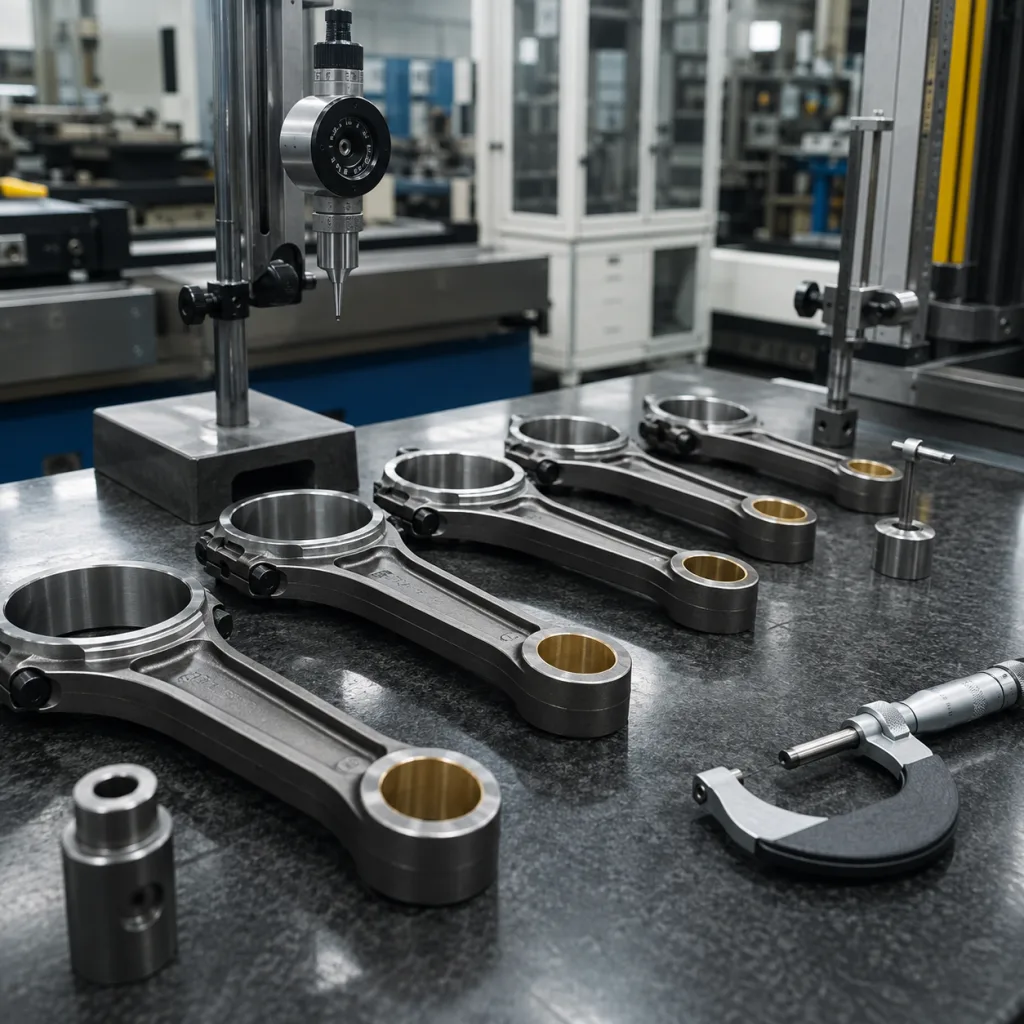
A camshaft phaser is a precision hydraulic actuator, not just a sprocket. Small deviations in bore position, tooth form, vane clearance or oil feed alignment can produce noisy start-up, delayed cam response, diagnostic trouble codes, rough idle, reduced drivability or accelerated chain wear. For this reason, incoming buyers should request dimensional reports from production tooling and pilot lots, not only one-off sample inspection data.
Typical control points for a Porsche-fit replacement phaser include:
Control item
Procurement requirement
Typical verification method
Camshaft locating bore
Match drawing, master data or approved sample
CMM, air gauge or bore gauge
Bolt seat face runout
Controlled to prevent axial wobble and uneven clamp load
Dial indicator or dedicated fixture check
Sprocket tooth profile
Match chain pitch, roller contact and timing geometry
Optical comparator, profile gauge or CMM scan
Oil feed alignment
Ports align with the camshaft and housing oil circuit
Fixture inspection and visual confirmation
Phaser angular travel
Within validated advance/retard range
Functional oil test bench
Internal leakage
Below defined flow limit at specified pressure and temperature
Flow measurement and pressure decay test
Locking pin engagement
Reliable lock at rest and clean release under oil feed
End-of-line cycling test
Surface hardness
Consistent with wear design and material specification
Rockwell or Vickers testing
Balance and concentricity
Stable at engine operating speed
Dynamic or fixture-based checks
</tr></thead><tbody> </tbody></table>For replacement programmes, Driventus works from customer-supplied drawings, approved samples, or reverse-engineered measurement sets where legally permitted. For OE part-number cross-reference management, buyers may map internal SKUs to their own catalogue references only when the data is accurate and lawfully used. We do not invent, misstate or claim ownership of brand-owned part numbers.
Materials, machining and assembly controls
The phaser body, rotor, vanes, locking pin, fastener interface and spring package all influence oil response and service life. Material selection depends on the specific application design, but the sourcing specification should state grade, hardness window, heat treatment, coating and cleanliness requirements instead of relying on broad phrases such as “OE material”. That language is too vague for repeatable production control.
A typical sourcing specification may include:
Sintered, forged or machined steel rotor and housing according to approved drawing or benchmark data.
Controlled heat treatment with batch traceability and defined hardness range.
Ground or precision-machined sealing faces to limit internal bypass leakage.
Deburred and washed oil passages to reduce contamination risk after installation.
Calibrated locking pin spring force and verified lock/unlock movement.
Surface treatment or anti-corrosion protection suitable for sea freight and warehouse storage.
Packaging that prevents tooth impact, oil-port contamination and face scratching.
Clear marking or lot coding to support traceability without interfering with fitment.
Assembly cleanliness is especially important. Residual chips, blasting media or abrasive particles can jam the locking pin, score vane sealing surfaces or restrict oil passages. Even when the geometry is correct, contamination can cause intermittent faults that are difficult for repair shops to diagnose.
Driventus applies controlled washing, filtered assembly handling and end-of-line oil function testing for phaser programmes where required by the customer specification. Manufacturing control is managed under IATF 16949:2016 and ISO 9001:2015 through the Driventus quality system. For regulated markets, buyers may also request material declarations aligned with REACH (EC) No 1907/2006 and RoHS Directive 2011/65/EU where applicable to their import, distribution or customer obligations.
Validation testing for replacement release
A camshaft phaser Porsche OE equivalent should be validated through both bench testing and installation-oriented checks. The exact plan depends on the engine family, expected annual volume, warranty exposure, target market and customer risk level. For a distributor private-label launch, a staged validation plan is usually more reliable and more cost-effective than approving a part from a single sample run.
Recommended validation sequence:
1. Dimensional layout: full measurement report against drawing, approved sample or master data, including critical-to-function dimensions. 2. Material confirmation: chemical composition, hardness, heat-treatment record and coating thickness if specified. 3. Hydraulic response test: advance/retard travel measured under controlled pressure, oil temperature and flow rate. 4. Leakage test: chamber sealing and pressure decay compared with the approved benchmark or customer limit. 5. Locking function test: repeated lock and unlock cycles under start-up simulation conditions. 6. Thermal cycling: exposure to low and high temperature to check spring response, sealing behaviour and dimensional stability. 7. Endurance cycling: repeated actuation to evaluate vane wear, pin wear, rotor-to-housing contact and return behaviour. 8. Fitment trial: installation on a representative engine, cylinder-head fixture or timing fixture to confirm clearance, timing alignment and chain engagement. 9. Pilot-lot review: inspection of early production parts to confirm that process capability matches the approved sample.
Test limits should be agreed before production approval. For example, response time is only meaningful if pressure, oil viscosity, temperature and measurement method are defined. The same applies to leakage limits: a room-temperature pressure decay result cannot always predict hot-oil behaviour unless the test plan is correlated.
Where customers require project-level development, Driventus can support custom manufacturing using customer drawings, samples, packaging requirements and inspection plans. This route is suitable for aftermarket distributors building a Porsche-fit timing range and for Tier-1, remanufacturing or specialist service customers that need controlled private specifications.
Documentation buyers should request
Importers and category buyers should treat documentation as part of the product, not an afterthought. A camshaft phaser may pass a visual inspection and still create warranty risk if material, geometry, cleanliness or assembly controls are not repeatable. The documentation package should make it clear what was checked, how it was checked and which production batch is covered.
For a replacement camshaft phaser programme, request the following before mass shipment:
Product drawing, master-sample record or critical-dimension control plan.
PPAP-style documentation where required by the customer, including process flow, control plan and failure-mode review.
Initial sample inspection report and pilot-lot inspection report if the project is new.
Material certificate and hardness record for controlled components.
Heat-treatment batch record and coating confirmation where specified.
End-of-line functional test summary for hydraulic response, leakage and locking behaviour.
Cleanliness or washing-process confirmation when oil passages and moving parts are critical.
Packaging drop-test or transport protection confirmation where relevant.
Batch traceability code format, retention period and record-access process.
Warranty return analysis procedure, including evidence required from the customer.
Compliance statements for REACH (EC) No 1907/2006 and other market-specific requirements where requested by the importer.
For regulated emissions-related systems, standards such as ECE R-83 may affect the vehicle approval context. A replacement camshaft phaser, however, is normally evaluated through fitment, function, customer warranty performance and market-specific parts regulations rather than direct approval under that regulation. Buyers should avoid supplier claims that imply vehicle manufacturer endorsement unless formal documentation exists.
Commercial checks before placing an order
A technically correct part still needs stable commercial execution. Before placing a stocking order, confirm the supply model, inspection level, packaging route and change-control rules. For multi-location repair chains and regional distributors, consistency across batches is often more valuable than a marginally lower unit price.
Key commercial points to confirm:
Topic
What to clarify before order
MOQ
Trial order quantity, carton quantity and ramp-up volume
Lead time
Sample lead time, pilot run timing and mass-production cycle
Tooling
Existing tooling status or new-tooling cost, maintenance and ownership terms
Branding
Neutral, Driventus, or customer private-label packaging
Inspection
AQL level, critical characteristics, inspection fixtures and retained samples
Traceability
Lot code, production date, shift or batch reference and inspection record access
Change control
Written notice before material, process, tooling, test-method or sub-supplier changes
Forecasting
Demand visibility, safety stock options and seasonal order planning
After-sales support
Return analysis timing, evidence required for claims and corrective-action format
</tr></thead><tbody> </tbody></table>It is also worth confirming how catalogue data will be handled. Porsche-fit applications can involve multiple engine variants, production years and supersession histories, so fitment data should be reviewed carefully before packaging and web listings are released. Poor catalogue mapping can create the same warranty cost as a manufacturing defect.
If your team is comparing several Porsche-fit timing components, share the target application, annual volume, packaging format, inspection standard and any existing OE cross-reference conventions. Driventus can review whether a current catalogue item is suitable or whether a controlled development route is required.
Frequently asked questions
No. OE-equivalent means the part is designed and validated to match the required fit, function and performance characteristics for the referenced application. It does not mean approval or endorsement by the vehicle manufacturer. Driventus is an independent aftermarket manufacturer; brand names are referenced for fitment only.
Useful data includes the target application, sample part, drawing if available, annual volume, packaging requirement, market destination, inspection requirements and any existing catalogue cross-reference format. Photos alone are not sufficient for a controlled replacement programme.
Yes. Driventus supports neutral, Driventus-branded and customer private-label supply, subject to MOQ, packaging artwork approval and agreed inspection criteria. For new applications, sample validation and pilot production are recommended before full release.
For a technical review of a Porsche-fit camshaft phaser project, share your application data, target volume and inspection requirements. You can [request a quote](/contact.html).