Valve Seat Recession and Valve Guide Wear: Sourcing Guide
Valve seat recession and valve guide wear often appear together, but they fail differently and they do not call for the same repair. Recession changes valve depth, lash behavior, and heat transfer; guide wear changes stem support, alignment, and oil control. For fleets, workshops, and procurement teams, the sourcing question is not simply ‘what is worn?’ It is whether the head needs seat work, guide replacement, or both. That decision affects downtime, machining time, and total parts cost.
This article walks through the failure chain, the checks that separate one problem from the other, and the dimensional details that matter when ordering replacement guides. Driventus is an independent aftermarket manufacturer; brand names are referenced for fitment only. For procurement teams, the priority is repeatable fit, verified material, and documented quality control under IATF 16949:2016 and ISO 9001:2015.
When the symptom points to the wrong part
The first clues are often indirect, which is why this failure gets misdiagnosed. A cylinder may show higher leak-down, lower compression, unstable idle, or a misfire after warm-up. Exhaust valves usually fail first because they run hotter and see greater erosion load.
Typical field symptoms:
Rising valve lash on one or more cylinders, often by 0.05 to 0.20 mm over a short service interval
Low compression with no piston or ring fault, commonly below the engine’s published minimum by 10 to 20 percent
Hot-start misfire or rough idle after the engine reaches operating temperature
Visible tuliping, pitting, or edge burning on the valve face, especially on exhaust valves with weak contact width
Oil consumption when guide clearance is excessive, often with blue smoke on decel or long idle
The trap is assuming every sealing issue is a seat problem. Valve seat recession and valve guide wear can reinforce each other. A valve that no longer lands concentrically on the seat transfers load unevenly, which raises temperature and accelerates face wear. A worn guide then lets the stem run off-axis, which increases local seat pressure and speeds recession again. In practice, a 0.03 to 0.08 mm change in stem-to-guide clearance can be enough to alter contact pattern and leak-down behavior on a high-mileage head.
Seat or guide? Use the failure chain
The cleanest way to diagnose the problem is to separate heat-transfer loss from stem-support loss.
Item
Main effect
Common cause
Typical check
Seat recession
Valve sits deeper
High exhaust temperature, poor seat material, incorrect contact width
Measure installed valve height and lash trend
Valve guide wear
Stem side play increases
Contamination, poor lubrication, high mileage, incorrect clearance
Measure stem-to-guide clearance
Both together
Loss of sealing and heat transfer
Long service interval, overheating, prior poor repair
Leak-down, visual contact pattern, head teardown
</tr></thead><tbody> </tbody></table>If inspection shows abnormal stem wobble, guide replacement is usually required before final seat cutting. If the seat face is too deep or installed height has moved out of tolerance, seat repair is also needed. A guide alone will not restore sealing if the seat is already recessed beyond the machining limit. As a practical benchmark, many passenger-car heads will not tolerate more than about 0.50 to 1.00 mm of installed-valve-height change before spring load, retainer geometry, or lash adjustment falls outside spec, but the exact limit must come from the OE data sheet or service manual.
A shop-floor inspection order that avoids rework
A correct diagnosis prevents repeat repair. Ask the machine shop or service team to document the head before any cutting begins.
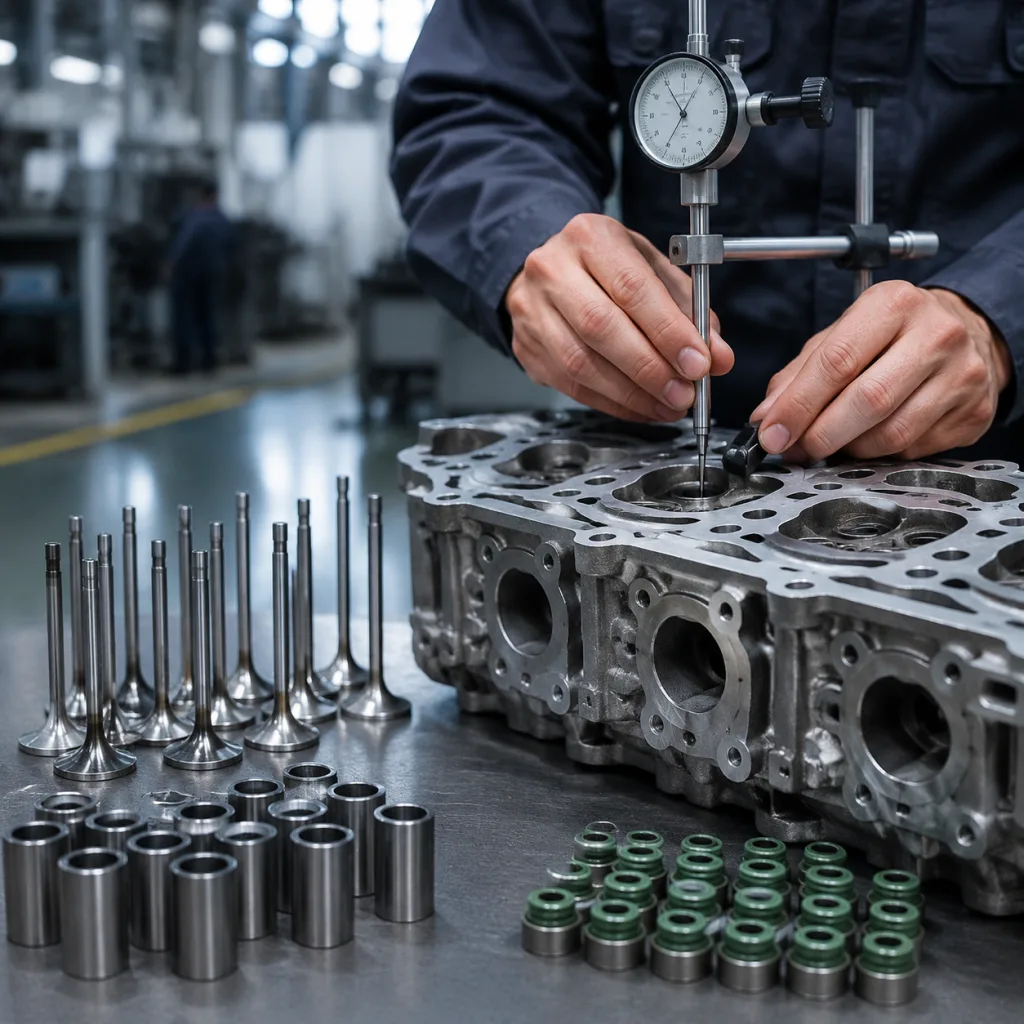
Use this inspection sequence: 1. Check compression and leak-down on the affected cylinders; record results hot and cold where possible. 2. Measure valve lash and compare cylinder to cylinder, noting any deviation greater than 0.05 mm from adjacent cylinders or the service baseline. 3. Inspect the valve face and seat contact pattern with marking compound, aiming for a centered band rather than an edge contact pattern. 4. Measure stem-to-guide clearance against the service manual limit, using a dial bore gauge or ball gauge and micrometer rather than a visual check. 5. Check installed valve height after any seat cut and compare against the minimum and maximum published height. 6. Confirm spring seat condition and retainer contact if the valve has dropped deeper.
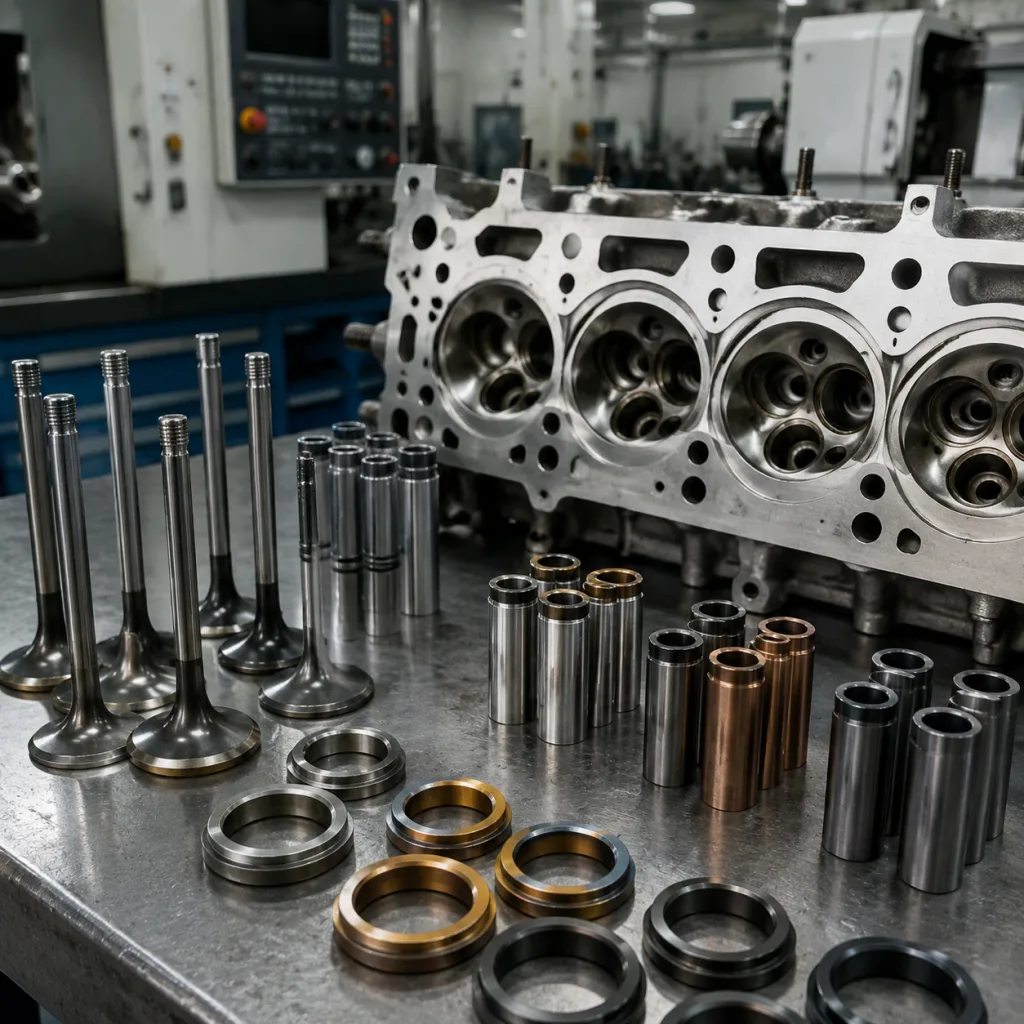
If the head uses bronze, sintered iron, or alloy guides, the buyer should confirm the replacement material and the finish on the guide bore. For procurement, the critical outputs are bore diameter, outer diameter, length, and honing or reaming allowance. Those values determine whether the part will fit OE machining practice or require a non-standard process. Buyers should also ask for actual measured size on a first article, not only the nominal print size, because many rebuild jobs need a +0.01 to +0.03 mm finish allowance after installation and final sizing.
Spec deep-dive: what a guide must match
For valve guide sourcing, the specification must go beyond a family name. The same engine platform can use different guide lengths, interference fits, and stem clearances across model years or emissions variants.
Minimum purchase specification
Material: alloy cast iron, phosphor bronze, or sintered iron, as required by the application
OD and ID: nominal size plus tolerance band, typically within ±0.01 to ±0.02 mm on critical bores and ±0.02 to ±0.05 mm on OD depending on platform
Length: full guide length and chamfer detail, with length tolerance usually held to ±0.10 mm or tighter where spring geometry is sensitive
Press fit: head interference target for the seat-pocket design, commonly in the 0.02 to 0.06 mm range for many cast heads but verified by OE print
Finish: reamed or honed ID condition, often Ra 0.8 to 1.6 µm after final sizing
Thermal stability: suitable for intake or exhaust duty, with exhaust guides specified for higher temperature resistance and wear stability
Traceability: batch code and inspection record
Packaging: bore protection, oil-free wrap, and corrosion prevention for sea or warehouse storage
For exhaust applications, heat resistance and wear stability matter more than low cost alone. For intake applications, oil control and stem fit are often the main priorities. Driventus can support OE-style cross-reference work, dimensional matching, and validation for aftermarket and OEM programmes through custom manufacturing when a catalogue item does not fit the application exactly. For higher-risk programmes, ask for PPAP-style dimensional samples or at minimum a first-article report showing actual OD, ID, concentricity, and straightness.
Decision point: repair the seat, the guide, or both
The best procurement decision depends on measured wear, not mileage alone. A guide replacement without seat work can be acceptable when the seat face is still within depth and concentricity limits. A seat repair without guide replacement often fails when stem clearance is already excessive.
Procurement rule of thumb:
Replace the guide only when stem support is out of tolerance but seat recession is still controlled
Recut or replace the seat when installed valve height is beyond limit or sealing width is uneven
Replace both when the head has run hot, the valve shows uneven contact, or the leak path cannot be stabilized
A simple workshop rule works well: if stem-to-guide clearance exceeds the OE maximum by more than about 0.01 mm, plan guide replacement; if installed valve height is already 0.20 mm or more beyond allowable adjustment range, plan seat correction; if both conditions exist, do both in one setup to avoid duplicate labor. For cross-reference work, buyers should verify OE dimensions, stem diameter, and head material before issuing a purchase order. If the application is part of a wider rebuild programme, review our catalog and the broader engine components range to align guide supply with seats, valves, and related gasket sets.
Sourcing checks that protect the build
Procurement teams should ask for process evidence, not only a part-number match. Driventus operates under IATF 16949:2016 and ISO 9001:2015, with incoming material checks, in-process dimensional control, and final inspection records.
When sourcing valve guides, request:
Dimensional inspection report for OD, ID, and length, including the measured sample size and tolerance result
Material declaration and batch traceability, with heat or lot number tied to shipping labels
Surface finish or post-machining condition statement, ideally with Ra reading or stated finishing method
Packaging method that prevents bore damage in transit, including anti-rust protection and separator trays for mixed lots
Lead-time confirmation for repeat orders and programme supply, plus minimum order quantity, price break points, and expedited options
Replacement policy for out-of-tolerance parts and the process for nonconformance claims
For buyers in the EU and UK, material compliance under REACH (EC) No 1907/2006 may also be relevant depending on the assembly scope. If your programme requires a non-standard guide geometry, custom manufacturing can support drawing-based production, and our quality system outlines how inspection data is controlled before shipment. As a sourcing practice, ask suppliers to quote MOQ, unit price at 1x / 10x / 100x, standard lead time, and sample lead time separately so you can compare total landed cost rather than only headline piece price.
Frequently asked questions
Yes. Excess stem movement can shift the valve off-axis, which increases local seat loading and worsens heat transfer. That can accelerate recession, especially on exhaust valves.
Replace both when the seat is deeply recessed, sealing is uneven, or stem clearance is already over limit. If only one dimension is out of spec, the repair may be limited to that component.
Confirm stem diameter, guide OD, guide length, press fit, and the target finish after reaming or honing. Also check material, batch traceability, MOQ, price break points, lead time, and the engine-specific OE cross-reference.
If you need OE-fit valve guides, dimensional confirmation, or drawing-based supply, contact Driventus for support and sample review at /contact.html.