Choosing a camshaft Jeep OE equivalent is less about matching a catalog label and more about proving the part will behave like the original across fit, timing, lubrication, and durability. In B2B sourcing, the real question is whether the camshaft reproduces the engine’s functional geometry and process controls closely enough for your channel, warranty exposure, and launch timeline.
This guide takes a buyer-first approach. It explains where OE-equivalent claims fail, which specs actually matter, how to compare samples against reference data, and what validation package to request before you release purchase orders. It is written for distributors, importers, repair-chain buyers, and private-label programmes sourcing aftermarket Jeep camshafts.
Driventus manufactures engine and powertrain components in Taizhou, Zhejiang, and exports to more than 60 countries. Our production and inspection workflow is aligned with IATF 16949:2016 and ISO 9001:2015. Driventus is an independent aftermarket manufacturer; brand names are referenced for fitment identification only.
Where OE-Equivalent Claims Break Down
For a replacement camshaft, OE equivalence means the component is engineered to perform the same function as the referenced original part within the target engine family. It does not mean the part is supplied, approved, or endorsed by the vehicle manufacturer.
The biggest sourcing mistakes happen when buyers rely on model name and year alone. Jeep platforms often carry running changes that alter cam phaser design, sensor trigger geometry, oil feed detail, or cylinder-head interface while leaving the catalogue description looking almost identical.
Use a control hierarchy instead of a loose description. The strongest reference is a buyer-supplied drawing, followed by an approved physical sample, then verified OE or TecDoc-style catalogue data, and finally a competitor sample. If references conflict, do not average them. One source must control the first article requirement.
For Jeep applications, define equivalence through verifiable criteria:
OE cross-reference format and catalogue source
Engine code, displacement, cylinder head type, valve train layout, and timing drive configuration
Intake or exhaust position, where separate camshafts are used
Cam phaser, sprocket, dowel, keyway, reluctor, or sensor trigger interface
Lobe lift, base circle, journal diameter, journal width, thrust face dimensions, and overall length
Oil feed passages, lubrication grooves, drilling orientation, plug depth, and end-face details where they affect installation or operation
Material grade, heat treatment route, lobe and journal hardness, straightness, and runout limits
Packaging, labelling, carton drop resistance, corrosion protection, and traceability requirements for the importing market
Specs Buyers Should Lock Before Quoting
Camshaft performance depends on repeatable geometry and compatible material processing. Small deviations can affect valve timing, hydraulic lifter operation, oil film stability, noise, emissions behaviour, and service life.
Lock the technical file before sample release. That file should state the feature, the nominal, the tolerance, and the measurement method. A tolerance without a method is not enough, because journal diameter, lobe profile, and angular timing features are not checked the same way.
Control item
Practical specification range
Why it matters
Journal diameter
Drawing nominal, commonly controlled within ±0.008–0.015 mm where bearing clearance is critical
Supports oil film stability and bearing clearance
Journal roundness/cylindricity
Typically ≤0.005–0.010 mm on ground journals, subject to drawing
Reduces local bearing load and oil leakage
Lobe lift
OE profile matched; production tolerance often ±0.03–0.05 mm after profile grinding
Controls valve opening and engine breathing
Base circle
Batch consistency commonly within ±0.02–0.04 mm unless drawing states otherwise
Maintains tappet preload and valve lash behaviour
Total runout
Typically ≤0.03–0.05 mm on datum journals for replacement programmes
Reduces wear, vibration, and timing variation
Lobe hardness
Chilled iron or treated surface commonly 50–60 HRC equivalent, or as specified by material route
Improves lobe durability against followers
Journal hardness
Usually lower than lobe surface where the OE design requires bearing compatibility
Prevents scuffing and abnormal journal wear
Surface roughness
Lobes often Ra 0.2–0.4 µm; journals often Ra 0.15–0.35 µm after finishing
Protects mating followers and bearing surfaces
Cam phaser interface
100% inspection of dowel, bolt face, oil feed, and locating geometry
Prevents timing control and assembly issues
Sensor trigger position
Angular position checked to drawing, commonly within ±0.5–1.0° where specified
Protects crank-cam correlation accuracy
</tr></thead><tbody> </tbody></table>Common production routes include chilled cast iron, ductile iron, forged steel, and assembled camshaft designs, depending on the engine family and requested specification. Heat treatment and surface finishing must match the mating followers, rocker arms, tappets, or hydraulic lifters. A camshaft that looks close can still be wrong if the follower system changed.
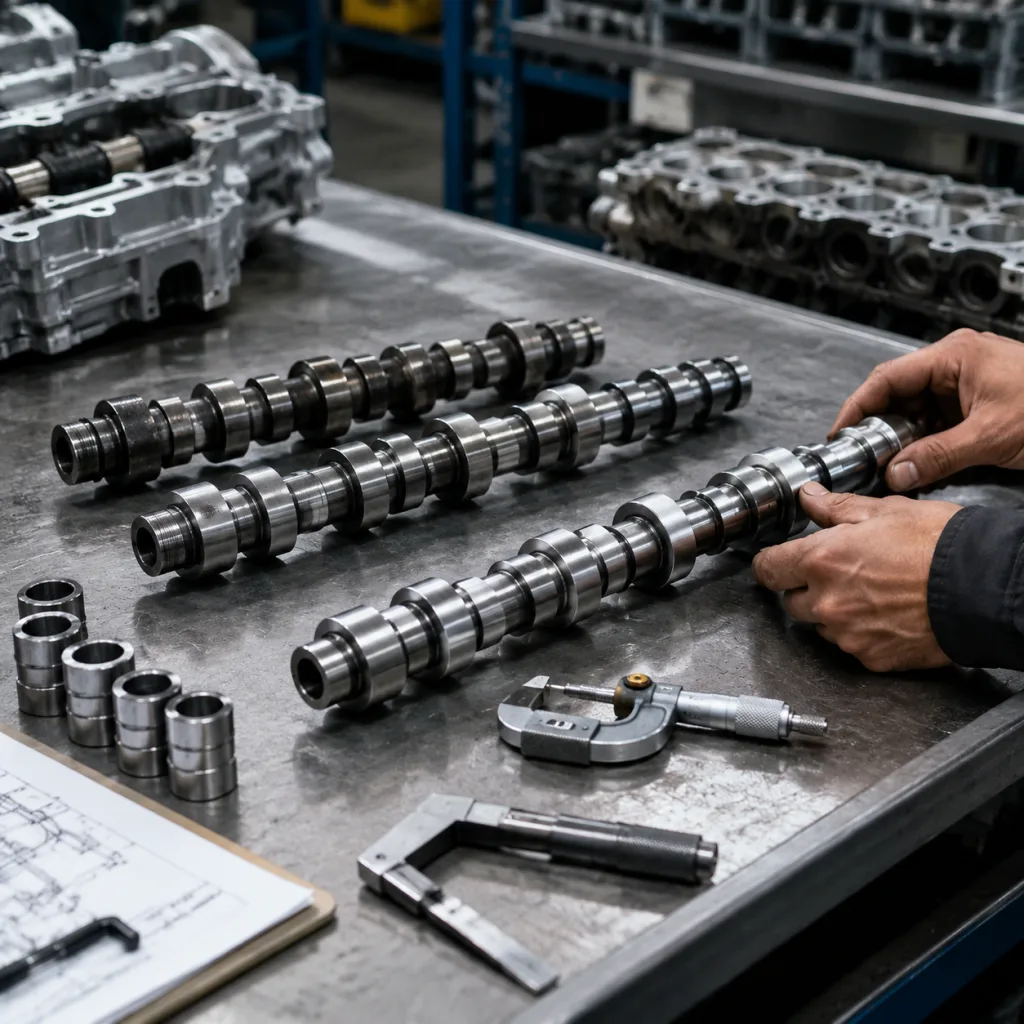
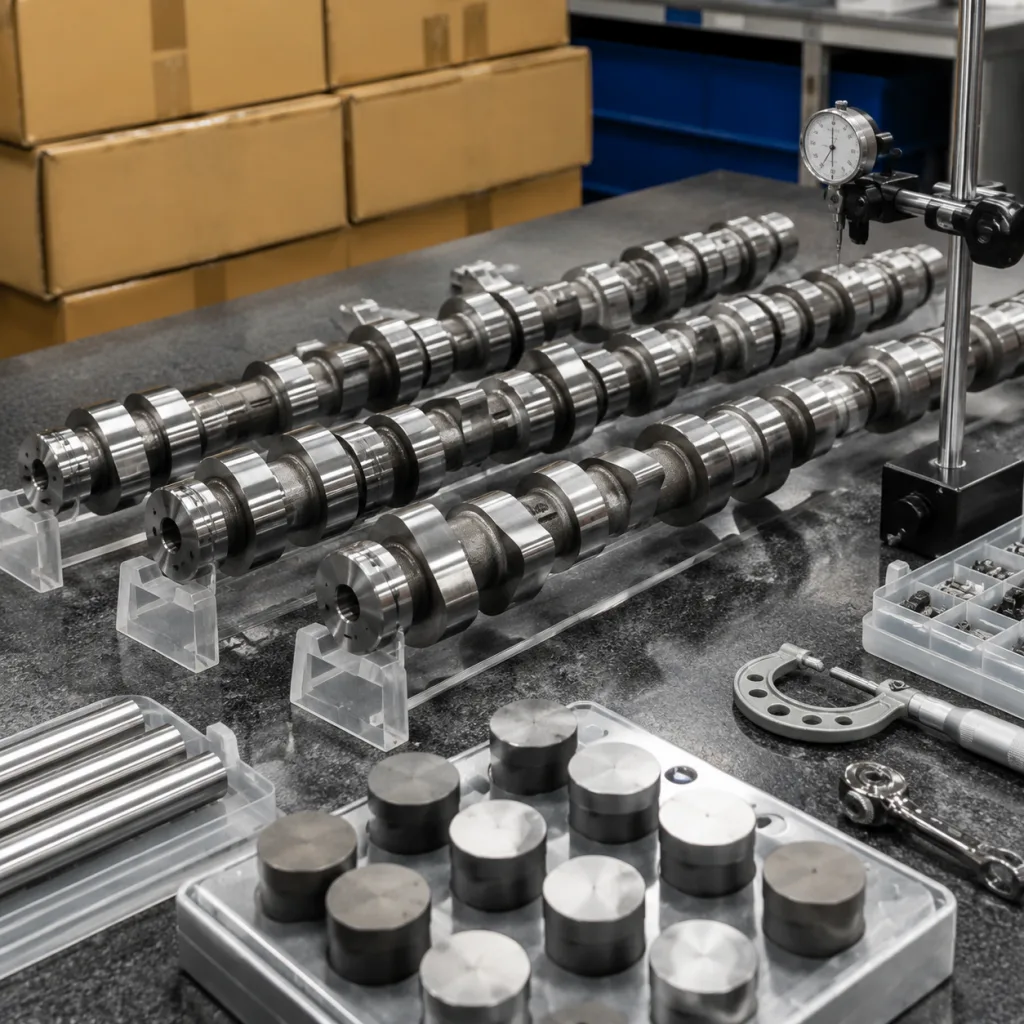
Include the inspection method in the RFQ. For example, journal diameter may be checked by calibrated micrometer or air gauge; lobe profile may require a cam profile measuring machine rather than a single lift reading; angular features may require a rotary fixture referenced to the datum journal and drive feature. For pilot lots, a practical approach is 5 pieces for full dimensional layout, 100% checking on timing-interface features, and AQL-based checks for packaging and appearance. Critical-to-function items should stay under serial-production control, not sample-only control.
If the programme includes lifters, rockers, timing chains, guides, sprockets, phasers, or oil control valves, state those assumptions in the technical file. That prevents the supplier from applying one camshaft design across applications that appear similar but operate differently.
Choose the Right Validation Path
Validation depth should match the risk of the programme. A catalogue continuation for an existing SKU does not need the same approval path as a new launch with warranty exposure and a new aftermarket channel.
Start with the part’s failure risk, not the factory’s default test menu. High-risk points include timing interface errors, phaser mismatch, bad hardening, poor runout, and packaging damage that arrives before the part even reaches the technician.
Recommended validation package:
First article inspection report with critical dimensions, datum scheme, instrument list, and actual measured values
Material certificate or batch material declaration showing grade, melt or batch number, and supplier traceability
Hardness report for lobes and journals, with test scale, test location, and minimum/maximum results
Metallographic or case-depth confirmation where the process uses induction hardening, carburising, nitriding, or chilled casting control
Surface roughness report on journals and lobes, including Ra value and cut-off setting where required
Runout and straightness inspection on defined datum journals
Timing feature angular position check for dowel, keyway, reluctor, phaser feed, or trigger feature
Oil passage and lubrication-feature verification using pin gauges, visual borescope, air flow, or oil-flow confirmation where applicable
Trial assembly confirmation with matching cylinder head, cam carrier, bearing caps, sprocket, phaser, or fixture
Packaging drop, anti-rust, VCI bag, desiccant, carton compression, and corrosion-prevention review for export shipments
For high-volume distributor programmes, add endurance bench testing or engine rig validation. Agree the oil grade, speed range, temperature, load cycle, inspection interval, measurement method, and failure criteria before testing starts. A practical launch plan may use 20–50 hours of motored or fired running, then a dimensional re-check of lobe lift loss, journal scoring, pitting, abnormal noise, and follower wear. Where warranty exposure is material, longer validation such as 100–300 hours or fleet feedback may be justified.
Sample approval timing should also be part of the plan. Existing routes often need 15–30 days for samples; new tooling or a new grinding fixture may take 30–60 days. Add inbound shipping, installation trial, lab review, and sign-off time. If test scope is vague, “validated” means different things to different teams, and that creates delays later.
Driventus can align inspection plans with customer drawings, supplied samples, verified catalogue data, or agreed control plans. Related engine items can be reviewed in our catalog, and the engine range is also listed under engine components.
Failure Modes to Watch in Jeep Programmes
Most camshaft rejects are not dramatic. They are cumulative. The part fits, but the engine does not behave right.
Watch for these failure modes during sourcing and approval:
Timing drift from incorrect phaser or trigger geometry
Oil starvation or poor lubrication from blocked, misdrilled, or shallow oil-feed features
Noise and wear from lobe finish that is too rough or too soft
Premature journal scuffing from hardness or surface mismatch
Assembly problems from end-face, dowel, keyway, or thrust-feature variation
Warranty noise from inconsistent packaging, corrosion protection, or batch traceability
A useful diagnostic habit is to separate “dimensional match” from “functional match.” A camshaft can measure close and still fail in service if the heat treatment route, follower interface, or angular timing feature is off. For Jeep replacements, those secondary details often decide whether the programme is repeatable or fragile.
When a supplier says a part is interchangeable, ask which reference is controlling: drawing, sample, catalogue data, or previous production. If the answer changes by SKU or by lot, treat that as a warning sign and re-check the inspection method before approval.
Compare Suppliers Before You Commit
Procurement teams often compare camshaft offers on unit price first. That is usually the wrong starting point. A lower quote can hide tooling exposure, looser inspection, higher scrap risk, or packaging that fails export handling.
Use a side-by-side comparison that covers technical and commercial variables together:
Comparison point
Better offer looks like
Risk signal
Reference basis
Drawing, sample, and catalogue data all aligned
Quote built from model name only
Material route
Declared and repeatable
“Same as OE” with no process detail
Inspection depth
Critical dimensions and timing features fully defined
Pass/fail only, no actual values
MOQ
Clear by SKU and tooling status
MOQ changes after sample approval
Lead time
Split by sample, approval, and serial production
One vague promise for all stages
Packaging
Export-ready, labelled, corrosion-protected
Generic pack with no drop or rust control
Change control
Written notification for process or material changes
Supplier can change quietly between lots
</tr></thead><tbody> </tbody></table>Commercial logic should be visible before sample approval. Existing camshaft SKUs may start at 50–200 pieces per part number depending on size, packaging, and stock status. New tooling or low-demand variants often move to 300–1,000 pieces, or the buyer may need to cover tooling, fixture, or sample costs separately.
Unit price is usually driven by material route, finished weight, machining time, grinding complexity, heat treatment, scrap risk, inspection depth, packaging type, and annual volume. A small launch order with full PPAP-style documents will not price the same as a repeat container order with an approved control plan.
Lead time should also be split by stage: 3–7 working days for feasibility review after complete data, 15–30 days for existing-route samples, 30–60 days for new-tooling samples, 30–45 days for first mass production after approval, and 20–35 days for repeat orders depending on capacity and packaging. Sea freight, customs clearance, and buyer-side incoming inspection sit outside factory lead time.
For private-label programmes, packaging control matters as much as the part. Artwork should avoid restricted marks, vehicle manufacturer logos, or wording that implies endorsement. Driventus can support custom manufacturing for buyer-controlled drawings, samples, packaging, labels, and inspection standards.
What Driventus Does in a New Program
Driventus produces camshafts and related engine components for aftermarket distributors, wholesalers, OEM/Tier-1 suppliers, and repair-chain programmes. Our Taizhou manufacturing base supports casting or forging coordination, machining, grinding, cleaning, inspection, and export packing through controlled production routes.
For a new camshaft programme, the usual workflow is:
1. Confirm application data, OE cross-reference, sample, drawing basis, target market, annual volume, and packaging requirement. 2. Review feasibility for material, process route, tooling, grinding fixtures, gauge plan, MOQ, sample cost, and lead time. 3. Produce samples or first article parts for customer review, with critical features protected during packing and shipment. 4. Complete dimensional, material, hardness, surface, runout, oil-passage, and timing-feature checks. 5. Agree packaging, labelling, batch code, inspection file, Incoterms, release schedule, and shipment plan. 6. Release serial production after approval and maintain traceability for repeat orders, engineering changes, and warranty review.
This process is intended to reduce fitment and durability risk before bulk shipment. It also gives buyers a clear basis for incoming inspection, warranty review, and future reorder control. For catalogue sourcing, buyers may send application lists, OE references, or competitor references. For engineered programmes, drawings and samples allow tighter control of the final specification, including material route, critical tolerances, packaging rules, and documentation depth.
For buyers building a multi-SKU Jeep engine range, Driventus can stage development by commercial priority: confirm fast-moving references first, validate shared process routes, then add low-volume variants once inspection fixtures and packaging rules are stable. This reduces launch risk because pricing, MOQ, lead time, and documentation expectations are established before the programme expands.
Frequently asked questions
No. OE-equivalent means the part is designed to match the function and fitment of the referenced original component. It does not mean approval, endorsement, or supply by the vehicle manufacturer. Driventus is an independent aftermarket manufacturer; brand names are referenced for fitment identification only.
Useful data includes engine code, camshaft position, OE reference if available, sample or drawing, annual volume, launch quantity, target market, packaging requirements, requested MOQ, target lead time, and required inspection documents. Photos of timing interfaces, sensor triggers, oil feed details, and end-face features help prevent interchange errors.
Yes. Driventus can review samples, drawings, and buyer-defined control plans for custom manufacturing. Feasibility depends on material, process route, tooling, tolerance requirements, validation scope, MOQ, sample approval timing, and acceptance criteria agreed before sampling.
If you are building a replacement camshaft programme, send the target applications, OE references, drawings, samples, annual volume, MOQ target, packaging requirement, and requested lead time for technical review. You can request a quote at /contact.html