Turbo Lag Causes and Fixes for Parts Buyers
Turbo lag is the delay between throttle input and boost response. For procurement teams and workshop buyers, the key issue is not whether a vehicle feels slow off boost, but what hardware or system condition is creating the delay. Common causes are mechanical and include compressor sizing, exhaust restriction, boost leaks, actuator error, dirty sensors, oil supply problems, or worn turbo bearings. A proper diagnosis separates normal calibration from a fault that needs replacement. Driventus is an independent aftermarket manufacturer; brand names are referenced for fitment only. Our diagnostic and replacement components are built under IATF 16949:2016 and ISO 9001:2015 controls, with material and traceability checks aligned to export-market requirements. This article outlines the main causes, the inspection sequence, and the parts that typically restore response without changing the engine platform.
What turbo lag is and what is normal
Turbo lag is the time between requested load and positive manifold pressure. Some delay is normal in small engines with large turbines, long exhaust runners, or conservative ECU calibration. It becomes a fault when the delay is greater than the vehicle’s usual behaviour, feels inconsistent, or appears with smoke, limp mode, or fault codes.
For buyers and service managers, the first task is to separate design lag from a defect. Normal lag is repeatable. Defect-driven lag changes with temperature, load, or road speed and often worsens over time.
Typical symptoms
- Slow boost rise below 2,000–2,500 rpm
- Flat acceleration after throttle tip-in
- Black smoke with delayed boost
- Whistling, hissing, or compressor surge
- Stored DTCs for boost control, air flow, or pressure plausibility
Inspection sequence that avoids unnecessary replacement
A fixed sequence reduces misdiagnosis and prevents repeat returns. Start with scan data, then move to physical checks.
1) Confirm the requested versus actual boost trace
Compare demanded boost, actual boost, throttle position, engine speed, and load. A large gap at all speeds suggests a pressure leak or turbo control fault. A gap only at high rpm may indicate restriction or compressor limitation.
2) Pressure-test the intake tract
Inspect intercooler end tanks, rubber couplers, charge pipes, and manifold seals. A small split can create a lag complaint that looks like turbo failure.
3) Check exhaust backpressure sources
A blocked DPF, damaged catalyst, or crushed exhaust pipe reduces turbine energy. On diesel applications, excessive soot loading often shows up as slow spool and higher exhaust temperature.
4) Verify actuator movement
For vacuum, electronic, or pneumatic systems, confirm travel, response time, and calibration. Sticky vanes, weak vacuum supply, or a faulty solenoid can hold boost back.
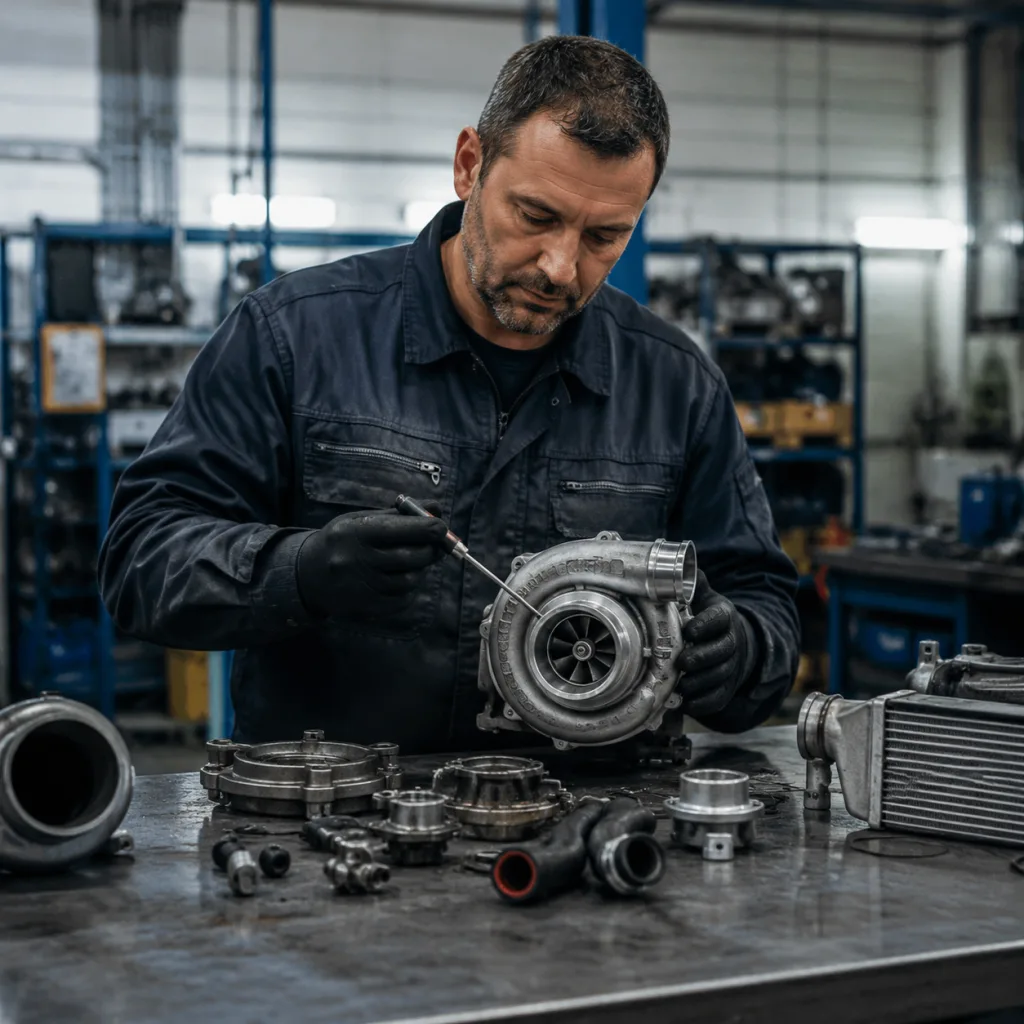
5) Inspect oil condition and turbo shaft play
Low oil pressure, sludge, or contaminated oil damages bearings and increases response delay. Excess radial or axial play, wheel contact, or oil seepage usually means replacement is justified.
Fixes by root cause
The repair should match the failed element, not the symptom.
- Boost leak: Replace swollen hoses, cracked intercooler parts, and weak clamps. Re-test under pressure before returning the vehicle.
- Sensor error: Clean or replace MAP and MAF sensors only after verifying wiring and reference values.
- Actuator fault: Replace damaged vacuum lines, solenoids, or the actuator assembly. Relearn adaptation values where required.
- Exhaust restriction: Remove soot loading, repair crushed pipework, and replace blocked aftertreatment components when cleaning is not effective.
- Turbo wear: Replace the turbocharger when the compressor wheel is damaged, the shaft has abnormal play, or oil leakage is present.
For fleets, it is often cheaper to replace a known weak turbo assembly than to cycle through hoses, sensors, and labour twice. Use matched gaskets, lines, and fasteners during installation to reduce comeback risk.
Replacement parts and validation checks
When a turbocharger is replaced, the supporting parts matter as much as the unit itself. A clean install protects the new assembly and helps separate a true part failure from a system problem.
Recommended replacement checklist
- Turbocharger assembly
- Oil feed and return line condition check
- New gaskets and seals
- Intake and intercooler hose inspection
- Vacuum or electronic actuator verification
- Fresh engine oil and filter
- Post-install boost log and road test
Driventus supports procurement for aftermarket distributors, repair networks, and OEM/Tier-1 programmes through our catalog, our quality system, and custom manufacturing. Published standards and compliance references include IATF 16949:2016, ISO 9001:2015, and REACH (EC) No 1907/2006 where applicable to material declarations. Driventus is an independent aftermarket manufacturer; brand names are referenced for fitment only.
If the part must match an OE cross-reference such as OE 06A107065, confirm flange orientation, actuator type, and mounting envelope before purchase. For catalogue help or fleet sourcing, use request a quote.
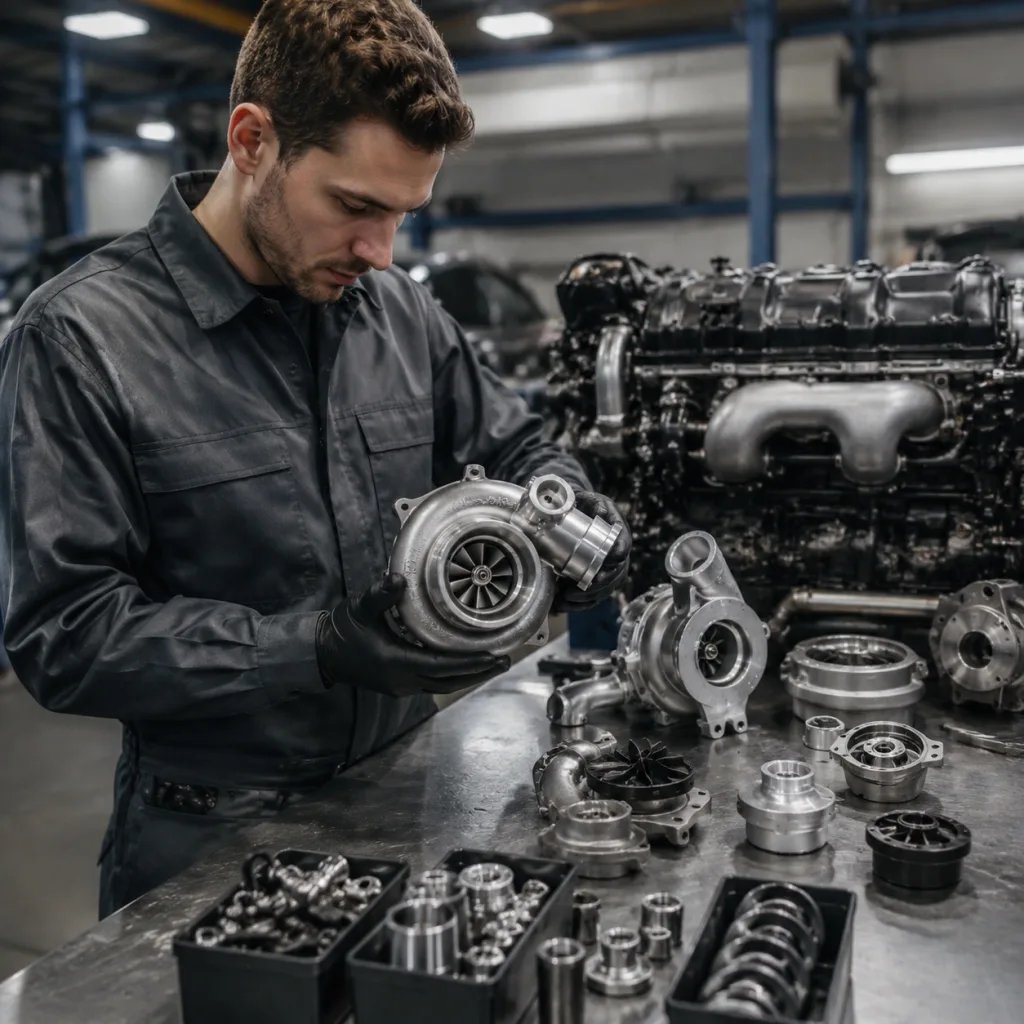
Procurement notes for buyers and service networks
For repeatable supply, buyers should define acceptance criteria before placing orders. That reduces returns and makes supplier comparison easier.
Specification points to confirm
- OE cross-reference and engine code
- Compressor and turbine housing configuration
- Actuator type and calibration range
- Gasket set inclusion
- Material traceability and serial marking
- Packaging suitable for export and warehouse handling
If your programme needs non-standard flange layouts or bracket changes, custom manufacturing can be used for application-specific builds. For standard replacement demand, keep part families grouped by engine platform so the procurement team can compare lead time, warranty terms, and validation data against the same baseline.
Frequently asked questions
Normal lag is consistent and usually tied to engine design or calibration. Failure-related lag often changes over time and appears with smoke, noise, oil leakage, or fault codes. Boost logs and pressure tests are the fastest way to separate the two.
Yes. A leak can reduce manifold pressure enough to mimic worn turbo bearings or a slow actuator. Always pressure-test hoses, intercooler joints, and clamps before ordering a replacement turbocharger.
Confirm OE cross-reference, flange layout, actuator type, mounting points, and gasket set contents. For higher-volume programmes, validate materials, traceability, and post-install boost response against the vehicle application.
If you need help matching a turbocharger or related diagnostic part, send the application details and our team will review the fitment and supply options at /contact.html.
Request a Quote