Turbo Gasket Kit Packaging Requirements for Export
A turbo gasket kit can fail export receiving before anyone opens the engine bay. One missing copper washer, a curled MLS gasket, a barcode that will not scan, or a carton softened by humidity can put the shipment on hold.
The challenge is not size. These kits combine thin stainless or coated gaskets, graphite and fibre sealing pieces, copper washers, elastomer O-rings, studs and nuts. Each item has a different damage mode. Export packaging must keep the kit complete, flat, clean, dry, identifiable and traceable through factory packing, consolidation, ocean or air freight, customs, warehouse receiving and onward distribution.
Use this guide as a practical decision tool for turbo gasket kit packaging requirements export buyers can put into RFQs, packaging standards and supplier quality agreements. It covers unit packs, cartons, pallets, corrosion control, labels, compliance records, inspection gates, MOQ effects and lead-time planning. Driventus is an independent aftermarket manufacturer; any brand or OE-style references are used only for fitment identification and do not imply vehicle manufacturer approval.
1. Start with the weakest part, not the biggest part
The packaging design should be built around the component most likely to be damaged, not the item that weighs the most. In many turbo gasket kits, the vulnerable part is a 0.15–0.30 mm coated stainless gasket, an embossed sealing track, a graphite-coated face or a soft elastomer seal. Studs and nuts are heavier, but they are usually less sensitive.
Before approving a bag size, backing board, carton drawing or label artwork, define the kit configuration in writing:
Full kit content list by application, including quantity per component. For service kits, specify zero shortage and zero substitution unless the buyer approves a deviation.
Material type for every sealing part: stainless steel, coated steel, copper, FKM, silicone, NBR, EPDM, graphite composite or fibre composite.
Largest gasket size, minimum unsupported web width and areas that must remain flat.
Maximum allowed bow or curl, commonly ≤2 mm over 150 mm unless the drawing states a different value.
Surface condition requirement: no visible scratch through coating, dent, crease, oil stain, corrosion, delamination or edge deformation on a sealing track.
Sales format: single aftermarket kit, bulk workshop pack, distributor replenishment pack or private-label retail pack.
Approved OE cross-reference use, if any, such as generic formats like OE 06A… or OE 11251… .
Destination-market language, importer information, recycling marks and warning-label needs.
Transport route: sea, air, road, parcel courier, LCL consolidation or mixed-mode.
Order model: sample lot, first article, replenishment, annual programme or private-label launch.
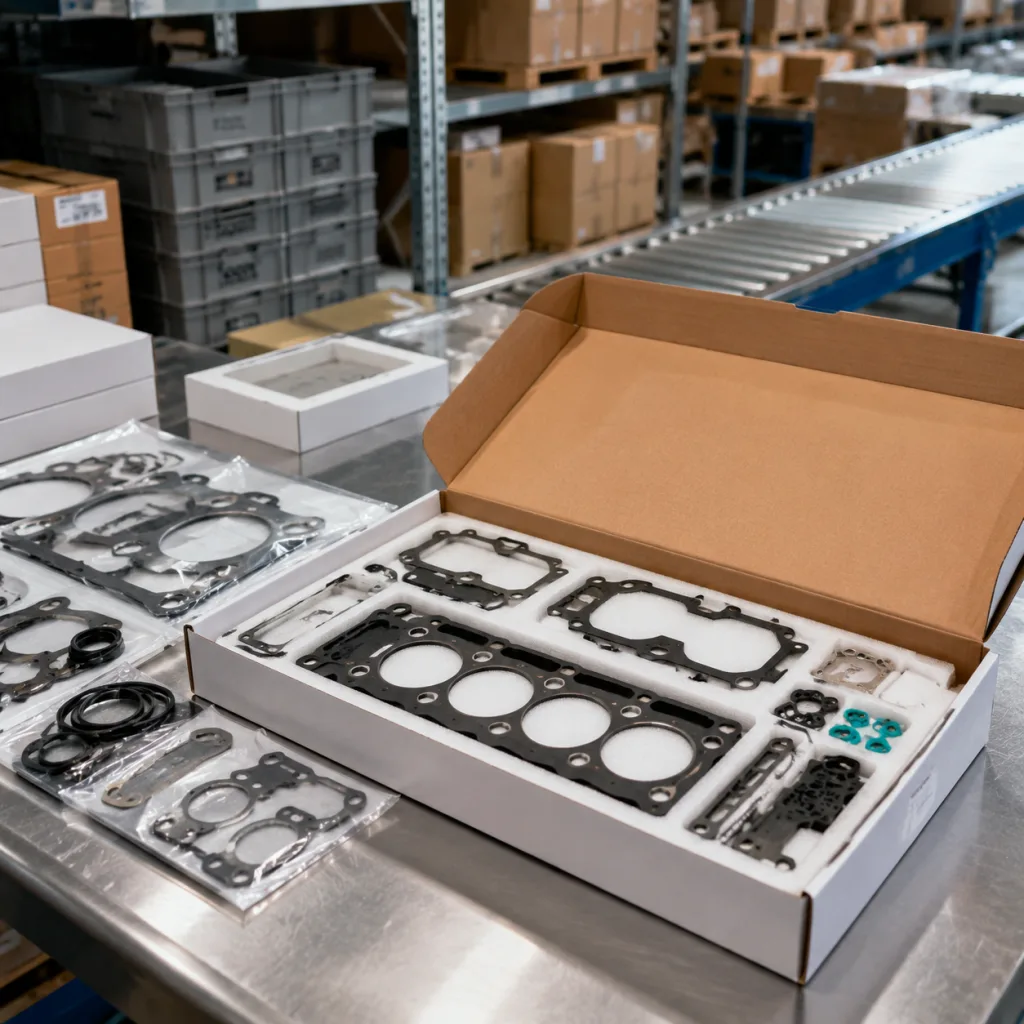
A simple rule prevents many failures: do not bend a thin gasket to make it fit a smaller pack. The inner bag or backing board should be at least 10–15 mm larger than the longest gasket edge. Avoid diagonal placement that leaves corners exposed to crushing. Keep copper washers, studs and nuts away from coated faces. Do not pack rubber parts against oils, solvents, PVC films or heat sources that could affect elastomer properties during storage.
Packaging decisions also affect MOQ and price. A neutral clear-bag kit with a printed label can usually be made at lower quantities. A printed colour box, sleeve, blister or private-label carton may require artwork approval, cutting dies, print plates and carton-printing MOQs. Ask suppliers to quote product cost, unit packaging, master carton, pallet materials, barcode labels, artwork setup and one-time tooling separately. That prevents a familiar sourcing problem: the pack looks good in a photo but fails in receiving, storage or handling.
2. Unit-pack failure modes: what damages the kit first
The unit pack is the package handled by a distributor warehouse, repair-chain branch, e-commerce fulfilment centre or assembly line. Its job is narrow but critical: keep one complete kit intact and scannable.
The common failure modes are predictable:
A washer or O-ring escapes through a weak seal.
A stud scratches a coated gasket face.
A large gasket curls because the bag or board is too small.
Moisture reaches mixed-metal parts during a long route.
A barcode is printed over a fold and cannot be scanned.
Manual counting misses a small part because gross-weight checking is not sensitive enough.
A practical primary-pack specification should include:
Packaging element
Recommended requirement
Why it matters
Inner bag
Heat-sealed PE, LDPE, CPP or recyclable equivalent; normally 60–80 microns for standard kits and 90–120 microns for heavy fastener kits
Keeps the kit complete and limits dust exposure
Seal width
Continuous heat seal, typically 6–10 mm wide, with no burn-through, open corner or trapped gasket edge
Prevents part loss and moisture entry
Board backing
300–600 gsm kraft, greyboard or coated board for large thin gaskets; at least 10 mm larger than the gasket outline
Reduces bending, corner damage and edge distortion
Small-part separation
Copper washers, O-rings, studs and nuts in sub-bags or compartments; fasteners must not contact coated faces
Prevents abrasion and supports accurate counting
Desiccant
Use when route duration, humidity or mixed-metal content justifies it; common starting point is 1–5 g silica gel per unit pack or a calculated carton-level quantity
Reduces moisture and corrosion risk
Label position
One flat, scannable face; not over a seal, fold or curved surface; barcode quiet zone preserved
Improves receiving and picking accuracy
Drop resistance
No part loss or gasket damage after agreed handling simulation, such as 5 drops from 760 mm for unit packs under 10 kg or a buyer-specific test
Reduces claims from opened or damaged packs
</tr></thead><tbody> </tbody></table>For coated multi-layer steel gaskets, avoid staples inside the bag. Loose fasteners should never rub against the coating. For O-rings, use sealed sub-bags and avoid compression under studs or nuts. Identify the elastomer compound in the BOM or inspection record so visually similar FKM, EPDM, silicone and NBR seals are not mixed. If desiccant is used, retain it so it cannot abrade rubber seals or coated surfaces.
Counting needs its own control method. Manual packing can use a signed count sheet, fixture count, optical count or sub-component weight check, followed by a final kit weight range. Be careful with gross-weight controls. If a copper washer weighs only 1–2 g, the final pack weight may not reliably detect one missing washer. For high-claim items, sub-bag counting is safer.
Retail display packaging adds a second risk: appearance may improve while transport strength decreases. Confirm hook-slot strength, board grade, burst or crush strength, barcode grade and colour tolerance. Keep artwork revision control in the approval file, not only in email threads.
3. Carton and pallet choices: sea freight versus air freight
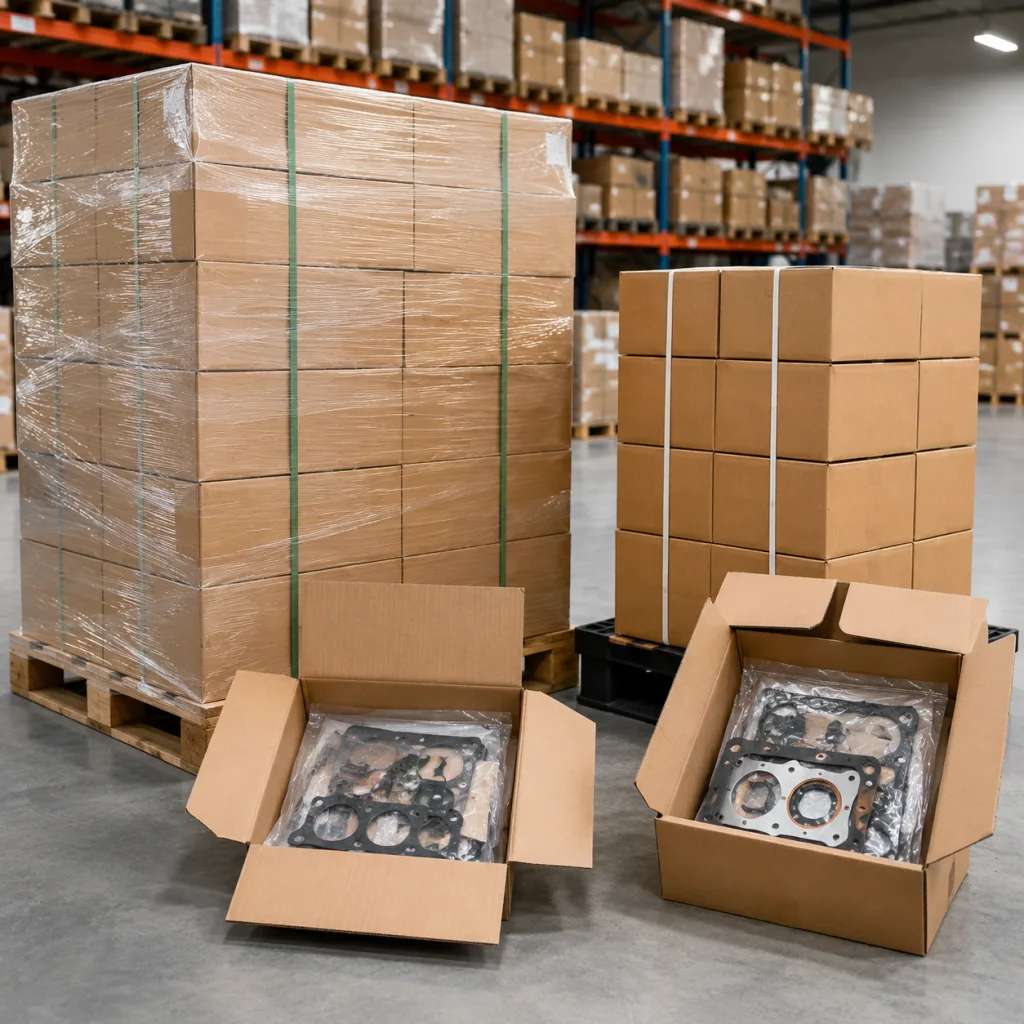
A master carton has to survive more than factory dispatch. It may be stacked, consolidated, deconsolidated, re-palletised, exposed to humidity, moved by hand, pushed through a parcel hub or stored under load. A carton that works domestically may be weak for export, especially for LCL cargo or long sea routes.
Set these requirements in the PO, packaging standard or supplier quality agreement:
Double-wall corrugated carton for mixed metal kits or cartons above 12 kg gross weight; common board grades include BC flute or equivalent.
Gross carton weight normally below 15 kg for manual handling. Use 18–20 kg only with buyer approval for ergonomic risk and carton strength.
Edge crush test (ECT) or burst strength defined by carton size, route, pallet pattern and stacking height. As a starting point, use ≥44 ECT double-wall or equivalent for heavier export cartons, then validate by stacking test.
Inner dividers, trays or void fill where unit packs can move more than 10 mm inside the carton.
Water-resistant or higher-strength outer carton for humid destinations, long ocean routes or LCL shipments; options include coated kraft liner or carton bag liner.
Pressure-sensitive or reinforced tape, with H-seal pattern for cartons above about 10 kg and tape width typically 48–75 mm.
No exposed metal staples where the buyer, warehouse or destination market prohibits them.
Carton dimensions reviewed for pallet efficiency and, for air freight, volumetric weight using a divisor such as 6000 cm³/kg or carrier-specific rules.
ISPM 15-compliant pallets when regulated solid wood packaging is used.
The sea-freight decision is mainly about compression, moisture and rehandling. Agree maximum pallet height and stack rating before booking. Many aftermarket distributors prefer pallet heights around 1.1–1.5 m because of racking and handling limits. Container floor-loading may need a different compression calculation. If cartons are double-stacked in a container, require either a stacking test or a compression calculation that covers expected top load plus a safety factor.
The air-freight decision is different. Empty volume becomes expensive. A carton that is only 70% full can increase chargeable weight and allow kit movement. For air shipments, carton fill ratio should normally be at least 85–90% unless cushioning requires more space.
Pallet build matters in both cases. Keep cartons inside the pallet footprint; target 0 mm overhang. Even 10–20 mm overhang can reduce compression strength and crush corners. Use a stable pattern, enough stretch film to secure the load without deforming cartons, and corner boards for high stacks, mixed-SKU pallets or LCL shipments. Typical stretch-film practice is 3–5 bottom wraps, 50% film overlap and top coverage, adjusted to carton strength.
For supplier comparison, make packaging approval part of the same sourcing gate as PPAP-style samples, dimensional reports and material declarations. Driventus can align kit packaging with buyer drawings, private-label carton layouts and distribution centre receiving rules through custom manufacturing.
4. Traceability data: make every scan reconcile
Receiving teams do not only inspect parts. They reconcile data. If the inner pack, master carton, pallet label and packing list disagree, the shipment may be held even when the gaskets are correct.
A workable label data set includes:
Buyer part number and Driventus part number where applicable.
Product description, for example turbocharger gasket kit.
Approved application or engine-family reference.
OE cross-reference field only when authorised and verified by the buyer, using formats such as OE 06A… where applicable.
Quantity per unit pack and quantity per master carton.
Country of origin.
Batch number, lot number or production order number.
Production date, packing date or expiry/retest date where required.
Barcode symbology: Code 128, EAN/UPC, GS1-128, DataMatrix or buyer-specific format.
Handling symbols for moisture protection, stacking, orientation and fragility where relevant.
Importer, distributor or private-label details when required by the destination market.
Carton serial number or SSCC where the buyer uses pallet-level warehouse scanning.
Barcode requirements should be measurable, not subjective. A common target is ANSI/ISO print grade C or better at the buyer’s receiving scanner, with grade B preferred for automated distribution centres. Place the barcode on a flat face. Avoid glossy laminate that causes reflection. Preserve the quiet zone. For Code 128 carton labels, approve x-dimension and label size during sample scan testing, not during mass printing.
That chain should connect the finished kit to incoming gasket materials, rubber compounds, fastener lots, inspection records and packing records. Under ISO 9001:2015 and IATF 16949:2016 expectations, packaging control is part of identification, traceability and product realisation. In practical terms, label verification, pack-count checks, barcode scans and nonconforming-pack control must be auditable.
The packing record should show operator, line, date, inspection status, carton quantity and any rework or label replacement. If a distributor reports a missing O-ring, the supplier should be able to identify the packing lot, inventory at risk, affected carton range and containment action within 24–48 hours.
Buyers can review Driventus process controls and inspection records through our quality system.
5. Compliance traps that delay export release
“Export standard packing” is too vague for turbo gasket kit packaging requirements export programmes. It does not tell the supplier which marks are allowed, which chemical declarations are needed, whether wood packaging is regulated, or which language must appear on labels.
Common compliance checkpoints include:
REACH (EC) No 1907/2006: relevant for chemical substances in articles and packaging materials supplied into the EU; request supplier declarations for packaging inks, films and rubber components where applicable.
RoHS Directive 2011/65/EU: sometimes requested by customers even when the kit is not an electronic assembly.
ISPM 15: applies to regulated solid wood packaging used in international trade, including pallets, crates and dunnage; the treatment mark must be legible and match the exporting country code.
ISO 9001:2015: supports documented control of purchasing, production, labelling, inspection and customer requirements.
IATF 16949:2016: relevant where the buyer requires automotive process controls, traceability, defect prevention and change control.
Packaging waste and recycling rules: may affect resin codes, recycling symbols, importer responsibility and environmental claims.
Prop 65 or customer chemical lists: may be requested for US distribution depending on materials and sales channel.
Bilingual or local-language labelling: often required by buyer policy or destination-market practice, such as English/French for some Canadian programmes.
Do not print compliance marks that have not been verified. Recycling symbols, resin identification marks and green claims must match the actual material. For example, use LDPE 4 only when the bag is actually low-density polyethylene. For Brazil, Canada, Australia, the UK, the EU and the US, importers may also request country-specific invoice wording, origin declarations, warning labels, distributor addresses or bilingual label formats. Confirm before mass-printing cartons or sleeves.
A practical safeguard is a packaging approval sample set. Include one labelled inner pack, one master carton, one pallet label and the matching packing list. Approve these before production packaging starts. Then lock the artwork revision, barcode data and carton specification in the supplier quality file. If the importer address, barcode prefix, origin wording or recycling claim changes, treat it as a controlled revision. Quarantine old labels and run first-article label verification.
Lead time must include compliance work. A neutral export pack may add only a few days after product readiness. A private-label programme with artwork approval, barcode registration, printed cartons and declaration collection can add 2–4 weeks. New print tooling or unusual carton sizes may take longer. Build this into the PO schedule before parts are produced.
6. Pre-shipment Q&A for buyers and inspectors
Use the following questions before releasing a shipment. They work as an RFQ attachment, control-plan input or supplier quality agreement checklist.
What should be checked on the packed kit?
Kit contents match the approved bill of materials and count sheet; no missing, extra or substituted components.
Gaskets are flat, clean and not scratched by fasteners, washers or carton inserts.
Critical gasket surfaces show no dent, crease, rust, delamination, coating loss or burr transfer.
O-rings and soft seals are separated, sealed and not compressed.
Inner bag seal is complete and does not trap, bend or crease a gasket edge.
Desiccant, if specified, is present in the correct quantity and safely positioned.
Unit label matches buyer part number, quantity, origin and barcode requirement.
Barcode is scannable after packing and not distorted by a fold or curved surface.
What should be checked on cartons and pallets?
Carton label matches the inner pack data and packing list.
Carton gross weight is within the approved limit, normally within the stated net/gross tolerance and below the manual-handling cap.
Cartons are not bulging, crushed, damp or under-filled.
Carton sealing method matches the approved packaging standard.
Pallet pattern matches the approved drawing or loading plan.
Cartons do not overhang the pallet footprint.
Wood packaging, if used, carries valid ISPM 15 treatment marks.
Photos are taken of inner pack, carton, pallet, container loading condition and final seal where applicable.
Random drop, compression or shake checks are completed for first articles, route changes, carton changes or LCL cargo.
Which documents should the buyer request?
Ask for a packing list, commercial invoice, certificate of origin where needed, lot traceability record, inspection report and packaging photos. For new projects, also request a packaging test summary, drop-handling check or transport trial result when the route is long, humid or includes multiple handling points. A practical inspection plan is normal sampling under ANSI/ASQ Z1.4 or ISO 2859-1, with tightened checks for first orders, new artwork, new carton suppliers or previous packaging claims.
How should MOQ, price and lead time be quoted?
Do not accept one vague “export pack” price. Request a price table that separates product, unit bag, sub-bags, backing board, desiccant, unit label, master carton, pallet materials and private-label print.
Typical sourcing logic:
Lowest MOQ: neutral bag plus printed label, suitable for samples and mixed-SKU trial orders.
Medium MOQ: standard master carton with buyer label, suitable for distributor replenishment.
Higher MOQ: printed colour box, printed sleeve or retail display packaging, because carton printing and colour control create minimum print runs.
Longer lead time: new barcode data, new importer label, unusual carton size, new pallet pattern, compliance declarations or customer artwork approval.
For standard turbo gasket kits and related engine sealing components, buyers can review our catalog. If the programme needs custom labels, consolidated kits, barcode rules or private-label export cartons, share the receiving specification when you request a quote.
Frequently asked questions
The main risk is damage to thin sealing surfaces or loss of small parts such as copper washers, studs and O-rings. A good pack separates hard parts from coated gaskets, keeps the kit flat and uses clear traceability labels.
Use desiccant when sea freight duration, humidity or mixed metal content creates corrosion risk. It should be sized for carton volume and route conditions, and it should not contact rubber seals or coated gasket faces directly.
Yes, if the buyer provides and approves the reference data. OE references should be used only for fitment identification, such as OE 06A… formats where applicable, and must not imply vehicle manufacturer approval.
For turbo gasket kit packaging, labelling or export carton specifications, send your drawings, packing rules and target market requirements to Driventus for review. Start with a low-pressure enquiry at /contact.html