engine block · 2026-06-19

Engine Block Land Rover OEM Supplier Sourcing Guide

Sourcing an engine block for Land Rover applications is not a catalogue-only decision. Importers, programme buyers, service-channel suppliers, and multi-location repair groups need confidence in casting quality, CNC machining capability, material traceability, validation records, and export execution. The highest procurement risks usually appear in dimensional variation, porosity, main tunnel alignment, thread quality, cleanliness, and packing protection during long-distance shipment. Driventus manufactures engine and powertrain components in Taizhou, Zhejiang, under IATF 16949:2016 and ISO 9001:2015 quality management systems. This guide explains how to evaluate an independent engine block supplier for Land Rover-fit applications, from audit evidence and engineering controls to MOQ, sample approval, and RFQ documents. Driventus is an independent aftermarket manufacturer; brand names are referenced only to identify fitment compatibility.

What buyers mean by an OEM supplier for Land Rover-fit engine blocks

The phrase engine block Land Rover OEM supplier is often used loosely in sourcing discussions. In a compliant B2B context, buyers should separate original equipment contracts from independent aftermarket production. Driventus does not claim approval, endorsement, or direct authorisation by any vehicle manufacturer. We manufacture engine blocks and related powertrain components to agreed drawings, benchmark samples, fitment references, and customer specifications.

For procurement teams, the practical requirement is OE-equivalent fit, repeatable machining, and documented conformity. On a block programme, the buyer should ask the supplier to identify critical-to-quality characteristics instead of relying on a generic catalogue match. Typical controlled items include:

  • Deck height, bore centre distance, main bearing alignment, and oil/coolant gallery geometry, with tolerances taken from the drawing or agreed from sample reverse engineering.
  • Casting material, chemical composition, hardness, wall thickness, and heat treatment status where specified.
  • CNC machining records for critical datums, bores, threaded holes, gasket faces, dowel holes, plug seats, and mounting surfaces.
  • Fitment compatibility with mating parts such as cylinder heads, crankshafts, pistons, oil pumps, timing covers, sump assemblies, flywheel housings, sensors, and brackets.
  • Protective packaging suitable for sea freight, air freight, warehousing, inland distribution, and multiple forklift handling events.

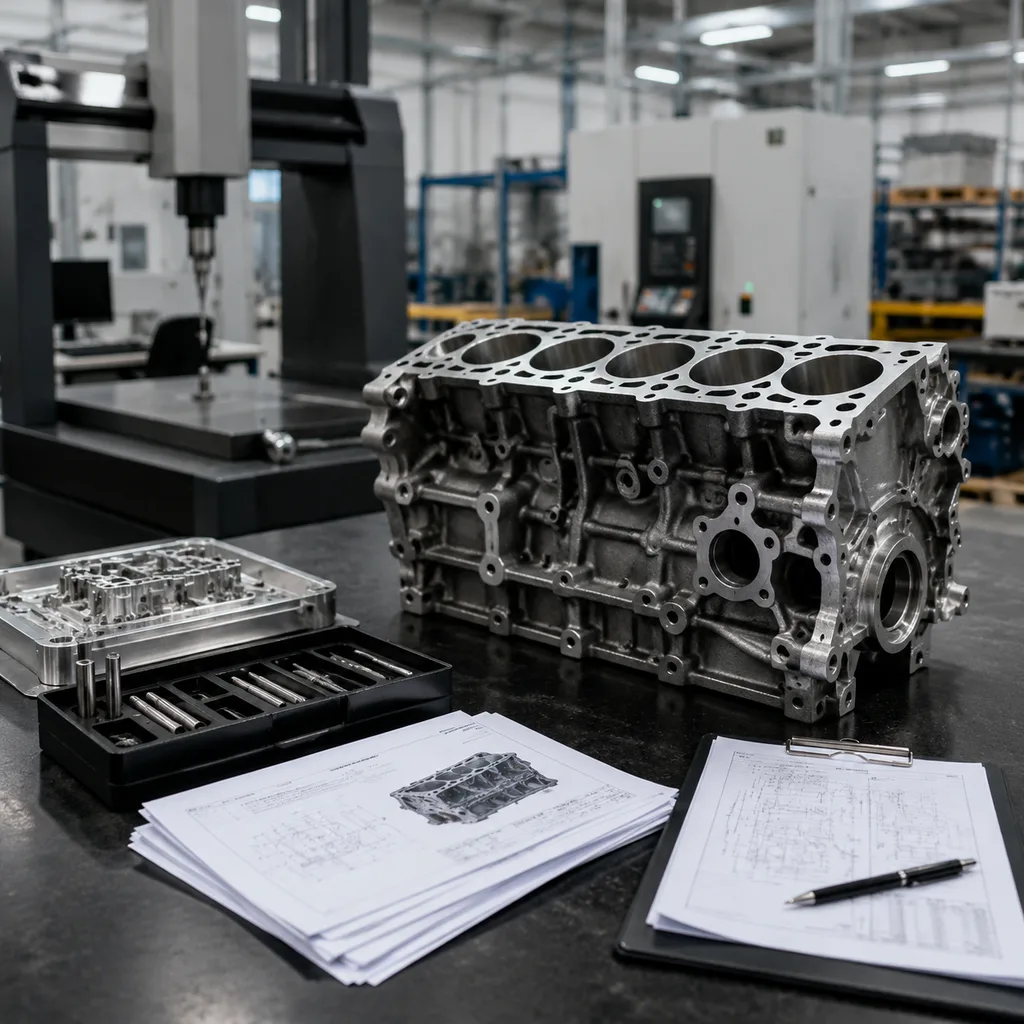
Where drawings are available, the RFQ should state the tolerance class and measurement condition, for example main caps torqued to the specified value before main tunnel measurement. Where the project is sample-based, buyers should allow time for 3D scanning or CMM mapping, section checks if required, and agreement on which dimensions are functional rather than cosmetic.

A buyer may provide an OE-style reference, application list, 2D drawing, 3D model, or sample block. Where part-number cross-references are needed, they should be handled as fitment references only, for example OE 06A… or OE 11251… when supplied by the customer. Brand names and reference numbers should not be used in a way that implies vehicle manufacturer approval.

Factory capability, certification, and audit evidence

An engine block programme needs more audit depth than a low-risk accessory line. The supplier must control foundry inputs, machining processes, inspection equipment, cleanliness, packing, and segregation of nonconforming material. Driventus operates under IATF 16949:2016 and ISO 9001:2015, with documented controls for production planning, incoming inspection, in-process inspection, final inspection, nonconforming product handling, and corrective action.

Before confirming production orders, procurement teams should review the supplier’s quality system and check that the audit file matches the technical risk of the part. For a Land Rover-fit block programme, request evidence such as:

</tr></thead><tbody> </tbody></table>Buyers should also ask how the supplier controls batch release. A practical expectation is 100% visual inspection, thread gauge checks on safety or assembly-critical holes, and recorded dimensional inspection for a defined sampling plan such as first piece, last piece, and periodic checks during the machining shift. For high-risk launch orders, a temporary 100% check on key features such as deck flatness, main tunnel size, cylinder bore size, dowel position, and plug sealing may be justified until process capability is proven.

For regulated markets, buyers may also need material declarations aligned with REACH (EC) No 1907/2006 and packaging information for local import compliance. An engine block is generally not certified as a standalone emissions component under vehicle emissions regulations such as ECE R-83; however, machining or sealing errors can affect assembled engine performance. Process evidence, batch records, and dimensional data therefore carry more value than broad claims about equivalence.

Engineering controls for block casting and machining

The main technical risk in engine block sourcing is not whether the component looks correct on arrival. It is whether the casting and machining remain stable across production lots. A capable supplier should define critical-to-quality features before sample approval, measure them with appropriate equipment, and retain inspection records for each batch.

Key control points include:

  • Cylinder bores: diameter, cylindricity, perpendicularity, surface finish, and allowance for final honing if the customer requires it. Typical buyer-controlled limits may include bore size within ±0.01–0.03 mm, cylindricity within 0.01–0.02 mm, and Ra agreed according to liner, ring, and honing specification.
  • Main bearing tunnel: alignment, roundness, cap register fit, bore size, and the torque condition used during measurement. Main tunnel alignment is commonly controlled in the 0.01–0.03 mm range depending on engine design and drawing requirement.
  • Deck surface: flatness, roughness, parallelism relative to the crankshaft centreline, and gasket sealing quality. A buyer may specify flatness within 0.03–0.05 mm over the full deck and Ra suitable for MLS or composite gasket use.
  • Oil and coolant galleries: position, cleanliness, plug thread quality, pressure integrity, and freedom from blocked passages. Leak-test parameters should state the medium, pressure, hold time, and allowable pressure drop rather than only saying “leak tested”.
  • Threaded holes and dowel locations: gauge verification for cylinder head, sump, timing cover, engine mounts, sensor ports, and accessory mounting points. Go/no-go thread gauges and dowel positional checks reduce trial-assembly failures.
  • Casting quality: porosity inspection, wall thickness checks, visual defect grading, controlled repair policy, and scrap criteria. Cosmetic surface marks should be separated from functional porosity, cracks, cold shuts, and sealing-surface defects.
  • Datum strategy: consistent fixture location so that machining features align correctly with mating parts. The same datum plan should be used in CNC fixtures, CMM programming, and customer drawings.

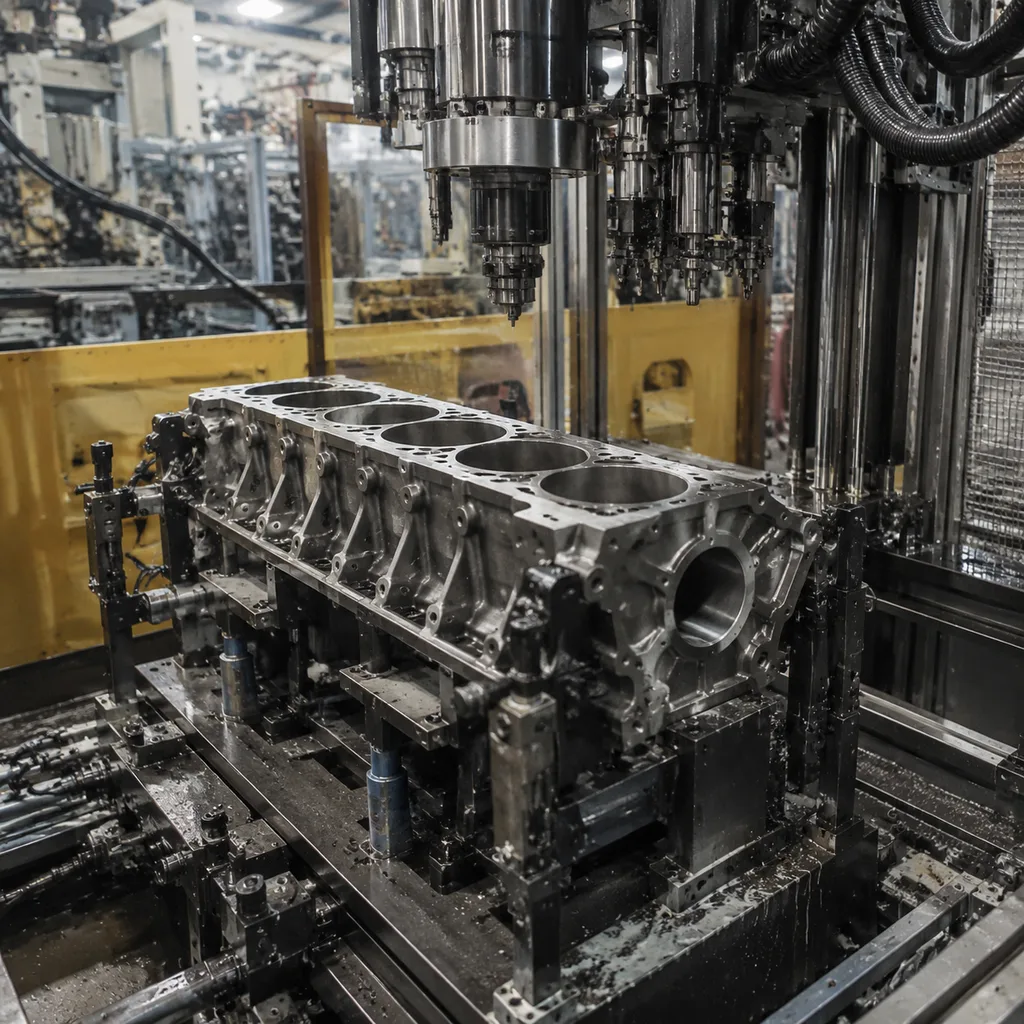
Process detail matters. A robust route normally includes incoming casting inspection, stress-relief or heat treatment if specified, rough machining, semi-finish machining, washing, finish machining of critical bores and faces, deburring, gallery cleaning, pressure testing where applicable, final washing, rust prevention, final inspection, and protective packing. Tool wear limits should be defined for cutters, taps, reamers, boring bars, and honing tools so that the last part in a batch is not allowed to drift out of tolerance.

For a customer-specific project, Driventus can support custom manufacturing from drawings, samples, application data, or benchmark parts. Engineering review normally begins with feasibility confirmation, followed by tooling assessment, sample machining, dimensional reporting, and production part approval in the customer’s preferred format. Where a customer uses a PPAP-style submission, the package can include dimensional results, material reports, process flow, control plan, PFMEA if requested, gauge information, inspection records, packing specification, and sample parts for validation.

Engineering controls for block casting and machining

MOQ, lead time, and commercial terms for import programmes

Commercial planning for engine blocks must reflect casting schedules, machining capacity, inspection time, export packing, and freight method. Unlike gaskets, sensors, or small service parts, blocks occupy more pallet space and require careful handling to protect machined faces, threads, plugs, and gasket surfaces. MOQ and lead time depend on whether the part is an existing Driventus item, a modified item, or a new development project.

Typical sourcing structure:

Audit item Evidence to request Procurement relevance
CertificationCurrent IATF 16949:2016 and ISO 9001:2015 certificates, scope page, expiry dateConfirms the quality management framework and whether machining is included in scope
Material traceabilityHeat number, casting batch, chemical composition report, hardness resultSupports containment and root-cause analysis if a defect occurs
Machining controlCNC process route, fixture plan, tool life records, inspection plan, first-piece sign-offReduces variation in bores, deck surfaces, threads, plugs, and datums
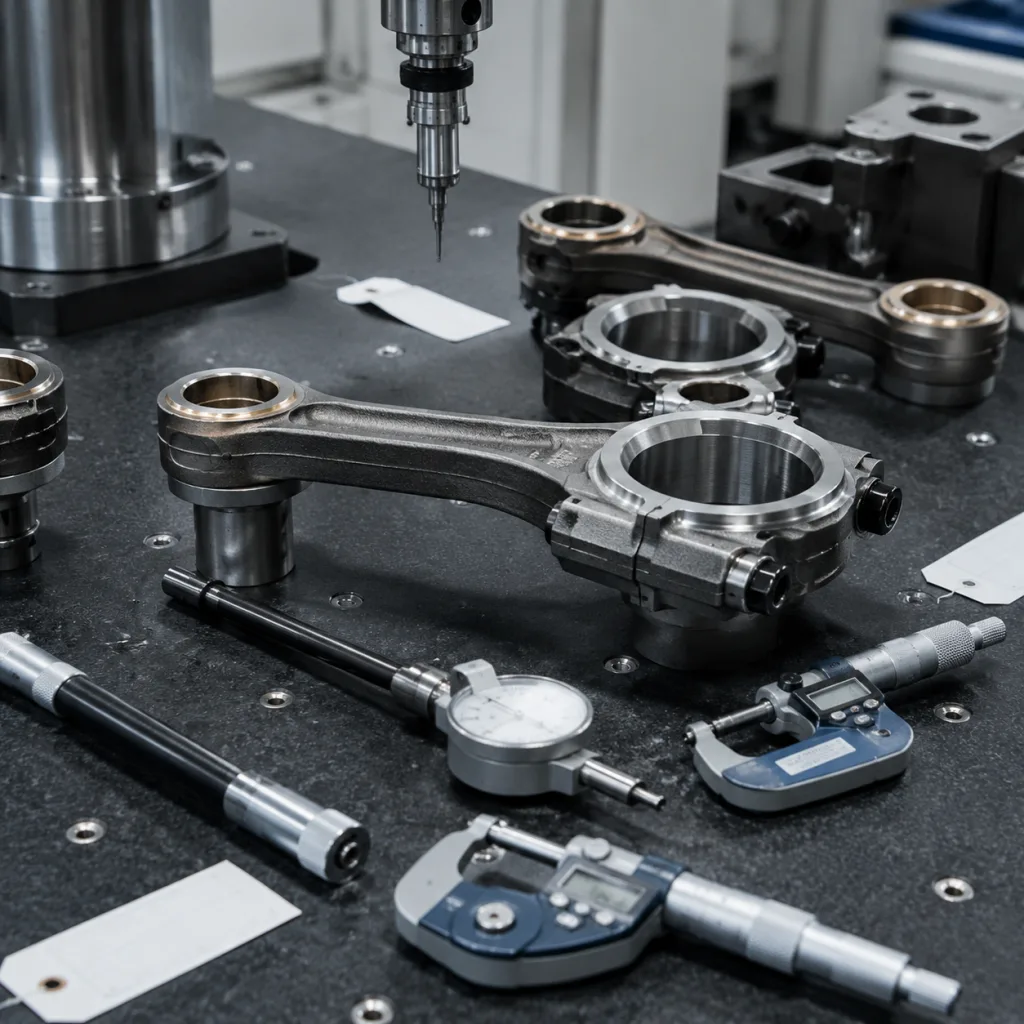
Measurement equipmentCMM, bore gauge, height gauge, thread gauge, air gauge, and surface roughness tester calibrationConfirms that critical dimensions can be verified reliably
Leak testingPressure or sealing test records where applicable, test pressure, hold time, acceptance ruleHelps identify porosity, plug sealing issues, cracks, and gallery defects
Cleanliness controlDeburring, washing, gallery brushing, compressed-air drying, plug protection processReduces assembly contamination and early field complaints
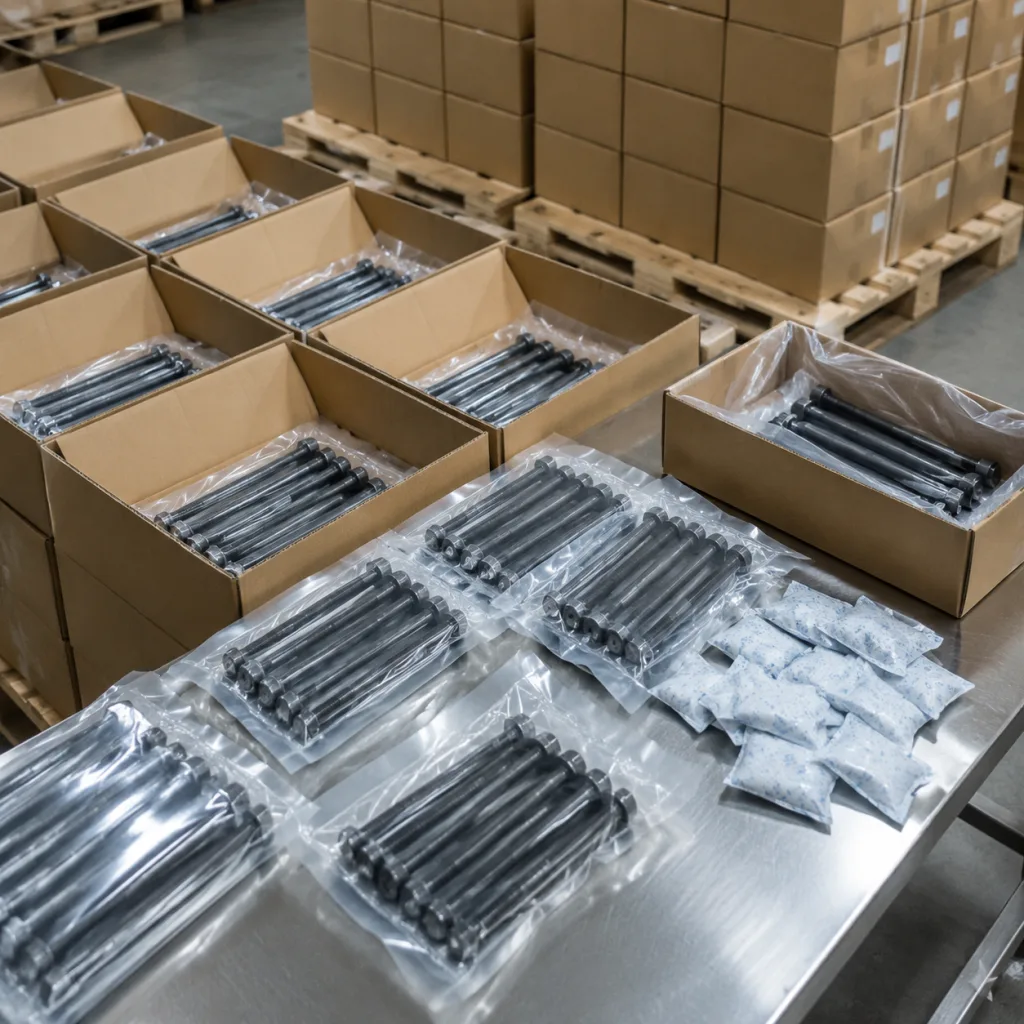
Packing validationVCI/rust prevention, machined-face protection, pallet strength, drop/tilt handling methodReduces freight damage and warehouse handling risk

</tr></thead><tbody> </tbody></table>Price is usually driven by casting weight, alloy or iron grade, machining cycle time, scrap allowance, inspection level, tooling amortisation, packing method, and order stability. For the same application, a 20-unit service order may carry a noticeably higher unit price than a 100-unit replenishment order because setup, fixture, inspection, and export documentation costs are spread over fewer pieces. Buyers should specify whether tooling is paid separately, amortised into the unit price, or owned by the buyer after full payment.

As a planning rule, heavy machined blocks should be quoted with clear Incoterms such as EXW, FOB Ningbo/Shanghai, CIF destination port, or DAP warehouse. Sea freight is normally the economic option for replenishment; air freight may be practical only for urgent samples or very small quantities because dimensional weight and packaging protection increase cost. Payment terms, inspection hold points, and any third-party inspection requirement should be agreed before production, not after goods are packed.

Buyers can review our catalog and engine-related coverage at /products/engine-components.html before issuing an RFQ. To reduce quotation delays, provide the target annual volume, first order quantity, destination port, preferred Incoterms, packaging requirement, inspection standard, and whether the order supports aftermarket distribution, service networks, or assembly supply. It is also useful to state whether the buyer expects neutral packing, private-label cartons, barcode labels, pallet labels, VCI protection, desiccant, wooden cases, or consolidated container loading with other engine components.

Documents to include in an RFQ and sample approval plan

A clear RFQ reduces engineering back-and-forth and prevents assumptions in price, tooling, inspection, and lead time. For an engine block Land Rover OEM supplier search, buyers should provide enough technical detail for fitment verification while also asking the supplier for objective evidence of manufacturing control.

Recommended RFQ package:

  • Application list with engine code, model years, displacement, fuel type where relevant, transmission or drive layout if it affects the block, and market region.
  • OE-style cross-reference format where available, for example OE 06A… or OE 11251…, used for fitment identification only.
  • 2D drawing, 3D model, or physical sample; if unavailable, identify which mating parts must be checked during trial assembly.
  • Required material grade, casting method, heat treatment, hardness range, or sample reference if no drawing is available.
  • Critical dimensions and tolerances for bores, deck, main tunnel, head bolt threads, dowels, mounting faces, plug seats, and oil/coolant galleries.
  • Required tests: dimensional inspection, leak test, hardness check, surface roughness check, cleanliness standard, torque/thread check, and visual criteria.
  • Target order quantity, annual forecast, requested delivery date, destination, preferred shipment mode, and Incoterms.
  • Labelling, barcode, private-label, carton marking, pallet marking, serial or batch traceability, and spare-parts channel requirements.
  • Compliance requests such as REACH (EC) No 1907/2006 material declaration, country-of-origin documents, packing list format, or customer-specific import forms.

Sample approval should not rely on a single visual check. A practical route is first article inspection, dimensional report review, material and hardness confirmation, trial assembly with mating components, leak verification where applicable, cleanliness and packaging checks, then a controlled pilot order before full-scale release. For launch control, buyers can require a marked sample set, CMM report for 5–10 critical features, photos of packing, and retention of one reference sample at the factory.

A useful approval sequence is: RFQ clarification, feasibility sign-off, tooling or fixture confirmation, sample production, first article report, buyer review, trial assembly, deviation closure, pilot batch, pilot inspection report, then mass production release. Any permitted deviation should be written with quantity, expiry date, affected feature, and corrective action; open-ended verbal approvals create avoidable warranty and receiving-inspection disputes.

Buyers serving the EU, UK, US, Canada, Australia, Brazil, and other regulated import markets should also confirm customs classification, tax documentation, country-of-origin rules, wood-packaging compliance where applicable, and aftermarket labelling requirements before shipment.

Documents to include in an RFQ and sample approval plan

Why source from a vertically integrated Chinese manufacturer

A vertically integrated supplier can shorten the feedback loop between casting, machining, inspection, packing, and corrective action. For heavy engine components, this matters because a small upstream variation can create expensive downstream scrap, assembly delay, or field returns. Driventus manufactures engine and powertrain components including pistons, crankshafts, gaskets, water pumps, turbochargers, and engine blocks, helping buyers consolidate related SKUs under one quality and export process.

For distributors, consolidation can improve container utilisation, simplify vendor management, and support more consistent labelling and packing. A pallet plan can combine slow-moving engine blocks with faster-moving service parts to improve landed cost per SKU, provided the packaging prevents contact damage and separates heavy components from fragile parts. For OEM and Tier-1 purchasing teams, the main value is process visibility, technical communication, and the ability to review manufacturing evidence rather than relying on trading paperwork alone. For multi-location repair chains, stable fitment and robust packaging help reduce workshop returns, inventory disruption, and emergency replenishment costs.

Driventus is an independent aftermarket manufacturer; brand names are referenced for fitment only. We do not state or imply approval by Land Rover or any vehicle manufacturer. The sourcing value is based on manufacturing control, documented quality management, export experience to 60+ countries, and the ability to manufacture to agreed technical requirements.

If the application is already active, the next step is cross-reference confirmation and quotation. If it is a new programme, the next step is feasibility review, sample benchmarking, tooling assessment, and a controlled development plan with defined sample quantity, inspection records, approval criteria, production MOQ, and target lead time.

Frequently asked questions

Yes, subject to application confirmation, technical review, and commercial feasibility. Driventus supplies independent aftermarket engine components and can work from customer drawings, samples, or fitment references. Brand names are used only to identify vehicle compatibility.

Request current IATF 16949:2016 and ISO 9001:2015 certificates, material reports, dimensional inspection records, calibration evidence, leak test records where applicable, cleanliness or packing specifications, and corrective-action procedures. For EU-related imports, REACH (EC) No 1907/2006 declarations may also be required.

Provide the application list, engine code, OE-style cross-reference if available, annual forecast, first order quantity, destination, packaging requirements, inspection requirements, and any drawings or samples. This allows the supplier to confirm feasibility and quote realistic lead times.

For an engine block sourcing review, send your application data, target volume, and inspection requirements. Driventus can assess feasibility and help you [request a quote](/contact.html).

Request a Quote
Programme type MOQ guidance Sample lead time Production lead time Notes
Existing application20–50 units2–4 weeks35–60 daysSubject to stock, machining queue, final inspection, and packing schedule
Existing casting with machining revision30–80 units4–8 weeks50–75 daysRequires drawing review, fixture confirmation, and first article inspection
New casting developmentProject-based10–16+ weeks75–120+ days after approvalTooling, trial casting, machining, validation, and approval are required
Mixed engine component orderBy consolidated value or pallet planVaries35–70 daysCan combine blocks with pistons, gaskets, pumps, crankshafts, or related SKUs