Engine bearings are cheap to buy and expensive to get wrong. A few microns of wall-thickness drift can change oil clearance; weak crush can let a shell move; a misplaced oil hole can turn a normal rebuild into a warranty claim. For B2B sourcing, fitment is only the entry ticket. Buyers need controlled geometry, material proof, coating discipline, traceability, corrosion protection, and packaging that survives export handling.
This guide reframes engine bearing specifications as purchasing decisions, failure controls, and approval checkpoints for aftermarket distributors, OEM/Tier-1 buyers, and repair-chain category teams sourcing from China. It covers dimensions, materials, tolerances, inspection, documentation, MOQ logic, price drivers, lead-time planning, and sample approval.
Driventus manufactures main bearings, connecting rod bearings, thrust washers, and bearing sets for petrol and diesel engine applications in Taizhou, Zhejiang. Driventus is an independent aftermarket manufacturer; brand names are referenced for fitment identification only.
Decision Framework: Which Dimensions Control Risk?
Start with the interfaces that can damage the crankshaft, block, or connecting rod if they drift. An engine code or application list helps identify the part, but it does not approve production. A serious RFQ ties every controlled feature to a drawing, sample measurement, verified OE cross-reference, or buyer-approved inspection standard.
The highest-risk dimensions usually sit between the crankshaft journal, bearing shell, housing bore, and oil film:
Parameter
Why it matters
Typical inspection method
Practical RFQ value to define
Inside diameter after assembly
Controls oil clearance with the crankshaft journal
Bore gauge after torqued housing simulation
Target assembled ID or oil clearance, often grade-specific
Wall thickness
Affects oil clearance and load distribution
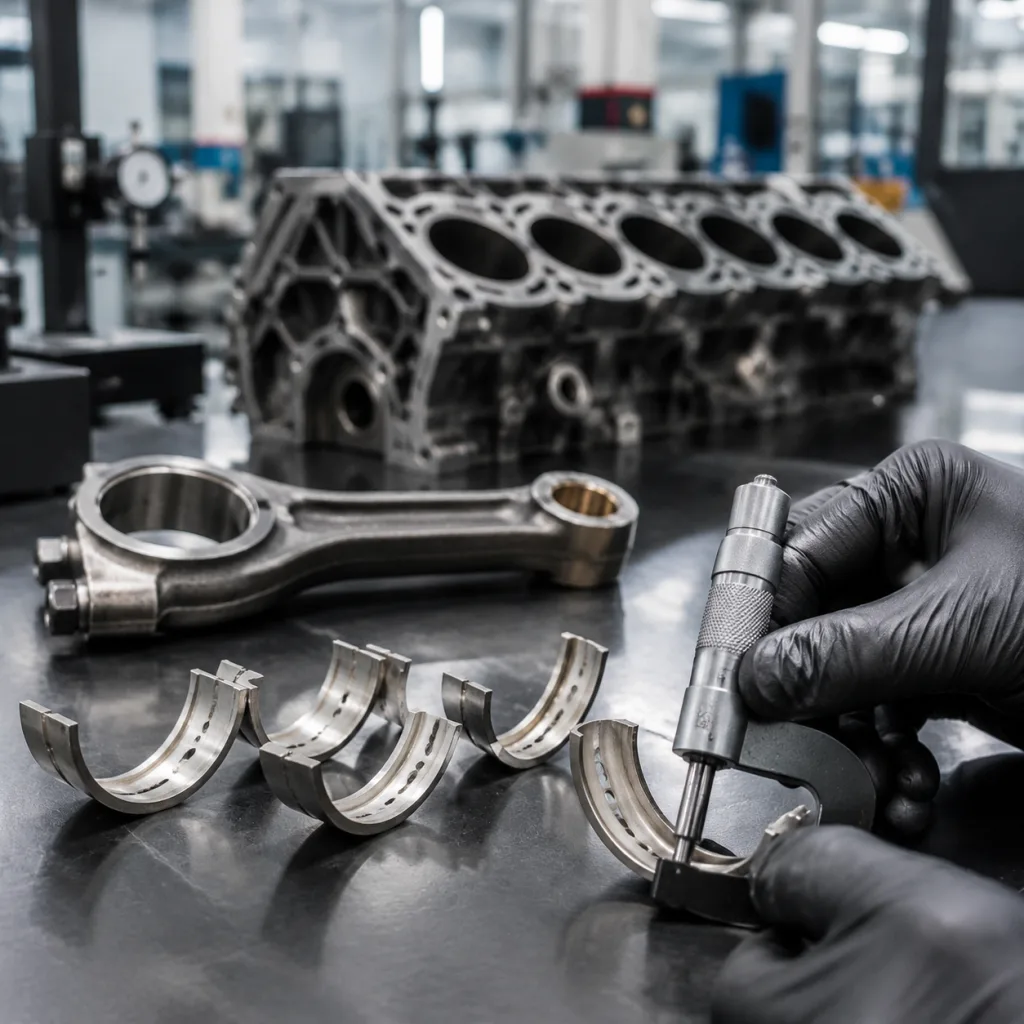
Ball anvil micrometer or dedicated fixture
Nominal thickness plus tolerance by shell position
Bearing width
Prevents edge loading and side interference
Vernier, digital width gauge, or width fixture
Width tolerance, typically tighter for flanged bearings
Crush height
Retains the shell in the housing bore
Crush tester or height fixture under defined load
Fixture load, crush value, and upper/lower acceptance limit
Locating lug position
Ensures correct seating and oil-hole alignment
Optical comparator or fixture gauge
Lug width, height, offset, and side reference datum
Oil-hole diameter and position
Maintains the lubrication path
Pin gauge and coordinate check
Hole diameter, slot length, angle, and positional tolerance
Thrust flange width, where applicable
Controls crankshaft axial movement
Micrometer and axial fixture
Flange thickness, overall width, and end-play target
</tr></thead><tbody> </tbody></table>A useful drawing does more than list sizes. It states datum surfaces, shell arc angle, chamfer size, part marking location, oil-groove geometry, and whether a value is measured before assembly or after installation in a torqued housing. Main bearing sets should separate upper and lower shells when one has an oil groove and the other is plain. Connecting rod bearings should define tang orientation, cap-side shell position, and any asymmetrical chamfer needed for crank radius clearance.
For replacement programs, Driventus recommends a golden-sample route: measure 5–10 sample sets, agree nominal values, build a pilot lot, inspect 20–30 pieces across cavities or batches, then freeze the drawing revision before mass production. This gives buyers a defensible approval trail for main bearing sets, connecting rod bearing sets, and thrust washer kits listed in our catalog.
Material Choice: Match Layer Structure to Duty Cycle
Two bearings can look identical on the shelf and behave very differently under load. The difference is usually hidden in the backing steel, lining alloy, overlay, barrier layer, or coating process. Procurement teams should treat material selection as a duty-cycle decision, not a catalog label.
Common constructions include:
Steel-backed aluminium alloy: Often used in light-duty petrol and diesel engines where seizure resistance, corrosion resistance, and thermal conductivity are important. Aluminium-tin systems may use tin content in the 6–20% range, depending on the design target and supplier process.
Steel-backed copper-lead alloy: Used in higher-load applications where fatigue strength matters. Buyers should confirm whether lead-containing material is acceptable for the destination market and customer policy.
Tri-metal bearing: Combines steel backing, copper-based intermediate layer, nickel barrier, and soft overlay for fatigue resistance, embedability, and conformability. Overlay thickness is commonly controlled in the single-digit to low double-digit micron range, depending on platform.
Polymer-coated bearing: Adds a low-friction running surface for boundary-lubrication periods, frequent start-stop operation, or high specific-load designs. Specify coating thickness, cure condition, adhesion, and visual coverage; do not rely on vague descriptions such as “black coating” or “low friction coating.”
Sputter or advanced overlay bearing: Suited to very high fatigue requirements. Confirm the engine platform really needs this technology because tooling, validation, MOQ, and price are usually higher than standard aftermarket bearings.
Write layer data into the RFQ in measurable terms: backing steel grade or approved equivalent, lining alloy family, lining thickness, overlay or coating thickness, hardness range where applicable, and banned-substance limits. If the original drawing cannot be disclosed, the supplier should still provide a material proposal and inspection plan before tooling or pilot sampling.
Compliance belongs in the material discussion, not at the end of the project. Review REACH (EC) No 1907/2006 for EU supply and any customer-specific restricted substance list. For coated bearings, the inspection plan should cover adhesion, layer thickness, surface continuity, cure verification where applicable, and customer-defined friction or wear requirements. A practical incoming-control request is one material certificate per heat or coil, one coating-batch record per production lot, and retained samples linked to the finished bearing lot number.
Failure Modes Hidden Behind “Looks OK” Parts
A bearing can pass a visual check and still fail in service. Outside appearance, engraving, and packaging do not prove crush, oil clearance, oil-hole location, or layer stability. That is why engine bearing specifications should combine component tolerances with functional limits.
The figures below are procurement examples only. Final values must follow the drawing, engine platform, size grade, and customer approval.
Specification item
Typical procurement range
Control note
Wall thickness variation within one shell
0.003–0.008 mm
Depends on bearing size, alloy, and grade
Wall thickness lot average tolerance
often within ±0.005–0.010 mm
Set separately for standard and undersize variants
Width tolerance
±0.05–0.10 mm
Tighter limits may apply to flange bearings
Oil-hole position tolerance
±0.10–0.20 mm
Confirm against block or rod oil passage
Oil-hole diameter tolerance
commonly ±0.05–0.10 mm
Slot length may require a separate tolerance
Surface roughness on running face
Ra 0.2–0.6 µm
Varies by overlay, aluminium lining, and coating
Back surface roughness
Ra 0.8–1.6 µm
Supports stable seating in the housing bore
Crush height
drawing-specific
Must be measured with controlled fixture load
Free spread
drawing-specific
Supports assembly retention before cap torque
Thrust face parallelism
drawing-specific, often tightly controlled
Important for crankshaft end-play stability
</tr></thead><tbody> </tbody></table>The common failure signals are predictable: insufficient crush, excessive wall-thickness variation, poor oil-hole alignment, burrs at the parting line, unstable coating quality, wrong undersize marking, or rough back surfaces that prevent stable seating. Each one has a measurable control point.
For critical programs, ask for capability data instead of accepting a single first-article report. Mature production should normally show Cpk ≥1.33 on stable key dimensions such as wall thickness, width, and oil-hole position. For safety-critical or customer-designated special characteristics, Cpk ≥1.67 may be appropriate. If the process is new or volume is low, request a control chart, 30-piece dimensional study, and reaction plan for out-of-control readings.
Documentation Levels: Distributor Order vs Tier-1 Program
The right quality file depends on risk, volume, and customer type. A replenishment order for an aftermarket distributor does not need the same documentation depth as a Tier-1 private-label launch, but both need more than a quotation sheet. Driventus operates under IATF 16949:2016 and ISO 9001:2015 quality frameworks, with incoming material checks, in-process inspection, and final release controls. Buyers can review our quality system before supplier approval, audit planning, or sample release.
A practical RFQ package should request:
Technical drawing or reverse-engineered inspection report with revision number and datum definition.
Material declaration, alloy proposal, coating description, and restricted-substance confirmation.
Dimensional inspection report by cavity, batch, production line, or agreed sampling level.
Hardness, bond integrity, and metallographic checks where applicable.
Surface roughness measurement for running face, oil groove, thrust face, and backing where relevant.
Coating thickness, adhesion, cure record, and visual coverage standard for coated bearings.
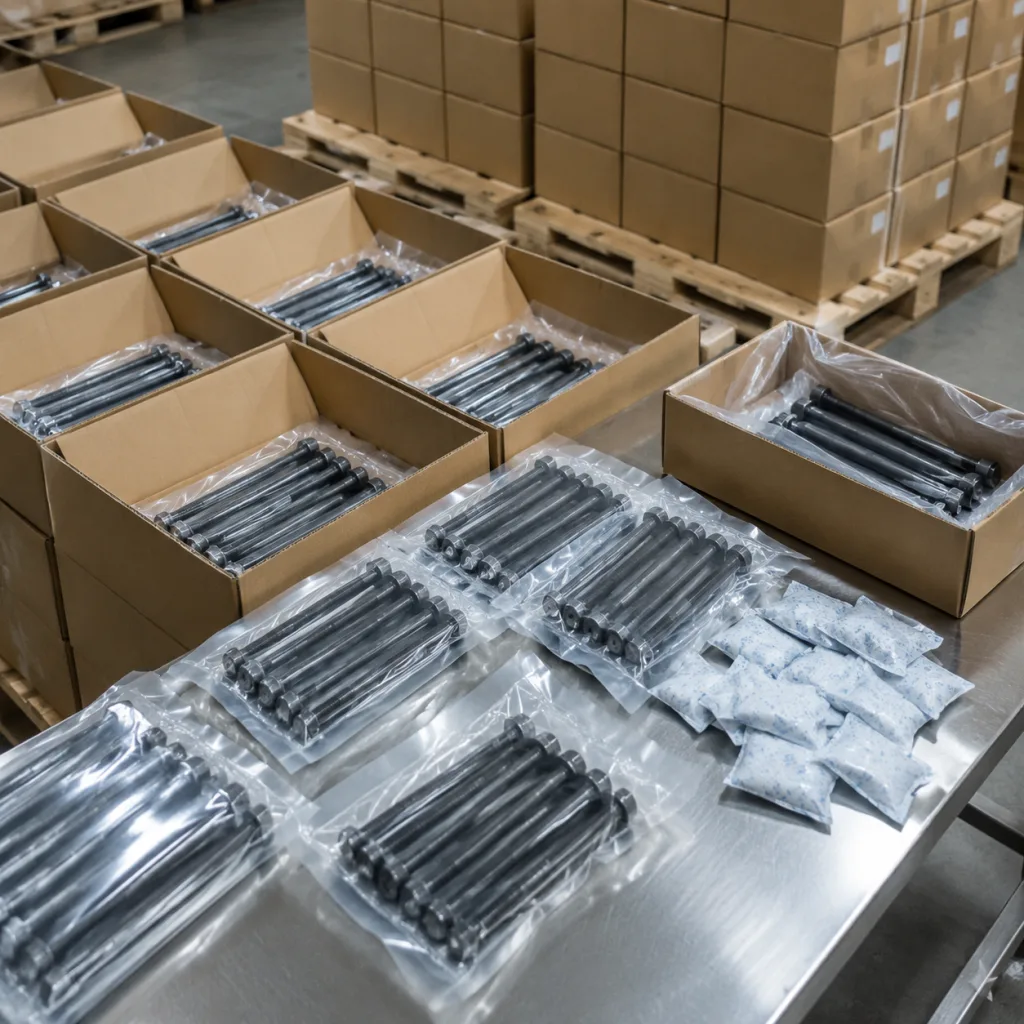
Packaging specification, including VCI paper, anti-rust oil if used, carton strength, and pallet pattern.
Lot traceability format, date-code method, and retained-sample period.
PPAP documentation where required by OEM or Tier-1 procedure.
For a distributor replenishment order, a dimensional report, material declaration, packaging approval, and traceability format may be enough. For a Tier-1 or private-label program, expect PPAP Level 3, process flow, PFMEA, control plan, MSA, capability study, IMDS or equivalent material reporting, and annual layout inspection. State the documentation level before quotation. PPAP depth affects engineering time, sample cost, and lead time.
Regulated markets add another layer. Include customer-specific restricted substance lists, REACH (EC) No 1907/2006 expectations, destination-market labelling, carton drop-test requirements, and packaging recycling rules at RFQ stage. If private-label supply is required, separate artwork approval from engineering approval so packaging revisions do not delay dimensional validation.
Step-by-Step Validation Before Volume Release
Validation should answer three questions before container-volume orders begin: does the bearing fit, is the material stable, and can production repeat the approved result? The required depth depends on whether the item is a direct aftermarket reference, an OE-equivalent replacement line, or a new development project through custom manufacturing.
Recommended sourcing validation
Sample comparison: Measure against a customer sample, engine housing, or approved drawing; record upper/lower shell differences and size-grade markings.
Assembly check: Install in a representative block or connecting rod and verify seating, oil-hole alignment, lug engagement, cap closure, and absence of rocking.
Oil-clearance check: Measure the crankshaft journal and assembled bearing bore using calibrated tools; record each housing position rather than only one average.
Torque-cycle check: Confirm shell retention after repeated cap assembly where relevant, using the specified torque and angle sequence.
Material verification: Confirm backing steel, intermediate layer, overlay, and coating by approved laboratory method.
Corrosion check: Verify protection after packaging and simulated shipping exposure, especially for sea freight and humid storage.
Batch repeatability: Inspect pilot-lot parts before mass-production release, including different cavities, operators, shifts, or coil batches where possible.
A workable development timeline is usually 7–15 days for drawing or sample review, 20–35 days for pilot sampling if tooling and material are available, and 30–60 days for new-tooling or coated-bearing projects. Sea shipment, private-label packaging, and third-party testing should be added separately to the launch schedule. Non-standard alloy, new coating, or low-volume engine applications may take longer because raw material and tooling cannot always be shared with existing programs.
For high-volume programs, Driventus can support first-article inspection, pilot batches, and locked production parameters. Buyers should define acceptance criteria before sampling: standard, 0.25 mm undersize, 0.50 mm undersize, oversize, or mixed bearing variants; pass/fail dimensions; packaging format; marking method; test quantity; and whether destructive material checks are required before production release.
RFQ Scenario: Comparing Two Bearing Quotes Fairly
A low unit price can be misleading if it hides tooling, coating setup, packaging, testing, or documentation cost. A complete RFQ makes suppliers quote the same scope, which reduces sampling cycles and part-number disputes. If an OE part-number cross-reference is used, keep the format generic unless the buyer provides its own verified number, for example OE 06A… for an application-family reference. Driventus does not claim approval or endorsement by any vehicle manufacturer.
Include the following data when requesting pricing:
RFQ field
Required detail
Product type
Main bearing, connecting rod bearing, thrust washer, or full kit
Engine application
Engine code, displacement, fuel type, and model-year range
Size grade
Standard, 0.25 mm undersize, 0.50 mm undersize, oversize, or customer-defined
Material
Aluminium alloy, copper-lead, tri-metal, polymer-coated, or other
Annual volume
Forecast by SKU, shipment batch, and delivery region
Order quantity
Trial order, replenishment MOQ, or annual blanket order release plan
Packaging
Neutral, private label, bulk, repair-chain kit, or engine-rebuild set format
Documentation
Inspection report, material declaration, PPAP, IMDS-style data, or customer template
Compliance
REACH, restricted substances, labelling, carton marking, and market-specific rules
Commercial terms
Target Incoterm, currency, payment term, delivery window, and consolidation plan
</tr></thead><tbody> </tbody></table>Ask suppliers to quote three breaks: sample or pilot lot, first commercial order, and annual-volume price. Existing aftermarket references may support lower MOQ by carton or mixed-SKU batch. New development items usually require separate tooling, fixture setup, artwork, and pilot validation, so MOQ is driven by raw-material coil yield, coating batch size, and machine setup efficiency.
Lead time should also be split by stage: engineering review, tooling or fixture preparation, sample production, lab testing, packaging artwork approval, mass production, and export preparation. Price should be separated by part cost, tooling or development charge, packaging upgrade, documentation cost, and freight term. For distributors consolidating engine components, bearing programs can be sourced alongside pistons, piston rings, gaskets, crankshafts, water pumps, and related parts through our catalog. For a technical quotation with drawings or sample review, buyers can request a quote.
Frequently asked questions
Wall thickness, wall-thickness variation, width, crush height, free spread, oil-hole position, surface roughness, material structure, coating thickness, and size grade are the main sourcing controls. Buyers should also define MOQ, packaging, traceability, compliance requirements, capability targets, and inspection documentation before sample approval.
Yes. Driventus can evaluate customer samples, drawings, or verified cross-references and develop aftermarket bearing sets through controlled measurement, material review, pilot sampling, dimensional inspection, and production validation. Final dimensions, tolerances, packaging, and approval criteria remain with the buyer.
Driventus operates under IATF 16949:2016 and ISO 9001:2015 quality frameworks. For export markets, buyers may also request dimensional reports, material declarations, REACH (EC) No 1907/2006 information, restricted-substance confirmation, PPAP documents, and customer-specific inspection templates.
Send drawings, samples, target volumes, size grades, MOQ expectations, packaging format, lead-time target, and documentation requirements for a technical review of your engine bearing sourcing program at /contact.html