Camshaft for Porsche Boxster Replacement: Fitment Checks
A camshaft for Porsche Boxster replacement has to match the exact engine variant, not just the visible shape of the shaft. Procurement teams should verify journal diameter, overall length, timing-drive interface, lobe geometry, surface finish, oiling details, and packaging against the engine code and production range. In practice, approval should be based on measured dimensions in millimetres, cam-lift/profile data, hardness values, runout limits, and batch traceability rather than a catalogue photo. Small deviations can affect valve timing, idle stability, emissions performance, lubrication, and wear rate; even a 0.02–0.05 mm error on a journal or an incorrect trigger reference can create assembly or diagnostic problems. For B2B sourcing, the decision is not whether the part resembles the original; it is whether the supplier can prove OE-equivalent fit, repeatable manufacturing control, and reliable batch documentation. Driventus is an independent aftermarket manufacturer; brand names are referenced for fitment only. We supply engine components to distributors, OEM and Tier-1 channels, and repair networks that need dimensional match, traceable inspection, and stable lead times. If you are comparing suppliers, start with the drawing, control plan, inspection records, MOQ/forecast plan, and application notes before relying on a broad vehicle listing.
What a replacement camshaft must match
For replacement sourcing, the camshaft must align with the original engine architecture, not only the vehicle nameplate. Porsche Boxster applications have used different engine generations and revisions, so buyers should confirm the engine family, intake or exhaust position, cylinder head revision, and timing-drive design before ordering. A correct camshaft for Porsche Boxster replacement should also be checked against the intended build range, because similar-looking shafts can have different trigger features, phasing interfaces, or lobe specifications.
A practical procurement checklist should include both nominal dimensions and acceptance limits:
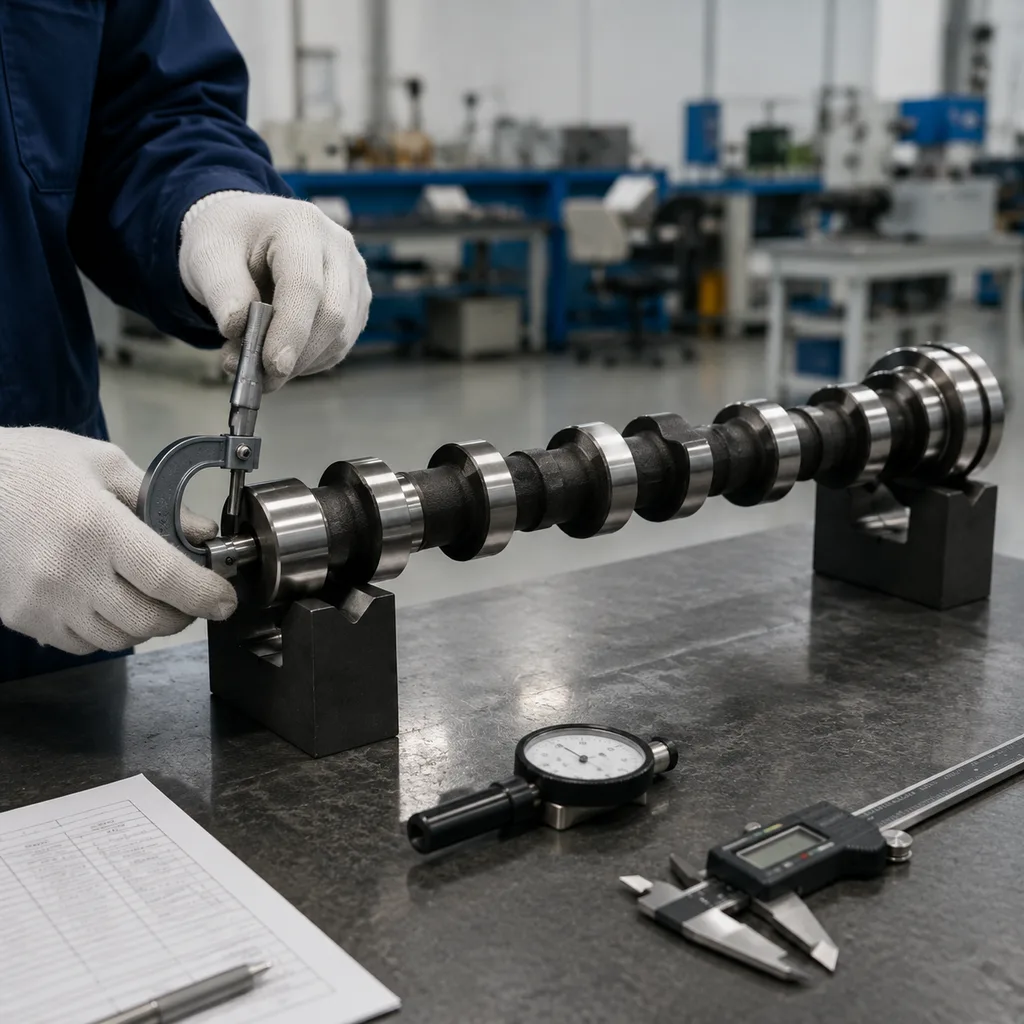
Journal diameter, bearing width, and oil-clearance requirements; typical journal checks should be recorded to 0.001 mm resolution with agreed tolerances, often in the ±0.005–0.015 mm range depending on the drawing
Overall shaft length and thrust-face position; control the datum system so the timing end, thrust shoulder, and reference journal are measured consistently
Lobe lift, duration, base circle, and lobe-separation relationship; compare intake and exhaust lobes separately and do not approve on maximum lift alone
Intake or exhaust location and cylinder-head compatibility; confirm left/right bank or position where the engine architecture requires different shafts
Trigger wheel, gear, sprocket, or phaser interface where used; verify keyway width, spline/gear form, bolt-circle, dowel position, and angular reference
Oil-feed holes, grooves, chamfers, and edge condition; define deburr limits such as no raised burrs and no sharp edges that can release particles
Surface hardness, runout, and ground finish; require measured values for lobes and journals, not only a heat-treatment statement
Packaging, corrosion protection, and labelling for export transit; lobes and journals should be sleeved or separated so shafts cannot contact each other in cartons
The purchase specification should make clear whether the item is for direct aftermarket replacement, engine rebuild stock, or a programme with special inspection requirements. If the application is part of a wider rebuild package, it is useful to source the camshaft together with related items from our catalog or the wider engine components range. That lets the buyer consolidate supplier review, inbound inspection, documentation control, and replenishment planning across related parts. For inventory planning, distributors typically separate sample orders, trial lots, and replenishment orders: 1–5 pcs for dimensional approval where stock exists, 50–200 pcs for pilot stocking, and forecast-based repeat POs for stable unit cost and production scheduling.
OE-equivalence checks before ordering
The safest way to buy a camshaft for Porsche Boxster replacement is to verify OE-equivalence at drawing level. That means comparing measurable features and controlled tolerances rather than assuming interchange from a marketing description. Catalogue cross-references can help narrow the search, but final approval should be based on the part drawing, sample comparison, inspection results, and the engine application data supplied by the buyer.
Check item
What to verify
Practical target for buyer review
Why it matters
Journal size
Diameter, width, roundness, concentricity
Measure all journals; record diameter, roundness, cylindricity, and width against drawing tolerances
Prevents bearing mismatch, oil-film loss, and seizure risk
Lobe geometry
Lift, base circle, flank form, nose shape
Compare profile on a cam measuring machine or master sample; flag lift/profile deviation before pilot release
Controls valve-event timing, valve-train load, and idle quality
Drive interface
Keyway, sprocket fit, gear form, phaser location
Check angular location from a defined datum; confirm bolt, dowel, spline, or key fit with the mating part
Avoids timing error, assembly rework, and fault codes
Verify trigger tooth/window count and angular offset; photograph and dimension the sensor reference zone
Supports correct cam-position signal and engine management
Surface finish
Ground finish, roughness, and edge condition
Specify Ra on journals/lobes where drawing allows; common journal/lobe grinding targets are often around Ra 0.2–0.8 µm
Affects wear rate, break-in stability, and follower contact
Material route
Casting or billet route, heat treatment, hardness range
Confirm material grade, heat-treatment process, and hardness window; do not mix routes without approval
Influences stiffness, fatigue life, and durability consistency
Runout
Measured on reference journals and critical zones
Define V-block or between-centres method; common procurement limits are often ≤0.03–0.05 mm TIR if not otherwise specified
Reduces vibration, uneven loading, and timing variation
</tr></thead><tbody> </tbody></table>For repeat buyers, the most useful supplier document is a dimensional report tied to the batch or lot number. A practical report should list sample size, inspection equipment, calibration status, nominal value, tolerance, actual readings, pass/fail result, inspector, and date. If the engine family spans multiple model years or regional variants, request revision control so the wrong version is not mixed into inventory. Procurement teams should also define how substitutions are handled: a supplier should not replace one camshaft version with another unless the interchange has been approved in writing and supported by dimensional evidence. For multi-warehouse distributors, add barcode or carton-label requirements at quotation stage so the correct camshaft version is traceable through receiving, shelf storage, and customer returns.
Material, hardness, and tolerance targets
A replacement camshaft should be specified as a controlled manufacturing item, not a generic turned shaft. For procurement review, the common points are material route, hardness window, lobe and journal finish, and the geometric tolerances that keep the valve train stable over the service life. The appropriate material and heat-treatment route can vary by design, so the buyer’s approval process should focus on meeting the validated drawing and performance requirement rather than selecting by material name alone.
Typical control points include:
Microstructure and heat-treatment records, including casting or steel bar heat number where applicable
Journal and lobe hardness verification; common camshaft programmes may specify approximately 50–62 HRC or an equivalent case-hardness range depending on material and follower design
Cam-lobe profile repeatability across the batch, with first-off, in-process, and final inspection rather than final inspection only
Total indicated runout on reference journals, measured with the same support method defined in the control plan
Controlled base-circle and lift measurements; record base circle, nose radius, peak lift, and angular position for each lobe family
Burr-free oil passages, grooves, shoulders, and edges; inspect oil holes after drilling, grinding, washing, and rust prevention
Cleanliness control before packing; parts should be washed, dried, and protected so no grinding swarf or abrasive residue remains in oil passages
Protective coating or corrosion inhibitor for storage and shipment; confirm protection duration such as 3, 6, or 12 months under normal warehouse conditions
Packing method that prevents impact damage to lobes and journals; use individual sleeves, VCI bagging, dividers, and export cartons or pallets suitable for sea freight
A workable tolerance discussion starts with the OE drawing or a reverse-engineered master sample. Where the buyer does not have a drawing, Driventus normally asks for a sample, the engine code, and the mating components so measurement datums can be agreed before quotation. Manufacturing flow usually includes blank sourcing or casting, rough machining, heat treatment, straightening if required, centreless or cylindrical grinding, lobe profile grinding, oil-hole finishing, washing, hardness/runout inspection, rust prevention, and final packing. Each step should have a control point; for example, hardness after heat treatment, runout after grinding, and visual/oil-hole checks after washing.
Published standards and requirements that may be relevant during supplier qualification include IATF 16949:2016, ISO 9001:2015, and REACH (EC) No 1907/2006 for material compliance. If your programme also includes validation for heat, humidity, salt exposure, or road dust, request test methods that are clearly named in the report and matched to the component being evaluated. For Europe-facing programmes, ensure documentation supports internal conformity review even when the part is sold as an aftermarket replacement. For North American or multi-region supply, buyers should also define any customer-specific reporting formats before production release so inspection data is captured in the correct structure from the first batch.
Validation testing that buyers should request
Before a PO is released, ask the supplier what was tested, how the part was accepted, and how those results are linked to production lots. A camshaft can pass a quick visual inspection and still fail in service if timing geometry, hardness, oiling features, or surface finish is inconsistent. For a replacement camshaft, validation should cover both fitment and durability-related characteristics, especially when the part will enter distributor stock or repair-network inventory.
Request these records where available:
1. First-article dimensional report with 100% of critical-to-fit dimensions checked on initial samples 2. Hardness and heat-treatment summary, including test locations on lobes and journals where relevant 3. Runout and profile inspection record, with the measuring method stated clearly 4. Material certificate or internal material-control record tied to heat number, batch, or supplier lot 5. Visual defect criteria and sampling plan, such as AQL level, sample quantity, and defect categories 6. Packaging and corrosion-protection specification, including VCI, oil film, bag type, carton strength, and pallet layout 7. Traceability to batch, lot, or production date, marked on label, carton, or inspection report 8. Nonconformance and corrective-action procedure, including segregation, rework approval, and replacement timing
For higher-risk releases, buyers can add 100% checking of journals, key timing features, and trigger references for the first shipment, then move to a sampling plan after stable performance. A practical pilot sequence is: technical review and quote, sample or first article, dimensional approval, pilot order, inbound inspection, field feedback, then repeat order. If the buyer requires PPAP-style documentation, specify the submission level, sample quantity, capability studies, and record retention period before tooling or production scheduling begins.
For larger programmes, a supplier should also explain how nonconforming parts are segregated, how rework is controlled, and how inspection equipment is calibrated. Calibration records should cover micrometers, dial indicators, height gauges, hardness testers, profile measuring equipment, and any custom go/no-go gauges used for interfaces. That is where a documented quality system matters more than a sales claim. If your team needs a special profile, phasing feature, customer label, or application-specific packaging, discuss custom manufacturing before finalising the drawing release. Early clarification reduces the risk of late engineering changes, duplicated sampling, or mismatched stock at the distribution level.
How Driventus supports B2B replacement sourcing
Driventus supplies engine and powertrain parts from Taizhou, Zhejiang, with export experience in more than 60 countries. Our camshaft programmes are built for distributors, repair networks, OEM channels, Tier-1 supply routes, and industrial buyers that need stable specification control rather than one-off retail supply. For a camshaft for Porsche Boxster replacement, we focus on application verification, inspection discipline, and practical export support so the buyer can make a documented sourcing decision.
What procurement teams usually review with us:
Drawing match against the target engine family, including datum selection and critical dimensions
Intake or exhaust position and application notes, including model year, engine code, and head revision where known
Sample comparison where available, with photos, measurement table, and difference list
MOQ, forecast, and replenishment alignment; MOQ depends on whether parts are in stock, under an active programme, or require a new production run
Export packing, labelling, and pallet requirements, including customer part number, batch number, country-specific label fields, and carton quantity
Batch traceability and inspection records, including dimensional, hardness, runout, and visual inspection data
Document set for internal supplier approval, such as quote sheet, drawing review, material declaration, inspection plan, and packaging proposal
Communication process for revisions or engineering changes, including written approval before switching design versions
MOQ, price, and lead time are linked. If a matching camshaft is already in a current production or stock programme, sample dispatch can often be arranged faster and the MOQ may be lower. If a new batch is required, unit price usually improves when the order covers setup, heat-treatment batch size, grinding changeover, and export packing efficiently. As a planning guide, buyers should identify whether they need 1–5 pcs for approval, 50–200 pcs for trial stock, or a scheduled replenishment quantity tied to quarterly or annual demand. Lead time is normally driven by sample confirmation, blank availability, heat treatment, grinding capacity, inspection workload, and sea/air freight choice; urgent samples should be separated from bulk replenishment planning.
We can support camshaft sourcing as a standalone item or as part of a broader engine rebuild package. If you are consolidating supply across pistons, gaskets, water pumps, timing-related components, and related rotating parts, the same supplier review process can be applied across the full bill of materials. When you are ready to compare options, you can request a quote with the part drawing, engine code, intake or exhaust position, sample reference if available, required documents, packaging standard, destination port, target MOQ, annual volume, and expected delivery schedule. That information allows us to review fitment, manufacturing feasibility, documentation needs, packing requirements, price breaks, and lead-time expectations before quotation.
Frequently asked questions
Provide the engine code, intake or exhaust position, model year range, cylinder-head or engine revision if known, and any OE drawing, sample, or reference photos. For faster quotation, also include target quantity, annual forecast, destination country, required inspection documents, and packaging or label requirements. Dimensional data is still required for final approval.
Not safely. Vehicle name alone is not enough because the same model can use different engine revisions, timing-drive interfaces, trigger features, or lobe specifications. Confirm the engine code, shaft position, timing interface, and measurable dimensions before issuing a production PO.
Ask for a dimensional report, hardness data, runout or profile inspection record, material traceability, batch traceability, packaging specification, and proof of compliance with your supplier quality requirements. For larger programmes, add a control plan, sampling plan, revision-control process, and corrective-action procedure.
If you are qualifying a camshaft supply line or comparing replacement options, send your drawing, sample, engine code, intake/exhaust position, target MOQ, annual volume, documentation requirements, and delivery destination. We will review fitment, process route, inspection scope, packing, price-break logic, and lead-time expectations. Start here: /contact.html