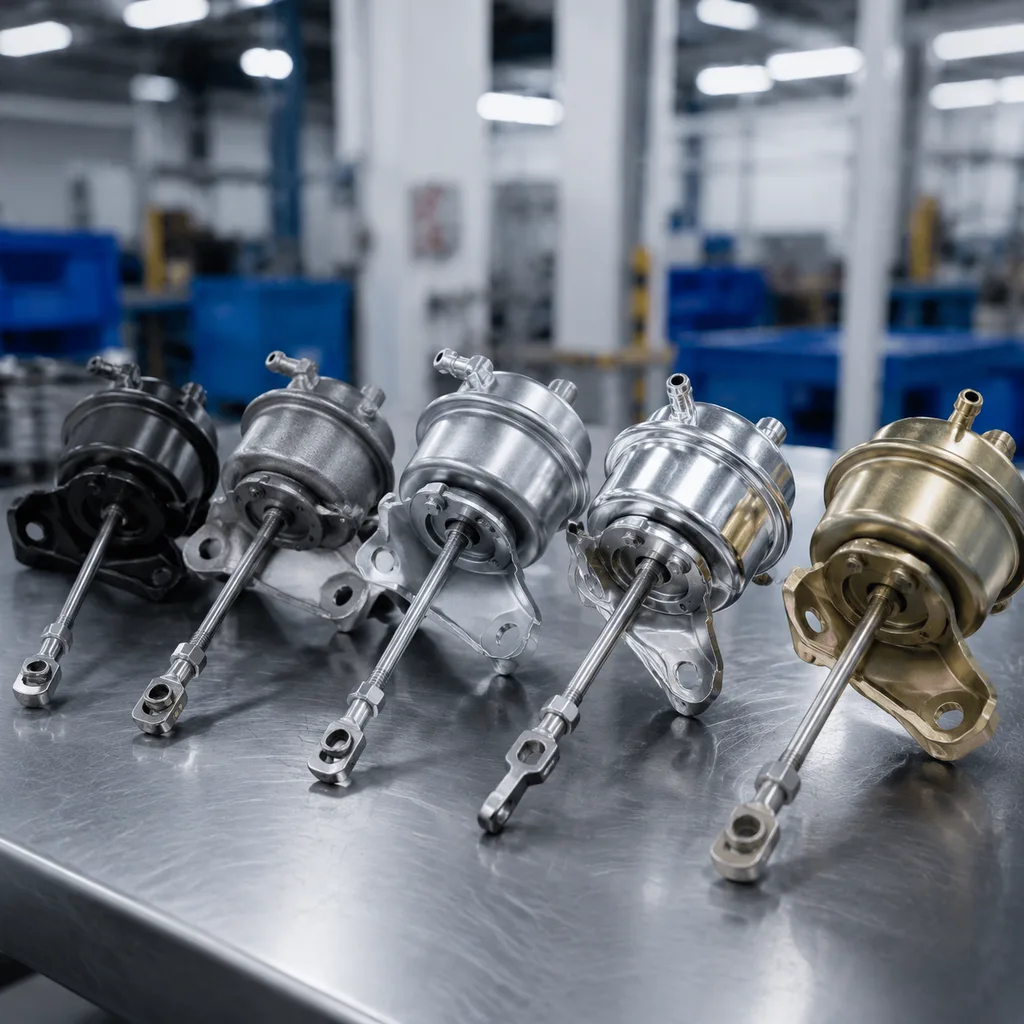
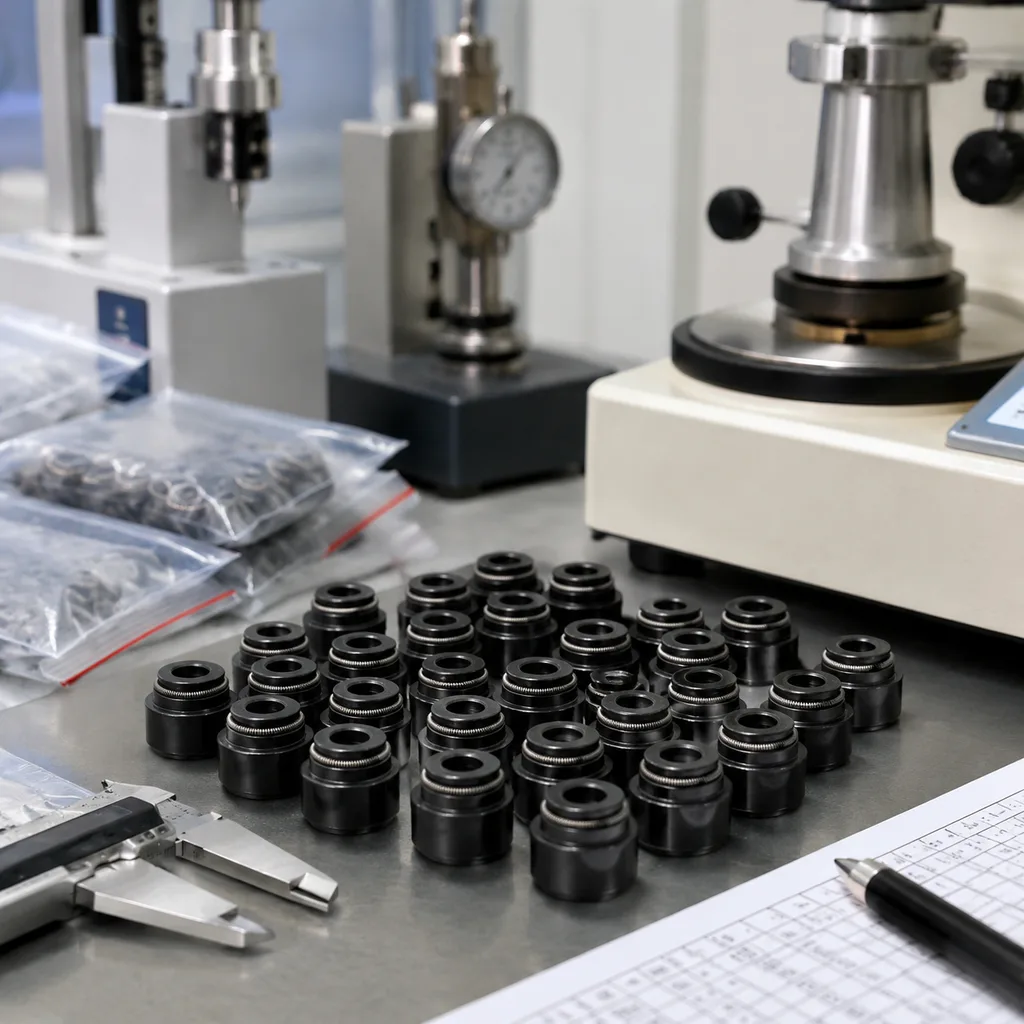
Turbo actuators operate close to the turbine housing, where sustained heat, vibration, moisture and road salt can trigger drift, seizure, connector failure or leakage. For procurement teams, a turbo actuator material grade comparison is not just a design exercise; it is a supplier verification task that affects warranty exposure, service life and interchangeability across turbocharger programmes. This guide explains how to compare the main material choices used in pneumatic and electronic turbo actuator assemblies, including housings, shafts, gears, springs, diaphragms and electrical connectors. It also gives a practical RFQ checklist for sourcing engineers, category buyers and import managers. Driventus manufactures turbocharger and powertrain components in Taizhou, Zhejiang, under IATF 16949:2016 and ISO 9001:2015 controls, with export supply to aftermarket distributors, OEM/Tier-1 suppliers and repair chains. Driventus is an independent aftermarket manufacturer; brand names are referenced for fitment only.
1. Define the actuator type before comparing materials
Material selection depends on whether the actuator is pneumatic, vacuum-operated, pressure-operated or electronic. A pneumatic actuator normally relies on a diaphragm, spring, rod and bracket. An electronic actuator adds a motor, reduction gears, position sensor, PCB, connector and sealed housing. These parts face different failure modes, so the comparison should be made at component level rather than by the actuator assembly alone.
Use the following procedure before issuing an RFQ:
1. Confirm actuator type: pneumatic, vacuum, pressure or electronic. 2. Identify operating location: mounted on turbocharger, compressor housing, bracket or remote linkage. 3. Record thermal exposure: continuous and peak temperature near the housing, including the expected range at the actuator body and connector. 4. Confirm linkage travel and force requirements, including nominal stroke, minimum stroke, maximum stroke and return-force target. 5. Check whether the actuator is supplied alone, with calibration, or as part of a turbocharger assembly. 6. Specify environmental requirements: salt spray, humidity, dust, oil mist and vibration. 7. Request material declarations for restricted substances under REACH (EC) No 1907/2006 where required for EU customers. 8. Define the acceptance window up front: dimensional tolerance, actuation force tolerance, leakage limit, electrical resistance limit and coating thickness requirement.
A correct turbo actuator material grade comparison starts with these boundary conditions. A high-grade alloy in one part does not compensate for an unsuitable seal, weak connector or poor calibration process. If the part will run near the turbine-side heat shield, a buyer should also specify the expected continuous service temperature and the peak short-duration temperature, because the same polymer may be acceptable at 110 °C continuous but marginal at 150 °C peak. For sourcing purposes, it is also helpful to state the required sampling level, for example 5 pilot units for dimensional checks, 10 units for validation, and a minimum of 30 endurance-cycle units when the customer expects repeatable calibration data.
2. Compare material grades by actuator component
The table below summarises common material choices and the main trade-offs. Exact grades should be agreed through drawings, samples and validation data, not by catalogue descriptions alone.
Component
Common material options
Procurement advantages
Risk if underspecified
Electronic actuator housing
Die-cast aluminium alloy, glass-filled PA66, PPS
Aluminium improves heat dissipation; PPS gives higher heat resistance than standard nylon; PA66-GF is cost-efficient for moderate heat zones
Warping, loss of sealing pressure, connector misalignment
Water ingress, intermittent signal, terminal oxidation
</tr></thead><tbody> </tbody></table>For most sourcing programmes, the best approach is not to specify the most expensive grade everywhere. Instead, identify the parts exposed to heat, corrosion and mechanical wear, then request a supplier justification for each grade. A buyer can push for a lower-cost polymer housing only if the supplier can show a validated thermal margin, for example a 20 °C buffer between the material heat-deflection threshold and the measured housing temperature under worst-case duty. Likewise, a coated carbon-steel rod should only be accepted if the coating type, thickness and corrosion result are all declared, such as 8–15 μm zinc-nickel or equivalent performance that passes the target salt-spray hour requirement. Driventus can align material options with application drawings through custom manufacturing.
3. Key tests to request from suppliers
A material grade is only meaningful when supported by process control and validation. Buyers should ask suppliers for test evidence linked to the actuator design, not generic raw-material certificates.
Recommended verification items include:
Dimensional inspection: mounting hole position, linkage length, shaft diameter, connector geometry and housing flatness, with critical dimensions reported to the agreed tolerance, for example ±0.05 mm on machined interfaces, ±0.10 mm on molded locating features and flatness within 0.15 mm where sealing depends on the face.
Thermal cycling: repeated exposure between low-temperature storage and elevated under-bonnet temperature, with function check after cycling; request the exact profile, such as -40 °C to 125 °C for 100 cycles or a customer-defined equivalent.
Salt spray or corrosion testing: suitable for actuator shells, rods, brackets and fasteners used in markets with winter road salt; specify a minimum target such as 96, 240 or 480 hours depending on market severity and warranty level.
Vibration testing: to confirm PCB, motor, gear train and connector stability for electronic actuators; ask for frequency range, acceleration level and dwell time, not just a pass/fail statement.
Leakage testing: required for pneumatic or vacuum actuators, including diaphragm and crimp-zone integrity; define maximum allowable leak rate, such as no visible pressure decay over 30 seconds or a quantified mbar/min limit.
Actuation force and travel testing: confirms spring rate, stroke range and repeatability; require force at specified stroke positions, not only nominal spring material.
Electrical response testing: position feedback, motor current, connector pin continuity and response time for electronic units; request output voltage, resistance, current draw and signal stability limits.
Material declaration: RoHS and REACH (EC) No 1907/2006 documentation when applicable to the target market.
Process capability evidence: at least initial Cp/Cpk or equivalent where dimensions or calibration are sensitive, with a buyer target such as Cpk ≥ 1.33 on key-to-function dimensions.
For factory assessment, review whether the supplier operates under IATF 16949:2016 and ISO 9001:2015. These standards do not prescribe a specific actuator material, but they require controlled processes, traceability, change management and corrective action systems. Buyers should also ask whether the supplier maintains incoming material lot traceability, calibration records for test equipment and defined reaction plans for out-of-spec results. Driventus publishes an overview of its quality system for buyers conducting pre-award review.
4. Step-by-step RFQ checklist for material comparison
Procurement teams can reduce ambiguity by using a structured RFQ format. The following checklist is suitable for aftermarket distributor sourcing, repair-chain private label programmes and Tier-1 technical review.
RFQ data to provide
Application list and turbocharger family, if available.
OE cross-reference format where relevant, for example OE 06A… or OE 11251…, without implying vehicle-maker approval.
Sample quantity and target annual volume.
Required actuator type: pneumatic, vacuum, pressure or electronic.
Target markets: EU, UK, US, Canada, Australia or Brazil.
Packaging requirement: bulk, neutral box, private label or kit packaging.
Target warranty period and expected field environment.
Required tolerances on critical dimensions, calibration points and connector orientation.
Required operating range, such as stroke, force, current draw or leak limit.
Required validation standard, such as in-house approval, customer PPAP or third-party test report.
Supplier documents to request
Bill of materials with material grade or material family for key components.
Control plan for incoming material, machining, assembly and end-of-line testing.
PPAP-level documentation where required by the customer.
Dimensional report based on approved drawing or reverse-engineered benchmark.
Functional test report for travel, force, leakage and electronic response.
Change-notification procedure for material, coating, mould or sub-supplier changes.
Typical production lead time by volume tier, with a firm commitment for each part number.
MOQ by configuration, including sample, pilot and mass-production quantities.
A useful commercial request is to ask the supplier to quote three options: sample batch, pilot batch and regular production. For example, a supplier may offer 20–50 pcs sample quantity with 7–15 days lead time, 100–300 pcs pilot quantity with 15–25 days lead time, and 500+ pcs mass production with 25–40 days lead time depending on tooling, calibration and testing load. Buyers should also request price breaks by volume, such as a sample price, a 100-piece price, a 500-piece price and a 1,000-piece price, so that landed cost can be modeled against forecast demand instead of evaluated on a single number.
After receiving quotations, compare suppliers on total control capability, not only unit price. A lower-cost actuator with an unverified housing resin, unprotected rod or inconsistent spring force can create returns that exceed the initial saving. A buyer should weigh price against incoming inspection burden, defect containment cost and the risk of field returns by asking the supplier to state the rejection policy, replacement lead time and corrective-action response time. For current turbocharger-related references, buyers can review our catalog before sending samples or drawings.
5. Practical trade-offs by material family
A useful turbo actuator material grade comparison should separate cost reduction from risk reduction. The following trade-offs are common in sourcing discussions:
Aluminium housing vs engineering plastic: aluminium improves thermal conductivity and dimensional stability near the turbine side, but adds weight and tooling considerations. Engineering plastics can be suitable when heat shielding and distance from the turbine are adequate. As a rule of thumb, aluminium is preferred when the housing sees sustained temperatures above about 120 °C or when dimensional drift cannot exceed a few tenths of a millimeter across the service range.
Stainless steel rod vs coated carbon steel rod: stainless steel usually improves corrosion resistance, especially in wet or salted environments. Coated carbon steel may be acceptable where the coating process is tightly controlled and validated. If the vehicle will operate in coastal or winter-salt markets, buyers should request a corrosion target and a coating thickness report, not only a “stainless option” description.
POM gear vs metal gear: POM offers low friction and quiet operation, but can deform or wear under excessive load or heat. Metal gears improve strength but may increase noise and require careful lubrication. A practical comparison should include backlash growth after endurance cycling, for example a target increase of no more than 0.2–0.3 mm unless the customer specification says otherwise.
NBR diaphragm vs FKM diaphragm: NBR is cost-efficient for many pneumatic actuators. FKM is preferred where temperature, oil mist or chemical exposure is higher. Buyers should ask for temperature rating, compression-set data and leakage performance, because material name alone does not tell you whether the diaphragm will hold calibration after heat soak.
Tin-plated vs higher-grade terminals: tin plating is common and economical. Higher-grade terminal systems may be required when vibration, temperature cycling or low-current sensor stability is critical. For electronic units, terminal choice should be paired with insertion force, pull-out force and contact resistance limits, such as a maximum contact resistance threshold agreed in the drawing pack.
Do not evaluate a material in isolation. For example, an FKM diaphragm still fails if the shell crimp geometry is inconsistent. A stainless rod can still seize if the bushing material and surface finish are poorly matched. Material selection must be paired with tooling accuracy, assembly fixtures and end-of-line calibration. Buyers should request the supplier’s control on mating clearances, for example shaft-to-bushing clearance, gear center distance and connector pin alignment, because those tolerances often determine whether the selected grade performs as intended.
6. What to verify during sample approval
Sample approval is where material claims should become measurable evidence. Ask for at least three sample groups: dimensional inspection samples, functional endurance samples and packaging/shipping samples. For electronic actuators, include communication and feedback checks according to the customer’s diagnostic requirements. For pneumatic actuators, include vacuum or pressure leakage and stroke repeatability checks.
A basic approval file should include:
Drawing with critical-to-function dimensions marked.
Material list for housing, rod, spring, diaphragm, seals, gears and connector.
Coating specification and corrosion test result for external metal parts.
Stroke-force curve or calibration data.
End-of-line test record with traceability code.
Packaging drop or vibration result if the actuator is sold as an individual aftermarket part.
Sample identification, lot code and revision level so the approved sample can be locked to a specific build configuration.
Acceptance criteria with numbers, such as stroke tolerance, force tolerance, electrical current range, leakage limit and connector seating depth.
During approval, buyers should verify the actual part-to-print match rather than relying on a visual fit check. A good practice is to measure at least five units from the same lot and compare mean value, range and outlier behavior. If the actuator is adjustable or calibrated, ask the supplier to disclose the adjustment method, the calibration tool used and the recheck frequency after assembly. If the program is sensitive to warranty cost, define a revalidation trigger in advance, such as any material change, sub-supplier change, mold cavity repair or process relocation.
Where a customer needs a specific mounting bracket, connector orientation, spring rate or private-label package, Driventus can review the application through custom manufacturing. The final specification should be frozen before mass production, with any material substitution handled through formal approval. Driventus is an independent aftermarket manufacturer; brand names are referenced for fitment only.
Frequently asked questions
The highest-risk materials are usually the housing, output shaft, spring, diaphragm or seals, and connector system. These parts determine heat resistance, corrosion resistance, leakage control and signal reliability. For electronic actuators, gear and PCB protection also need clear specification. Buyers should also set the numeric tolerances that define acceptable performance, such as stroke window, leak limit, coating thickness and contact resistance, because material name alone is not enough for sourcing control.
Not always. Stainless steel improves corrosion resistance, but coated carbon steel can be suitable when coating thickness, salt-spray performance and surface finish are controlled. The decision should reflect climate, warranty target, cost and validation results. A practical RFQ should ask for rod diameter, straightness tolerance, coating spec and corrosion hours so the choice can be compared on equal terms.
Yes. Driventus can review drawings, samples, material requirements and target market regulations, then propose a controlled manufacturing route. Final approval depends on validation results, tooling feasibility and agreed inspection criteria. Buyers can also request sample-stage and mass-production-stage pricing, MOQ and lead-time commitment so the material choice is aligned with commercial targets before release.
For a material review, sample comparison or RFQ package, send your actuator drawings, photos and target volumes. Driventus will respond with sourcing options and validation requirements through [request a quote](/contact.html).