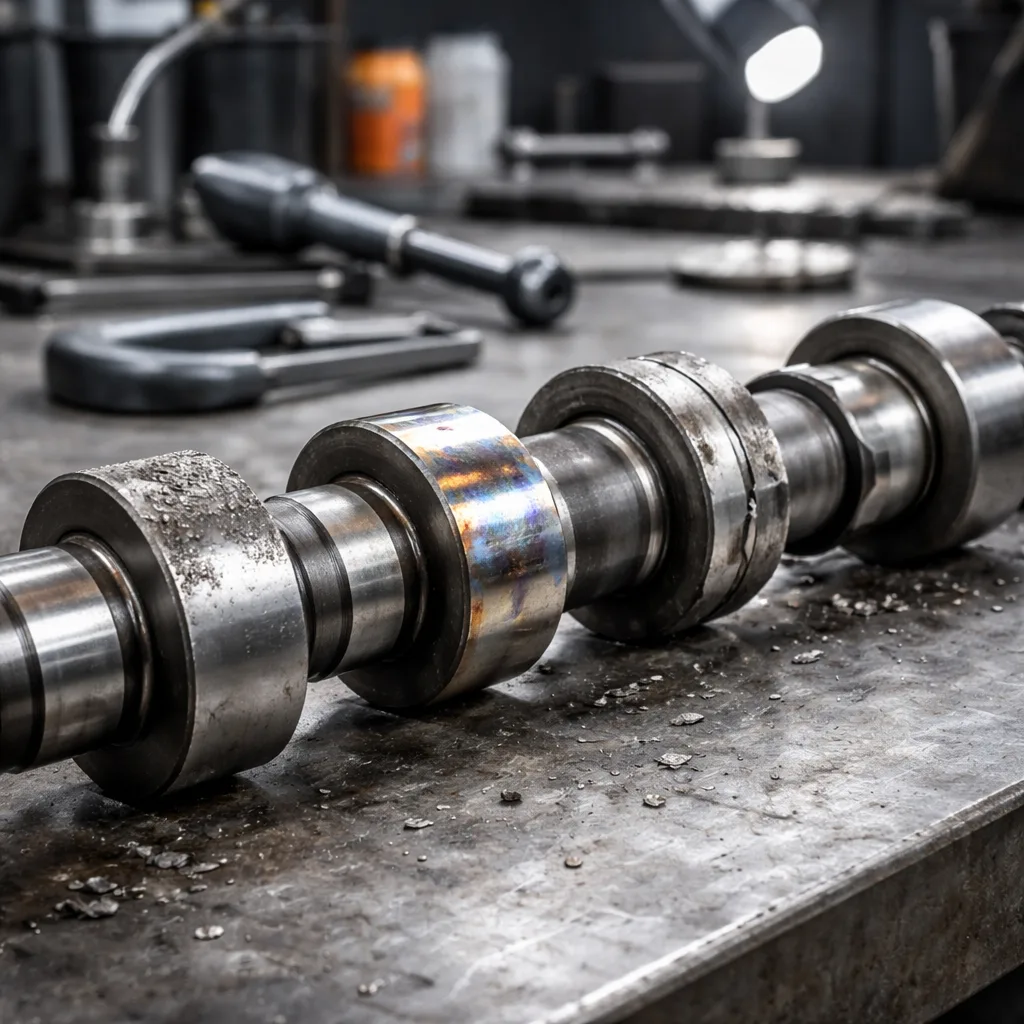
A camshaft for Dodge Charger OE equivalent replacement programs cannot be sourced from a catalogue title alone. The buying risk sits in the details: engine family, cam position, datum scheme, journal geometry, lobe profile, oil-feed alignment, heat treatment, surface finish, cleanliness, traceability, and packaging. One small miss—a 0.05 mm dimensional shift, a mixed intake/exhaust label, an unprotected journal—can become a labour claim, noisy valve train, timing fault, check-engine complaint, or early lobe wear.
This article treats sourcing as a controlled engineering decision, not a generic price enquiry. It explains how procurement teams can specify and evaluate an OE-equivalent replacement camshaft without implying approval by the vehicle manufacturer. The target is replacement-market performance: physical interchangeability, controlled metallurgy, repeatable production, documented validation, and batch consistency.
Driventus supplies engine and powertrain components from Taizhou, Zhejiang, under IATF 16949:2016 and ISO 9001:2015 controls, with exports to more than 60 countries. Driventus is an independent aftermarket manufacturer; vehicle and brand names are referenced only for fitment identification.
Decision framework: define “OE-equivalent” before asking for price
In replacement sourcing, “OE-equivalent” should mean the camshaft installs and functions within the same application envelope as the original component. It should not be used as a loose marketing phrase. It does not mean the part is approved, endorsed, licensed, or supplied by the vehicle manufacturer.
Before any price comparison, the RFQ should translate “equivalent” into inspection points, tolerances, materials, and evidence. A practical buyer specification defines the functional match by drawing, inspection layout, or approved sample. Control points usually include:
Overall length and datum locations, commonly held within ±0.10 mm unless the drawing requires tighter control
Journal diameters, roundness, cylindricity, and surface finish; many programs target diameter tolerance of ±0.010 to ±0.020 mm and roundness below 0.005 mm on bearing journals
Lobe lift, base-circle diameter, flank profile, and phasing; lobe lift is often controlled within ±0.03 mm, with profile checked against a master trace
Thrust face location, thrust width, and end-float control surface
Oil-hole position, diameter, chamfer, and burr-free condition; drilled oil passages should be visually or borescope checked after cleaning
Sensor trigger feature geometry, tooth count, slot width, angular position, and edge condition where applicable
Intake, exhaust, bank, and variable valve timing configuration, clearly separated by SKU
Material grade, casting or forging route, heat treatment, hardness range, and any case-depth requirement
Cleanliness, rust prevention, individual protection, and export packaging suitable for ocean freight
For a camshaft for Dodge Charger OE equivalent program, cross-reference work should start with application, engine code, model year range, camshaft position, and the buyer’s internal reference. The Charger name spans multiple engine families and production periods, so a broad fitment line is not enough for bulk purchasing. Where catalogues use OE-style references, keep them buyer-supplied and controlled rather than inventing brand-owned numbers.
Driventus can review drawings, samples, or customer fitment tables through custom manufacturing for private-label or distributor-specific programs. The review should compare the sample and drawing at datum level, confirm the inspection method for each special characteristic, and decide which features require 100% checking, batch sampling, or capability study before release.
Spec deep-dive: dimensions that separate a usable camshaft from a claim
Visual comparison is a weak validation method. Two camshafts can look identical on a bench while one has incorrect lobe centreline, thrust location, oil-feed alignment, or sensor geometry. In a valve-train system, those errors affect oil-film stability, timing accuracy, noise, and wear.
Use dimensional evidence first.
Control item
Typical buyer target
Verification method
Journal diameter
±0.010–0.020 mm to approved drawing/sample
Micrometer, air gauge
Journal roundness/cylindricity
≤0.005–0.010 mm where bearing clearance is critical
Roundness tester
Journal surface finish
Ra 0.2–0.4 µm typical target
Profilometer
Lobe lift
±0.02–0.05 mm depending on application
Cam profile measuring machine
Base circle
±0.02–0.04 mm
Cam profile machine, micrometer fixture
Lobe phasing/centreline
±0.5° to ±1.0° crank-equivalent target where specified
CMM or dedicated cam fixture
Thrust face location
±0.03–0.08 mm
CMM, height gauge, fixture
Runout/straightness
≤0.03–0.05 mm total indicator reading
V-block and dial indicator or CMM
Oil-hole diameter/position
Diameter ±0.05 mm; position per drawing
Pin gauges, borescope, CMM
Hardness
Per material route, commonly HRC or HB range by zone
Rockwell, Brinell, microhardness
Cleanliness
Particle size/count agreed by buyer
Wash test, filter inspection
</tr></thead><tbody> </tbody></table>These figures are RFQ ranges, not replacements for the original drawing or approved master sample. Their value is practical: they reveal whether a supplier understands camshaft precision before tooling, sampling, or price confirmation.
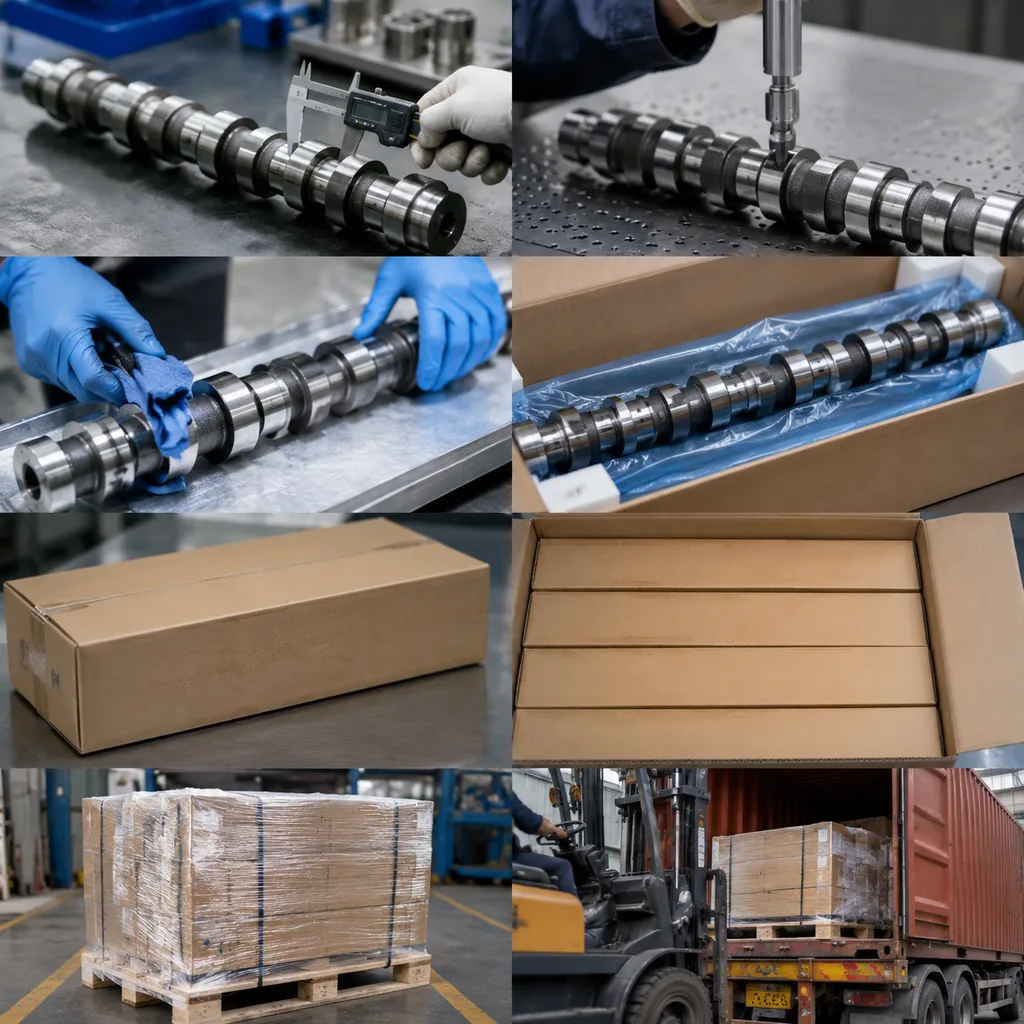
The inspection layout should show datum references, instrument type, sampling frequency, and reaction plan. A typical control plan may require 100% runout and oil-hole visual inspection, first/last-piece lobe profile checks per shift, and a full dimensional report for 5 pieces from the first mass-production lot. Driventus can align production controls with PPAP-style documentation when requested, including dimensional reports, material certificates, heat-treatment records, control plans, and inspection records.
Do not approve a high-volume program from one polished prototype. Request initial sample inspection from more than one production batch where possible. A sound release path is 3 to 5 initial samples, then pilot production of 50 to 200 pieces, followed by mass production only after fitment, noise, oiling, and packaging checks are accepted. Driventus’ quality system is structured around IATF 16949:2016 and ISO 9001:2015 requirements, including document control, traceability, corrective action, and process monitoring.
Failure modes: where material and heat treatment usually go wrong
Camshaft wear problems rarely come from one number on a hardness report. They come from a mismatch between material route, follower type, lubrication condition, contact stress, and heat-treatment control. Common aftermarket routes include chilled cast iron, alloy cast iron, ductile iron, induction-hardened steel, and machined steel billets or forgings for specific applications. The correct option is the one that matches the original functional requirements and mating components. More hardness is not automatically better.
Build the procurement specification around failure prevention:
Material grade or equivalent chemical composition range, with melt or heat number traceability
Casting, forging, or machining route, including whether lobes are chilled, induction hardened, nitrided, or otherwise treated
Heat-treatment method, furnace or induction record, quench medium where relevant, and acceptance range
Lobe and journal hardness requirements; cast camshafts may use HB/HRC targets while induction-hardened steel may require surface hardness plus case depth
Case depth or hardened-layer requirement, for example effective case depth checked at an agreed hardness threshold
Microstructure acceptance criteria for cast camshafts, including graphite form, carbide distribution, chill depth, or matrix structure where specified
Maximum decarburisation, porosity, crack, grinding burn, or surface defect limits
Magnetic particle, dye penetrant, or visual crack inspection requirement for high-risk lots
Coating, phosphate, rust-prevention oil, or VCI preservation requirement
Cleaning process before packing, including oil passage flushing and blow-out
Under-hardening can accelerate lobe wear, create metallic debris, contaminate oil, and trigger warranty claims. Over-hardening can cause brittleness, grinding cracks, or poor compatibility with the mating follower. A single hardness value without location, method, and tolerance is not enough. A useful report identifies the lobe nose, lobe flank, base circle, journal, thrust face, test load, measured values, batch number, and acceptance range.
For distributors and repair chains, the commercial question is batch stability. Does the second shipment perform like the approved sample? Heat-treatment records should be linked to batch traceability, and hardness testing should be performed at agreed locations. If the camshaft uses different hardening zones, the control plan should show the zone map and define how off-zone hardening, soft spots, and grinding damage are detected.
Importers may also need environmental and chemical compliance evidence. Packaging materials, rust preventives, and supplied articles should be reviewed against REACH (EC) No 1907/2006 where required by the destination market. For the EU and UK, buyers should keep technical files, declarations, and supplier compliance statements aligned with their own due diligence process, especially when private-label packaging places importer responsibility on the buyer.
Fitment scenario: the right cam profile, the wrong position, and a costly return
Imagine a receiving team opens a mixed shipment of Charger-related camshafts. The catalogue description looks correct. The profile looks correct. But one SKU separates intake from exhaust by a small sensor trigger difference, and another separates left bank from right bank by oil-feed orientation. If those units are labelled only by a broad vehicle description, the warehouse can ship the wrong part before anyone sees the mistake.
That is why fitment control must be treated as part of quality control. Dodge Charger applications span different engines, model years, and valve-train configurations. Depending on generation and engine family, differences may involve intake versus exhaust position, left-bank versus right-bank location, variable valve timing hardware, sensor trigger design, thrust layout, oil-feed orientation, or superseded references. A single catalogue sentence is not reliable enough for container-level buying.
Recommended fitment controls include:
Engine family and displacement confirmation, not only model name
Model year start/end validation and, where possible, production date split
Intake versus exhaust camshaft distinction, with position printed on the unit label if required
Left-bank and right-bank distinction on V-engine layouts
Variable valve timing feature compatibility, including phaser interface and locating pin geometry
Sensor trigger pattern confirmation, including tooth/slot count and angular reference to datum
Thrust surface, oil-feed, oil-groove, and plug configuration
Supersession control for old and new references, with effective date and market notes
Clear labelling on individual boxes, inner cartons, and master cartons
For distributors managing multiple Charger-related SKUs, the safest tool is a buyer-approved cross-reference file. It should include the customer SKU, supplier SKU, vehicle application, engine code, production date range, camshaft position, buyer-supplied OE-style reference if used, sample status, drawing revision, and packaging code. Lock this file before production. Treat every change as a controlled revision, not an email comment.
Packaging and labelling influence fitment accuracy. Individual boxes should identify SKU, batch or date code, quantity, cam position, and country-of-origin marking where required. Master cartons should be scannable and segregated by SKU; mixed cartons should be avoided unless the buyer approves a defined packing list. For warehouse receiving, useful label data includes part number, description, quantity, gross/net weight, carton number, production lot, PO number, and barcode. Clear labelling reduces mis-picks, mixed returns, and installation errors that can look like manufacturing defects.
Driventus can support application review using buyer-provided samples, drawings, and fitment tables. Standard camshaft and engine components can be reviewed through our catalog and the engine range at /products/engine-components.html.
Step-by-step validation pack for first orders and repeat supply
A camshaft for Dodge Charger OE equivalent supply program should create evidence before shipment, not after a field complaint. The documentation level can scale by order value, warranty exposure, destination market, and whether the item is a catalogue part or custom project. Still, every repeat program should define the evidence required before the first purchase order is released.
Suggested RFQ document pack
2D drawing or controlled inspection layout with datum scheme and tolerances
Buyer-approved sample or reference part, where available
Bill of material or material declaration
Initial sample inspection report, typically 3 to 5 pieces with full dimensions
Material certificate with chemical composition and heat or batch number
Heat-treatment and hardness report by location
Surface roughness report for journals, lobes, and thrust faces
Cam profile inspection data with lift curve or deviation table
Runout or straightness report
Oil-hole, oil-passage, plug, and deburring inspection evidence
Crack inspection evidence if required by application risk
Process flow chart, PFMEA if requested, and control plan
Gauge list with calibration status for critical instruments
Packaging specification, corrosion protection method, and carton/pallet plan
Traceability plan by batch, date code, or lot number
For larger programs, ask for capability data on critical dimensions. Many automotive buyers use Cpk ≥1.33 as a practical threshold for stable production characteristics and higher targets for special characteristics, although the agreed requirement should match the buyer’s quality manual. IATF 16949:2016 supports process control, risk management, document control, and continual improvement; it does not replace part-specific validation.
Functional validation may include bench measurement, trial installation, oil-flow inspection, cold and hot noise assessment, start-up lubrication review, and endurance testing agreed between buyer and supplier. A buyer may run 20 to 50 installation checks for a first market release, or a longer durability cycle for high-warranty markets. If engine timing can influence emissions-related behaviour, consider the regulatory environment of the destination market. Standards such as ECE R-83 apply to emissions approval at vehicle level; they should not be presented as camshaft approval standards.
Traceability makes the documentation useful. Inspection reports should identify the part number, revision, batch, inspection date, operator or inspector, instrument or method, measured value, tolerance, sample quantity, and approval status. That level of detail speeds future claim analysis and helps separate installation issues, catalogue errors, handling damage, and true manufacturing defects.
Commercial Q&A before approving a bulk camshaft order
What should be checked besides unit price? Warranty exposure. Camshaft claims can create labour reimbursement, return freight, customer downtime, diagnosis time, and loss of catalogue confidence. A low piece price is not useful if the supplier cannot control traceability, packaging, and claim response.
Which commercial terms should be locked before purchase order release?
MOQ by SKU, mixed-SKU MOQ, and whether first orders can combine pilot quantities with replenishment stock
Sample lead time and mass-production lead time; typical project logic is 15 to 30 days for sample preparation where tooling exists, 35 to 60 days if tooling or fixtures are needed, and 30 to 55 days for mass production after approval, depending on quantity and process route
Price logic by quantity tier, for example prototype/sample pricing, 100–300 pcs, 500–1,000 pcs, and 2,000+ pcs annual-volume brackets
Incoterms, currency, payment terms, packing method, and carton labelling format
Tooling, fixture, gauge, and sample charges, including ownership and maintenance responsibility
Batch traceability on each part or package
Spare parts policy for mixed orders and slow movers
AQL or 100% inspection points for critical features; many buyers require 100% visual/rust/runout checks and sampling for full profile data
Claim response time, containment timing, and evidence required; a practical target is 24–48 hours for initial response and 5–10 working days for 8D analysis after parts are received
Whether private labelling, neutral packaging, or barcode integration is required
Destination compliance documents for the EU, UK, US, Canada, Australia, or Brazil
Packaging strength for ocean freight, palletisation, warehouse stacking, and long storage periods
Why is packaging part of the quality decision? Precision journals and lobes are vulnerable to impact, moisture, corrosion, and abrasion. Rust-prevention oil, sleeves, VCI bags, formed pulp or plastic inserts, separators, end caps, or individual foam protection may be required depending on the route and storage period. Ask for a packaging specification with carton size, gross weight limit, pallet pattern, desiccant or VCI method, anti-rust period target, and photos of packed samples. For critical programs, request drop-test or transport simulation evidence before the first container ships.
What does a reliable supplier need from the buyer? Driventus manufactures camshafts and related engine components within an integrated supply base in Taizhou. For distributor lines and repair-chain replacement programs, the goal is repeatable production: controlled dimensions, stable metallurgy, protected shipment, clear labelling, and audit-ready documentation.
If your team is comparing suppliers, include drawings, samples, annual volume, target market, target price range if available, expected MOQ, claim history, and packaging requirements when you request a quote. That information helps engineering and commercial teams respond with fewer assumptions and a more realistic sourcing proposal.
Frequently asked questions
Yes. Driventus can review buyer-provided fitment data, samples, or drawings for replacement camshaft supply. OE-equivalent means designed for functional interchangeability in the aftermarket. It does not mean approval, endorsement, licensing, or supply by the vehicle manufacturer.
Provide the engine application, model year range, intake or exhaust position, bank position if applicable, sample photos, key dimensions or drawing, buyer SKU, annual volume, destination market, packaging requirement, and any target inspection standard. If you use an internal or OE-style reference, include it in the RFQ file for controlled cross-reference.
Driventus operates under IATF 16949:2016 and ISO 9001:2015 quality management controls. Part-specific validation, inspection reports, material certificates, heat-treatment records, capability data, packaging evidence, and traceability documentation can be discussed according to the buyer’s order volume and technical requirements.
For camshaft sourcing, send your application list, sample requirements, drawings or reference data, destination market, target volumes, MOQ expectations, and packaging requirements for a technical review. Contact Driventus to discuss replacement supply or private-label production at /contact.html