RoHS Testing for Valve Stem Seal: Buyer Checklist
RoHS testing for valve stem seal procurement should not be handled as a last-minute certificate request. The real question is whether the seal’s rubber, metal insert, garter spring, coating, adhesive, pigments, and process residues are controlled from approved material to shipped batch.
For B2B buyers sourcing aftermarket or OE-equivalent valve stem seals from China, the risk is rarely the finished part name. It is the hidden material change: a new pigment, cheaper coating, alternative adhesive, or unapproved compound used after the first sample passes. This guide gives sourcing engineers, importers, and distributors a practical way to specify, verify, and maintain RoHS evidence without turning every repeat order into a laboratory project.
It covers decision points, document review, lab-report red flags, supplier qualification, and PO-release checks. It also shows how RoHS controls can sit alongside IATF 16949:2016 and ISO 9001:2015 systems for traceability, document control, supplier management, and change approval. Driventus is an independent aftermarket manufacturer; brand names and OE references are used for fitment identification only.
Decision point: does your valve stem seal actually need RoHS evidence?
Start with scope. RoHS usually refers to Directive 2011/65/EU and amendment Directive (EU) 2015/863, which restrict hazardous substances in electrical and electronic equipment. A valve stem seal is normally a mechanical engine component, not an electrical product.
That does not mean buyers can ignore RoHS requests. Many importers ask for RoHS declarations for rubber-metal parts because the seals may be supplied in service kits, exported assemblies, private-label programmes, or customer compliance systems where the same restricted-substance rule is applied to all purchased components.
Use this decision logic:
- If the seal is sold as a standalone mechanical aftermarket component, RoHS may be a customer documentation requirement rather than a direct legal requirement.
- If the seal is included in a larger assembly or kit covered by a customer compliance file, RoHS evidence may be mandatory under the buyer’s contract.
- If the buyer’s internal restricted-substance system requires RoHS and REACH evidence for all rubber, metal, plastic, and coated parts, treat the seal as in-scope for procurement control.
- If the application, destination, or customer is unclear, state the required declaration and report basis in the RFQ before price negotiation.
The standard RoHS limits are 0.1% by weight, or 1,000 mg/kg, for lead, mercury, hexavalent chromium, PBB, PBDE, DEHP, BBP, DBP, and DIBP, and 0.01% by weight, or 100 mg/kg, for cadmium. These limits apply to homogeneous material, not the finished part averaged as one mass.
For a valve stem seal, that distinction matters. The elastomer body, plating layer, adhesive layer, spring coating, and packaging material can each carry different risk. Do not let a supplier average a small non-compliant spring coating into a large rubber body and call the finished seal compliant.
Review these material areas separately:
- Elastomer body: FKM, ACM, NBR, HNBR, VMQ, or PTFE, including pigments, fillers, plasticizers, accelerators, and processing aids
- Metal insert or case: carbon steel, stainless steel, or plated steel, commonly 0.20–0.50 mm thick depending on design
- Garter spring: carbon steel or stainless steel wire, often 0.20–0.60 mm wire diameter, with any anti-corrosion coating or treatment
- Bonding agent or adhesive layer between rubber and metal, especially primer/topcoat systems
- Lubricant, release agent, or process residue from moulding, trimming, and assembly
- Packaging inks, labels, PE bags, desiccants, and anti-corrosion papers if the buyer includes packaging in the compliance scope
RoHS also does not replace REACH (EC) No 1907/2006. REACH addresses substances of very high concern and wider chemical management obligations. A European import file often contains both RoHS and REACH statements, even when the valve stem seal itself is not directly within RoHS legal product scope.
Seven-step workflow that prevents certificate surprises
A clean approval process starts before the purchase order. The aim is not to collect more paperwork. It is to make sure the report, the material, and the shipped part all describe the same construction.
Follow this sequence for a valve stem seal programme:
1. Lock the requirement in the RFQ or drawing note. State whether RoHS is mandatory, customer-specific, or requested for documentation only. Include the applicable substance list, required declaration wording, mg/kg reporting basis, and accepted report validity period, commonly 12 or 24 months. 2. Ask for the material-family BOM. Buyers do not need confidential recipes, but they do need enough detail to identify elastomer type, hardness range, metal grade category, plating or coating, adhesive, and spring material. 3. Collect declarations by controlled material. A useful declaration identifies supplier name, part family or material family, material type, date, responsible contact, and revision status. 4. Review third-party lab reports before sample approval closes. Check sample description, test method, analytical equipment, detection limit, restricted substances, measured values, and conclusion against RoHS limits. 5. Match the tested sample to the production route. The report must correspond to the actual compound, coating, spring, adhesive, and process used for mass production. “Similar material” is not enough unless equivalence is documented. 6. Tie compliance to incoming inspection. For repeat orders, check that batch certificates and production records match approved suppliers, approved material codes, and the current drawing revision. XRF screening can help for metal/coating lots where practical. 7. Write re-test triggers into the control plan. Re-test or revalidate after changes to elastomer compound, pigment, plasticizer, metal coating, adhesive, spring supplier, production site, or applicable regulation.
A workable sampling model is to test one representative construction per material family, then link all covered part numbers through a controlled equivalence matrix. For first approval, buyers often request 5–20 sample pieces per construction for dimensional and functional review, plus separate material coupons or disassembled components for lab testing.
For repeat production, batch traceability plus annual or two-year document revalidation is usually more efficient than testing every shipment. The exception is a changed material, changed supplier, disputed result, or high-risk customer requirement.
For buyers comparing part families, our catalog is a practical starting point for valve train and engine sealing references.
Evidence pack comparison: weak file versus audit-ready file
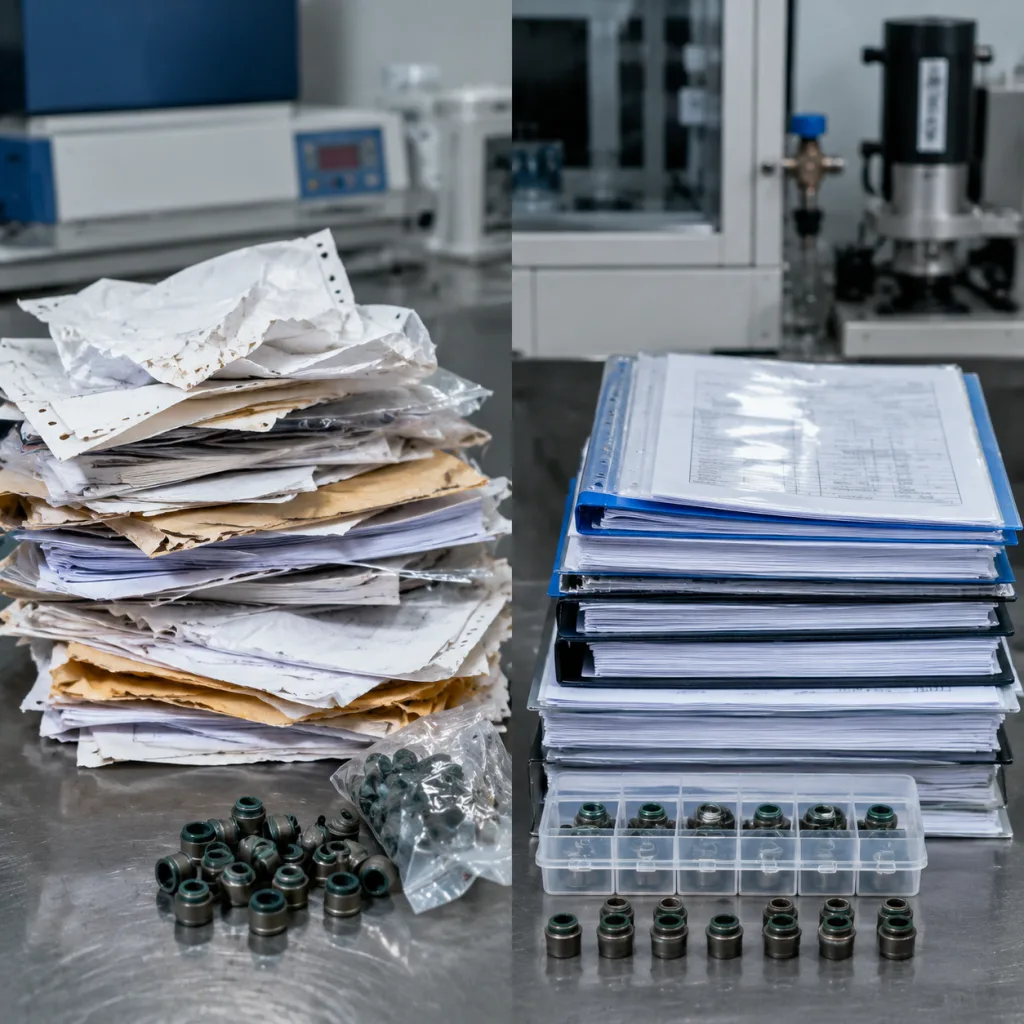
A one-page generic certificate may satisfy a quick enquiry. It is weak evidence for private-label supply, controlled aftermarket programmes, or Tier-1 sourcing. An audit-ready file connects the compliance statement to material control, drawing control, and batch traceability.
| Document | Audit-ready evidence | Failure mode to avoid |
|---|---|---|
| RoHS declaration | Mentions Directive 2011/65/EU and Directive (EU) 2015/863; signed and dated; lists the 10 restricted substances and limit basis | Declaration has no material, part-family, or revision reference |
| Third-party test report | Sample description matches elastomer, metal case, spring, coating, adhesive, or finished seal; results shown in mg/kg or ppm | Report covers only one material while the seal contains several components |
| Material specification | Elastomer type, hardness range, temperature rating, oil compatibility, compression set target, and approved supplier | Generic “rubber” description without grade or compound control |
| Drawing and tolerance file | Stem ID, guide OD, seal height, lip geometry, and spring position are controlled | RoHS report is acceptable, but supplied geometry differs from approved sample |
| Change-control record | Buyer approval required before material, supplier, tooling, coating, adhesive, or process changes | Supplier changes pigment, adhesive, or coating without notice |
| Batch traceability | Production lot links to compound batch, spring batch, metal insert batch, moulding date, and inspection record | Traceability stops at finished goods carton level |
| Quality certificate | ISO 9001:2015 or IATF 16949:2016 certificate matches the manufacturing site where applicable | Certificate is expired or issued to a different facility |