Transmission Mount Packaging Requirements for Export
Transmission mounts are not fragile electronics, yet weak export packing can still erase margin. The usual failures are ordinary and expensive: rubber compressed into a permanent set, studs punching through cartons, plated brackets scuffed in transit, similar references mixed together, origin labels missing, pallets rejected, customs delayed, and warehouse claims opened before the parts reach inventory.
For importers, the packaging decision belongs before production, not at the loading dock. Carton tooling, label artwork, pallet height, barcode data, and CBM all affect quotation, MOQ, lead time, inspection, and landed cost. The risk rises when one shipment contains several rubber hardness grades, bracket geometries, hydraulic and solid designs, or OE cross-reference families that look almost identical once packed.
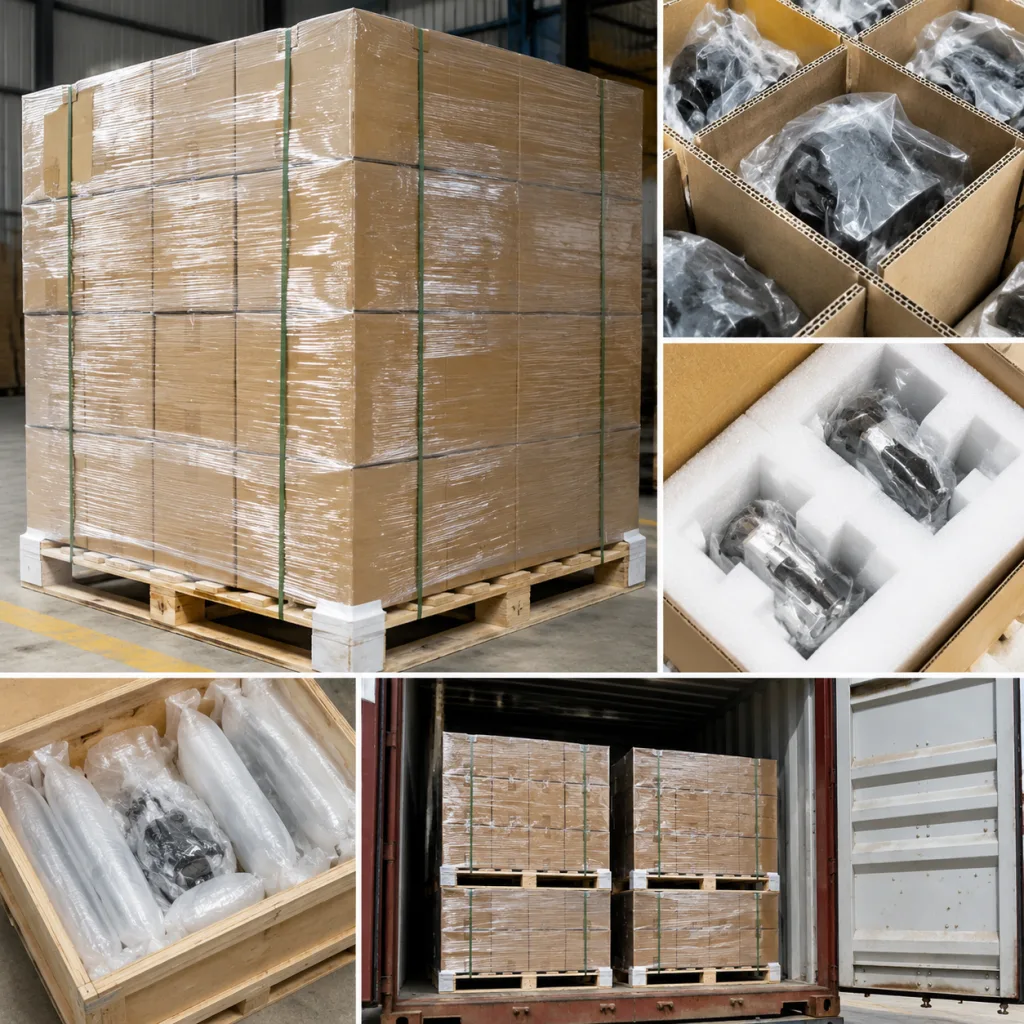
A strong export packing plan defines how each mount is protected, counted, labelled, palletised, loaded, and documented from the factory in Taizhou to the distributor warehouse or assembly point overseas. This guide gives practical transmission mount packaging requirements export buyers can place in RFQs, purchase orders, supplier audits, and pre-shipment inspections. Driventus is an independent aftermarket manufacturer; brand names are referenced for fitment only.
Decision First: Classify the Mount Before Choosing the Pack
Do not start with a standard carton. Start with the part.
A rubber-metal transmission mount may combine vulcanised NR, SBR, EPDM, or other synthetic rubber with steel or aluminium brackets, studs, sleeves, bonded plates, and sometimes hydraulic chambers. Each feature changes the export risk during handling, 25–45 days of sea freight, container dwell time, and warehouse storage.
Use this decision framework before approving the packing method:
Rubber carries load? Keep direct packing pressure off the rubber element. Require visible clearance, a divider, or an orientation rule where stacked parts would load the rubber. Reject packs that create obvious flattening after 24 hours.
Studs or external threads exposed? Cover the full thread with plastic caps, paper tubes, corrugated sleeves, or orientation-controlled dividers. A cap that protects only the tip is not enough.
Painted, plated, or visible bracket surfaces? Prevent metal-to-metal contact with PE bags, kraft paper, EPE foam, honeycomb pads, or corrugated partitions where parts can rub under vibration.
Hydraulic design? Pack fluid-filled mounts in the drawing-specified position where orientation matters. Add “this side up” marks only if that orientation can survive palletising, loading, and receiving.
Similar-looking SKUs? Separate them by inner box, colour dot, carton label, and packing-list line. Never mix two references in one unlabelled inner lot.
High-humidity route? Plan for 60–90% relative humidity, rain during transshipment, container condensation, and tropical storage. Use desiccant or lined cartons only when the buyer’s storage process justifies the added cost.
Procurement teams should send packing expectations during RFQ together with target carton gross weight, pallet height limits, barcode needs, country-of-origin wording, destination labels, expected annual volume, and first-order MOQ. Private labels, printed inner boxes, special dividers, and custom pallet patterns can all change unit price and lead time.
When reviewing our catalog, buyers can flag mount families that need stronger individual separation because of bracket shape, stud length, hydraulic construction, rubber geometry, or visual-finish requirements.
Spec Deep-Dive: Build the Packaging Bill of Materials
A packing instruction should read like a bill of materials, not a vague note saying “standard export carton.” It should name the material, thickness or grade, quantity per pack, carton dimensions, gross-weight limit, label position, sealing method, and approved substitutions. That single document should match the quotation, factory work instruction, label artwork, pallet plan, and final inspection checklist.
A practical hierarchy looks like this:
Packaging level
Practical specification target
Verification point
Unit protection
PE bag 0.03–0.06 mm, kraft wrap, EPE sleeve 1–3 mm, thread cap, or corrugated divider
No metal-to-metal contact; rubber not compressed
Inner box
1 piece for heavy or finished mounts; 2–6 pieces only if separated
Correct label, part number, quantity, barcode if required
Master carton
5-ply double-wall for most bracketed mounts; 10–20 kg gross weight preferred, 25 kg maximum only by approval
Carton strength, sealed edges, matching packing list
Pallet
Export pallet with corner boards, stretch film, and top protection where needed
Stable stacking, pallet label, no overhang
Container loading
Dry 20GP/40GP/40HQ, blocked and braced as needed
No crushed cartons, pallet count matches documents
</tr></thead><tbody> </tbody></table>Carton weight is a commercial and operational choice. In EU, UK, US, Canadian, Australian, and Brazilian distribution channels, many buyers prefer master cartons below 20 kg gross weight for manual handling, although local workplace rules and warehouse practices vary. For dense mounts with cast or stamped brackets, 12–18 kg gross weight per master carton is a useful working range. Keep dimensional tolerance around ±5 mm and gross-weight tolerance around ±5% against the approved packing sheet.
Heavier cartons may look cheaper on the packaging line. They can become expensive later through dropped-carton damage, repacking labour, safety complaints, and shortage claims.
Specify carton grade where possible, such as double-wall BC flute or equivalent for heavy bracketed mounts. If cartons will be stacked above 1.2 m, define edge-crush or burst-strength expectations. If recycled board is allowed, confirm compression performance through internal checks or agreed testing.
For higher-claim routes, add a small validation set: 1-hour compression hold at planned stack load, corner-drop checks from 60–80 cm on a packed carton, and a vibration review after local truck transfer. Do not approve only a sample carton if production cartons may later come from a different source.
Packaging also affects MOQ and price. Plain export cartons with standard labels usually have the lowest MOQ and shortest lead time. Printed private-label inner boxes, custom barcodes, colour cartons, and die-cut dividers may require artwork approval, plate or knife charges, and minimum packaging-material purchases. If annual volume is uncertain, ask the supplier to quote the part price and packaging surcharge separately.
Failure Modes at Pallet and Container Level
Pallet errors are easy to overlook because the parts may be well protected inside the carton. Then the shipment fails at the next layer: pallet marks are missing, cartons overhang, the stack leans, ISPM 15 marks are unreadable, or CBM is higher than quoted.
State the pallet type, footprint, loading limits, and stacking method before shipment booking. Pallet size and height directly change CBM per 1,000 pieces, so this is not just a warehouse preference.
Common export pallet requirements include:
Fumigated or heat-treated wood packaging compliant with ISPM 15 where solid wood pallets are used, with legible marks on at least two sides.
Plastic, plywood, or presswood pallets where the buyer wants to avoid solid wood packaging restrictions.
Maximum pallet height, commonly 1,100–1,600 mm including pallet, depending on racking, forklift access, container plan, and destination warehouse rules.
No carton overhang beyond pallet edges; use a 0 mm overhang rule unless the buyer approves a specific tolerance.
Corner boards on vertical edges for sea freight pallets, plus stretch film and strapping where carton movement is likely.
Pallet labels on at least two adjacent sides, normally showing PO, SKU or mixed-SKU status, carton count, gross weight, net weight, dimensions, and destination.
Mixed-SKU pallets need extra discipline. If one pallet contains several transmission mount references, apply a mixed-pallet label and attach a carton-level packing breakdown. Receiving teams should not need to open every carton to find a slow-moving SKU. A clean rule is one SKU per pallet where volume allows; if not, one SKU per layer or one clearly separated block per SKU.
Container loading has its own risk. Transmission mounts are dense compared with body, trim, or plastic parts, so weight distribution matters. Pallets should be arranged to avoid concentrated axle-weight issues during inland transport and to reduce carton crushing under vibration. Before booking, ask for a loading plan showing pallet count, pallet gross weight, container position, and total declared gross weight.
For LCL shipments, assume more handling. Cargo may be re-stacked, exposed, and transferred several times before reaching the consignee. Stronger cartons, water-resistant outer wrapping, and full-face labels are worth considering.
Lead time also moves with the packing route. Standard plain export packing can often fit the normal production and final-inspection window. Custom pallets, printed cartons, special barcode labels, or customer-specific kitting may add 3–10 working days after artwork approval and packaging-material arrival. If a vessel closing date is fixed, lock pallet rules before deposit or PO confirmation.
Traceability Q&A: Labels, Barcodes, and Export Documents
What must be on the label?
Each inner box and master carton should identify the buyer part number, supplier part number where allowed, quantity, batch or lot number, country of origin, production or packing date, and consignee or customer code where required.
How readable should it be?
Use human-readable text plus barcode. The part number and quantity should be readable from at least 1 m in warehouse lighting. If the buyer uses barcode receiving, confirm barcode type, data fields, print contrast, quiet zone, label size, and label position before mass packing.
Which barcode format is common?
Code 128 is common for part number and lot data. EAN or UPC should be used only where the buyer controls retail or distribution coding.
What label defects should trigger rejection?
No missing labels. No wrong labels. No unreadable barcodes. No label placed across carton seam tape where it will tear during opening.
Can OE cross-references be printed?
Only where agreed. Aftermarket packaging may include OE-style references for fitment mapping, but it should not use brand-owned logos, trademarked packaging designs, or approval language unless the buyer has explicit legal authorisation. Driventus is an independent aftermarket manufacturer; brand names are referenced for fitment only.
A basic export document set should include:
Commercial invoice with buyer and seller details, HS code where agreed, currency, incoterm, and country of origin.
Packing list with SKU, carton count, gross weight, net weight, carton dimensions, pallet count, and CBM.
Certificate of origin where required by destination, customer process, or trade terms.
Bill of lading or airway bill.
Fumigation or heat-treatment certificate for applicable wood packaging.
Material compliance declarations where requested, including REACH (EC) No 1907/2006 for EU supply chains.
Photo record of representative inner packs, master cartons, pallet labels, and loaded container where the buyer requires shipment evidence.
Traceability should connect the carton label to production records, rubber batch records, metal treatment records, packing date, final inspection results, and shipment documents. For rubber-metal bonded products, keep packing records, label files, and lot traceability for at least the warranty period or the buyer’s stated retention requirement. Driventus manages this under an IATF 16949:2016 and ISO 9001:2015 aligned quality system, with lot-level controls for rubber-metal bonded products.
Step-by-Step: Run the Pre-Shipment Packaging Check
Packaging inspection should happen before release, not after the cartons are already on the truck. The buyer’s inspector or supplier quality engineer should verify both the sample carton and the loaded pallets. For a first order, freeze the method from approved samples. For repeat orders, confirm the factory has not substituted thinner bags, weaker cartons, shorter thread caps, or different labels.
Use this sequence:
1. Confirm product reference, revision, rubber hardness where relevant, and order quantity against the purchase order. 2. Check one inner pack from each SKU, or AQL-style samples from each packing format, for correct label, count, and physical protection. 3. Inspect rubber surfaces for compression marks caused by packing pressure; reject visible deformation, tearing, contamination, or forced bending of bonded rubber. 4. Confirm thread caps, separators, sleeves, PE bags, foam, and dividers are fitted where specified. 5. Weigh master cartons and compare with the approved packing specification; investigate cartons outside the agreed ±5% gross-weight tolerance unless quantity explains the difference. 6. Measure carton dimensions where freight CBM is critical; confirm dimensions remain within the approved packing sheet tolerance. 7. Check carton sealing method, tape adhesion, carton damage, moisture exposure, strap pressure, and label legibility. 8. Scan barcodes from representative inner boxes and master cartons using the buyer’s required data format where possible. 9. Verify pallet type, ISPM 15 marks where applicable, pallet height, no overhang, corner protection, stretch film, and pallet stability. 10. Match pallet labels to the packing list, commercial invoice, PO, carton count, gross weight, and mixed-SKU breakdown. 11. Photograph representative cartons, inner protection, mixed pallets, pallet marks, container floor condition, and container loading. 12. Record deviations before release and agree corrective action, rework deadline, and responsibility for added cost.
For custom mount programs, packaging validation can be included in PPAP-style submission packages where the buyer requires it. This is common for OEM, Tier-1, and private-label distribution programs using custom manufacturing. Packaging drawings, label artwork, approved carton specifications, test photos, pallet patterns, and change approvals should be controlled documents, especially when several plants or warehouses receive the same part family.
Cost Scenario: Cheap Packing vs. Lower Landed Cost
The cheapest carton is not always the cheapest shipment.
A weak pack can create warehouse rework, shortage claims, scuffed brackets, missing labels, customer chargebacks, delayed stock availability, and line-down risk for assembly users. Too much packaging creates a different problem: higher CBM, more disposal cost, more material waste, and slower unpacking. The target is controlled protection with repeatable handling performance and a known cost per shipped unit.
Before order placement, ask competing suppliers for the same data set:
Packing method photos from previous export shipments, including inner protection and pallet condition.
Carton dimensions, pieces per carton, net weight, and gross weight per SKU.
Pallet pattern, pallet gross weight, and estimated CBM per 1,000 pieces.
Packaging cost split, including standard packing, private label surcharge, printed carton cost, and any tooling or plate charge.
MOQ impact for private labels, special dividers, barcode labels, or printed colour boxes.
Lead-time impact for packaging artwork approval, packaging-material procurement, and mass packing.
Label template in English and destination language if required.
Confirmation of ISPM 15 compliance for solid wood packaging.
Traceability format linking carton, pallet, and production lot.
Packaging change control process and approval contact.
Compare offers by landed effect, not only EXW unit price. A lower part price may be worse if the carton count increases CBM by 8–15%, if pallets cannot be double-stacked, or if private-label materials require a high packaging MOQ. When volume is uncertain, request two options: standard export packing for trial or low-MOQ orders, and optimized private-label packing for repeat container shipments. Compare part price, packaging surcharge, pieces per carton, CBM, pallet count, estimated ocean freight effect, and expected claims risk.
Management standards such as IATF 16949:2016 and ISO 9001:2015 do not prescribe a single carton design. They do require controlled processes, documented requirements, and verification where applicable. Environmental and chemical compliance may also apply to packaging materials, inks, coatings, adhesives, and product-contact materials under buyer-specific requirements and REACH (EC) No 1907/2006 for European markets.
Attach the written packing specification to the purchase order. Include acceptable substitutions because packaging material availability can change during production. Any substitution should be approved before mass packing, with photos, revised carton data, and buyer confirmation. It should not be discovered when the container arrives.
Frequently asked questions
The main requirement is preventing rubber deformation and metal-to-metal damage while keeping each SKU traceable. Unit protection, carton weight control, clear labels, and stable palletisation should all be defined before production packing starts. For most export programs, keep master cartons around 12–18 kg gross weight where possible and require thread protection, dividers, or inner boxes for parts with exposed studs or finished brackets.
Usually yes. Solid wood packaging used in international trade commonly needs ISPM 15 heat-treatment or fumigation marking, with the mark visible on the pallet. Some buyers avoid this by specifying plastic, plywood, or presswood pallets, depending on destination rules, cost, availability, and warehouse requirements.
Yes, Driventus can support agreed private-label cartons, barcode labels, packing lists, and pallet specifications for B2B programs. Private-label packaging may affect MOQ, price, and lead time because printed cartons, label artwork, and custom dividers need approval and material procurement before mass packing. Label content must avoid unauthorised brand logos or approval claims and should be confirmed before production packing.
If you need a packing specification reviewed for a transmission mount program, send the SKU list, destination market, annual volume, first-order MOQ target, carton requirements, barcode fields, pallet limits, and preferred incoterm. You can [request a quote](/contact.html).