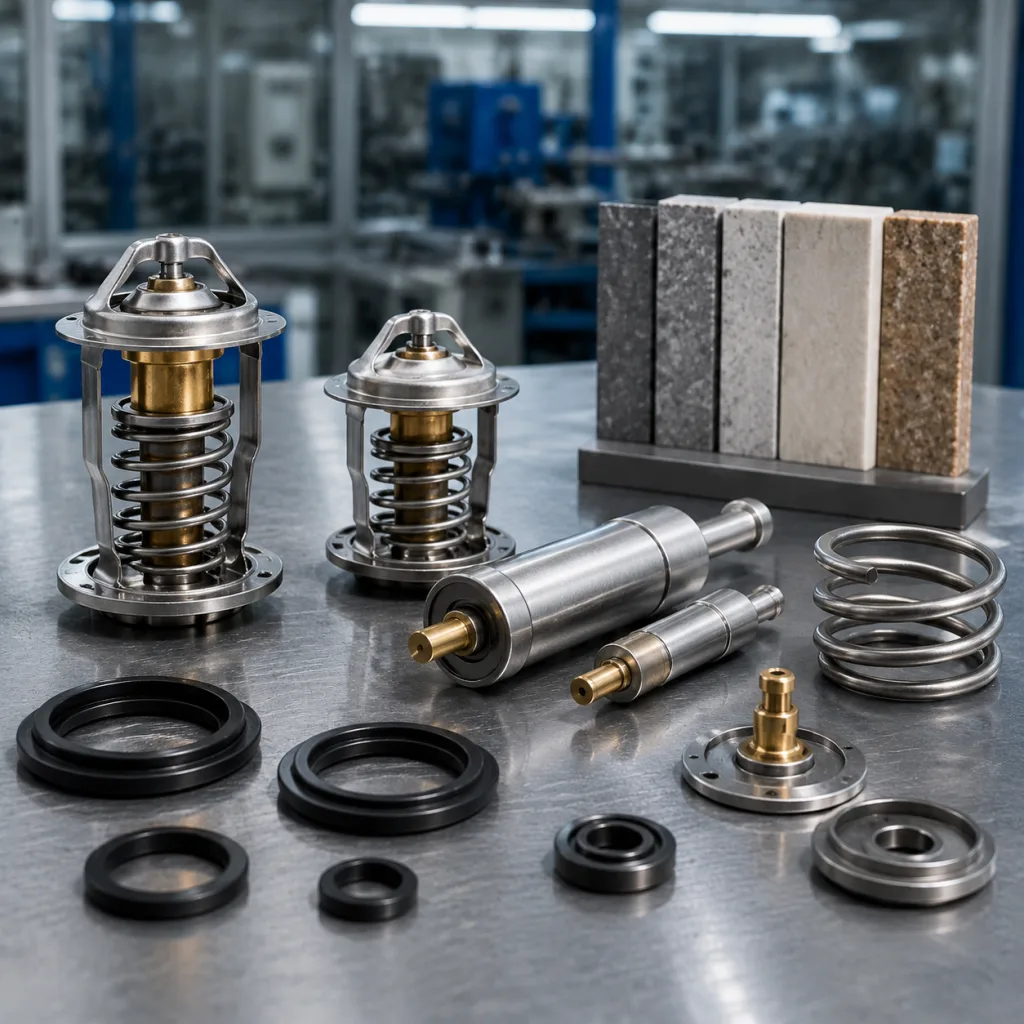
A thermostat is small, but the material stack behind it is not. Housing alloy, spring grade, wax capsule construction, seal compound, and surface treatment all affect warm-up control, coolant sealing, corrosion resistance, and warranty exposure across an engine programme.
This thermostat material grade comparison is written as a sourcing tool, not a generic buyer’s guide. It helps procurement teams decide what to verify before RFQ release, sample approval, PPAP review, or supplier change approval. Driventus manufactures engine and powertrain components in Taizhou, Zhejiang under IATF 16949:2016 and ISO 9001:2015 controls. Driventus is an independent aftermarket manufacturer; brand names are referenced for fitment only.
Start with the thermostat’s failure points
Before comparing grades, identify where the part can fail. The housing does not fail the same way as the wax motor. A spring does not age like an EPDM seal. If the wrong material is used in the wrong zone, the thermostat may still pass appearance inspection and fail in service.
Break the assembly into functional zones:
Housing or flange: aluminium alloy, zinc alloy, engineering plastic, or stainless steel.
Valve plate and frame: stainless steel or plated carbon steel.
Spring: stainless steel or equivalent corrosion-resistant spring material.
Wax motor capsule: brass, copper, or stainless construction with controlled wax media.
Main seal and O-rings: EPDM or another coolant-compatible elastomer.
Bypass valve or jiggle pin: stainless or plated steel.
Sensor port or connector, where applicable: threaded or moulded features that add sealing and dimensional risk.
That breakdown matters because sourcing decisions should match the exposure. Coolant chemistry, clamping load, vibration, thermal cycling, and packaging damage all create different failure modes. A thermostat for a compact high-heat engine bay deserves a different material review than one for a simpler legacy application.
Before releasing an RFQ, request the drawing, nominal opening temperature, tolerance band, pressure rating, coolant exposure requirement, packaging specification, and any buyer-specific inspection standard. If the buyer supplies OE-style references, use them only as fitment references, not as proof of equivalence. Check bolt-hole spacing, flange thickness, hose neck geometry, gasket groove depth, bleed orientation, thread form, and installation torque area. Small mismatches can cause leakage, trapped air, or wrong orientation even when the sample looks correct.
Match housing grades to the risk profile
The housing is usually the first place buyers try to save cost. It is also the first place poor material control shows up as cracks, porosity, warpage, thread damage, or galvanic corrosion. The right grade depends on engine layout, coolant specification, temperature range, clamping method, and installation torque.
Require leak testing, alloy declaration, and casting defect limits
Zinc alloy die casting
Compact housings and covers
Good dimensional repeatability, clean finish
Creep at elevated temperature, coating sensitivity
Confirm coolant exposure, temperature range, and coating spec
Glass-fibre reinforced PA66 or PPS
Plastic thermostat modules
Lower weight, complex geometry, less machining
Hydrolysis, creep, weld-line weakness
Ask for resin grade, heat-ageing data, and moulding controls
Stainless steel shell
Insert thermostats and valve assemblies
Corrosion resistance, stable thin-wall form
Higher forming cost, burrs, crimp variation
Verify grade, edge condition, forming control, and passivation if specified
</tr></thead><tbody> </tbody></table>For aluminium housings, do not stop at “aluminium alloy” on the quote. Ask for alloy designation, heat treatment if used, porosity class, sealing-surface finish, machining datum control, thread quality, and surface conversion treatment. Also confirm whether the part is gravity cast, die cast, or machined, because each process brings a different defect profile.
Plastic housings need more than a simple resin label. A quoted “PA66-GF30” tells you very little unless the supplier also provides resin maker data, glass content, hydrolysis resistance, heat-ageing performance, mould flow control, weld-line assessment, and regrind rules. For high-temperature or compact engine bays, PPS or upgraded PA grades may be justified, but only if the thermal profile and validation plan support the choice.
If the target market has restricted substance requirements, buyers may also request material declarations under REACH (EC) No 1907/2006 and, where applicable, RoHS Directive 2011/65/EU for electrical or sensor-integrated assemblies. Those rules do not define thermostat performance, but they affect disclosure and supplier readiness.
Deep-dive the wax motor, spring, and seal specs
This is where many thermostats pass a visual check and still fail the job. The housing may be fine. The motion system may not be.
Wax motor and opening control
Specify the opening temperature and tolerance first. Common setpoints include 82 °C, 88 °C, and 92 °C, but the drawing controls the requirement. During validation, the supplier should record initial opening temperature, full-stroke temperature, valve lift, and hysteresis after thermal cycling.
Watch for wax leakage, capsule swelling, unstable stroke, and delayed return. Ask how the capsule is made, how the crimp is controlled, how wax fill is verified, and how final calibration is locked. If several temperature versions share similar geometry, the supplier should also explain how mix-up prevention works on the line.
Spring and elastomer choices
For the spring, request the stainless grade or equivalent family, wire diameter, free length, load at working height, surface condition, and fatigue test requirement. Do not accept visual approval alone. Spring relaxation often appears only after repeated hot-cold cycles and sustained hot coolant exposure.
For seals and O-rings, EPDM is the usual choice because it resists ethylene glycol coolant and heat. NBR is generally a poor fit for long-term hot coolant use unless the application explicitly allows it. Silicone and other compounds can appear in some designs, but each one must be validated for coolant chemistry, temperature, compression set, and assembly compression.
A useful RFQ package should name the functional targets, not just the part name:
Opening temperature and tolerance, such as 88 °C ± 2 °C if defined by drawing.
Minimum valve lift at the specified temperature.
Leakage limit at closed position and defined pressure.
Housing material grade, process route, and surface treatment.
Spring material, load at working height, and fatigue requirement.
Seal compound, hardness range, compression set, and coolant immersion performance.
Coolant compatibility with ethylene glycol and OAT coolant where required.
Wax capsule material, crimp requirement, and functional test method.
Traceability by batch, cavity, supplier lot, or production date.
Use tests to prove the material choice
Material claims are cheap until you test them. A thermostat material grade comparison only becomes useful when it is tied to measurable acceptance criteria, calibrated equipment, and a clear sample plan. Certificates help, but function proves the grade.
Recommended validation and production checks:
Test or inspection
Purpose
Typical evidence to request
Dimensional inspection
Confirms fitment and sealing geometry
CMM or fixture report against drawing
Opening temperature test
Confirms wax calibration
Water bath record with calibrated equipment
Full-stroke lift test
Confirms coolant flow capacity
Lift measurement at defined temperature
Pressure leak test
Checks closed valve and housing sealing
Leak-rate result at specified pressure
Thermal cycling
Evaluates wax, spring, seal, and housing durability
Cycle count, temperature range, and post-test function
Coolant immersion
Checks corrosion and elastomer stability
Mass, hardness, dimensional, and visual change report
Salt spray, where specified
Screens coating and corrosion resistance
Result against the buyer’s test plan
Pull, torque, or thread checks, where applicable
Confirms robustness of ports, fasteners, and inserts
Test value and failure mode record
</tr></thead><tbody> </tbody></table>The supplier also needs a way to separate thermostat batches by opening temperature. Colour marks and part labels are not enough. Wax filling, capsule crimping, spring load, assembly force, seal installation, and final functional testing all need control. If one line builds several temperature ratings or similar housings, poka-yoke controls and lot segregation become critical.
Driventus applies incoming material inspection, in-process control, and final sampling under its quality system, aligned with IATF 16949:2016 and ISO 9001:2015. For engine emission-related parts, the thermostat supports thermal management but is not itself an emissions approval device. Vehicle-level standards such as ECE R-83 may apply to the complete vehicle programme, while the thermostat still needs component-level validation against the drawing and test plan.
Use this RFQ sequence to compare suppliers cleanly
If your RFQ is vague, the lowest bid usually wins on paper by downgrading materials, trimming tests, or assuming looser controls. A better process is to force every supplier to quote the same technical scope.
Follow this sequence:
1. Define the application. List engine family, model years, target markets, coolant type if known, and any OE-style references supplied by the customer. 2. Attach controlled drawings or samples. If only samples are available, require reverse engineering reports and buyer approval before tooling release. 3. State material expectations. Do not write only “same as sample”. Specify aluminium alloy, resin family, spring material, seal compound, and coating requirements where known. 4. Request the validation plan. Include opening temperature, lift, leak, thermal cycling, coolant immersion, corrosion checks, and acceptance criteria. 5. Confirm compliance documents. Ask for IATF 16949:2016 or ISO 9001:2015 certificates, material declarations, and restricted substance controls under REACH (EC) No 1907/2006 where needed. 6. Review traceability. Require batch identification for wax elements, springs, seals, housings, and critical purchased materials. 7. Define production controls. Clarify inspection frequency, final functional test coverage, calibration control, and reaction plans for out-of-tolerance results. 8. Set packaging rules. Protect thermostats from flange damage, seal deformation, sensor-port contamination, and mixed-temperature packing. 9. Separate commercial items. Ask suppliers to quote tooling, sample cost, PPAP or approval documentation, unit price, MOQ, lead time, and export packaging separately.
That structure makes comparisons faster and cleaner. It also exposes suppliers who can quote a part but cannot support the material or validation burden behind it.
Procurement teams can review standard thermostat families through our catalog or engine-related product group pages such as /products/engine-components.html. Where the required design is not available as a standard line, Driventus can support custom manufacturing from drawing, sample, or buyer technical specification.
Where material selection goes wrong
Most thermostat problems are not caused by one dramatic failure. They come from quiet trade-offs made too early or too cheaply.
A common mistake is treating the housing as the only meaningful material decision. Another is accepting a spring or seal with no fatigue or coolant-immersion evidence because the sample looked fine. Buyers also get trapped by generic wording such as “equivalent material” or “OEM quality” without a real grade declaration behind it.
Plastic housings are often oversold on weight reduction alone. That is not enough. If the resin source is unclear, if regrind is uncontrolled, or if heat-ageing data is missing, the part may be cheaper and more fragile at the same time. The same goes for wax motors: a thermostat can hit the right opening temperature on day one and still drift after thermal cycling.
The safest comparison is usually not the lowest-cost one. It is the one that matches the service environment, is fully declared, and is backed by repeatable test evidence. If a supplier cannot separate tooling, unit price, test cost, PPAP or sample cost, MOQ, packaging, and lead time, the quotation probably hides a trade-off somewhere.
For drawings, samples, annual volume, and export documentation, buyers can request a quote with the application details and target markets.
Frequently asked questions
It depends on the application. Aluminium offers strength and heat transfer, stainless steel resists corrosion in insert designs, and reinforced plastics support complex low-weight modules. Durability must be confirmed by leak testing, thermal cycling, coolant immersion, and dimensional inspection against the buyer’s drawing.
EPDM is commonly specified because it resists hot ethylene glycol coolant and maintains sealing performance under heat ageing. Buyers should still request hardness, compression set, and coolant immersion data, because compound formulation and processing quality affect service life.
Yes. Driventus can review drawings, samples, material requirements, opening temperature, testing plan, and packaging requirements for standard or custom thermostat projects. Driventus is an independent aftermarket manufacturer; brand names are referenced for fitment only.
For a controlled thermostat material review, send drawings, samples, target markets, and annual volume. Our team can confirm feasibility, validation scope, and quotation details at /contact.html