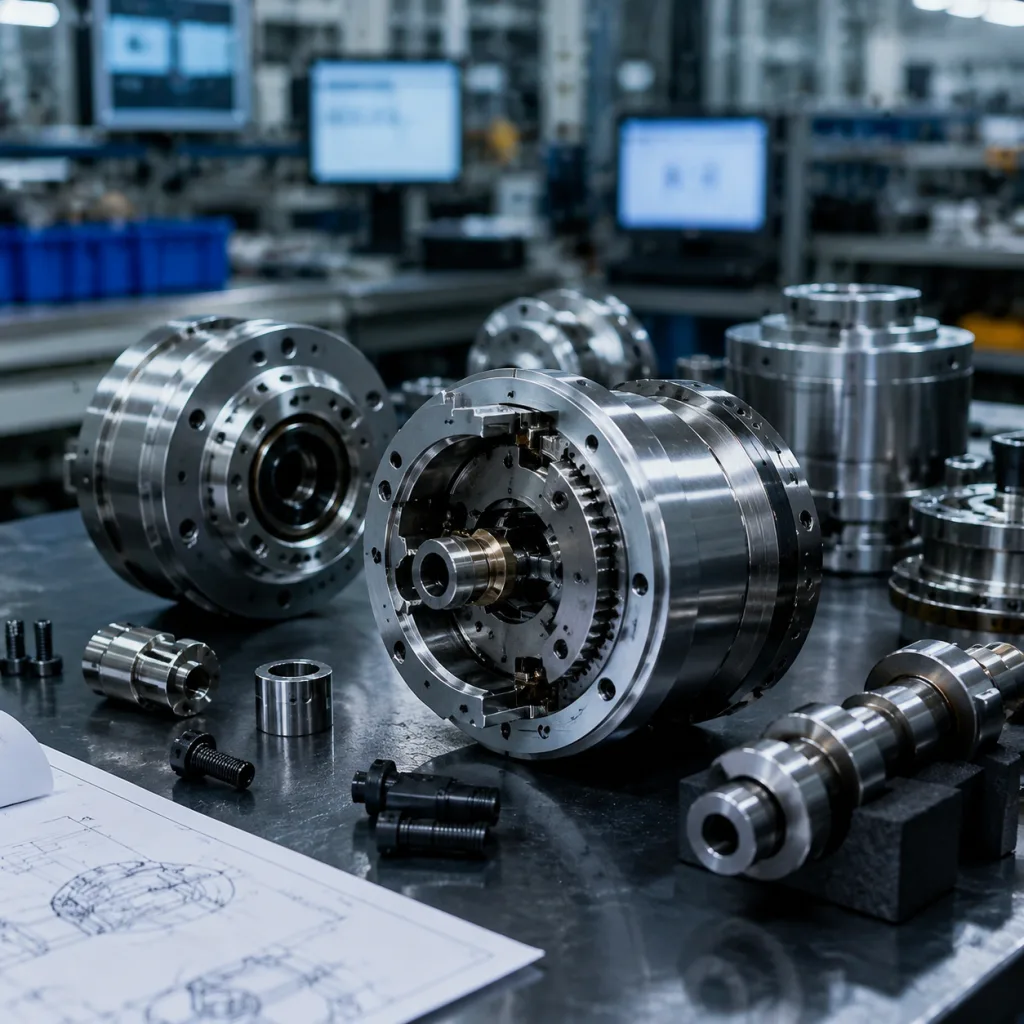
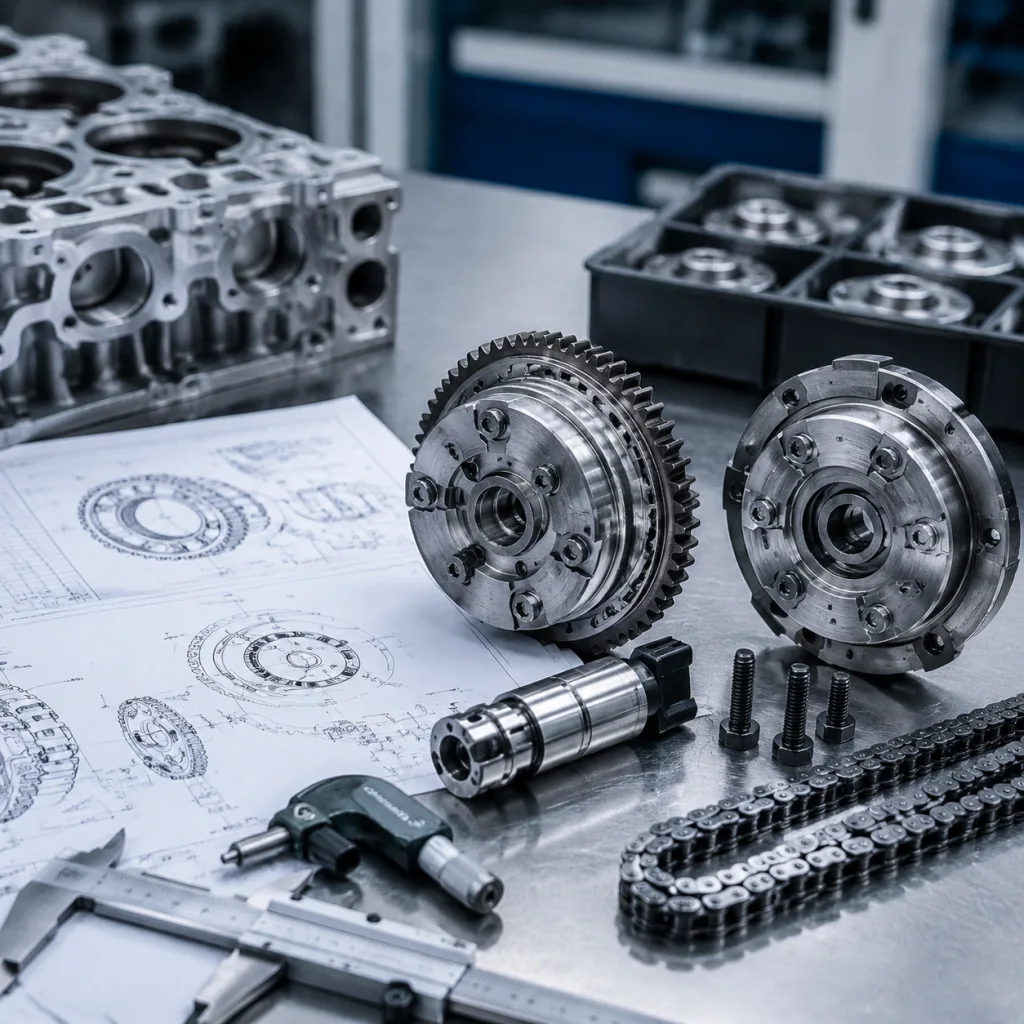
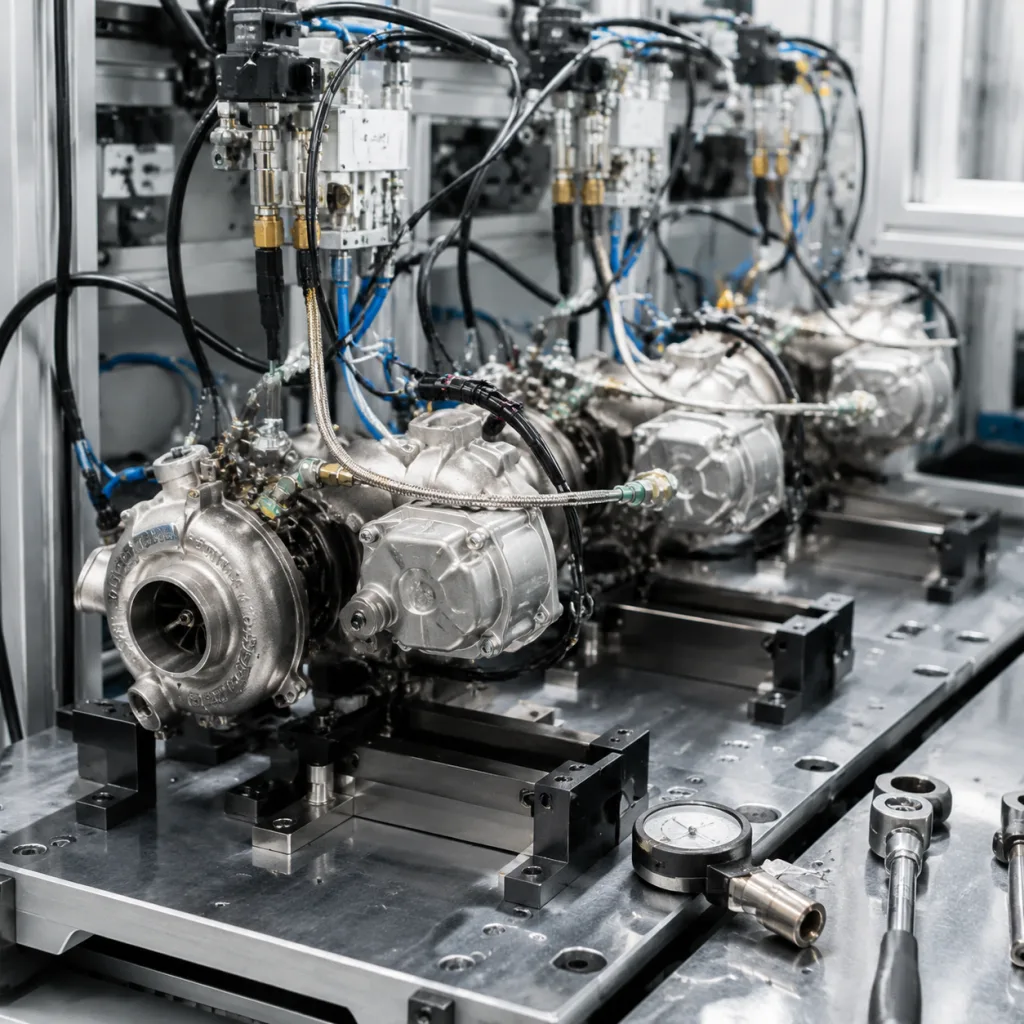
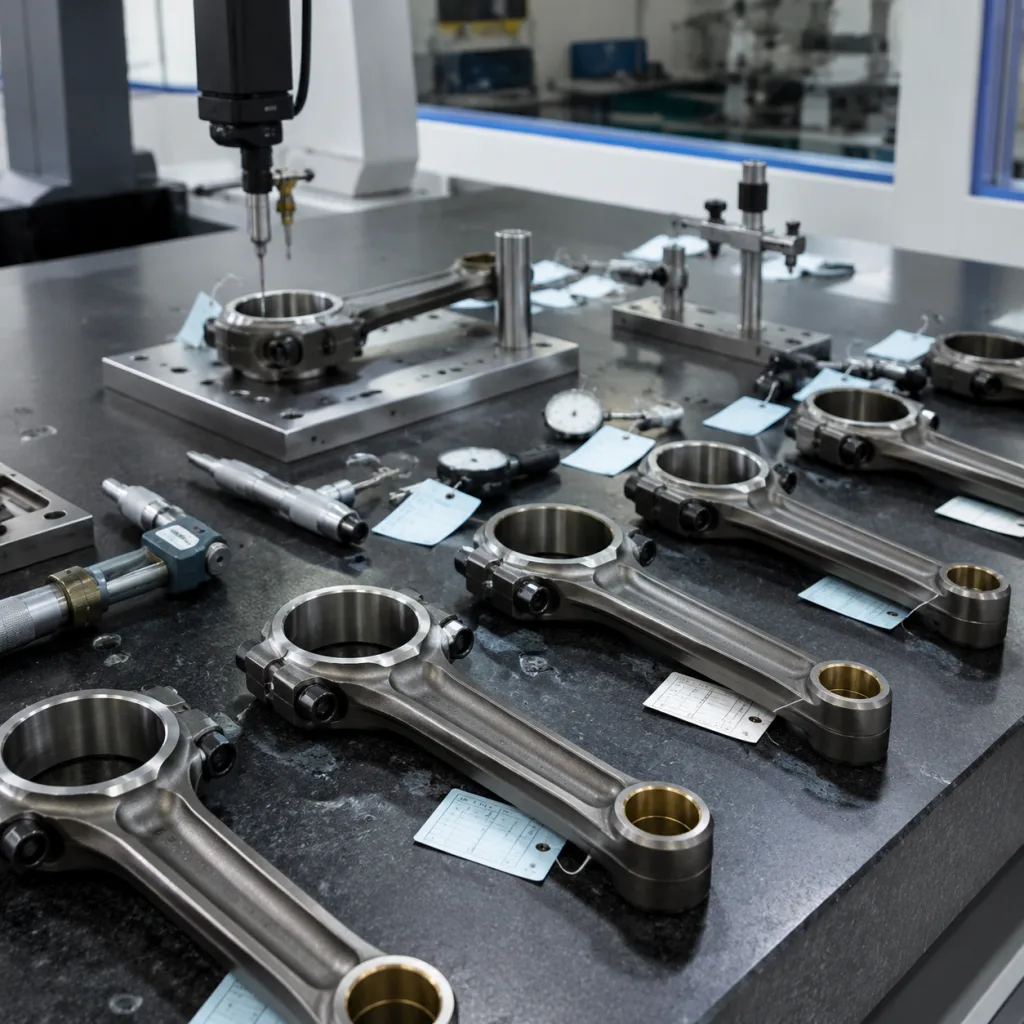
A Jeep camshaft phaser sourcing project can fail long before the first container ships. The usual cause is not price. It is weak control of oil passages, locking-pin behavior, vane leakage, timing references, or fitment data. Treat the part as a precision hydraulic actuator, not as a pulley with teeth.
This guide gives procurement teams a practical way to qualify a camshaft phaser Jeep OEM supplier for aftermarket, private-label, OEM-style, and Tier-1 sourcing programs. It covers what to check first, how to compare supplier evidence, which manufacturing controls matter, where MOQ and lead time assumptions break down, and what RFQ data prevents sample delays.
Driventus manufactures engine and powertrain components in Taizhou, Zhejiang, and exports to more than 60 countries. We support B2B buyers with IATF 16949:2016 and ISO 9001:2015 aligned production controls, drawing review, PPAP-style documentation where required, and batch traceability. Driventus is an independent aftermarket manufacturer; brand names are referenced for fitment identification only.
Start With the Failure Modes, Not the Catalog Match
Application coverage matters, but it is only the entry ticket. A Jeep camshaft phaser program becomes risky when the supplier cannot show how it controls the rotor, stator, vane sealing surfaces, locking-pin bore, return spring, oil passages, and timing reference features from machining through final inspection.
Before approving samples, ask which failure modes the supplier is actively preventing:
Start-up rattle: caused by weak lock retention, poor locking-pin repeatability, excessive internal leakage, or contamination in the lock bore.
Slow advance or retard response: caused by oil-passage restriction, vane clearance drift, high friction, or unstable hot-oil hydraulic performance.
Incorrect fitment: caused by an unverified cross-reference, wrong intake or exhaust position, wrong bank location, or mismatched timing reference surface.
Diagnostic trouble codes: caused by angular travel variation, incorrect parked position, sensor target mismatch, or unstable cam timing response.
Early corrosion or handling damage: caused by weak oil-hole protection, poor anti-corrosion method, unvalidated cartons, or mixed batch labeling.
Use these first-stage checks to separate real process control from brochure claims:
Application scope: engine family, model years, intake or exhaust position, bank location where relevant, chain or belt timing architecture, and VVT control strategy.
OE cross-reference discipline: use generic references such as OE 06A… or 11251… only when supplied in the buyer’s data package; require mapping to engine code, phaser position, and drawing revision before quotation.
Interface dimensions: camshaft mounting face, bolt pattern, central bore, oil-feed alignment, dowel or key location, sensor target position, and allowable runout at the timing reference surface.
Hydraulic response: advance and retard angle, lock-release pressure, chamber leakage rate, hot-oil response at 90–110°C, and cold-oil release at the buyer’s specified viscosity.
Packaging: VCI bag or oiled anti-corrosion method, threaded-port and oil-hole protection, label format with SKU and batch code, single-carton drop-test requirement, and pallet configuration.
A simple screening rule works well: request one dimensional layout, one functional test record, and one batch traceability example before releasing sample approval. If the supplier can only offer visual inspection and fitment photos, the risk remains high.
Buyers can review related engine parts in our catalog. Where the project also includes timing kits or adjacent powertrain components, see the engine components range at /products/engine-components.html.
Supplier Comparison Scorecard for Jeep Phaser Programs
A qualified camshaft phaser supplier needs more than CNC equipment and a certificate. The factory must connect machining accuracy, controlled assembly, functional testing, traceability, corrective action, and export documentation into one repeatable process.
Use the scorecard below during RFQ comparison or supplier audits.
Qualification item
What to request
Buyer acceptance logic
Quality certification
IATF 16949:2016 and ISO 9001:2015 certificates
Confirm scope covers machining, assembly, or engine components; certificate alone should not release production
Process controls
Control plan, inspection plan, gauge list, PFMEA summary
Critical dimensions should have inspection frequency, reaction plan, gauge ID, and responsible station defined
Traceability
Batch number, material lot, heat-treatment lot, assembly date
Records should link finished cartons back to machining, heat treatment, spring, seal, and final-test lots
Functional validation
Locking, angle travel, leakage, noise, and oil-pressure response data
Results should show actual values, limits, oil temperature, test pressure, and pass/fail judgment
Compliance documents
REACH (EC) No 1907/2006 declaration where applicable
Supports EU import and distribution requirements; confirm material and coating coverage, not only carton text
Audit readiness
Factory audit checklist, process flow, calibration records
Calibration status, nonconforming-product control, and corrective-action closure reduce risk before volume commitment
</tr></thead><tbody> </tbody></table>For a practical 100-point review, assign 25 points to machining and gauge control, 25 to hydraulic functional testing, 20 to traceability and document discipline, 15 to packaging and export readiness, and 15 to commercial responsiveness. A supplier scoring below 70 should stay in sample study or small pilot status until corrective actions are closed.
Look for evidence with dates, limits, and actual measured values. “Passed inspection” is not enough. A useful report shows what was checked, how it was checked, who released it, and which batch it belongs to.
For supplier audits, Driventus provides documentation through its quality system, including inspection workflows, material control, and corrective-action handling. Audit scope can be aligned with the buyer’s internal supplier manual.
Spec Deep-Dive: The Controls That Change Field Performance
Camshaft phasers combine powder metallurgy, CNC machining, heat treatment, precision grinding, spring control, cleaning, and hydraulic assembly. Small deviations do not always appear during a quick bench fitment check. They often appear later as start-up noise, slow response, diagnostic trouble codes, or oil leakage after repeated thermal cycles.
The controls below have the strongest link to field performance:
Rotor and stator flatness: sealing faces should be controlled to the drawing limit, commonly in the 0.01–0.03 mm range for precision hydraulic faces, to reduce internal leakage across vane chambers.
Vane clearance: side clearance and radial clearance should be checked against the validated master sample or drawing, typically with go/no-go gauges or CMM checks on sampled parts, to maintain pressure balance without excessive drag.
Locking-pin movement: free movement, release pressure, return force, and repeatability should be checked after cycling; a useful sample report shows minimum, maximum, and average release values rather than only “OK.”
Oil-passage cleanliness: washing, drying, filtration, and particle inspection should be controlled; many buyers specify no visible burrs and particle limits such as no metallic particles above 600 µm, with final limits set by the drawing or buyer standard.
Angular travel: advance and retard travel should be measured against the engineering specification, recorded in actual degrees, and checked against the parked position and sensor target reference.
Surface treatment: coating or heat-treatment route should match wear, corrosion, and engine-oil compatibility requirements; request hardness and coating-thickness records where the design depends on them.
Validation Evidence to Request
For an OEM-style sourcing program, request sample inspection reports, dimensional layouts, material certificates, hardness data, functional test curves, and endurance evidence. A useful validation set includes 5-piece initial sample dimensional results, 100% final functional test records for production lots, salt-spray or humidity evidence for coated surfaces when required, and locked/unlocked cycling data at the agreed oil pressure and temperature.
For private-label distribution, add packaging validation, corrosion-resistance evidence, barcode traceability, and carton compression or drop-test results. Supplier files should cite standards such as IATF 16949:2016, ISO 9001:2015, and REACH (EC) No 1907/2006 accurately. Avoid unsupported claims about vehicle-maker approval.
Driventus is an independent aftermarket manufacturer; brand names are referenced for fitment identification only.
Planning Scenario: From Sample Build to Repeat Orders
The commercial plan changes depending on the sourcing model. Standard aftermarket stock, private-label cartons, and drawing-controlled OEM-style parts do not move through the same approval path. Separate the work into sample approval, pilot production, packaging confirmation, and mass-production scheduling. Each stage affects capacity, cash flow, and shipment timing.
A typical B2B planning scenario looks like this:
Sample quantity: 5–20 pieces per reference for dimensional, functional, and installation review; use 3–5 pieces for bench inspection and reserve the rest for fitment, durability, or customer evaluation.
Pilot order: 100–500 pieces per SKU, depending on machining fixtures, packaging, and test requirements; new or revised designs may need a 30–100 piece pre-pilot before distributor release.
Mass-production MOQ: commonly negotiated around 300–1,000 pieces per SKU for active references, with lower MOQ possible for shared tooling and higher MOQ likely for custom machining, private-label packaging, or low-turn SKUs.
Sample lead time: commonly 20–45 days when tooling, drawings, and reference samples are stable; add 10–20 days if reverse engineering, fixture changes, or special material confirmation is required.
Production lead time: commonly 45–75 days after sample approval, packaging confirmation, and deposit or credit approval; repeat orders with stable forecasts can often be planned in shorter production windows.
Forecast window: 3–6 months is preferred for stable machining capacity and raw-material planning; 12-month rolling forecasts support better price control for annual programs.
Do not compare quotes only by unit price. Machining cycle time, powder-metal or forged blank cost, heat-treatment batch size, 100% hydraulic testing, packaging type, warranty reserve, and shipment consolidation all affect EXW, FOB, or CIF pricing. A higher first-order MOQ may reduce fixture amortization and packaging setup cost. A low MOQ may require a sample charge, tooling contribution, or higher unit price until annual volume is proven.
These figures are planning ranges, not a universal offer. Final MOQ and lead time depend on phaser design, material route, test requirements, and whether the project uses existing Driventus tooling or custom manufacturing. For distributors carrying multiple Jeep-related engine SKUs, consolidated production and shared shipping can reduce per-unit logistics cost.
Step-by-Step RFQ Package That Prevents Rework
Incomplete RFQs slow down camshaft phaser sourcing more than most buyers expect. The part is position-specific, engine-specific, and validation-sensitive. Send structured technical and commercial data at first contact so the supplier can quote, flag risk, and plan samples without repeated clarification rounds.
Build the RFQ package in this order:
1. Define the application: target vehicle application, market region, engine code where available, and model-year range. 2. Confirm the position: intake or exhaust location, bank location if applicable, and quantity per engine. 3. Provide technical evidence: existing sample, 2D drawing, 3D file, validated aftermarket reference, or clear photos of both faces, oil ports, and timing marks. 4. State cross-reference limits: any OE-style cross-reference already used in your system, such as OE 06A… when applicable, with the source and revision of that reference. 5. Set the commercial frame: annual forecast, first-order quantity, target MOQ, shipment term, required delivery destination, and expected order cadence. 6. Define packaging: neutral, private label, bulk, repair-chain kit format, barcode type, label language, carton size, and pallet limit. 7. List required documents: inspection report, material certificate, PPAP-style file, REACH declaration, certificate of origin, packing list format, or customer-specific forms. 8. Name the tests: leakage, angular travel, lock-release pressure, endurance cycling, noise screening, temperature condition, oil viscosity, and sample-size requirement.
Add the commercial boundary conditions before quotation: target price level by Incoterm, acceptable payment method, warranty handling process, and whether tooling or fixture cost should be quoted separately. If the buyer needs annual blanket orders, specify release quantities and inventory responsibility. If the buyer needs one-time spot stock, state the latest acceptable ship date.
A capable supplier will confirm what can be validated internally and what requires buyer confirmation. Driventus does not claim endorsement or approval by any vehicle manufacturer. Fitment discussions are based on dimensional review, sample comparison, buyer data, and agreed validation criteria.
Q&A: How Driventus Handles OEM-Style Supply
What does Driventus supply for this type of program?
Driventus manufactures camshaft phasers and related engine components for B2B customers that need stable sourcing, clear documentation, and export-ready packaging. The manufacturing base in Taizhou supports machining, assembly, inspection, and supplier coordination for related powertrain parts including pistons, crankshafts, gaskets, water pumps, and turbochargers.
What support is available during a Jeep camshaft phaser project?
Support can include:
Application review and interchange discussion based on buyer-supplied data, sample comparison, and dimensional confirmation.
Sample development using existing tooling or project-specific engineering review, with clear separation of sample charge, tooling cost, and production unit price where applicable.
Incoming material inspection and controlled machining of critical hydraulic features, including checks for sealing faces, oil passages, timing reference surfaces, and threaded interfaces.
Functional testing for lock operation, leakage, angular movement, and final pass/fail records linked to production batches.
Batch traceability with production and inspection records, including material lot, machining date, assembly date, operator or station record, and carton label code.
Export packaging for distributors, wholesalers, repair chains, OEM-style programs, and Tier-1 supply channels, including neutral, private-label, and bulk configurations.
What does a typical project path look like?
After complete RFQ data is received, Driventus typically reviews the request within 2–5 working days, confirms the sample plan, builds 5–20 sample pieces, supports buyer validation, moves to pilot order, and then schedules mass production under agreed MOQ and lead-time terms. For repeat programs, production windows can be aligned with rolling forecasts, combined SKU shipments, and buyer-required document packages.
Does “camshaft phaser Jeep OEM supplier” mean vehicle-maker approval?
No. The phrase describes a sourcing requirement: an OEM-style supply process, technical documentation, and production discipline suitable for professional procurement. It should not be treated as a claim of vehicle-manufacturer approval. Driventus is an independent aftermarket manufacturer; brand names are referenced for fitment identification only.
To start an evaluation, buyers can request a quote with drawings, samples, target volume, and required documentation.
Frequently asked questions
Send the application, engine code if available, intake or exhaust position, sample or drawing, annual forecast, first-order quantity, packaging requirement, target Incoterm, delivery destination, and any test or documentation requirements. OE-style references may be included only as buyer-supplied fitment data.
Yes. Driventus supports neutral, bulk, and private-label packaging for distributors and repair-chain programs. Label format, carton strength, barcode rules, corrosion protection, pallet configuration, and minimum packaging quantity should be confirmed during RFQ review.
No. Driventus does not claim approval or endorsement by any vehicle manufacturer. Driventus is an independent aftermarket manufacturer; brand names are referenced for fitment identification only.
If you are qualifying a camshaft phaser Jeep OEM supplier for distribution, repair-chain, or OEM-style sourcing, send your application list, sample data, forecast, target MOQ, delivery term, and documentation requirements. Start a technical RFQ at /contact.html