Thermostat Housing Material Grade Comparison Guide
Selecting a thermostat housing material is rarely just a cost exercise. For procurement teams, the chosen grade affects leak rate, bolt-load retention, sensor sealing, warranty exposure and line-side fit. A housing can pass initial assembly and still fail later after thermal cycling, coolant ageing, pressure pulsation or clamp-load relaxation. That is why a structured thermostat housing material grade comparison matters when you are reviewing new suppliers or re-sourcing an existing program.
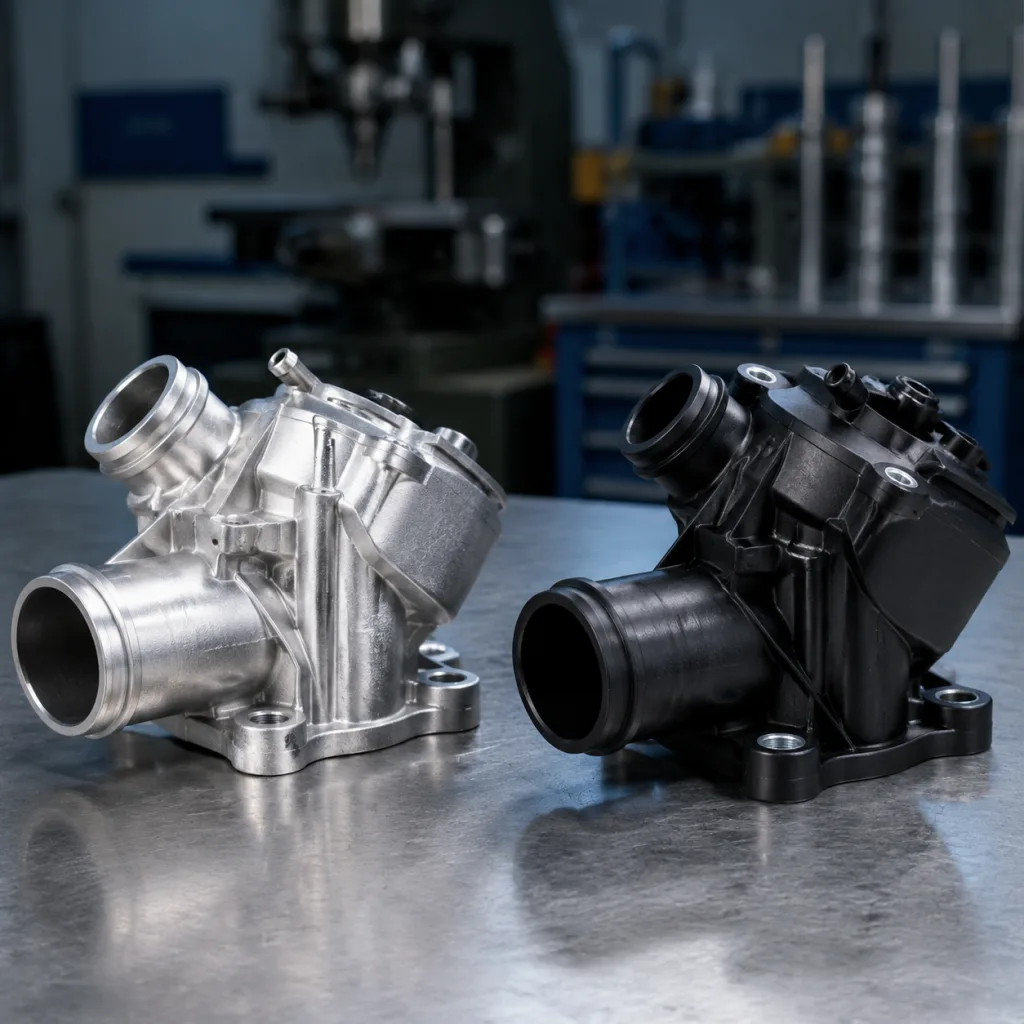
Most aftermarket and OE-equivalent housings are made in reinforced engineering polymer or die-cast aluminium. The better choice depends on sustained coolant temperature, short-term overtemperature excursions, under-bonnet radiant heat, mating-surface flatness, pressure pulse profile and the required service interval. Buyers should also confirm process capability, material traceability and conformity with IATF 16949:2016, ISO 9001:2015 and REACH (EC) No 1907/2006. This guide sets out what to compare, which grades are commonly used and how to reduce sourcing risk before release.
A useful comparison goes beyond listing resin names or alloy families. It should tie material behaviour to the failure modes that appear in service: flange distortion, bolt-load loss, hose-neck cracking, porosity-related seepage, sensor-seat drift and corrosion at mixed-metal interfaces. When the review is framed that way, engineering, quality and purchasing teams can judge alternatives against the same criteria and avoid approving a part that looks cheaper on paper but proves weaker in the field.
Which grades are most common in thermostat housings
The main material families are glass-fibre reinforced polyamide, higher-temperature PPS compounds and die-cast aluminium alloys. Each has a legitimate place. The sourcing mistake is not choosing one family over another; it is assuming every grade inside that family is interchangeable when moisture uptake, creep resistance, mould shrinkage and dimensional stability can differ materially.
Material family
Typical grade example
Typical technical profile
Main limitations
Typical sourcing use
PA66 GF30
30% glass-fibre reinforced nylon 66
Good mouldability, density about 1.35-1.40 g/cm3, continuous-use capability often acceptable around 110-125°C coolant-side with proper design
Moisture uptake typically around 1-2% at equilibrium in standard lab conditions and higher at saturation; creep and flange relaxation must be controlled
Standard passenger vehicle coolant outlets and thermostat covers
PA66 GF35/GF40
35-40% glass-fibre reinforced nylon 66
Higher modulus and better bolt-area stiffness than GF30; improved support for sealing lands and inserts
More abrasive to tooling, higher mould pressure, greater warpage sensitivity from fibre orientation
Higher clamp-load designs, larger flanges, more rigid mounting points
PPS GF40
40% glass-fibre reinforced PPS
Very low moisture absorption, often below 0.1%; strong dimensional stability at elevated temperature; strong chemical resistance to glycol-based coolants
High-heat engine bays, turbo-adjacent layouts, integrated sensor or thin-wall precision features
Die-cast aluminium
Common aftermarket die-cast grades such as ADC12 or A380 type alloys
High rigidity, stable geometry over temperature, good castability, no moisture-driven dimensional shift
Higher mass, galvanic/corrosion management required, machining and porosity control needed
Heavy-duty cycles, legacy metal interfaces, rigid sealing and mounting applications
</tr></thead><tbody> </tbody></table>PA66 GF30 is often the commercial baseline because it balances cost, weight and production efficiency. It is widely used in coolant outlet and thermostat housing applications where coolant temperatures are controlled and flange geometry is not especially demanding. Even so, field performance still depends heavily on the design. A PA66 GF30 housing with long bolt spans, thin sealing lands or a large unsupported flange can lose gasket compression over time if creep under bolt preload is not properly managed.
PA66 GF35 and PA66 GF40 usually come into the conversation when extra stiffness is needed. The higher glass content generally raises flexural modulus and improves local deformation resistance around fasteners and inserts. In practice, that can reduce flange lift and make sealing more robust after thermal cycling. It is not a drop-in material swap, though. Fibre orientation, anisotropic shrinkage, weld-line strength and flatness control all become more sensitive, so buyers should expect design and process revalidation rather than assuming an automatic improvement.
PPS GF40 is typically chosen where thermal exposure is more severe, moisture stability is critical or packaging places the housing close to turbochargers, EGR hardware or other sustained heat sources. In a thermostat housing material grade comparison, PPS stands out because it holds dimensions more consistently under heat and humidity than PA66. That makes it attractive for integrated sensor bores, close-tolerance O-ring grooves and compact sealing geometries. The trade-off is cost and a tighter processing window, which means the supplier's compounding consistency, melt-temperature control, mould maintenance and venting discipline matter even more.
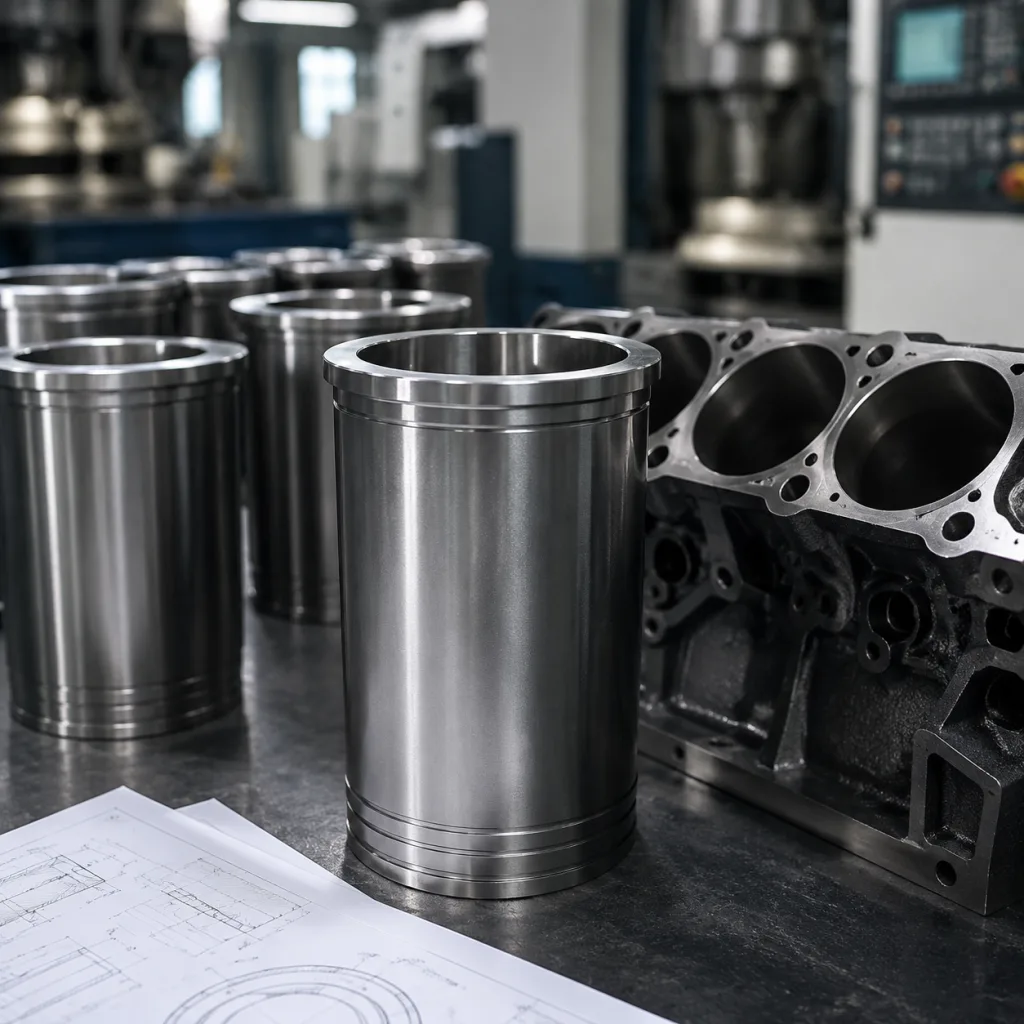
Die-cast aluminium remains common where rigidity and temperature margin take priority. Buyers often see it in applications with demanding service intervals, higher duty cycles or legacy OE designs built around cast metal interfaces. Alloys such as ADC12 or A380 type materials offer good castability, but performance still depends on porosity control, machining quality, sealing-land flatness and corrosion protection. A low-cost casting with poor degassing or unstable machining capability can create as much warranty risk as an under-specified polymer.
For most sourcing programs, start by comparing the original material family, then the reinforcement level and then the supplier's process controls. A switch from PA66 GF30 to a lower-cost unfilled polymer is rarely acceptable in an engine-cooling application. A switch from PA66 GF30 to PA66 GF35 may be viable, but only if mould shrinkage, fibre orientation effects and sealing geometry are revalidated. Likewise, an aluminium housing offered as an upgrade still needs review for galvanic compatibility, mass increase, machining tolerance and gasket behaviour rather than being treated as automatically safer.
How to compare grades step by step
Use a checklist, not a catalogue description. The grade decision should be tied to the functional loading of the housing, not just the resin price per kilogram. A disciplined thermostat housing material grade comparison usually starts with the OE requirement and then measures any proposed alternative against the actual thermal, mechanical and chemical loads it will see.
1. Verify the thermal profile
Check normal coolant temperature, short-term excursion temperature and the number of thermal cycles expected over service life. In many passenger-vehicle systems, nominal coolant operation is around 90-110°C, but local housing surfaces can see higher metal-side or radiant temperatures, especially near turbochargers or EGR routing. Ask for both short-term peak tolerance and long-term ageing behaviour, because many failures appear after 500 to 2,000 thermal cycles or prolonged dwell at elevated temperature rather than after one extreme event.
2. Review pressure and clamp load
Thermostat housings see internal coolant pressure, pressure pulsation, hose clamp compression and bolt preload at the flange. Typical cooling-system operating pressure is often in the 1.0-1.5 bar range, with higher proof or burst requirements in validation. Compare creep resistance and flange deflection, not only tensile strength. If bolt-load loss reduces gasket compression, leakage follows. For polymer parts, ask how the supplier validated torque retention after thermal cycling and heat ageing. For aluminium parts, review whether thread integrity, insert retention and local distortion around machined seats remain stable under assembly torque.
3. Check coolant chemistry exposure
Long-life OAT and HOAT coolants can interact differently with polymers, coatings and sealing interfaces. Request chemical compatibility data and ageing results after immersion in the specified coolant-water mixture, commonly 50:50 by volume unless the program specifies otherwise. The review should cover not only the base housing material but also seals, inserts, sensor interfaces and any overmoulded or bonded features. If the application serves multiple markets, verify whether regional coolant specifications, pH ranges or inhibitor packages differ.
4. Evaluate moisture absorption
PA66 absorbs substantially more moisture than PPS. That changes dimension, modulus and fit over time. For parts with integrated sensor bores or close-tolerance O-ring grooves, moisture behaviour needs to be part of the approval file. Ask whether dimensions were checked dry-as-moulded, conditioned and after thermal ageing, because a sample that is compliant in one state may drift out of tolerance in service. On PA66, even a few tenths of a percent moisture change can shift flatness and bore size enough to matter on tight sealing features.
5. Confirm process route
Injection moulding, die casting, machining of sealing lands and post-mould annealing or conditioning all affect final performance. Material grade alone does not guarantee field durability. With moulded polymers, review drying parameters, melt and mould temperature windows, gate location, fibre orientation strategy, cycle control and any annealing or conditioning step. With aluminium, review casting process, melt control, porosity management, machining sequence and leak-test method. Two suppliers quoting the same nominal grade can deliver very different performance if their process discipline is different.
6. Match validation to application
Ask for pressure pulse, thermal shock, burst, torque retention and leak-testing evidence. As a practical benchmark, many buyers expect component- or assembly-level pressure testing above normal operating pressure, followed by cyclic pressure and thermal ageing, before approval. The test plan should reflect the actual engine layout and service environment. A generic validation pack is helpful, but it is not enough when geometry, clamp arrangement or temperature exposure changes.
7. Compare design intent, not just material labels
Many quote packages focus on the material callout while overlooking geometry changes. In practice, wall thickness, rib placement, insert design, sealing-land width and hose-neck transition radius can influence durability as much as the material itself. If a supplier changes the grade and the geometry together, the approval team should treat the package as a redesign, not as a direct equivalent.
8. Review commercial risk alongside technical fit
Finally, compare resin or alloy supply stability, traceability, tool life impact and change-control discipline. A technically suitable grade still creates sourcing risk if the supplier cannot lock the compound source, monitor glass-fibre content or control lot-to-lot consistency. The best comparisons therefore combine engineering evidence with procurement safeguards such as PPAP documentation, traceability requirements and notification rules for any material or process change.
Key properties buyers should request from suppliers
Procurement teams should ask for measured values, test methods and batch traceability. A short data sheet without the underlying method is not enough for a release decision. In a thermostat housing material grade comparison, the aim is to move beyond generic claims such as high-temperature resistant or OEM quality and collect property data that matches the real application.
A practical request pack includes:
Resin or alloy designation, including glass-fibre content where applicable
Material supplier name and compound reference
Tensile and flexural data measured to recognised methods such as ASTM D638 / ISO 527 and ASTM D790 / ISO 178 for polymers
Heat deflection temperature measured to ASTM D648 or ISO 75 where relevant
Water absorption data, for example to ASTM D570 or ISO 62 for polymers
Coefficient of linear thermal expansion where sealing geometry and mixed-material interfaces are critical
Creep or stress-relaxation data at elevated temperature, especially for bolted polymer flanges
Corrosion and coolant-ageing evidence where aluminium or mixed-material assemblies are used
Mould-flow or casting feasibility review for wall-thickness transitions, hose necks and sensor bosses
Dimensional capability on critical features such as flange flatness, hose neck OD and sensor seat geometry
Leak-test criteria at production end-of-line, including test pressure, hold time and reject limit
Declaration of conformity for REACH (EC) No 1907/2006 and any customer-specific restricted substances list
Go beyond room-temperature results whenever possible. For polymers, that often means comparing dry-as-moulded and conditioned properties, plus retention after thermal ageing and coolant exposure. A PA66 grade that looks acceptable on a standard data sheet may show a meaningfully different stiffness or dimensional profile once moisture and temperature are factored in. For aluminium, room-temperature mechanical properties are only part of the story; casting integrity, porosity distribution and achievable surface finish on sealing faces can be more decisive in service.
Dimensional data deserves the same weight as raw material properties. Critical checks normally include flange flatness, true position of bolt holes, sensor-bore diameter and concentricity, hose-neck outside diameter, O-ring groove width and depth, and thread quality where threaded ports or inserts are used. On sealing lands, buyers often request flatness and surface-finish evidence because a capable bulk material cannot compensate for waviness or a machining issue at the gasket interface.
Lot traceability should also be requested. For polymer housings, that can include compound batch identification, drying logs, moulding parameters and any post-mould conditioning or annealing records. For cast aluminium, it may include alloy certificates, melt control records, X-ray or porosity inspection standards where used, machining control plans and leak-test records. This matters because many field issues are process-related even when the nominal grade matches the specification.
If the part is sold into regulated vehicle markets, material stability also supports downstream durability performance. A leaking housing can contribute to overheating and secondary failures that affect compliance-related systems, even if the housing itself is not an emissions device. That is why buyers often connect part validation to broader system durability expectations under frameworks such as ECE R-83.
You should also review the supplier's quality system. Certification to IATF 16949:2016 and ISO 9001:2015 does not replace application validation, but it does reduce risk around traceability, change control and corrective action discipline.
When quotations are compared side by side, it helps to convert supplier responses into a common matrix. List each required property, the test standard, the reported value, the sample condition, the number of tested parts and whether the result comes from resin data, component-level data or assembled-system testing. That makes gaps visible early and prevents a low-information quotation from appearing equivalent to a fully documented one.
Trade-offs between polymer and aluminium housings
The usual trade-off is lower mass and easier functional integration on the polymer side versus rigidity and thermal margin on the aluminium side. Neither option is universally better. Each becomes stronger or weaker depending on temperature, mounting strategy, geometry complexity and warranty expectations.
Polymer housings allow integrated ports, clips, bosses and sensor mounts in one moulded part. That can reduce part count, eliminate some secondary machining and lower mass relative to cast metal. In the right grade, this is entirely suitable for many passenger-vehicle applications. The weak points are usually creep at bolted joints, warpage around large flanges and long-term dimensional change if the grade is not well matched to heat and moisture. In return, polymer gives designers substantial freedom to combine functions and simplify hose-routing interfaces.
Within polymer options, PA66 and PPS do not behave the same way. PA66 is often attractive on cost and processing familiarity, but it demands careful management of moisture-related dimensional change and long-term clamp-load retention. PPS offers a stronger stability margin in hotter, tighter or chemically harsher environments, but higher material cost and stricter moulding control can narrow the qualified supplier base. A proper thermostat housing material grade comparison should therefore look not only at polymer versus metal, but also at lower-cost polymer versus higher-performance polymer.
Aluminium housings tolerate high temperature well and keep flange geometry stable over time. Their modulus is far higher than reinforced polymers, so they generally resist bolt-area deformation and sealing-land distortion more effectively. They are often preferred where mounting rigidity is critical or service conditions are severe. The trade-off is higher mass, more complex corrosion control and additional machining for sealing faces, threaded interfaces or sensor seats. Aluminium can also add extra production steps such as machining, thread finishing and tighter leak management around casting porosity.
Corrosion deserves specific attention in mixed-material systems. An aluminium housing connected to steel fasteners, other metals and glycol-based coolant can face galvanic or surface-corrosion risks if alloy selection, coatings, coolant chemistry or service conditions are not well controlled. While polymer avoids galvanic corrosion on the housing body itself, it introduces different concerns around heat ageing, creep and moisture. The practical sourcing question is not which material has no weakness, but which weakness is easier to control in the target application and supply chain.
From a sourcing standpoint, ask whether the supplier is offering a true material-equivalent design or a cost-down redesign. A housing converted from aluminium to polymer should not be approved without full validation, even if nominal envelope dimensions match. The same applies in reverse because gasket compression behaviour, torque windows and heat transfer will change. Fastener strategy may also need review, especially if a rigid metal flange is replaced by a polymer flange with different stress-relaxation behaviour.
Serviceability can also influence the decision. Aluminium threads and sealing lands may tolerate repeated disassembly differently from polymer bosses, moulded threads or insert-based designs. If the housing is likely to be removed during routine maintenance, that maintenance profile should be included in the material review rather than left outside the sourcing brief.
For broader fitment options, buyers can review our catalog and, where engine-side interfaces matter, custom manufacturing requirements should be defined before tooling release.
Validation points before you approve a new source
Before nomination, document the checks that separate a compliant sample from a durable production part. The purpose of validation is not simply to show that a part fits once on a bench, but to confirm that the selected grade, geometry and process can survive the full service window without unacceptable leak risk or dimensional drift.
Confirm flange flatness and critical dimensions after thermal ageing, not only at room temperature
Compare torque retention or residual clamp load after thermal cycling for polymer grades with different glass loading
Verify proof pressure, burst pressure and cyclic pressure performance on assembled housings
Inspect weld lines, knit lines or porosity in high-stress areas such as hose-neck transitions and bolt bosses
Review sealing performance with the actual gasket or O-ring material and hardness used in the program
Check surface finish on sensor bores, gasket lands and threaded features
Validate coolant compatibility and ageing with the specified fluid family, concentration and service interval
Lock change-control requirements for resin source, glass content, colourant, alloy source and mould or die maintenance intervals
These checks should be structured in stages. First article inspection confirms that the part meets drawing dimensions and visible workmanship standards. Material verification then confirms that the moulded or cast component actually matches the quoted compound or alloy. Endurance testing finally shows whether the finished part remains stable after heat, pressure and coolant exposure. A source should not be approved on dimensional conformity alone if long-term loading has not been assessed.
For polymer housings, torque retention and flange stability are especially important. Buyers should compare performance before and after thermal cycling, and ideally after coolant ageing as well. Differences between PA66 GF30, PA66 GF35, PA66 GF40 and PPS GF40 often become more visible after ageing than at the initial assembly stage. A sample that seals well on day one can still lose compression if the flange relaxes, creeps or takes a permanent set around the fasteners.
For aluminium housings, validation should focus strongly on casting integrity, machining consistency and corrosion resistance. Burst and leak tests are important, but they should be supported by evidence that porosity is controlled in the actual production process. If sealing surfaces are machined, check capability on flatness, surface finish and positional tolerance rather than relying only on visual inspection.
Where thermostat housings integrate sensors, bleed screws, hose connectors or mounting brackets, those sub-features should be included in the validation scope. It is common for the main body material to perform adequately while a local feature fails due to wall-thickness variation, insert pull-out, thread damage or poor surface finish. Robust approval therefore treats the housing as a functional assembly, not just a base material sample.
For procurement teams managing multiple vehicle platforms, it is also useful to request OE and aftermarket cross-reference logic in the quotation pack where applicable. If a customer brief already cites an identifier such as OE 06A107065, keep the cross-reference format generic and documented. Never treat cross-reference as proof of material equivalence by itself.
Production controls should also be defined before release. That includes incoming material verification, first-off checks, end-of-line leak testing, reaction plans for non-conforming lots and clear notification rules for any resin, alloy, tooling or process change. In many sourcing projects, the main risk is not the approved sample but the unannounced variation introduced later.
Driventus is an independent aftermarket manufacturer; brand names are referenced for fitment only.
If you are qualifying a new thermostat housing program, use a sample plan that includes dimensional inspection, material verification and endurance testing before commercial release. Where a custom geometry or grade upgrade is needed, request a quote with the target performance conditions and annual volume.
Frequently asked questions
No. PA66 GF30 is common, but suitability depends on sustained coolant temperature, local under-bonnet heat, clamp load, flange span, coolant chemistry and required service life. In hotter or tighter-tolerance applications, PA66 GF35/GF40 or PPS GF40 can provide better stiffness retention and dimensional stability, but the geometry and process still need validation.
Aluminium is usually considered when rigidity, long-term flange stability, repeated service disassembly or severe thermal exposure are the main risks. Reinforced polymer remains suitable for many applications, but only when creep, moisture uptake, weld-line strength and sealing performance are validated against the duty cycle.
Ask for the full material designation, compound or alloy source, compliance declarations, critical-dimension capability data, leak-test criteria, validation results and change-control terms. For production sourcing, certification to IATF 16949:2016 and ISO 9001:2015 should also be visible in the supplier approval file.
If you are comparing thermostat housing grades for a new sourcing program, send the drawing, target material and validation requirements to Driventus for review through [request a quote](/contact.html).