Connecting Rod Audi OE Equivalent: Sourcing Guide
Buyers sourcing a connecting rod Audi OE equivalent need more than a fitment claim. The part has to match the original in length, bore geometry, pin interface, mass balance, and load behavior, and the supplier has to prove it with repeatable inspection data. Driventus supplies engine components from Taizhou, Zhejiang, with documented process control under IATF 16949:2016 and ISO 9001:2015. Driventus is an independent aftermarket manufacturer; brand names are referenced for fitment only. This guide focuses on the checks that actually prevent returns, the failure modes that cause bad substitutions, and the evidence procurement teams should request before approving a replacement. For a broader view of available engine parts, see [our catalog](/products.html) and [our quality system](/quality.html).
What makes a rod truly OE equivalent?
OE-equivalent is not a marketing label. For a connecting rod, it means the replacement must preserve the fit and function of the original application even if the production route differs.
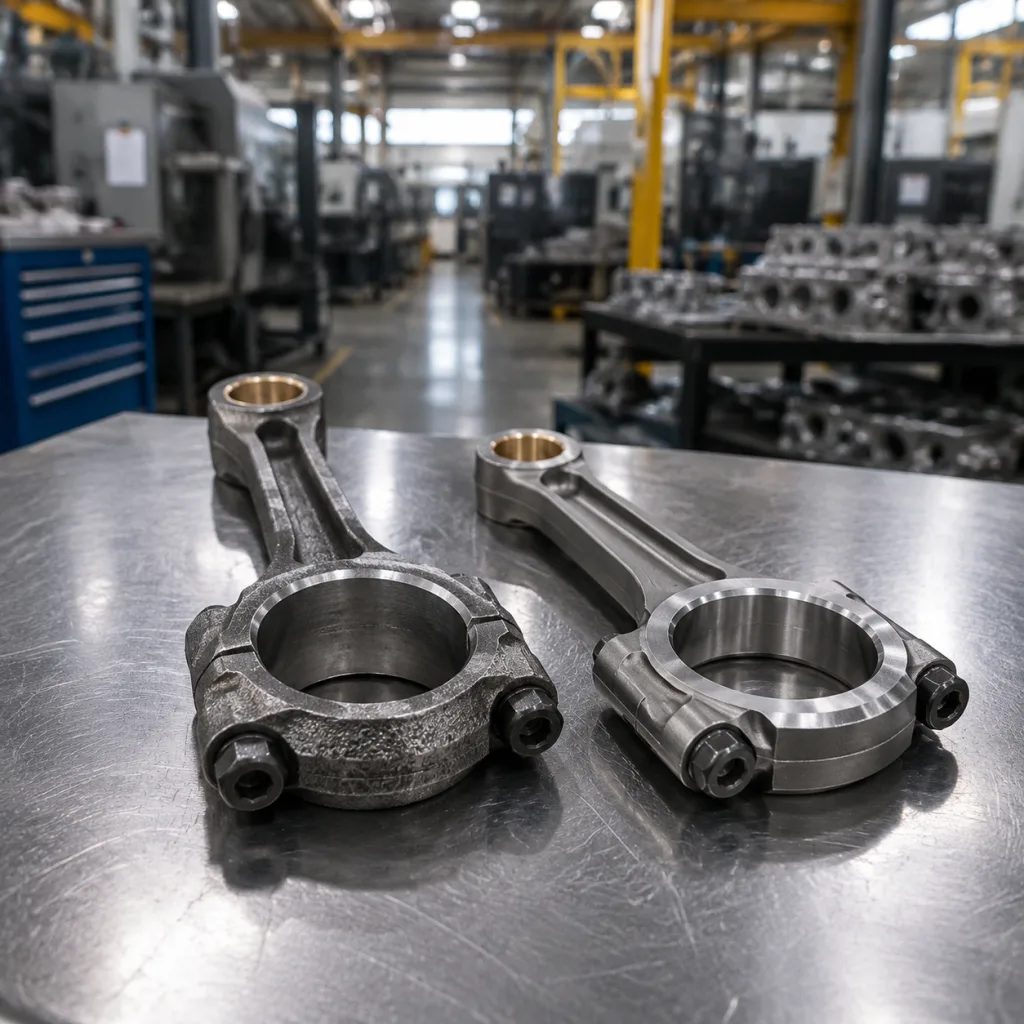
Start with the dimensions that define the part. Confirm center-to-center length, big-end bore, small-end bore, cap alignment, and the fastener specification. Then check the attributes that affect service life: material grade, heat-treatment range, surface finish, and the weight target for matched sets.
For passenger-car programs, buyers often specify center distance within ±0.05 mm, big-end roundness within 0.01 mm to 0.02 mm, small-end bore within ±0.01 mm to ±0.02 mm, and pair-to-pair weight variation within 3 g to 5 g. Those numbers are not universal, but they show the level of control required. If the engine is turbocharged or otherwise highly loaded, ask for rod mass, beam thickness, and bolt preload data instead of accepting a generic “fits Audi” statement.
A supplier should also be able to connect the part to inspection records, batch traceability, and controlled process documents. That matters in repair networks and distribution channels, where one bad lot can create repeat returns and warranty claims.
Where replacements go wrong
The most common sourcing mistake is treating platform fitment as proof. It is not. Two rods that look similar can still fail in service if one of the critical interfaces is off.
Typical failure modes include:
- Wrong center length, which shifts compression behavior and can affect engine clearance
- Big-end bore variation, which changes bearing crush and oil film stability
- Small-end mismatch, which can cause pin wear or seizure
- Weight spread across a batch, which increases vibration and imbalance
- Fastener mismatch, especially when bolt grade or stretch spec differs from OE
- Incorrect heat treatment, which can reduce fatigue resistance even when dimensions pass
Audi applications deserve extra caution because engine families and revisions can differ within the same model line. Do not approve a part based only on the car name. Ask for the OE reference, engine code, and any superseded numbers. A valid cross-reference must resolve to the specific engine version, not just the vehicle badge.
If the supplier cannot explain how the part was validated, treat the offer as incomplete. A low price does not offset a bad bore, unstable hardness, or unverified bolt spec.
A fast decision framework for buyers
Use this sequence when evaluating a connecting rod Audi OE equivalent.
1. Identify the exact engine code and OE number. 2. Confirm center length, pin size, big-end bore, and bolt specification. 3. Check whether the rod is stock replacement or a custom build. 4. Request inspection data for the current batch, not a generic catalog sheet. 5. Compare weight tolerance, material certificate, and heat-treatment data. 6. Approve only after the supplier matches the agreed measurement standard.
This framework keeps the conversation focused on risk, not branding. If you are buying for aftermarket distribution, the deciding question is usually whether the supplier can repeat the same dimensions and quality window across batches. If you are buying for a repair program, the key question is whether the part will install cleanly and survive the expected duty cycle without creating comebacks.
When the application is uncertain, ask for photos of the original rod, the engine code, and any markings on the cap or beam. That is often enough to separate a real cross-reference from a vague catalogue match.
The spec sheet that matters
Procurement teams should ask for data, not adjectives. A usable OE-equivalent spec sheet should include:
| Check item | What to verify | Why it matters |
|---|---|---|
| Length | Center-to-center dimension and tolerance | Affects compression and engine geometry |
| Big-end bore | Diameter, roundness, and cap alignment | Controls bearing clearance and oil film stability |
| Small-end bore | Pin diameter, bushing fit, and finish | Prevents pin wear and seizure |
| Weight | Individual weight and batch spread | Reduces imbalance and vibration |
| Material | Alloy or forged-steel grade with chemistry | Supports fatigue strength and durability |
| Heat treatment | Hardness range and uniformity | Keeps service life consistent |
| Fasteners | Bolt grade, torque-angle, or stretch spec | Prevents cap separation under load |
| Surface treatment | Shot peening, coating, edge break | Improves fatigue resistance and wear control |