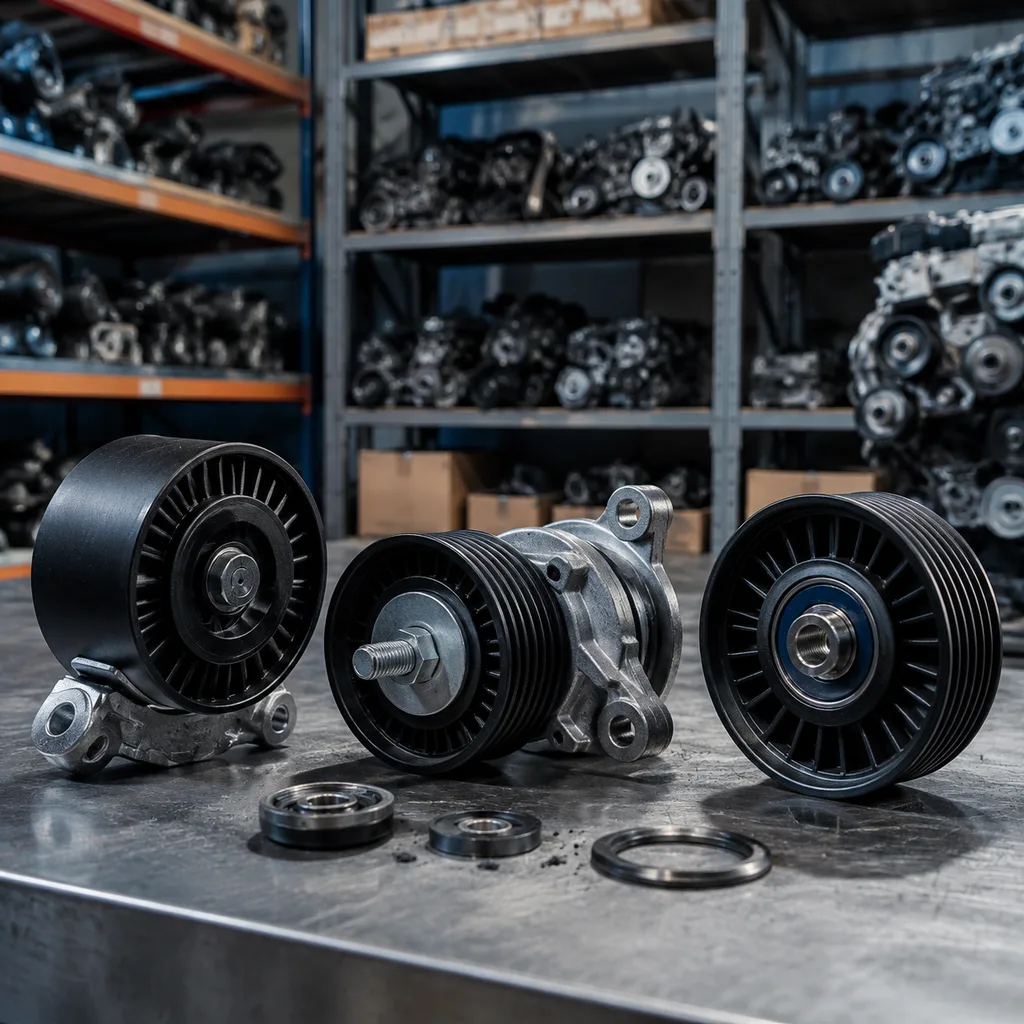
Tensioner Pulley Symptoms of Failure: B2B Diagnostics
Tensioner pulley symptoms of failure rarely arrive as a neat “pulley failed” report. Workshops usually describe belt squeal, chirp, accessory-drive vibration, intermittent charging complaints, belt flutter, edge wear, or a hot bearing smell. For a distributor, repair-chain buyer, or sourcing engineer, the commercial question is sharper: is the pulley defective, or did belt condition, alignment, accessory drag, installation, or an under-specified replacement part cause the failure?
The component works in a hard location. It carries continuous radial load while seeing -40°C cold starts, 120–150°C under-bonnet heat peaks, dust, splash water, oil mist, pulley-plane errors, and vibration from alternators, A/C compressors, water pumps, and crankshaft dampers. A small change in bearing grease, seal lip design, pulley concentricity, rib profile, bracket seating, or press-fit control can turn into noise after 500–5,000 km, even when the part passed a simple fit check.
This article is written for B2B failure review, not generic repair advice. It shows how to read the symptom pattern, separate pulley faults from system faults, turn warranty evidence into supplier controls, and specify replacement parts so repeat claims fall. Driventus is an independent aftermarket manufacturer; brand names are referenced for fitment only.
Start With the Complaint Pattern, Not the Part Number
Before replacing stock or blaming a batch, classify the reported tensioner pulley symptoms of failure by when they occur. The timing of the noise often tells more than the first visual inspection.
Field report
What it often points to
First checks to run
Squeal only on cold start
Bearing drag, moisture, glazed belt, low tension, belt contamination
Belt surface, spin feel, tensioner travel, morning-start video
Side play, bolt shoulder contact, radial and face runout
</tr></thead><tbody> </tbody></table>Use simple thresholds. A pulley that is too hot to touch after a short run, shows blueing on a steel race, has hand-felt radial looseness, or sounds rough with the belt removed should be treated as suspect. But “suspect” is not the same as “root cause”. A seized alternator clutch, tilted bracket, reused damaged belt, or incorrect belt length can destroy a good pulley quickly.
For repeat claims, require workshops to record the trigger condition: cold start only, below 1,500 rpm, during A/C engagement, under high electrical load, after rain, or continuous. Add mileage, installation date, belt brand and specification, engine code, tensioner type, installation torque where known, and whether the belt or connected accessories were replaced. This evidence helps separate product defects from installation errors and upstream drive-system faults.
The cost of getting this wrong is not limited to one pulley. A failed pulley can damage the belt, alternator bearings, water pump shafts, A/C compressor clutch bearings, and crankshaft pulley dampers. The reverse is also true: a dragging accessory can overload a new pulley and make the replacement look defective.
A Seven-Step Diagnostic Route for Noisy Returns
Use a fixed diagnostic route when a workshop reports noise or when a distributor receives a return. It reduces random part swapping and gives the supplier usable evidence.
1. Confirm the sound source. Use a mechanic’s stethoscope or electronic listening tool near the pulley bearing housing and nearby accessories. Keep clear of rotating belts. Compare the noise with the alternator, idler pulley, water pump, A/C compressor, and crankshaft damper. 2. Watch the drive under load. Observe belt flutter, tensioner arm oscillation, pulley wobble, and belt movement toward one edge. Check at idle, then apply electrical load, blower, rear defogger, headlights, and A/C. If the tensioner arm repeatedly moves more than a few millimetres at idle or hits the travel stop, suspect damping, spring force, belt length, or accessory load before blaming the pulley alone. 3. Read the belt. Glazing, transverse cracks, missing ribs, oil contamination, edge polishing, embedded debris, and heat hardening are evidence. One-side polishing or rib shaving on a multi-rib belt is a strong sign of offset or angular error. A new pulley will not silence a belt that has already been overheated, contaminated, or cut by misalignment. 4. Check alignment. Use a straightedge or laser tool across pulley faces. Misalignment can come from an incorrect spacer, non-original accessory, damaged bracket, distorted tensioner arm, or incomplete pulley-bolt seating. Investigate visible offset, belt contact against a flange, or measured pulley-plane error above the vehicle maker’s limit. For aftermarket screening, many buyers set internal targets around 0.5–1.0 mm depending on pulley span. 5. Feel the bearing with the belt removed. Rotate the pulley by hand. Roughness, notchiness, side play, grinding, or dry rotation indicates bearing damage. A serviceable sealed bearing should turn smoothly without looseness. A bearing that free-spins for a long time with almost no grease drag may be under-filled, washed out, or incorrectly specified. 6. Measure runout where claims repeat. Use a dial indicator on the pulley outer diameter and face. Excessive radial or axial runout can create belt tracking problems, periodic chirp, and accelerated rib wear. Ask suppliers to report radial runout and face runout in 0.01 mm resolution and define the datum, because results differ when the part is held by the bore, bearing inner race, or outer profile. 7. Inspect the tensioner mechanism. A good pulley on a weak tensioner assembly can still slip, vibrate, and bounce. Check the arm, pivot, spring, travel stops, and damping element. On damped tensioners, failed damping may be the main fault even when the pulley bearing still feels acceptable.
For warranty-return handling, photograph the part before disassembly. Capture seal displacement, one-side pulley polishing, impact marks, corrosion, bolt seating marks, missing washer contact, and signs of under- or over-tightening. Bag the pulley and belt together. Keep carton labels and batch codes. Do not wash the failed part before grease, seal, and contamination evidence has been reviewed.
Replace Pulley Only, Assembly, or More? A Decision Framework
Not every noise complaint calls for a pulley-only replacement. Some engines service the tensioner pulley separately. Others require the pulley and tensioner arm as an assembly. Confirm the service strategy by application, engine code, tensioner design, and the buyer’s OE cross-reference convention, such as OE 06A… or OE 11251… where relevant in the internal database.
Use this decision logic before approving a replacement part:
Bearing noisy, belt clean, alignment correct, arm stable: pulley-only replacement may be reasonable if the application allows separate service.
Bearing noisy and belt glazed, cracked, frayed, oil-contaminated, or heat-hardened: replace the belt as well. Reusing it often brings the noise back.
Pulley smooth but tensioner arm oscillates heavily: inspect spring force, damping, belt length, and accessory load. The pulley may not be the cause.
Belt edge damage or rib shaving: check pulley offset, bracket face, spacer stack, accessory seating, and tensioner pivot before fitting new parts.
Pulley overheated: check alternator, water pump, A/C compressor, and other driven accessories for drag. Excess belt load can shorten pulley life.
Immediate noise after installation: verify bolt shoulder seating, washer contact, torque, bore fit, and whether the fastener is loading the bearing inner race correctly.
The replacement specification should also be reviewed. Critical points include:
Bearing specification: correct series, load rating, clearance class such as C3 where the application requires it, and sealed construction suitable for dust, splash water, and accessory-drive heat.
Grease selection: high-temperature automotive grease with stable low-temperature torque, oxidation resistance, seal compatibility, and a stated fill quantity. Many sourcing specifications require an operating target such as -40°C to 150°C plus grease brand, base oil type, and thickener type.
Pulley material: steel, glass-fibre reinforced polymer, or machined aluminium according to OE design, mass target, thermal environment, and belt interface. For polymer pulleys, request resin grade, glass content, moisture-conditioning controls, and mould-cavity traceability.
Rib, groove, or crown profile: correct geometry for the belt type, rib count, wrap angle, and tracking requirement. Profile errors can create noise even when the bearing is acceptable.
Mounting bore and offset: controlled bore diameter, shoulder fit, perpendicularity, and pulley offset. Do not rely only on sample matching. Define tolerances on drawings; common critical dimensions may need 0.02–0.10 mm control depending on feature and process.
Fastener interface: correct shoulder, washer face, thread engagement, and torque-retention design. Wrong contact can distort the bearing inner race and create immediate roughness.
Surface finish: no burrs, mould flash, sharp edges, corrosion, coating buildup, dents, or machining marks on belt-contact areas. If roughness is measurable, agree the Ra/Rz method and inspection position before production.
Lot repeatability: stable CTQ dimensions across production, not just on approval samples. For PPAP-style release, retain master samples and compare the first three production lots against the same CTQ list.
Turn Failure Modes Into Supplier Control Points
For B2B programmes, tensioner pulley symptoms of failure should become measurable controls. “No noise” is not a specification. Bearing torque, runout, offset, seal integrity, press-fit load, and material verification are.
Driventus manufactures engine and powertrain components in Taizhou, Zhejiang, with process controls aligned to IATF 16949:2016 and ISO 9001:2015. Our quality system supports incoming material checks, in-process inspection, traceability, and batch documentation for export customers.
Failure mode in the field
Supplier control point
Example verification method
Cold-start squeal or rough noise
Bearing rotation torque and noise feel
100% or sampled torque check at defined rpm and temperature
Chirp, wobble, belt tracking issue
Radial and axial runout
Dial gauge, V-block fixture, bearing-inner-race fixture, or automated fixture
</tr></thead><tbody> </tbody></table>Build these points into a control plan. A typical approach is 100% visual inspection, 100% bearing rotation check for noise-sensitive designs, CTQ dimension checks at start-up and at defined production intervals, and final AQL inspection before packing. Export orders may use general inspection level II with AQL 1.0 for major defects and 2.5 for minor defects, but safety- or noise-critical characteristics should have tighter sampling or 100% checks.
Quality-system certificates do not define pulley dimensions, grease performance, bearing life, or belt-contact geometry. They define the management framework. Buyers still need drawings, CTQ lists, sampling plans, packaging requirements, compliance declarations, and warranty evidence rules. For EU-oriented supply chains, material compliance may also include REACH (EC) No 1907/2006 and customer-specific restricted-substance declarations.
Importer Scenario: From Sample Request to Stable Supply
Imagine a repair network reports repeated belt noise on a fast-moving reference. The importer has three possible explanations: workshops are installing the part incorrectly, the belt-drive system has application-specific sensitivity, or the sourced pulley is drifting from the approved sample. The sourcing file decides how quickly that argument is resolved.
A complete file should include:
Application list with engine codes, model years, body or market notes, and drive-belt layout where available.
Buyer-supplied OE-style cross-references, for example OE 06A… or OE 11251… where relevant.
2D drawing, 3D data, or sample part with controlled dimensions and tolerance expectations.
Bearing type, seal type, grease requirement, internal clearance, target noise/torque behaviour, and operating temperature target.
Pulley material, coating requirement, and belt-contact surface specification.
Critical dimension list, inspection report format, and AQL or other sampling plan.
Packaging expectations for sea freight, inland transport, and warehouse storage, including corrosion protection and carton compression.
Warranty return form covering mileage, belt condition, installation torque, installer notes, photos, batch code, and whether the belt was replaced.
Carton, inner box, and part-marking traceability requirements where applicable.
Commercial planning should match the technical risk. Catalogue parts with existing tooling and approved bearings are often limited by carton quantity and bearing MOQ; importers may start with a few hundred pieces per reference or consolidate several references to reach a practical shipment volume. For new tooling or private-label design, MOQ is driven by mould or stamping setup, bearing purchase lot, packaging print quantity, and validation samples.
Do not compare quotations by unit price only. A few cents can reflect grease type, seal design, bearing origin, polymer grade, coating thickness, corrosion protection, or inspection level. The quotation should state those assumptions.
Lead time also changes by reference status. Existing references with components in stock can move quickly. New references require sample measurement, drawing confirmation, tooling or fixture preparation, pilot build, dimensional approval, packaging artwork, and production. Split the plan into sample lead time, buyer approval time, mass-production time, and sea-freight time. Before shipment, agree the evidence set: inspection report, photos, material declaration, packing list, and retained sample record.
Driventus supplies tensioner pulleys and related engine components through our catalog, with additional powertrain products listed under engine components. For private-label ranges or application-specific pulley designs, our engineering team can support custom manufacturing from sample analysis and drawing confirmation to tooling, pilot production, and validation. Driventus is an independent aftermarket manufacturer; brand names are referenced for fitment only.
Q&A for Reducing Repeat Failure Programmes
When does one failed pulley become a programme issue? When claims cluster by symptom, vehicle application, production lot, mileage band, installer, region, or installation date. A single return can be handled through normal warranty. A pattern should trigger containment and a structured review.
What should distributors do first? Separate returns by symptom and batch. Quarantine remaining stock from the same lot until inspection is complete. Compare returned parts with retained production samples and pre-shipment inspection records. Do not mix early bearing noise, belt edge wear, corrosion before installation, and installer damage into one defect category.
Which workshop actions reduce repeat claims?
Replace the belt when it is contaminated, glazed, cracked, frayed, rib-damaged, or heat-hardened.
Check accessory drag when pulley bearings fail early or show overheating.
Use correct torque values, belt-routing diagrams, and application-specific installation notes.
Confirm pulley-plane alignment after any bracket, accessory, or tensioner replacement.
Photograph belt condition and installation marks before removing failed parts.
What does an 8D-style review need? Set the trigger before launch. For example, open a review if claims exceed an agreed percentage within the first 3–6 months or if several early failures occur on the same lot below a defined mileage. The first containment step is to identify the batch from carton and part marking, isolate remaining stock, and collect failed samples.
The technical review should cover bearing rotation feel, seal condition, grease evidence, radial and axial runout, offset, bore damage, belt-contact wear pattern, corrosion, impact marks, and installation marks. Compare those findings with the CTQ list and supplier inspection records.
How should performance be measured commercially? Track claim rate per 1,000 units sold, not only total claim count. A slow-moving reference with three claims may be more serious than a high-volume reference with ten. Monitor whether claims cluster by workshop, region, engine code, belt brand, or production lot.
What is the sourcing lesson? The lowest quoted price is rarely the lowest programme cost if bearing noise, dimensional drift, weak packaging, poor sealing, or poor traceability creates recurring claims. A balanced specification covers fitment, durability, compliance documentation, packaging, batch identification, and supplier response time. The best supplier conversations start with measured symptoms and failed-sample evidence, not verbal reports of noise.
Frequently asked questions
Common signs include cold-start squeal, chirping, rough bearing noise, belt flutter, belt edge wear, visible pulley wobble, overheated bearing smell, and premature belt wear. Charging, cooling, or power steering complaints may also appear if belt slip affects driven accessories.
Yes, if the belt is cracked, glazed, contaminated, frayed, heat-hardened, or has run on a misaligned pulley. Reusing a damaged belt can cause noise to return even when the replacement pulley is dimensionally correct.
Request drawings or sample confirmation, critical dimension reports, bearing and grease specifications, runout checks, material compliance declarations, batch traceability, packaging requirements, inspection sampling plans, and quality management certification such as IATF 16949:2016 or ISO 9001:2015.
If your team is reviewing pulley returns or adding new belt-drive references, share the application list, samples, drawings, target MOQ, annual forecast and packaging needs. We will provide a practical manufacturing assessment and quotation logic. To discuss specifications and pricing, [request a quote](/contact.html).