camshaft · 2026-06-20

Camshaft for Hyundai Tucson Replacement: OE-Equivalent Sourcing Guide

A camshaft for Hyundai Tucson replacement is not a catalogue-line decision. It is a control point for valve timing, oiling, sensor reference, VVT/CVVT operation, noise, wear, and warranty exposure. Two shafts can look identical in photos and still differ in lobe profile, journal size, thrust width, trigger pattern, or heat-treatment condition.

For B2B buyers, the sourcing file should answer a few hard questions before price negotiation starts: Which Tucson engine code and model-year range is covered? Is the part for intake or exhaust? What VVT/CVVT interface does it use? Which OE-reference number or supersession is being matched? What drawing revision, inspection tolerance, packaging method, MOQ, price basis, and lead-time assumption will govern repeat orders?

Driventus supplies engine components to distributors, importers, wholesalers, and repair networks that need replacement parts checked against OE references, production tolerances, and export packaging requirements. Driventus is an independent aftermarket manufacturer; Hyundai and Tucson names are referenced only to identify vehicle fitment. This guide shows how to qualify the application, where camshaft replacement programmes usually fail, what evidence to request, and how to compare aftermarket supply options with fewer warranty risks.

Start with the fitment decision: what has to match before anything else?

Before approving a camshaft for Hyundai Tucson replacement, reduce the application to a fitment decision tree. If any of the early answers are uncertain, pause the order. A correct-looking camshaft with the wrong engine code, phaser interface, or trigger pattern can create immediate installation problems or delayed drivability complaints.

Use these questions as the first screen:

1. What is the Hyundai Tucson engine family, engine code, fuel type, displacement, and model-year range? 2. Is the camshaft for the intake or exhaust side? If the engine layout requires bank identification, which bank? 3. Is the cylinder head SOHC or DOHC? What follower system is used: bucket tappet, roller follower, rocker arm, or another design? 4. Does the shaft interface with CVVT/VVT hardware? Check the phaser mounting face, dowel, oil-control groove, bolt pattern, and oil-feed route. 5. Is an OE part-number cross-reference available, including supersession history? 6. Are the timing reference features integrated into the camshaft: keyway, dowel, trigger wheel, slots, teeth, or reference marks? 7. Will the buyer approve by sample comparison, supplier drawing, OE reference, or all three?

The measurable features then become the purchase specification: base circle, lobe lift, lobe profile, duration reference, lobe separation, journal diameter, thrust face dimensions, end-float interface, oil-hole position, and sensor trigger geometry. The sensor feature deserves special attention. Tooth count, slot width, phase angle, trigger edge shape, and reference mark location can affect fault-code behaviour even when the shaft installs cleanly.

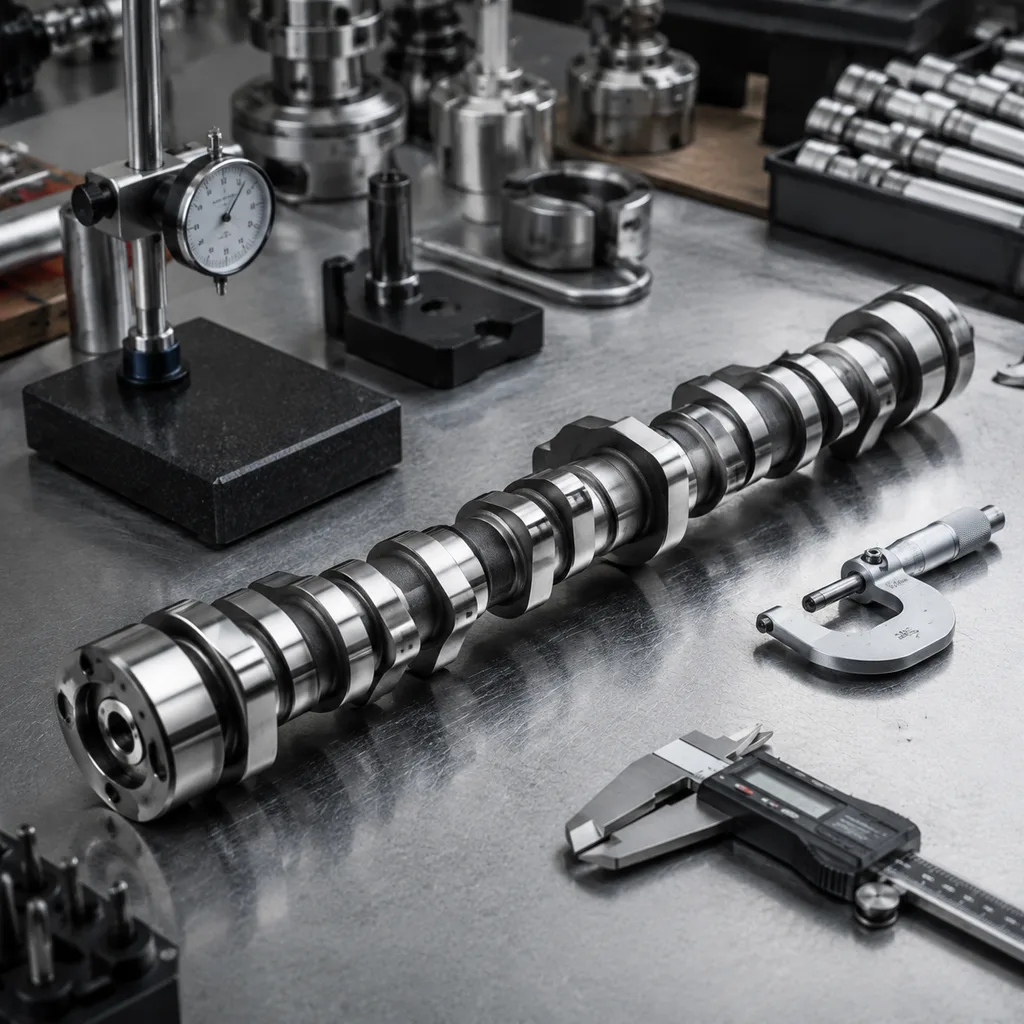
For incoming checks, many buyers verify journal diameter with a micrometer at multiple clock positions, lobe height with a height gauge or cam profile fixture, and runout between centers. Practical aftermarket control ranges often include journal size held to the supplier drawing within about `±0.010–0.020 mm`, lobe lift repeatability around `±0.02–0.05 mm`, and total indicated runout below `0.03–0.05 mm`, depending on the original design. These are buying-control targets, not universal Hyundai specifications. Replace them with the approved drawing wherever available.

The safest rule is simple: do not approve a Tucson camshaft because it resembles the removed part. Approve it because the fitment data, sample comparison, drawing, and inspection evidence agree.

Where replacement camshaft programmes fail in the field

Most camshaft sourcing failures are not dramatic at the sample-review stage. They appear later as noisy starts, unstable idle, misfire codes, oil-starved journals, premature lobe wear, or returns from workshops that cannot explain why the engine does not behave like it did before repair. The root cause is often a small uncontrolled feature.

Common failure modes include:

  • Correct vehicle, wrong engine variant. Tucson applications can vary by region, year, fuel system, displacement, and emissions package. Engine code confirmation matters more than vehicle name alone.
  • Intake and exhaust confusion. Similar shafts may have different lobe phasing, trigger features, or VVT interfaces. Labelling errors can create expensive workshop delays.
  • Lobe profile drift. A small change in lift, duration, ramp rate, or base circle can alter valve events, hydraulic lash adjuster position, idle quality, and emissions behaviour.
  • Journal sizing or finish problems. Oversize, undersize, taper, ovality, or rough journals reduce oil-film stability and can accelerate head or bearing-surface wear.
  • Runout after heat treatment. A shaft that is not straight after final processing may rotate with abnormal contact, noise, and uneven follower loading.
  • VVT/CVVT interface mismatch. Incorrect dowel position, oil groove location, mounting face, bolt pattern, or oil-control passage can prevent proper phaser operation.
  • Trigger pattern mismatch. A different tooth edge, slot width, phase angle, or reference position may cause cam/crank correlation faults.
  • Oil-hole contamination. Chips, blasting media, rust inhibitor, burrs, or blocked passages can damage a new camshaft quickly after installation.
  • Weak export packaging. Lobes and journals damaged in transit can turn an approved technical part into a rejected shipment.

A useful sourcing file treats each of these as a preventable risk. It should define inspection points for lobes, journals, thrust faces, keyways, dowels, oil holes, timing-reference features, and packaging. Visual inspection is still needed, but it should support measurement rather than replace it.

For mixed fleets or regional stock programmes, keep the removed OE sample available during first-article approval. Compare it with the supplier drawing, the application list, and the first production batch before releasing bulk inventory. This prevents a common B2B problem: one SKU that is technically suitable for one Tucson engine variant but sold too broadly across several.

Specification deep-dive: dimensions, material, hardening, and cleanliness

A replacement camshaft should be purchased against measurable specifications, not catalogue wording. The buyer’s approval checklist should cover machining accuracy, grind consistency, surface treatment, straightness after processing, oil-passage cleanliness, corrosion protection, and packaging condition.

</tr></thead><tbody> </tbody></table>Material choice depends on the original engine design and the production route. Aftermarket programmes may use chilled cast iron, forged steel, or alloy steel billets, followed by induction hardening, carburizing, nitriding, or another approved surface treatment. A generic material name is not enough. Ask for the grade, heat number or batch reference, hardening method, hardness range, and grinding process route.

Cleanliness also belongs in the specification. A camshaft with accurate lobes can still fail if oil holes contain debris or burrs. Define washing after machining, oil-passage deburring, visual or magnetic-particle crack inspection where required, anti-rust oil type, and shelf-life expectation for packed goods.

Driventus manufactures engine components under `IATF 16949:2016` and `ISO 9001:2015` controlled processes. For compliance-sensitive markets, buyers may also request material declarations aligned with `REACH (EC) No 1907/2006` where applicable. The best supplier response is not a broad quality claim; it is a technical file with drawing references, inspection data, material or heat-treatment evidence, control-plan highlights, process-flow records, and packaging confirmation.

Specification deep-dive: dimensions, material, hardening, and cleanliness

Sample approval workflow: from OE reference to controlled trial order

A disciplined approval process keeps a camshaft sourcing project from becoming a guess based on one sample and a low quotation. For a camshaft for Hyundai Tucson replacement, validation should move from application proof to dimensional proof, then to installation and logistics proof.

A practical workflow looks like this:

1. Lock the application. Confirm engine code, model year range, intake/exhaust position, VVT/CVVT type, valve-train layout, and OE-reference number where available. 2. Compare the reference. Review the removed OE sample, approved drawing, or supplier drawing. Check visible features first: oil holes, dowel, keyway, phaser face, trigger pattern, thrust face, and journal count. 3. Approve first-article inspection. Require data for journals, lobes, thrust faces, keyways, dowels, oil holes, timing-reference features, runout, hardness, and any specified roughness points. 4. Review profile confidence. For higher-risk programmes, request cam-lift or profile data at defined angular increments, not only peak lift. 5. Install-check the sample. Confirm free rotation in the target cylinder head or engine family, oil-feed alignment, phaser fit, sensor reference position, and end-float compatibility. 6. Test the packaging system. Verify anti-corrosion method, end protection, carton strength, label content, barcode readability, pallet pattern, and traceability marking. 7. Release a controlled trial order. Use `5–20` pilot samples or a small first batch with full reporting before moving to bulk stock.

The approval pack should include application confirmation, first-article dimensional inspection, material or heat-treatment evidence, hardness and roughness records where specified, runout data, visual defect criteria, installation feedback, packaging specification, and batch traceability reference.

If the application is tied to emissions-controlled calibration, do not treat cam geometry as a flexible feature. Any unintended difference in lift, duration, ramp shape, phasing interface, VVT oil route, or trigger geometry can affect drivability, cam/crank correlation, fault codes, and emissions performance. Buyers serving regulated markets should keep the approval file available for audits, field claims, and workshop support.

This workflow also protects distributors from a non-technical failure: approving the part but receiving cartons that cannot be scanned, stored, traced, or handled properly. In replacement parts, logistics quality is part of product quality.

How to compare Driventus with other aftermarket supply options

When buyers compare camshaft suppliers, the decision should not be framed as “Who has the lowest line price?” A better comparison is: which supplier can repeat the geometry, document the batch, protect the part during export, and support fitment review when field questions appear?

Use this comparison lens:

  • Fitment support: Can the supplier confirm engine code, model year, intake/exhaust position, VVT/CVVT interface, and OE-reference matching where data is available?
  • Geometry control: Are journal diameters, lobe lift, profile, thrust faces, runout, oil holes, and trigger features measured against a drawing or approved sample?
  • Process consistency: Is there a controlled route for material receipt, rough machining, heat treatment, straightening, grinding, deburring, washing, anti-rust treatment, and final inspection?
  • Documentation: Can the supplier provide first-article reports, material or heat-treatment evidence, hardness/roughness data where specified, and traceability records?
  • Packaging reliability: Are lobes and journals protected for sea freight, warehouse storage, and branch distribution?
  • Development capability: Can the supplier handle an existing SKU, application extension, reverse-engineering project, or custom production programme?

Driventus supplies camshafts as part of a broader engine-component range for distributors, wholesalers, importers, and repair networks. Buyers can review related items through our catalog and engine components. Our quality system covers incoming material control, in-process inspection, final release checks, and traceability practices.

A typical camshaft control route includes material receipt verification, rough machining, heat treatment or surface hardening, straightening where required, journal and lobe grinding, oil-passage deburring, cleaning, anti-rust treatment, final dimensional inspection, label verification, and export packing. Depending on the drawing requirement, inspection tools may include micrometers, dial indicators, hardness testers, surface roughness testers, profile fixtures, and CMM or contour measurement equipment.

For non-standard profiles or market-specific specifications, custom manufacturing is available. Buyers can provide an OE sample, drawing, OE-reference number, engine code list, target annual volume, and preferred packaging format. Driventus can then review whether the requirement should be handled as an existing SKU, an application extension, a sample reverse-engineering project, or a custom programme.

How to compare Driventus with other aftermarket supply options

Commercial scenario: stocking one Tucson camshaft SKU without creating hidden costs

Consider a distributor planning to add a Tucson camshaft SKU for regional repair demand. The purchase team has three quotes. One is cheaper, one includes stronger inspection documentation, and one offers faster shipment but limited packaging detail. The right decision is rarely the lowest unit price alone.

Score the offer across technical and commercial risk:

  • MOQ and packaging configuration by SKU, such as `50–100 pcs` for a stocked item or higher MOQ for a new casting/forging or custom profile
  • Price basis by order quantity, tooling status, material route, inspection depth, private-label packaging, and Incoterms such as EXW, FOB, CIF, or DDP where available
  • Batch traceability, lot coding, carton identification, and linkage between inspection reports and shipped quantities
  • Initial order lead time, replenishment lead time, and separate shipping time
  • Export documentation support, HS code confirmation, packing list accuracy, certificate availability, and shipping readiness
  • Warranty terms, claim evidence requirements, installation documentation, oil-contamination review, and response process
  • Fitment data by engine code, model year, camshaft position, VVT/CVVT interface, and OE reference
  • Barcode accuracy, label language, private-label carton artwork, and warehouse handling requirements
  • Corrosion protection suitable for sea freight, humid ports, inland warehousing, and regional storage conditions

Separate the timing assumptions. A common sourcing schedule is `7–15 days` for confirmation or available samples, `30–60 days` for first production depending on material and capacity, plus transit time by air, LCL, or FCL shipment. Custom profiles, new tooling, or reverse-engineering projects take longer because drawing approval, pilot samples, heat-treatment validation, and packaging approval must happen before bulk production.

Normalize price before comparing suppliers. One quotation may exclude individual packaging, anti-rust treatment, inspection reports, export palletization, private-label cartons, or destination-side delivery. Those omissions become real cost later.

For multi-location repair chains, stable availability can matter more than a one-time discount. Downtime and repeat repairs damage service reputation. For distributors, accurate labelling, protective packaging, and consistent batch documentation reduce receiving errors, mis-picks, and avoidable returns. Driventus exports to 60+ countries, so export-oriented packaging, document preparation, and logistics coordination are built into the supply model rather than treated as late-stage add-ons.

Frequently asked questions

Match the engine code, model year range, intake or exhaust side, valve-train layout, VVT/CVVT interface, sensor trigger pattern, and any available OE cross-reference. The safest final check is dimensional confirmation against the removed original sample or an approved technical drawing.

Yes, provided it matches the original cam profile, lift, timing-reference features, sensor trigger geometry, and VVT/CVVT interface. Any change in lobe timing, lift, duration, phasing oil route, or trigger geometry can affect drivability, fault codes, and emissions control.

Request first-article dimensional inspection data, material or heat-treatment evidence, hardness and roughness information, runout data, traceability details, packaging confirmation, and evidence of `IATF 16949:2016` and `ISO 9001:2015` controlled production.

If you are building a replacement programme or checking OE cross-references, send your application details, engine code, camshaft position, OE-reference number, sample or drawing availability, packaging requirement, and target quantity through /contact.html.

Request a Quote
Check item Typical buyer expectation
Journal diameterMeasured at every bearing location and clocked for taper/ovality; commonly controlled to drawing tolerance with practical aftermarket targets around `±0.010–0.020 mm`
Lobe lift and profileMatches the OE lift window and valve-event requirement for the stated engine code; peak lift variance often targeted within `±0.02–0.05 mm` after profile approval
Base circle and lobe heightChecked per lobe, not only on one reference lobe; variation must not create abnormal valve clearance or hydraulic lash adjuster travel
Runout and straightnessMeasured between centers after heat treatment and final machining; typical buyer limits are often below `0.03–0.05 mm TIR`, subject to shaft length and design
Thrust width and end-face squarenessCompatible with cylinder-head thrust control so installed end float remains inside the engine service specification
Surface hardnessConsistent with the specified alloy and heat-treatment route; buyers often request lobe hardness evidence such as `HRC 50–60` or an equivalent approved specification where applicable
Surface roughnessSuitable for oil-film formation and follower contact; common targets include journal `Ra 0.2–0.8 µm` and lobe contact surfaces finished to the approved drawing
Oil hole alignmentFully open, correctly positioned, chamfered/deburred, and free of chips, blasting media, rust inhibitor blockage, or machining debris
VVT or sensor trigger featuresMatched to the original pattern, phasing interface, dowel position, trigger edge geometry, and sensor reference angle
PackagingVCI bag or oil film, end protection, individual partitioning, export carton strength, and palletization suitable for sea freight and warehouse storage