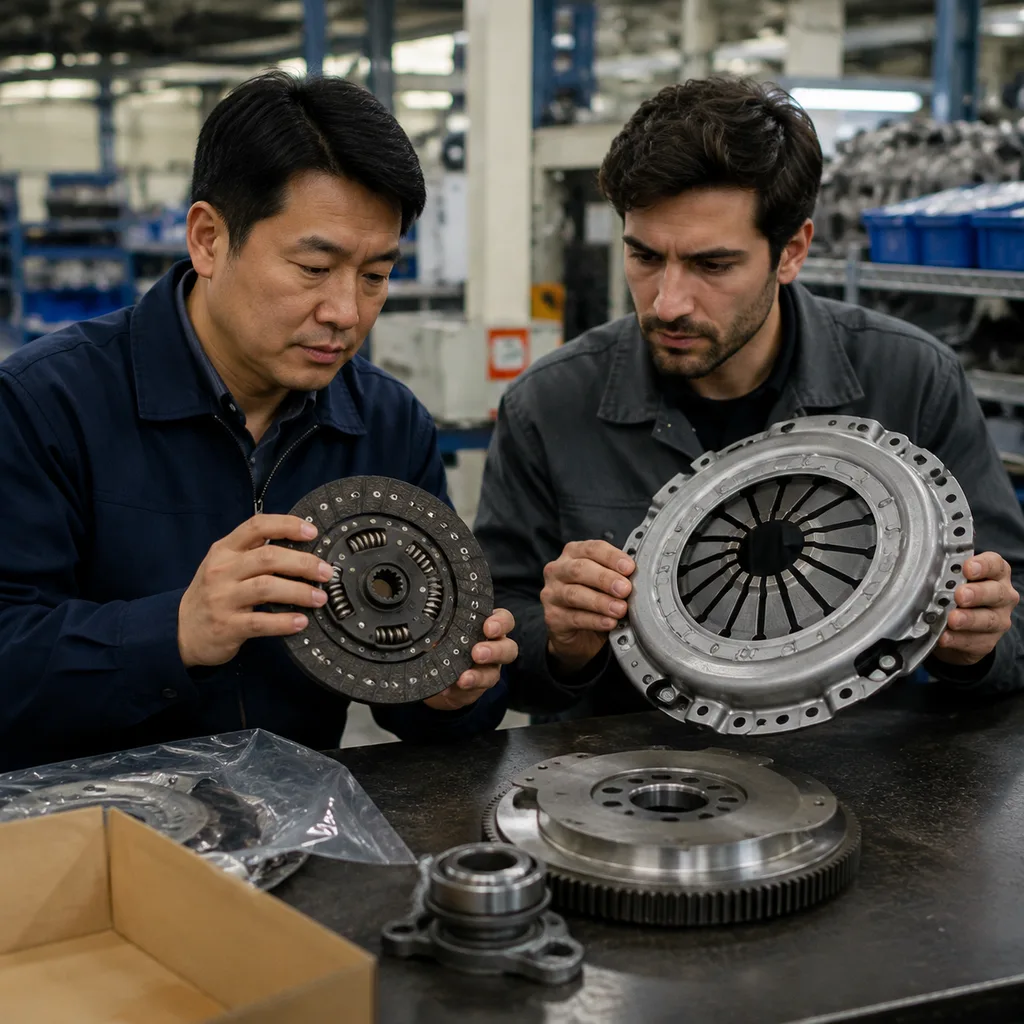
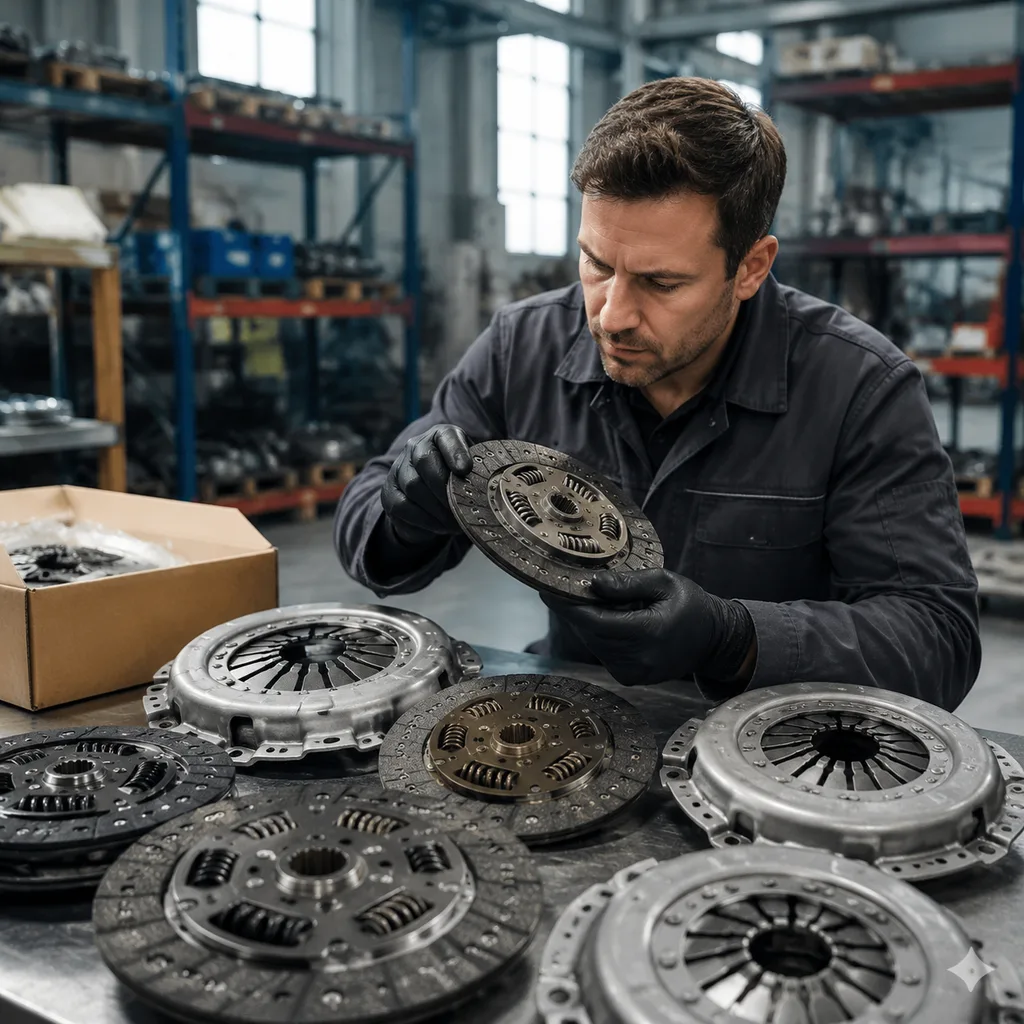
A clutch kit Hyundai replacement programme is not a single yes/no fitment exercise. Most importers, distributors, and repair-chain buyers need coverage across petrol and diesel applications, consistent pedal feel, reliable release behaviour, and low labour-cost warranty exposure after installation. The disc spline may fit, yet the kit can still fail commercially if cover height, clamp load, bearing geometry, friction material, or release travel sits outside the intended design window.
Treat every kit reference as a controlled assembly. The RFQ should identify disc outside diameter, spline count and major diameter, cover bolt pattern, working clamp-load range, release bearing type or concentric slave cylinder, lining thickness, packaging format, annual volume, and documentation requirements. MOQ, price, and lead time then become easier to interpret: common catalogue kits move quickly; private-label, low-volume, or validation-heavy references need more engineering time.
This guide sets out the checks Driventus recommends before approving a replacement clutch kit for Hyundai applications. It is written for B2B buyers comparing samples, factory records, batch controls, and supplier audit readiness. Driventus is an independent aftermarket manufacturer; vehicle brand names are used for fitment identification only.
Decision gate: prove the kit before negotiating the landed cost
Start with a hard rule: do not compare prices until the candidate kit has passed the engineering screen. A cheaper clutch kit Hyundai replacement line can become expensive fast if it causes judder, drag, bearing noise, heavy pedal feel, early slip, or catalogue returns. The buyer’s first decision is not “which supplier is cheapest?” It is “which supplier can prove the assembly matches the application and can repeat it by batch?”
For Hyundai applications, require fitment documentation by vehicle platform, model year range, engine code, transmission type, flywheel type, and OE part-number cross-reference where applicable. Use generic cross-reference formats such as OE 06A… or OE 11251… only when they already exist in your internal data set. Do not invent or publish unsupported brand-owned numbers in RFQs, catalogues, or marketplace listings.
A complete replacement kit specification normally defines:
Clutch cover assembly with pressure plate and diaphragm spring
Driven disc with matched hub spline, cushion plate, facing, and damper system
Release bearing or concentric slave cylinder where required
Alignment tool if required by the service channel
Pilot bearing or bushing where applicable
Bolts, clips, retaining rings, or grease sachet only where approved for the application
Installation notes with torque-reference guidance and cautions on flywheel condition
Batch traceability label for the kit, cover, disc, and bearing or CSC
Approve the kit as one controlled assembly, not as a box of interchangeable parts. The disc, cover, bearing, and accessories interact. A small change in bearing face profile or diaphragm finger height can alter release travel, load, and noise behaviour. As a buyer-side rule, do not mix a cover from one approved kit with a disc or bearing from another unless the new combination is checked again.
For quotation planning, divide the range into three lanes: fast-moving catalogue references, medium-volume regional references, and engineered or private-label references. Catalogue kits may support lower MOQs per SKU when consolidated in a mixed order. Special packaging, custom lining, non-standard barcode labels, or buyer-specific inspection reports usually raise MOQ and extend lead time. Driventus supplies clutch kit programmes through our catalog and can support fitment tables for distributor ERP import, TecDoc-style data mapping, and private-label packaging review.
Spec deep-dive: the measurements that separate a fitment from a real approval
Visual matching is not sample approval. Similar vehicle names can hide differences in model year, engine variant, production market, transmission family, release system, and flywheel configuration. The inspection sheet should state the nominal value, tolerance, measuring point, gauge or fixture, and sampling frequency.
Check item
What to confirm
Practical tolerance or record to request
Buyer risk if missed
Disc outside diameter
Correct application range, normally measured in mm
Nominal OD and tolerance, commonly controlled within about ±0.5 mm where design allows
Slip, incomplete contact, wrong kit selection
Disc thickness
New compressed or free thickness according to drawing
Facing thickness, overall thickness, rivet head depth, and wear allowance
Drag, release problem, short service life
Spline count and shaft diameter
Hub matches gearbox input shaft
Go/no-go gauge result, major/minor diameter, spline count, and flank fit
Cannot install, vibration, premature hub wear
Disc runout
Hub and facing concentricity
TIR reading on specified fixture, often targeted below 0.8 mm for many passenger-car discs
Judder, pedal pulsation, uneven wear
Cover bolt pattern and locating dowels
Hole pitch, dowel position, cover height
Coordinate check or template gauge against approved sample
Misalignment, cover distortion, release fault
Clamp load
Within approved engineering window
Production release range in N, test height, and load curve
Slip if low; heavy pedal or bearing overload if high
Release travel window
Disengagement distance and bearing contact geometry
Finger height, release load, and working travel record
Drag, hard shifting, bearing overheating
Friction lining
Material grade, thickness, rivet depth
Formulation revision, asbestos-free declaration if required, and coefficient range
Judder, odour, short service life
Damper springs
Spring rate, pre-load, and free play control
Spring colour/code, torque-angle curve, and backlash check
Gear rattle, harsh take-up, noise complaints
Release bearing interface
Inner diameter, face profile, travel compatibility
ID/OD, face radius or flatness, grease and seal specification
Noise, drag, incomplete release, early failure
</tr></thead><tbody> </tbody></table>Material confirmation should cover the pressure plate casting grade, diaphragm spring steel, hub steel grade, friction lining formulation, bearing grease, bearing seal material, and corrosion protection. For EU and UK channels, request substance compliance declarations aligned with REACH (EC) No 1907/2006. If your market requires asbestos-free confirmation, keep the signed declaration tied to the exact lining formulation revision, not just the supplier name.
Batch linkage matters. A sample report from a showroom kit is useful for screening, but it does not protect a multi-container programme unless production parts can be traced to approved drawings, inspection records, and controlled revisions. For incoming control, inspect 3 to 5 kits per SKU on pilot orders. After two or three clean shipments, move to AQL-based checks while keeping critical dimensions under routine surveillance.
Failure-mode testing: what to ask for before the first bulk order
Validation should be built around the ways a clutch kit can fail in the field: slip, drag, judder, hot fade, damper noise, bearing failure, hydraulic leakage, corrosion, or transport damage. The supplier should be able to explain the test method, acceptance criteria, equipment used, calibration status, and sample size. For new references, ask for evidence before bulk production. For established references, request the latest batch or annual validation summary.
Useful validation evidence includes:
Static clamp load measurement before and after endurance cycling, with test height and acceptable load-loss percentage stated
Disc thickness, runout, parallelism, and balance checks before and after testing
Spline fit and hub runout measurement using a defined input-shaft gauge
Burst-speed or overspeed safety test for the driven plate, with rpm and hold time recorded
Engagement and disengagement travel verification across the release-bearing working range
Thermal cycling for friction lining stability, hot clamp behaviour, and fade recovery
Wear checks after simulated operating cycles, including lining wear, rivet clearance, and damper looseness
Bearing rotation noise, seal performance, grease retention, and temperature-resistance checks
CSC hydraulic leakage, stroke, and pressure-hold tests where a concentric slave cylinder is included
Salt spray or corrosion-resistance checks where specified by the buyer, commonly 48 to 96 hours depending on market requirement
Packaging drop or vibration checks for export shipments, especially for mixed-SKU pallets and e-commerce handling
For first approval, plan for 3 to 10 sample kits depending on risk. One may go to dimensional measurement, one to installation trial, one to functional or bench testing, and the balance to internal distribution or workshop evaluation. Increase the sample quantity if the kit includes a CSC or a newly sourced bearing. Hydraulic and bearing issues create expensive claims because the replacement labour often costs more than the part.
Use standards carefully. Clutch kits are not certified under emissions rules such as ECE R-83, and they are not brake components tested under SAE J2527. A supplier that respects those boundaries is less likely to make unsupported certification claims in tenders or sales material.
Quality management still matters, even when the part is not type-approved. Driventus operates under IATF 16949:2016 and ISO 9001:2015 principles for process control, corrective action, document management, and traceability. Buyers can review our quality system when assessing production discipline, inspection records, and audit readiness.
Step-by-step controls for scaling from one approved SKU to a range
Replacement clutch kit purchasing often breaks down after the first successful sample. The buyer approves one reference, then quickly adds adjacent applications without rechecking disc diameter, release bearing type, flywheel configuration, or hydraulic release requirements. Build a release process before the range grows. Commercial launch dates should depend on engineering release, not catalogue enthusiasm.
Use this control sequence:
1. Application freeze: define vehicle years, engine codes, transmission references, flywheel type, and target markets. Freeze the fitment list before sample testing so the supplier is not validating a moving target. 2. Engineering file: require drawings, critical dimensions, material declarations, validation evidence, and approved component sources. Include nominal dimensions and tolerances, not only photos. 3. Golden sample: retain approved cover, disc, bearing, and accessory samples at buyer and supplier locations. Seal or mark them, and record the approval date and revision. 4. First article inspection: compare production batch parts against the signed sample before shipment release. At minimum, verify disc OD, spline, runout, cover height, clamp load, bearing dimensions, kit weight, and label data. 5. Packaging approval: confirm kit contents, carton strength, corrosion protection, labels, and barcode logic. Export cartons should protect heavy covers from damaging bearings and alignment tools during vibration. 6. Change control: require written approval before changing lining, spring supplier, bearing source, grease, tooling, heat treatment, corrosion coating, carton structure, or label format. 7. Warranty feedback loop: classify field returns by installation error, catalogue error, material fault, production variation, or transport damage. Track claim rate by SKU, lot, installer type, and vehicle application.
For repair chains, installation guidance is a risk control, not an afterthought. Many complaints blamed on clutch kits come from contaminated flywheels, unmachined or overheated contact surfaces, incorrect torque sequence, hydraulic system air, worn forks or guide tubes, and reused release components. Ask whether the supplier can provide installation cautions for technical support teams without implying vehicle-manufacturer approval.
A practical warranty file should include the returned kit, vehicle mileage, installation date, flywheel photos, hydraulic condition, symptom description, and batch code. Without those details, the buyer cannot separate product faults from installation or catalogue errors. Once the wrong kit enters distribution, the cost can include workshop time, customer downtime, freight, credit notes, lost bay time, and damage to the repair network’s confidence.
Scenario planning: when the catalogue kit is not enough
Standard catalogue parts cover many Hyundai replacement needs. They do not cover every business model. Custom work may be required for private-label programmes, regional parc differences, older platforms, fleet-specific demand, or a repair-chain pack that differs from the standard aftermarket kit. In those cases, the buyer should provide a controlled sample, application data, target annual volume, packaging requirements, target price range, and expected validation level.
Driventus can support custom manufacturing for clutch kit assemblies where commercial volume and technical data justify tooling, fixture development, or special inspection plans. Typical customisation areas include:
Friction material selection for duty cycle and market preference, such as urban taxi use, hilly routes, or high-temperature markets
Damper spring configuration for NVH behaviour and gear-rattle control
Release bearing sourcing and seal specification, including buyer-approved brands or in-house alternatives
Cover assembly parameters within the required design window, including clamp-load target and diaphragm finger height
Kit content definition for repair-chain workflow, such as including bolts or alignment tools where the service model requires them
Private-label carton, inner protection, moisture protection, and palletisation
Lot coding and distributor barcode formats, including EAN, UPC, Code 128, or buyer-specific serial logic
Inspection reports or documentation packs aligned with buyer requirements
Custom work changes both MOQ and timing. A standard stocked or current-production reference may be possible at lower quantity when combined with other SKUs. A private-label carton usually brings a packaging print-run MOQ as well as a clutch kit MOQ. A new or modified assembly may require sample tooling, fixture adjustment, bench validation, and pilot production before mass shipment. Build time into the plan for drawing confirmation, sample build, testing, packaging artwork approval, production scheduling, inspection, and freight.
OEM and Tier-1 buyers should expect a heavier documentation package than aftermarket distributors. Plan for process flow charts, control plans, production part approval evidence where requested, measurement system checks, capacity review, and structured corrective action reporting. Driventus does not claim approval or endorsement by any vehicle manufacturer.
Buyer Q&A: questions that expose weak sourcing proposals
Before issuing a purchase order for a clutch kit Hyundai replacement line, use a technical questionnaire that forces SKU-level answers. Broad factory statements are not enough. The goal is to expose weak catalogue mapping, uncontrolled component sourcing, incomplete validation, or a price that only looks attractive because risk has been left out.
Ask the supplier:
Which vehicle applications, model years, and engine/transmission combinations are covered?
What are the disc diameter, spline count, hub profile, free disc thickness, and cover height?
What clamp-load range is used for production release, and at what test height is it measured?
What are the diaphragm finger-height tolerance and release-load range?
What disc runout limit is used at final inspection, and what fixture is used?
Which friction lining grade is fitted, and is the formulation controlled by revision?
Are release bearings produced in-house or sourced externally, and can the bearing source be locked for the contract period?
What checks are performed on bearing noise, seal quality, grease retention, and temperature resistance?
If a CSC is included, what pressure-hold, leakage, stroke, and connector checks are performed?
What batch traceability appears on the product, carton, pallet label, and inspection record?
Can the factory provide current IATF 16949:2016 and ISO 9001:2015 certificates where applicable?
What is the normal lead time for samples, first production order, repeat orders, and mixed-SKU containers?
What is the MOQ by kit reference, carton type, private-label artwork, and consolidated shipment?
What are the price drivers: lining grade, bearing source, CSC inclusion, bolts, carton specification, inspection report level, and order quantity?
How are warranty returns analysed, documented, and reported back to the buyer?
What changes require advance written approval, and how much notice is given before implementation?
For commercial comparison, request price breaks at realistic buying levels: pilot order, mixed-pallet order, LCL order, and full-container order. Do not compare a plain brown-carton offer with no inspection report and variable bearing sourcing against a private-label offer with locked components and batch inspection. That is not a price gap. It is a scope gap.
If your programme includes multiple powertrain categories, consider reviewing clutch kits alongside adjacent engine and drivetrain components. This can reduce supplier count and simplify quality audits, provided the factory has documented capability for each product group and is not treating unrelated parts as a trading bundle.
Frequently asked questions
Start with application accuracy: vehicle platform, model year, engine, transmission, disc diameter, spline count, cover mounting pattern, flywheel type, and release bearing or CSC type. Then review clamp load, friction material, validation data, packaging, MOQ, lead time, and batch traceability before comparing prices.
Aftermarket replacement kits should be validated for dimensional match, function, durability, and installation compatibility, but suppliers should not claim vehicle manufacturer approval unless they have documented authorization. Driventus does not claim endorsement by any vehicle manufacturer.
Yes. Driventus can discuss private-label packaging, kit content, barcode requirements, fitment data, MOQ, lead-time planning, and validation needs for distributors, OEM/Tier-1 buyers, and repair chains where volume and technical data support the project.
For fitment lists, samples, MOQ, price-break, and lead-time review, send your target markets, annual volume, packaging needs, and required documentation to Driventus. You can [request a quote](/contact.html).