RoHS Testing for Crankshaft Pulley: Supplier Checklist
RoHS testing for crankshaft pulley sourcing should be handled as part of a complete compliance and supplier-control review, not as a simple stand-alone pass or fail. Buyers need to confirm that the finished pulley assembly—and any attached, bonded, coated, or marked components—does not contain restricted substances above the limits set by applicable RoHS rules and customer requirements. In practice, the main risk is usually not the steel or cast-iron substrate. It is more often found in coatings, rubber damping elements, adhesives, surface treatments, inks, inserts, sleeves, or fasteners used in the final assembly. Procurement teams should request material declarations, third-party test reports, drawing-revision control, and traceable batch records before approving production release or shipment. Driventus is an independent aftermarket manufacturer; brand names are referenced for fitment only. We supply crankshaft pulley parts and related engine components under documented controls aligned with IATF 16949:2016 and ISO 9001:2015, with export documentation available for buyers in the EU, UK, US, Canada, Australia, and Brazil.
What RoHS Means for a Crankshaft Pulley
RoHS restricts specific hazardous substances in covered electrical and electronic equipment. A crankshaft pulley is normally a mechanical engine component, so the first question is whether RoHS is legally required for the exact product, destination market, and sales channel. Even when the regulation does not directly apply, many B2B buyers still request RoHS-style evidence because the pulley may be sold into mixed supply chains, included in kits, bundled with sensor-related assemblies, or managed under a customer’s global restricted-substance policy.
For a crankshaft pulley, the practical compliance review is to confirm whether any covered material contains restricted substances above applicable thresholds. EU RoHS currently restricts substances including lead, cadmium, mercury, hexavalent chromium, PBB, PBDE, and certain phthalates such as DEHP, BBP, DBP, and DIBP. Other markets or customers may add their own reporting rules, so the compliance file should match the actual buying specification rather than rely on a generic statement.
Key point: a machined steel or cast-iron pulley body is rarely the main concern. The review should focus on the complete build, especially:
Elastomer or rubber damping rings
Phosphate, zinc, black oxide, e-coat, paint, or decorative coatings
Adhesives and bonding agents used in damped pulley construction
Paint, ink, laser-marking residues, labels, or marking compounds
Inserts, sleeves, balance weights, washers, or retained fasteners
Packaging or accessory items if the customer’s compliance scope includes them
If the part is ordered by OE cross-reference, buyers should verify the exact build specification, drawing revision, and material set instead of relying only on a catalogue description. Similar-looking crankshaft pulleys can use different damping materials, coatings, or production processes depending on application, market, and manufacturing revision. Driventus is an independent aftermarket manufacturer; brand names are referenced for fitment only.
Testing Methods Buyers Should Ask For
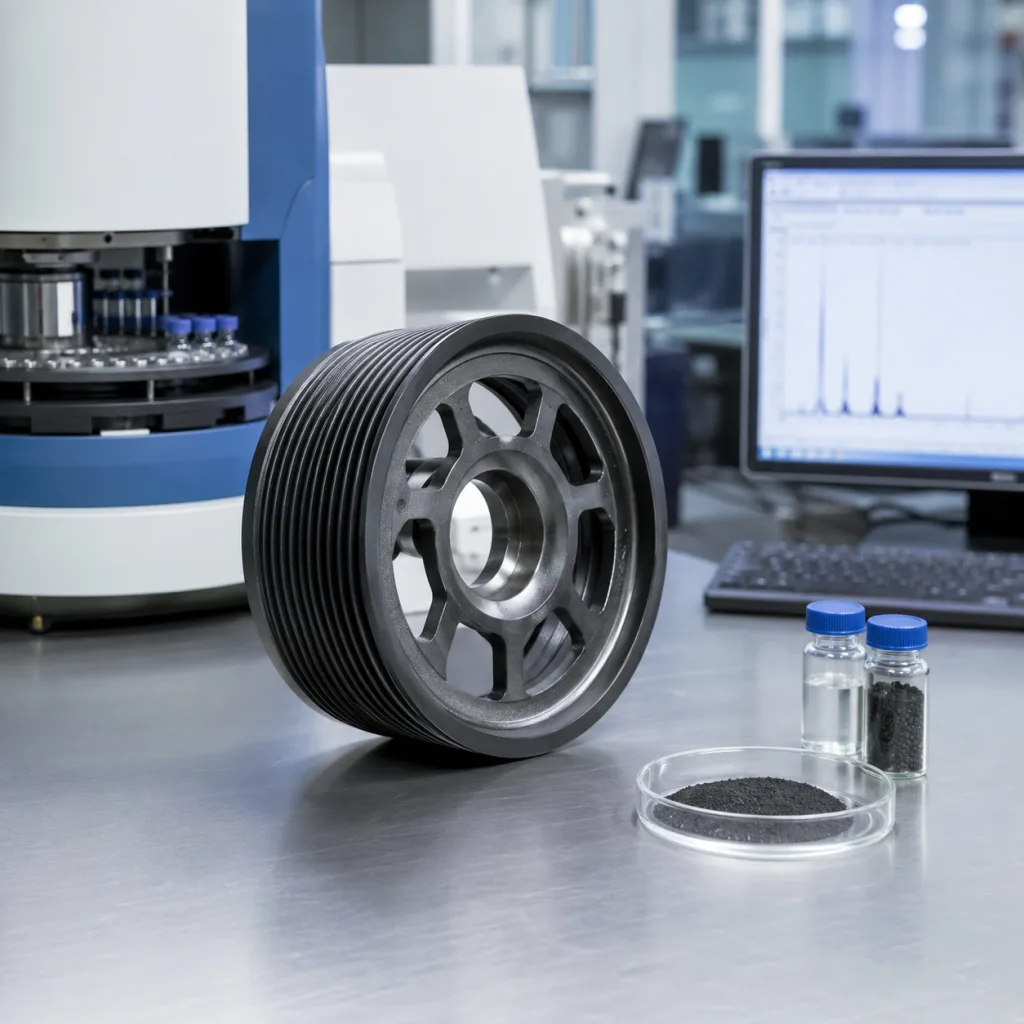
A supplier statement that a pulley is “RoHS compliant” is not enough on its own. Buyers should ask how the conclusion was reached, which sample was tested, whether the report covers the current revision, and whether the result can be linked to the production lot being shipped. For procurement and quality teams, the strongest evidence usually combines supplier material declarations, XRF screening, and confirmatory laboratory analysis where screening cannot provide a clear answer.
Test item
Typical method
What it tells you
Base metal screening
XRF
Rapid check for elements such as lead, cadmium, chromium, and mercury in accessible metal surfaces
Coating analysis
XRF / wet chemistry
Confirms whether surface finishes or passivation layers exceed restricted-substance limits
Elastomer or adhesive analysis
GC-MS / wet chemistry
Checks restricted phthalates and related organic compounds in rubber or bonding materials
Hexavalent chromium confirmation
UV-Vis / wet chemistry
Distinguishes chromium VI concerns from total chromium where required
Supplier declaration
Material declaration / substance declaration
Identifies subcomponents, compound sources, and declared restricted-substance status
Batch traceability
Lot records / production records
Links the compliance evidence to the shipped production batch
</tr></thead><tbody> </tbody></table>XRF is useful for fast screening, but it has limits. It may not reliably identify certain compounds, distinguish hexavalent chromium from total chromium, or confirm phthalates in elastomers and adhesives. When the part contains rubber damping material, bonding layers, or coated surfaces, buyers should expect either targeted chemical testing or a credible material declaration supported by supplier controls.
For border shipments and customer audits, request the report date, sample ID, test lab name, test method, detection limits, exact part number, and drawing revision. If a pulley uses a bonded damper, keep the metal hub, outer ring, elastomeric ring, adhesive system, and surface finish separated in the compliance file. Many sourcing mistakes happen when a report covers only the metal hub while the shipped product is a complete damped assembly.
Step-by-Step Procurement Checklist
Use a fixed review process before approving a crankshaft pulley supplier. A consistent checklist prevents the same common gap: a part may be commercially correct and dimensionally acceptable, but the compliance evidence does not match the exact item being purchased.
1. Confirm the exact OE cross-reference, engine application, and destination market. 2. Request the current drawing, specification, or approved sample definition. 3. Ask for a full bill of materials for the pulley assembly, including inserts, coatings, dampers, adhesives, and markings. 4. Confirm whether any coatings, inks, passivation layers, rubber rings, or bonding materials are applied after machining. 5. Collect RoHS test reports from an accredited or recognised laboratory where testing is required. 6. Ask for material declarations from the supplier and, where relevant, from sub-suppliers of rubber, coating, or adhesive systems. 7. Verify that the tested sample matches the current part number, drawing revision, and manufacturing process. 8. Check whether the report covers the complete assembly or only one component. 9. Confirm that the supplier can maintain traceability by batch number, production date, and shipment record. 10. Review whether any customer-specific restricted-substance list goes beyond standard RoHS requirements. 11. Define when re-testing or re-approval is required after a material, coating, process, or sub-supplier change. 12. File the declaration, test report, and traceability records with your import and compliance documents.
This process is especially important for damped crankshaft pulleys, where the metal body and rubber isolator may come from different material streams. It also helps distributors respond quickly when a downstream customer asks for evidence after goods have already entered inventory.
What Procurement Teams Should Verify in the Report
A usable RoHS report should answer four practical questions: what was tested, how it was tested, when it was tested, and which lot or production condition it represents. If one of these points is missing, the document may be weak for supplier approval, customer audit, or import recordkeeping.
Minimum document checks
Part name and part number are shown exactly as ordered
Drawing revision, specification, or sample reference is identified
The report states whether testing covered the full assembly or selected materials only
Test method, detection limits, and measured values are included
Lab accreditation, scope, or technical competence is identifiable
The test date is recent enough for the buyer’s internal policy
Results are linked to the supplied batch, production period, or controlled material source
The declaration covers EU RoHS requirements and any customer-specific restrictions
Any exemptions, if claimed, are clearly stated and justified
The supplier’s compliance statement is signed or otherwise formally controlled
For non-EU shipments, buyers still often request RoHS-style screening because it simplifies downstream compliance management and supports global resale. A distributor in the US, Canada, Australia, or Brazil may still need documentation if the same SKU is later sold into a customer program with EU or UK restricted-substance expectations.
If the pulley is shipped with a rubber isolator or bonded damper, make sure the declaration addresses the complete assembly, not only the hub. If the report lists only “metal part” or “pulley body,” ask for clarification before accepting it. For custom material control or application-specific sourcing, see our custom manufacturing page.
Common Failure Points in Sourced Pulleys
Most compliance problems in crankshaft pulley sourcing are documentation failures rather than confirmed material failures. The part may meet the required substance limits, but the buyer cannot prove it with records that match the shipment. That gap can delay customs clearance, block customer approval, or force unnecessary re-testing after goods are already produced.
Typical issues include:
Supplier submits a generic declaration for a different part family
Test report covers only the metal body, not the coated or bonded assembly
Sample tested was from an older drawing revision or previous material source
No lot traceability between the test report and the shipment
Finish, adhesive, rubber compound, or coating supplier changed without re-testing or re-approval
Report lists broad descriptions such as “auto part” without a clear part number
Test method is not suitable for the material being evaluated
Customer-specific restricted-substance requirements are overlooked
The compliance file is held by a trading company but not supported by the actual manufacturer
For crankshaft pulley sourcing, control the change process as tightly as the dimensional inspection. A small adjustment in coating chemistry, moulding compound, bonding process, or marking ink can change the compliance position even when the part still looks identical. Buyers should define which changes require notification, renewed declaration, or third-party testing before shipment.
Buyers in the EU and UK should also keep records aligned with REACH (EC) No 1907/2006 where applicable, especially when the part includes non-metallic materials. RoHS and REACH are not the same regulation, but procurement teams often manage them together because both affect substance control, supplier declarations, and customer documentation.
How Driventus Supports Compliance-Based Sourcing
Driventus manufactures engine and powertrain components under IATF 16949:2016 and ISO 9001:2015 controls. For crankshaft pulley programs, we can support buyers with material declarations, production documentation, batch traceability, and compliance records for export review. The goal is to give B2B sourcing teams a clear file that connects the part number, revision, materials, and shipment batch.
Our process is built for distributors, importers, OEM and Tier-1 supply chains, and multi-location repair networks that need stable replenishment with controlled specifications. For crankshaft pulley sourcing, this includes attention to dimensional consistency, runout control, surface finish, damping construction where applicable, packaging requirements, and documentation that supports customer approval.
Depending on the program, the compliance pack may include supplier declarations, available third-party test reports, inspection records, production batch information, and export documents. For custom programs, we can review the requested material restrictions, target market, annual volume, lab-testing expectations, and any customer-specific declaration format before confirming the supply plan.
If you need a documented review of a specific OE cross-reference, send the application details, annual volume, target market, required compliance pack, and preferred lead-time window. You can request a quote for standard supply or ask for a review of a custom crankshaft pulley program.
Frequently asked questions
Not always. RoHS applies to covered electrical and electronic equipment, while a crankshaft pulley is usually a mechanical engine component. However, buyers may still request RoHS evidence for bundled assemblies, mixed-use supply chains, customer quality files, or global resale programs. The safest approach is to verify the exact material set, sales channel, and destination market requirements.
The metal body is usually straightforward. Higher-risk areas include coatings, rubber damping rings, adhesives, inks, passivation layers, inserts, sleeves, and fasteners. For a damped pulley, the compliance review should cover the complete assembly rather than only the hub.
Ask for a laboratory test report where testing is required, a material or substance declaration, batch traceability, drawing revision, and a signed compliance statement. The report should identify the exact part number, tested sample, method, detection limits, test date, and link to the supplied production lot.
If you need a documented compliance file for a crankshaft pulley program or a bulk sourcing review, contact Driventus for specifications, available test records, traceability details, and lead-time options at /contact.html.