Cylinder Liner Dodge OEM Supplier: Sourcing Guide
Procurement teams sourcing a `cylinder liner dodge oem supplier` need more than a competitive unit price. They need verified metallurgy, repeatable machining, traceable lot control, and a factory that can support audit requests, packaging requirements, and stable replenishment schedules. For engines that use wet or dry cylinder liners, small deviations in outside diameter, wall thickness, surface finish, or protrusion can affect sealing, heat transfer, and service life. Driventus supplies engine components from Taizhou, Zhejiang, with production controls aligned to IATF 16949:2016 and ISO 9001:2015. Driventus is an independent aftermarket manufacturer; brand names are referenced for fitment only. This article outlines what buyers should verify before placing an order, how to compare supplier capability, and which documents to request during RFQ and PPAP-style review. For buyers building an approved source list, the focus should be fitment, process control, and delivery discipline rather than catalogue claims.
Decision framework: what matters before RFQ
When qualifying a supplier for Dodge engine cylinder liners, start with the drawing and the service condition. Confirm whether the application uses a dry liner, wet liner, or parent-bore repair sleeve. Then verify the nominal dimensions, interference fit, bore finish, and any top land protrusion requirements.
Spec points to request in the RFQ
- Material grade and heat-treatment route
- Finished bore diameter and tolerance band, typically ±0.01 mm to ±0.03 mm depending on application
- Outer diameter, roundness, and cylindricity limits, often controlled within 0.01 mm to 0.02 mm on critical fits
- Flange thickness, height, and squareness, with deck protrusion documented to the required installation height
- Surface finish on the running bore and outer shell, commonly Ra 0.2–0.8 μm for honed bores and Ra 1.6–3.2 μm on non-running external surfaces
- Coating, phosphate treatment, or anti-rust oil if required
- Packaging standard, carton count, and anti-corrosion protection
Ask the supplier to state the exact measuring instruments used for the quoted tolerances, such as bore gauges, micrometers, roundness testers, or air gauges, and request the inspection frequency by lot. If the part is cross-referenced to an OE number, use the OE reference only for fitment confirmation, for example OE 06A107065 when that is the cited application. Do not accept a supplier answer that only says “fits Dodge” without dimensional evidence.
Failure modes: where liner programs go wrong
Cylinder liners are simple in appearance and demanding in execution. Most sourcing failures come from mismatch, not from visible damage. A liner that is slightly off on outside diameter, wall thickness, or bore finish can pass a quick visual check and still fail after press fit or thermal cycling.
Common failure points include:
- Overly loose or tight interference fit, which can cause movement, cracking, or heat-transfer loss
- Bore taper or out-of-round condition that accelerates ring wear and oil consumption
- Flange squareness errors that prevent proper seating and deck sealing
- Poor surface finish that shortens service life even when dimensions look correct
- Packaging damage or corrosion caused by weak rust prevention and handling discipline
A buyer should ask how the mill, heat treatment, honing, and final inspection steps are controlled. For export programmes, documentation matters as much as the part itself. Driventus operates under IATF 16949:2016 and ISO 9001:2015 quality management systems. For material compliance in the EU and UK, request REACH (EC) No 1907/2006 status where applicable. If the liner is part of an engine package for emissions-controlled markets, ask how the supplier supports internal validation against relevant customer requirements and vehicle programme documents.
A credible supplier should provide:
- Material certificate or heat-lot traceability tied to every production batch
- Incoming and final inspection records with sample size, gauge type, and pass/fail criteria
- Dimensional reports for critical features, including bore, OD, flange height, and concentricity
- Process flow and control plan on request, showing turning, honing, cleaning, inspection, and packing points
- PPAP-style documentation for OEM or Tier-1 supply, typically including first-article samples, check sheets, and revision control
A factory audit should confirm measurement equipment calibration at the required interval, segregation of accepted and rejected stock, and barcode or lot traceability from raw tube or cast blank to packed shipment. For higher-risk programs, ask whether the supplier performs SPC on key dimensions and what Cp/Cpk targets are used for release. A practical benchmark is Cpk 1.33 or higher on critical characteristics, unless the customer specification is more stringent.
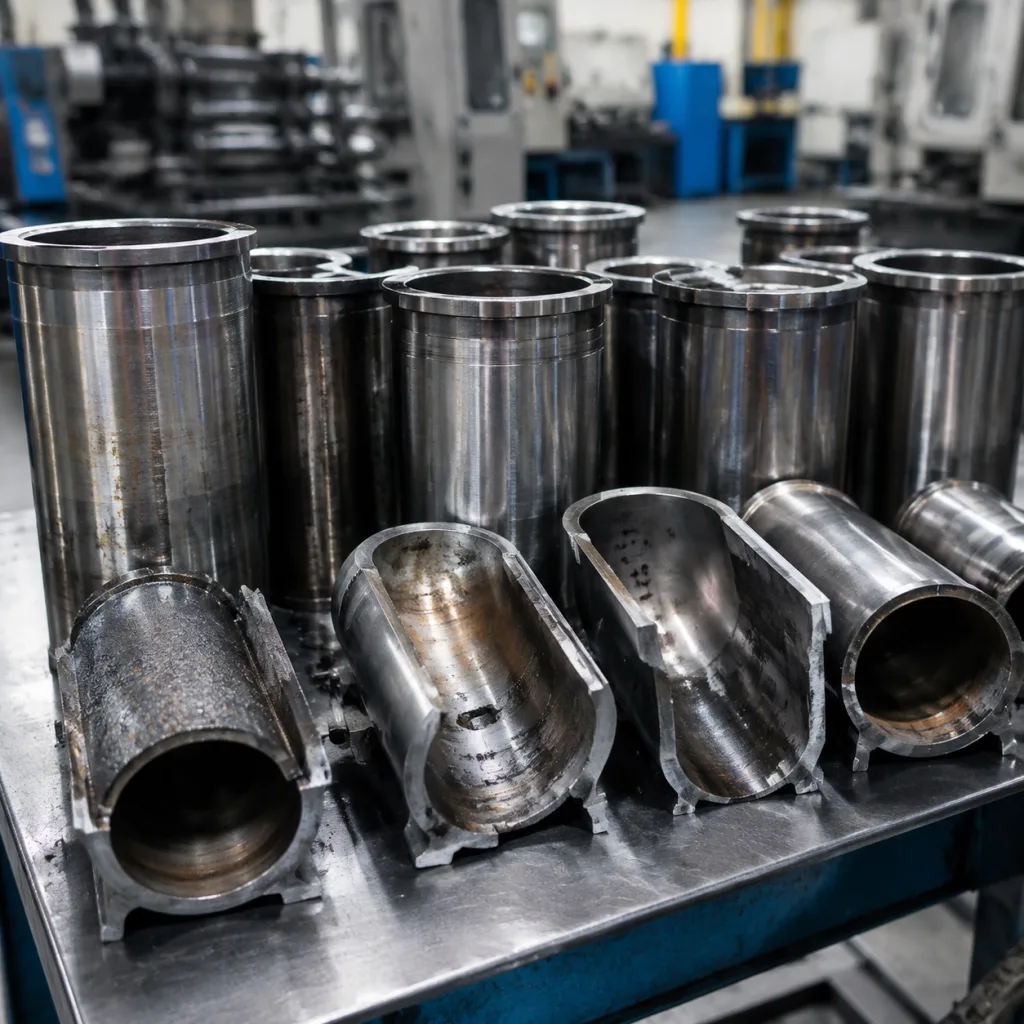
Spec deep-dive: dimensions, finish, and acceptance
Cylinder liner performance depends on consistency. The liner must hold bore size after machining, resist distortion during press fit, and maintain sealing under thermal cycling. Small defects in roundness or surface finish can increase ring wear and oil consumption.
To assess a sample lot, check these areas:
- Bore diameter at multiple depths, typically top, middle, and bottom, to confirm taper within the drawing limit
- Cross-hatch or hone condition where supplied finished, including angle and plateau quality if specified
- Wall thickness variation around the circumference, especially in thin-wall repair sleeves
- Flange and deck contact geometry, including squareness and seated height after press fit
- Visual defects: porosity, scoring, chips, rust, and tool marks
For performance engines or duty-cycle-sensitive applications, ask whether the liner material and heat treatment have been verified against internal durability testing. Where the end customer requires it, suppliers may also reference test methods such as SAE J2527 for corrosion or ECE R-83 only when the programme context makes it relevant. Do not rely on generic “OEM grade” language. Ask for the actual inspection criteria and acceptance limits instead. For incoming acceptance, many buyers specify a 100% check on appearance and critical dimensions, plus AQL sampling for non-critical cosmetic points, so the supplier should be ready to quote both the inspection method and the rejection threshold.
Step-by-step sourcing plan for lead time and MOQ
For procurement teams, lead time is a supply-chain question, not just a production question. Standard cylinder liners often move faster when the supplier already holds tooling, gauges, and approved process windows. Custom variants need longer scheduling because the bore size, flange geometry, or surface treatment may change the machining route.
| Item | Standard production | Custom manufacturing |
|---|---|---|
| Typical MOQ | 100–300 pcs per SKU | 300–1,000 pcs per SKU |
| Lead time | 15–30 days after order confirmation | 30–60 days, plus validation time if tooling changes |
| Tooling need | Existing | New or modified |
| Validation effort | Basic inspection and dimensional report | Full first-article review and sample approval |
| Change control | Limited | Formal approval required |