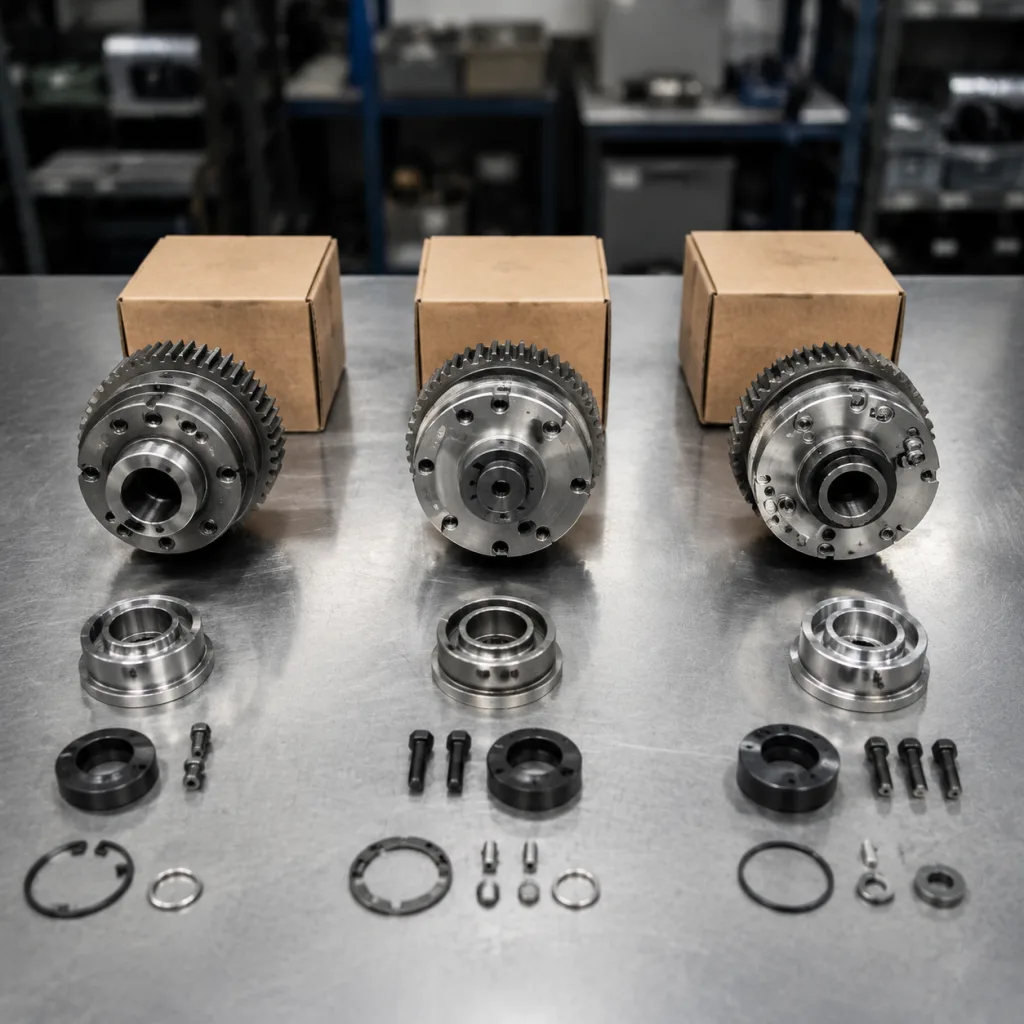
Camshaft Phaser Volvo OE Equivalent: Sourcing Guide
A Volvo camshaft phaser OE equivalent must match the original functional envelope, not just the bolt pattern. That means verifying hub geometry, vane travel, oil-control response, locking behavior, and sensor phasing so the part installs cleanly and performs predictably at cold start, idle, and load. For aftermarket distributors, repair chains, and importers, the goal is dimensional and functional equivalence backed by measurable test data, controlled tolerances, and repeatable production. Driventus is an independent aftermarket manufacturer; brand names are referenced for fitment only. We supply engine and powertrain components from Taizhou, Zhejiang, with production controlled under IATF 16949:2016 and ISO 9001:2015. This article shows what to verify before purchase, how to challenge a cross-reference, and which standards, tests, commercial terms, and inspection points matter when buying for Volvo applications.
Start with the failure modes, not the catalog photo
A camshaft phaser can look correct and still fail in service. That is the trap. Catalog images only tell you the casting shape. They do not tell you whether the part will hold phase at idle, return to lock after shutdown, or stay quiet when oil viscosity changes.
Before comparing suppliers, identify the risk that matters most in your program:
- Cold-start rattle caused by slow lock-up or poor drain-back control
- Cam correlation faults from incorrect phasing range or sensor target geometry
- Idle instability when response lag is too slow for the ECU strategy
- Warranty returns from leakage, sticking vanes, or weak spring preload
- Installation rework when hub indexing or connector orientation is off
This is why a Volvo camshaft phaser OE equivalent should be treated as a controlled hydraulic and mechanical assembly, not a simple fitment part. If the supplier cannot explain how it behaves under pressure, temperature, and repeated cycling, the risk sits with your warehouse, not theirs.
What OE-equivalent means in Volvo applications
For this category, OE-equivalent means the replacement reproduces the original functional envelope. Not just the outer shape. Not just the bolt pattern. The part has to behave like the OE unit inside the engine control system’s expected window.
For Volvo fitment, confirm these points before sample approval:
- Bolt circle, hub spline count, and camshaft indexing position match the OE reference
- Vane count, vane thickness, and stop geometry align with the OE design
- Phasing angle range matches the target engine family, typically within the OE window of about ±1.0° crank angle at lock and through the full operating range
- Lock and unlock thresholds are repeatable across samples, with no sticking during oil-pressure transitions
- Oil gallery orientation, port timing, and sealing surfaces maintain the same hydraulic path as the OE part
- Connector, reluctor, and sensor target geometry remain within the same installation envelope where applicable
- Mass, inertia, and rotational balance stay within the declared tolerance band, commonly within ±3% mass variation unless the OE drawing states tighter limits
For Volvo programs, a valid cross-reference needs the OE number, engine code, model year range, bank position, and exact engine variant. If the supplier cannot show dimensional records or endurance data, the part may still bolt on but fail later during cold start, idle learning, or high-load operation.
Validation pack: what buyers should demand
Ask for a document pack before you approve the first order. A serious aftermarket supplier should provide evidence, not a compatibility claim.
| Item | What to verify |
|---|---|
| Dimensional report | Key diameters, offsets, runout, spline fit, and axial play against the OE sample; request measured values with tolerances, not pass/fail only |
| Functional test | Phasing movement, lock/unlock behavior, and oil response time; ask for response time in seconds and test oil temperature |
| Material record | Housing alloy, vane material, seals, spring material, and surface treatment; confirm heat treatment or coating spec where used |
| Endurance data | Cyclic operation, leakage control, and wear after extended testing; ask for total cycle count and failure criteria |
| Traceability | Batch number, date code, inspection status, and production lot history |
| Packaging inspection | Corrosion protection, desiccant, part label, carton mark, and barcode format |

| Comparison point | Preferred result |
|---|---|
| OE cross-reference | Exact part-number mapping, engine code, and bank position; avoid generic fitment language |
| Sample approval | Physical sample matched to an OE sample or drawing, with measured deviations recorded |
| Test evidence | Measured data, not a statement of compatibility; include sample count and test conditions |
| Packaging | Batch-controlled, corrosion-protected, labeled for traceability, with lot code visible on carton and part |
| Commercial terms | Clear MOQ, lead time, warranty window, and claim process in writing |
| Supply consistency | Repeatable lot-to-lot dimensions and controlled process drift |