control arm · 2026-06-15

Replacing a Control Arm Bushing: Buyer’s Guide

Control arm bushings are small, low-cost components, but weak material control or poor dimensional accuracy can lead to suspension noise, alignment drift, tyre wear, installation problems, and warranty returns. For distributors, repair-chain buyers, and sourcing engineers, replacing a control arm bushing is not only a workshop procedure. It is also a sourcing decision that affects SKU planning, inventory exposure, service consistency, and field-claim risk. This guide explains how to evaluate replacement bushings, complete control arms, and assembled repair kits for passenger cars and light commercial vehicles. It covers fitment validation, rubber-to-metal bonding, hardness control, dimensional checks, testing evidence, packaging, and supplier documentation. Driventus manufactures engine and powertrain components in Taizhou, Zhejiang, and applies a controlled sourcing approach to chassis-related aftermarket supply programmes through audited production partners where required. Driventus is an independent aftermarket manufacturer; brand names are referenced for fitment only.

When Bushing Replacement Is Commercially Practical

For a workshop, the choice is usually between pressing in a new bushing and replacing the full control arm assembly. For a distributor or repair-chain buyer, that choice should be judged by labour time, tooling requirements, expected claim rate, and how often the vehicle platform appears in the local parc.

A separate bushing is commercially practical when the arm is structurally sound, the ball joint remains serviceable, and the bushing bore can still hold the required press-fit after removal. A full arm is often more efficient where aluminium arms may deform, ball joints are riveted or integrated, corrosion is common, or technician time is the larger cost driver.

The procurement question is therefore not simply which part has the lowest unit price. The better comparison is installed cost plus claim exposure. A bushing that reduces purchase price by 30–50% can still become the expensive option if it needs special sleeves, creates noise after 10,000 km, or cannot be fitted consistently across workshops.

</tr></thead><tbody> </tbody></table>For aftermarket programmes, Driventus can support cross-reference mapping from customer-supplied OE-format data, such as OE 06A… style references where applicable, without claiming vehicle manufacturer approval.

Fitment Data Buyers Should Verify Before Ordering

Many avoidable returns begin with catalogue mismatch rather than visible product defects. Before placing a bulk order, buyers should verify application data against vehicle generation, production date split, arm position, steering side, engine variant, and subframe configuration. Left-hand and right-hand bushings may also differ in void position or installation clocking.

Minimum fitment data should include:

  • Vehicle make reference, model, generation, and market region
  • Production date range and chassis split, where relevant
  • Front or rear axle position and upper or lower control arm location
  • Inner diameter, outer diameter, width, flange height, and sleeve length
  • Rubber void orientation and any installation arrow or clocking mark
  • Arm material compatibility: stamped steel, forged steel, cast aluminium, or fabricated assembly
  • OE part-number cross-reference format where provided by the customer, for example OE 11251…

Dimensional drawings are more reliable than catalogue text alone. For press-fit bushings, an outer-diameter variation of only a few hundredths of a millimetre can change retention force and installation feel. Buyers should request first-article inspection reports and compare them with retained golden samples before approving a line for stock.

Driventus recommends linking platform demand data with physical samples before launch. Buyers can review related chassis and powertrain items in our catalog, then use custom manufacturing for drawings, packaging, or private-label requirements.

Material, Bonding, and Dimensional Checks

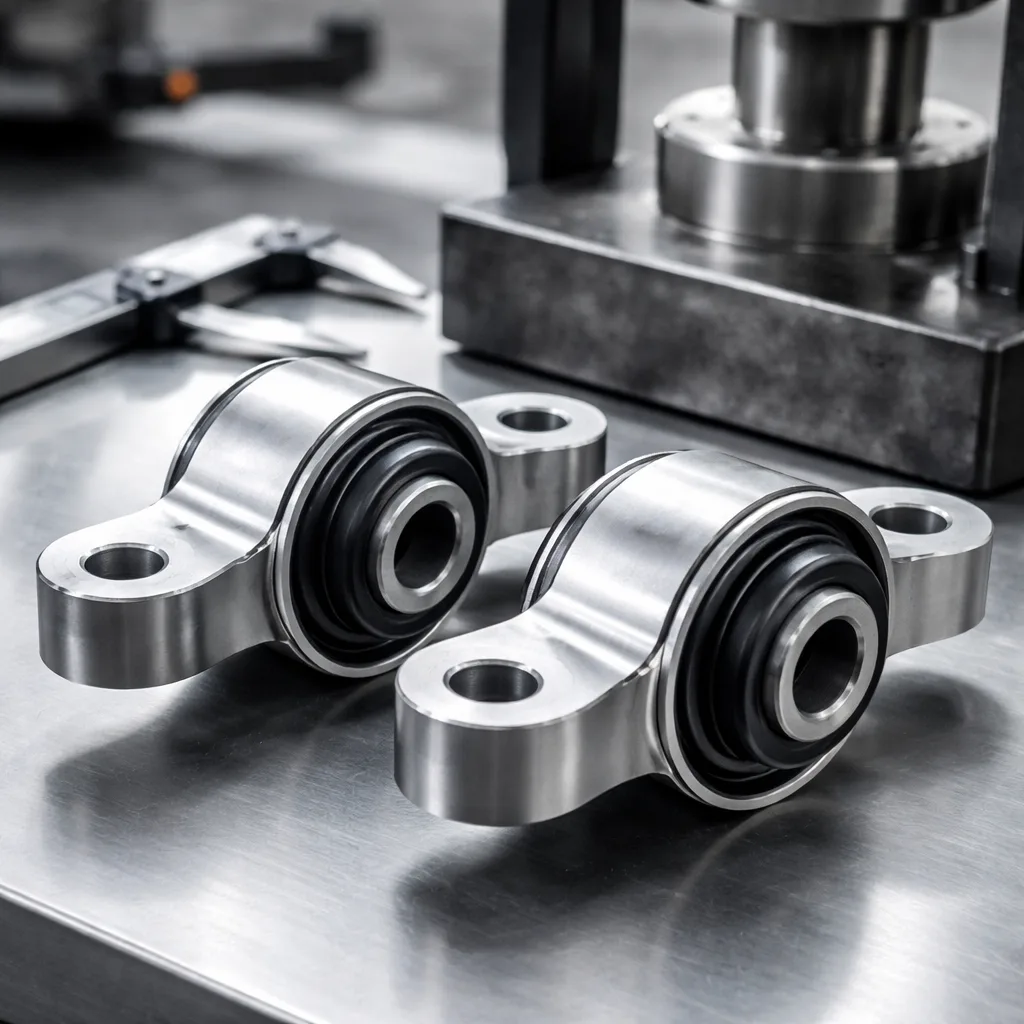
A control arm bushing normally combines an elastomer, an inner sleeve, an outer sleeve, and a bonding system. The elastomer manages compliance and vibration isolation, while the sleeves provide retention and bolt-clamping surfaces. Common failure modes include rubber cracking, sleeve separation, excessive compression set, sleeve corrosion, and incorrect hardness.

Common elastomers include natural rubber, NR/SBR blends, EPDM for selected ageing-resistance requirements, and polyurethane for special stiffness applications. For OE-equivalent aftermarket supply, compound selection must balance tear resistance, ozone ageing, oil exposure, compression set, and noise, vibration, and harshness performance.

Sourcing option Typical use case Procurement advantage Main risk to control
Separate rubber-metal bushingHigh-volume platforms with reusable armsLower landed cost and compact inventoryPress-fit variation and installation damage
Complete control armCorroded arms, integrated ball joints, high-labour marketsFaster installation and fewer tooling variablesHigher freight volume and SKU cost
Pre-assembled repair kitChain workshops and fleet contractsStandardised job contentRequires accurate fitment and packaging control
Polyurethane bushingMotorsport or special-use applicationsHigher stiffness and chemical resistanceNVH increase and non-OE ride feel

</tr></thead><tbody> </tbody></table>For business-to-business supply, buyers should ask for documented control plans instead of judging samples by appearance alone. The plan should define inspection frequency, measuring equipment, acceptance criteria, and reaction rules for out-of-tolerance production. Packaging also matters: sleeve dents or flange damage can affect pressing, create fitment complaints, and reduce customer confidence before installation begins.

Driventus’ quality system is built around IATF 16949:2016 and ISO 9001:2015 principles, including incoming inspection, process control, traceability, and corrective action. Material compliance can also be screened against REACH (EC) No 1907/2006 where required for EU import programmes.

Replacement Workflow and Validation Points

Although this guide is written for buyers, understanding the workshop sequence helps procurement teams specify a product that can be installed reliably. Replacing a control arm bushing normally involves safe vehicle lifting, control arm removal, orientation marking, press-out, bore inspection, press-in, reassembly, and wheel alignment.

A practical service workflow is:

1. Confirm symptoms such as clunking, braking pull, irregular tyre wear, steering wander, or visible rubber cracking. 2. Inspect the arm, ball joint, mounting bolts, and subframe before choosing a bushing or complete arm. 3. Mark the original bushing orientation, especially for voided, hydraulic, or directional designs. 4. Use a press tool that contacts the sleeve correctly, not the rubber section. 5. Clean the arm bore and check for corrosion, elongation, or previous installation damage. 6. Press the new bushing squarely to the specified depth or shoulder position. 7. Tighten pivot bolts at normal ride height where the vehicle procedure requires it. 8. Complete wheel alignment and road-test for noise, steering return, and stability.

The sourcing connection is direct. If a bushing needs a non-standard sleeve, lacks orientation marks, or has inconsistent shoulder height, workshops may blame the part even when installation force caused the damage. Clear packaging inserts with torque-position reminders can reduce avoidable claims, provided they support rather than replace the vehicle service procedure.

Validation should combine static dimensional inspection with application-level checks. Depending on programme requirements, suppliers may provide rubber ageing results, salt-spray checks for metal sleeves, push-out force measurements, and road or rig durability data. For brake-related components, buyers may encounter SAE J2527 in the wider chassis category, but control arm bushings should be validated against relevant internal and customer-specific suspension durability requirements rather than unrelated approval claims.

Supplier Evaluation for Distributors and Repair Chains

For a high-demand part family, procurement teams should separate catalogue breadth from manufacturing control. A supplier can list many references while still lacking repeatable compound control, sleeve sourcing discipline, bonding validation, or meaningful claim analysis.

A practical supplier audit should check:

  • Certification status: IATF 16949:2016 or ISO 9001:2015 certification scope and validity
  • Drawing control: revision history, tolerance table, and customer approval record
  • Material traceability: rubber batch, sleeve batch, adhesive batch, and cure lot
  • Process control: mould temperature, cure time, bonding preparation, and press-fit gauges
  • Testing: hardness, dimensions, bond strength, ageing, corrosion, and packaging drop checks
  • Logistics: MOQ, lead time, carton labelling, pallet standards, and export documentation
  • Claim handling: 8D response process, retained samples, and field-return analysis

For distributors, a strong launch package includes sample approval, pilot-order review, barcode-ready labels, neutral or private-label packaging, and carton dimensions for landed-cost calculation. For repair chains, it should also include installation notes, kit contents, and stable availability across regional branches so each workshop receives the same job content.

Driventus exports to more than 60 countries and supports B2B buyers in the EU, UK, US, Canada, Australia, and Brazil. We do not claim endorsement or approval by any vehicle manufacturer. Driventus is an independent aftermarket manufacturer; brand names are referenced for fitment only.

Ordering Checklist Before a Bulk Purchase

Before approving a bushing line for stock, buyers should align the technical file with commercial requirements. The following checklist reduces launch risk and helps compare quotes on evidence, not only unit price.

Parameter Typical procurement check Why it matters
Rubber hardnessShore A test on production samplesControls stiffness and ride feel
Rubber-to-metal bondPeel or destructive separation checkPrevents sleeve detachment under load
Outer sleeve diameterCMM or go/no-go gaugeDetermines press-fit retention
Inner sleeve lengthVernier/CMM measurementAffects clamp load and torque stack-up
ConcentricityFixture or CMM checkReduces installation stress and uneven wear
Surface treatmentSalt-spray or coating specification reviewLimits corrosion during storage and use

</tr></thead><tbody> </tbody></table>When comparing quotations, request landed-cost assumptions including carton quantity, pallet loading, HS code review, and sample freight. For mixed-SKU orders, MOQ flexibility can matter more than a small unit-price difference. Buyers should also confirm whether the supplier can consolidate control arms, bushings, ball joints, and related chassis components under one shipment.

If your programme requires special geometry, revised hardness, private-label packaging, or customer-owned drawings, discuss it through custom manufacturing. For current stock and platform coverage, see our catalog or request a quote.

Frequently asked questions

It depends on arm condition, labour cost, and workshop tooling. A separate bushing can reduce unit cost when the arm and ball joint are serviceable. A complete control arm can reduce installation time and claim risk where the arm is corroded, made from aluminium, or uses an integrated ball joint.

Request drawings with tolerances, material specifications, hardness records, rubber-to-metal bond checks, sleeve coating details, first-article inspection reports, verified fitment data, packaging plans, and a traceability method. For EU programmes, ask for REACH (EC) No 1907/2006 declarations where applicable.

Yes. Driventus supports B2B sourcing with sample review, packaging coordination, catalogue cross-reference checks, and custom manufacturing discussions. Requirements should include drawings, target market, annual volume, packaging format, and any customer-specific validation plan.

For drawings, sample review, MOQ, and lead-time discussion, send your target references and market requirements to Driventus. Our team will review the programme and respond through /contact.html

Request a Quote
Checkpoint Ask the supplier for Acceptable evidence
Fitment confirmationApplication list and OE-format cross referencesCustomer-verified catalogue sheet and sample match
Dimensional controlDrawing with tolerancesFirst-article inspection report
Material controlRubber compound specificationHardness and ageing test record
Bonding reliabilityRubber-to-metal bonding processBond test or destructive sample report
Corrosion resistanceSleeve coating detailSalt-spray record or coating specification
PackagingUnit, inner, and master carton planLabel file and drop-protection method
ComplianceRestricted substance screeningREACH (EC) No 1907/2006 declaration where applicable
Corrective actionClaim response procedure8D template and traceability method