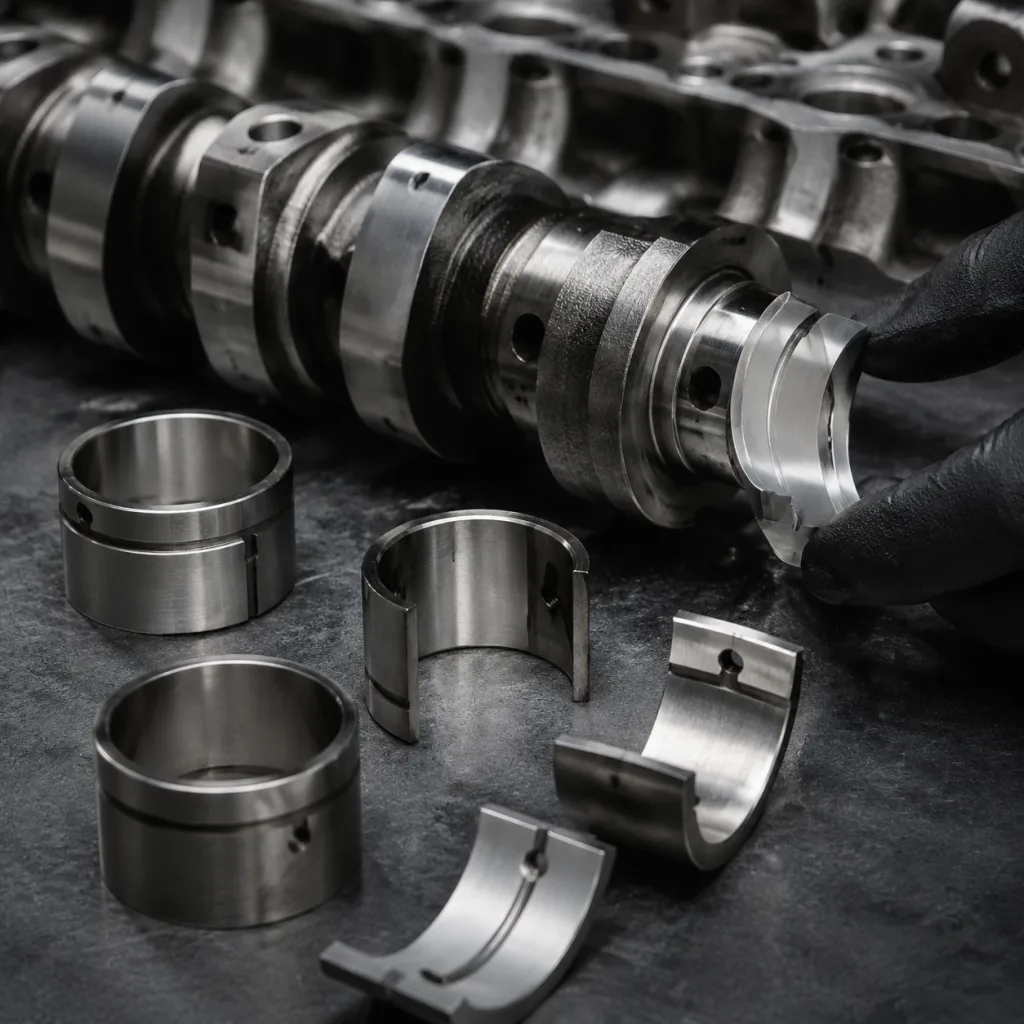
Rear main seal selection starts with dimensional control, not catalogue description alone. For procurement teams, a seal that matches the nominal shaft and housing size but misses tolerance, lip geometry, or material specification can still create leakage risk, installation scrap, and warranty cost. The most important checks usually include inner diameter, outer diameter, width, lip design, shaft surface condition, and elastomer compatibility with engine oil, temperature, and service-life targets. Buyers should also confirm whether the seal is supplied as a single-lip, dual-lip, dust-lip, or cassette design, and whether shaft speed and operating conditions stay within the material’s performance range. This article outlines the rear main seal dimensions and related fit details commonly reviewed when sourcing rear crankshaft oil seals for aftermarket and OE-service programmes. Driventus is an independent aftermarket manufacturer; brand names are referenced for fitment only.
Start with the fit system, not the catalogue size
Rear main seal dimensions are usually written as ID × OD × width in millimetres. Useful, yes. Sufficient, no.
A buyer who approves a seal on nominal size alone is still exposed to leakage, distortion after press-in, and poor lip tracking. The real question is whether the seal, shaft, and housing work as one fit system.
A complete drawing or technical data sheet should confirm:
Inner diameter (ID): nominal shaft contact diameter, commonly matched to crank running diameters from 60.00 mm to 125.00 mm in passenger and light commercial engines
Outer diameter (OD): housing bore fit diameter; on metal-case designs, even 0.10-0.25 mm change in effective press fit can materially alter retention force and roundness after installation
Width: total installed thickness, often 8-16 mm for radial seals and 14-25 mm for cassette units
Lip offset and contact band width: typical contact band may be around 0.5-1.5 mm, and offset determines whether the lip runs on a fresh crank surface or an existing wear track
Spring type and preload: where a garter spring design is used, buyers should request actual spring wire/spec and lip radial force test data rather than generic "standard spring" wording
Lead-in chamfer compatibility: a shaft lead-in chamfer around 15°-30° and controlled edge break helps prevent lip rollover during fitting
Case construction: rubber-covered OD, metal OD, or cassette style; each changes bore-fit and installation-force behaviour
Runout and eccentricity allowance: should be stated against crankshaft and housing condition; excessive dynamic runout will sharply reduce seal life
Typical dimensional format
Parameter
Typical unit
Why it matters
Shaft diameter
mm
Determines seal ID and lip interference
Housing bore diameter
mm
Determines OD retention and static sealing
Seal width
mm
Controls installation depth and axial package space
Shaft tolerance
mm
Affects lip load and wear rate
Bore tolerance
mm
Affects OD press fit and distortion risk
Shaft surface roughness
µm Ra
Influences leakage and lip wear
Shaft hardness
HRC / HV
Important for wear resistance on the running track
</tr></thead><tbody> </tbody></table>In RFQs, specify the complete fit system rather than the headline size. Asking for a 90 × 110 × 10 mm seal without shaft finish, bore tolerance, or installation position leaves too much room for supplier variation.
A stronger line item looks like this: shaft 90.000-89.965 mm, bore 110.000-109.965 mm, seal width 10.0 ± 0.2 mm, installed face flush to housing ± 0.1 mm. That is how rear main seal dimensions become usable purchasing data rather than catalogue shorthand.
Where rear main seal dimensions usually fail in sourcing reviews
Most dimensional mistakes are not dramatic. The part often looks correct on paper. The failure shows up later: difficult installation, early leakage, or inconsistent field life.
Rear main seals vary by engine family, but many passenger vehicle and light commercial applications fall within a shaft diameter range of about 60 mm to 125 mm, with seal widths commonly between 8 mm and 16 mm. Heavy-duty applications can be larger, especially for cassette designs, with shaft sizes often extending to 130-170 mm and overall widths to 25 mm or more.
Those ranges help with planning. They do not replace drawing control.
Common failure points buyers should check:
Shaft diameter tolerance too loose: often held within about 0.02-0.05 mm on the sealing track to maintain correct lip interference
Housing bore tolerance out of range: frequently controlled within about 0.03-0.08 mm depending on OD construction, to provide retention without distorting the seal case
Installed concentricity missed: total indicated runout outside supplier recommendation can create local hot spots and rapid wear; many programmes target ≤0.10-0.20 mm TIR at the installed running line
Axial position not controlled: often kept within ±0.10-0.30 mm where the crankshaft running track has a narrow wear-free zone
OE reference used as a shortcut: a number such as OE 06A107065 may help cross-reference, but it should never replace dimensional verification
Typical procurement comparison
Item
Standard single-lip seal
Dual-lip seal
Cassette seal
Common width
8-12 mm
10-14 mm
14-25 mm
Contamination control
Moderate
Better
High
Misalignment tolerance
Moderate
Moderate
Better in many designs
Unit cost
Lower
Medium
Higher
Installation sensitivity
Moderate
Moderate
Higher if tooling is not controlled
Typical use
Passenger car
Dustier duty cycles
Heavy-duty / extended life
</tr></thead><tbody> </tbody></table>The commercial picture changes with design. A standard NBR single-lip seal is usually the lowest-cost option. Dual-lip FKM designs typically cost more. Cassette seals can be several times higher because construction and assembly are more complex.
MOQ also shifts by process. Common catalogue sizes may start around 300-500 pcs, while custom lip geometry, private-label packaging, or modified tooling often pushes MOQ to 1,000-3,000 pcs. Typical production lead times are often 25-35 days for stock-based repeat sizes, 35-45 days for non-stock standard items, and 45-60+ days where tooling modification, validation samples, or special packaging approval are required.
If you are building an RFQ around OE-style fitment, include every available dimensional point and cross-reference. For broader programme sourcing, buyers can review our catalog for applicable engine-component ranges.
Same size, different outcome: material and lip design change the result
Two seals can share the same rear main seal dimensions and still behave very differently in service. That is because material choice, reinforcement, and lip geometry directly affect sealing force, friction, thermal stability, and wear.
Common material options include:
NBR: suitable for many standard oil sealing duties, with cost advantages; common continuous temperature planning range is roughly -40°C to 100-120°C depending on compound
FKM: preferred for higher temperature resistance and improved chemical compatibility with modern lubricants; many buyers use it for programmes expecting sustained exposure around 150°C and short peaks above that
PTFE lip designs: used in some low-friction or dry-start-sensitive applications, often with stricter installation requirements and no pre-lubrication rule in certain designs
ACM: used in some elevated-temperature environments, depending on application targets, often positioned between NBR and FKM in heat performance and cost
Key dimensional-performance interactions include:
Thermal expansion: can change lip contact pressure during hot-soak operation; materials with different expansion behaviour may alter sealing force at the same installed dimensions
Compression set: influences long-term OD static sealing and lip force retention; lower compression set usually supports better retention of sealing load after thermal cycling
Rubber swell: must remain controlled during engine oil exposure; excessive swell can change ID behaviour and raise friction and wear
Case rigidity: affects bore fit during press-in installation and service vibration; thin or poorly controlled metal cases are more prone to distortion
This is where nominal size stops being a useful comparison tool. An NBR seal and an FKM seal may both be quoted as 90 × 110 × 10 mm, but if one compound drifts out of hardness target by ±5 Shore A instead of a controlled ±3 Shore A, actual lip load and wear can differ in the field.
For RFQs, ask for compound-level data rather than polymer family alone. Useful items include hardness, low-temperature performance, oil immersion change, and compression-set results after elevated-temperature ageing.
When sourcing for regulated export markets, material declarations should also support chemical compliance checks where applicable, including REACH (EC) No 1907/2006. For process consistency, suppliers should operate within certified systems such as IATF 16949:2016 and ISO 9001:2015. You can review our quality system for certification scope and control approach.
What to ask for before you approve a drawing or a sample
A workable sourcing package for rear crankshaft seals needs more than an ERP description and a sample photo. Before approval, buyers should request:
2D drawing with nominal dimensions and tolerances
Material specification for elastomer, spring, and case
Surface-finish requirement for the crankshaft running surface
Recommended bore finish and lead-in geometry
Installation direction and depth requirement
Leakage and endurance test method
Lot traceability requirement
Packaging specification to protect lip geometry during transport
For rear main seal dimensions, the drawing should define more than the published size. The critical points often include OD tolerance, total width tolerance, lip-to-face distance, spring cavity position, case squareness, and visual standards for flash or surface defects.
Why does this matter? Because a seal can pass incoming inspection on diameter alone and still fail if the working lip runs on the wrong crank surface location.
For incoming QC, buyers often sample ID, OD, width, lip position, rubber hardness, and appearance against an agreed AQL or special inspection level. If the seal is private-label or programme-critical, many importers also ask for first article approval samples, dimensional reports, and retained golden samples before mass production release.
Where programmes require validation, common checks may include bench endurance, thermal ageing, oil immersion, and dimensional stability after exposure. Typical endurance planning may range from 100-300 hours on bench rigs for aftermarket validation, with leakage observation at defined shaft speed, temperature, and eccentricity conditions.
Installation validation should also be clarified, especially for PTFE or cassette designs that may require a mandrel, installation sleeve, or controlled dwell time before shaft rotation.
For friction-material testing in adjacent brake categories, standards such as SAE J2527 may be relevant, but for oil seals the buyer should focus on application-specific sealing and endurance validation agreed with the supplier. For vehicle emissions compliance at system level, standards such as ECE R-83 may affect engine oil leak expectations in service, even though they do not directly specify seal dimensions.
If a distributor or OE-service customer needs revised geometry, mould tooling adaptation, or private-label packaging, custom manufacturing is often the practical route. In commercial terms, tooling changes normally affect both MOQ and lead time: a geometry revision that needs new mould inserts or assembly fixtures usually requires sample approval first, after which mass production may follow on a 4-8 week timeline depending on material and packaging complexity.
A buyer’s step-by-step checklist for rear main seal dimensions
Use this checklist before approving a rear seal source:
1. Confirm nominal size in ID × OD × width format. 2. Match shaft and bore tolerances to the seal drawing. 3. Verify lip type: single lip, dual lip, PTFE, or cassette. 4. Check material compatibility with engine oil, additives, and target temperature. 5. Review shaft finish and hardness requirements. 6. Confirm installation method and whether a sleeve or special tool is needed. 7. Request validation records for leakage and endurance. 8. Verify packaging controls to prevent lip deformation in shipment. 9. Check batch traceability and PPAP-style documentation needs where applicable. 10. Align aftermarket fitment references with dimensional inspection, not reference alone.
This is the practical shift from part-number buying to specification buying.
For an actionable RFQ, buyers should ideally state at least the following numeric items: shaft size and tolerance, bore size and tolerance, seal width tolerance, target material, operating temperature range, packaging quantity, annual demand, and required Incoterm. That gives the supplier enough information to quote accurately on MOQ, price tier, and lead time.
For example, a standard repeat order of 500 pcs in neutral packaging may be quoted from existing capacity, while a 2,000-5,000 pcs annual programme with custom box, barcode label, and private part number can justify better unit pricing. Very small trial orders usually carry higher per-piece cost because compound batching, set-up, and packaging labour are spread over fewer units.
Import buyers should also check whether price is based on NBR vs FKM, whether tooling cost is included or separate, and whether the quoted lead time starts from deposit, artwork approval, or sample sign-off. Those details often explain why two offers for the same rear main seal dimensions differ materially.
For buyers consolidating engine sealing components, it can also be useful to review related items under /products/engine-components.html.
Driventus manufactures engine and powertrain components for export programmes and supports dimensional review, material selection, and fitment-based sourcing. Driventus is an independent aftermarket manufacturer; brand names are referenced for fitment only.
Frequently asked questions
They are usually specified as inner diameter × outer diameter × width in millimetres, but buyers should also request shaft tolerance, bore tolerance, lip type, material, and installation depth. Nominal size alone is not enough for sourcing control.
Yes. Material grade, lip geometry, spring preload, case design, and manufacturing tolerance all affect leakage resistance, wear, and installation behaviour. Always compare the drawing and validation data, not only the printed size.
At minimum, ask for a dimensional drawing, material specification, compliance declaration where required, inspection standard, traceability method, and validation test summary. For larger programmes, add packaging requirements and change-control terms.
If you need dimensional review, cross-reference support, or private-label supply for rear crankshaft seals, you can [request a quote](/contact.html).