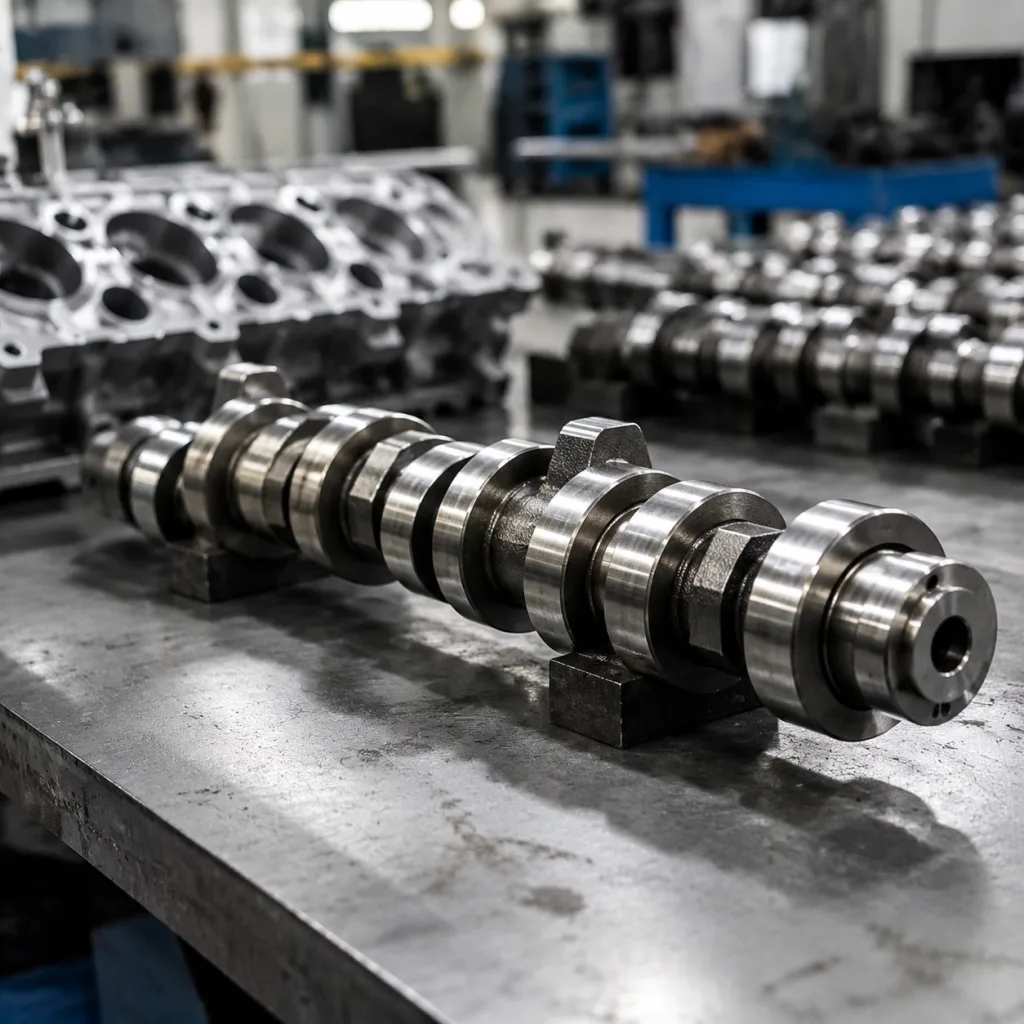
Engine Block Infiniti OEM Supplier: Sourcing and QA
Choosing an engine block Infiniti OEM supplier is not a price-table exercise. The first question is whether the block can survive the buyer’s assembly reality: correct engine family, casting architecture, bore geometry, deck height, oil and coolant circuits, mounting interfaces, sensor pads, bellhousing face, and release evidence.
Small errors become expensive quickly. A 0.30 mm shift on a location face can stop assembly. An unverified oil gallery can contaminate a build. The wrong threaded plug standard can create leakage, rework, or a field claim.
Driventus supplies engine blocks for aftermarket and industrial programmes with controlled casting, CNC machining, pressure testing, traceable inspection, and export packaging for procurement teams that need repeatable supply rather than one-off trading. Driventus is an independent aftermarket manufacturer; brand names are referenced for fitment identification only.
A useful sourcing project starts with engine code, drawings or master samples, annual demand, target supply condition, and validation criteria. Decide early whether you need a bare casting, rough-machined block with stock allowance, semi-finished block, or finish-machined unit ready for assembly. For related parts and assemblies, see our catalog and engine components.
RFQ decision framework: prove the block before pricing it
Do not issue an RFQ with only a vehicle model, year range, or badge reference. For an Infiniti-related programme, that information helps identify the application, but it is not a technical specification. Within the same model line, engines can vary by production year, region, emissions package, drivetrain layout, sensor position, bellhousing interface, coolant jacket design, and service-replacement requirement.
Use the RFQ to separate viable suppliers from quote collectors. Confirm these points first:
- engine code, displacement, model year range, market application, and OE reference number used only for fitment identification
- block material, commonly grey cast iron, compacted graphite iron, or aluminium alloy depending on the programme
- deck height, bore spacing, nominal bore diameter, cylinder spacing, and required machining allowance, typically 1.0–3.0 mm on rough-machined bores unless the drawing states otherwise
- main bearing cap style, main tunnel nominal size, cap bolt thread, dowel location, and crankshaft counterweight clearance areas
- minimum cylinder wall thickness, water-jacket location, core-shift limit, and areas that need ultrasonic thickness verification
- oil gallery routing, gallery plug positions, blind-hole depths, and thread forms such as M6, M8, M10, NPT, BSPT, or customer-specific plugs
- knock sensor pads, starter motor face, mounting bosses, accessory brackets, lifting points, and ground strap positions
- sealing face requirements for the deck, timing cover, oil pan rail, rear housing, water pump, and oil filter adaptor
- target surface roughness on gasket faces, for example Ra 0.8–1.6 µm for many machined sealing surfaces when specified by print
- whether the request is for bare casting, rough-machined block, semi-finished supply, or finish-machined supply
Send a 2D drawing with GD&T at minimum. Add 3D CAD if available, photos of the reference block, target annual volume, first sample quantity, packing requirement, and incoming inspection standard. If the block is intended as a service replacement, ask for the customer drawing, master sample, inspection method, and trial-fit criteria before negotiating price.
This prevents a common sourcing failure: a block that looks right in photos but fails on bore alignment, deck sealing, accessory fit, or assembly clearance. You can also review our catalog before sending a formal specification so the RFQ covers adjacent parts, packaging needs, and programme volume from the start.
Failure-mode control: where engine blocks usually go wrong
Engine blocks fail in predictable ways. The risk is rarely one dramatic defect; it is usually a chain of small process escapes: casting porosity, wall-thickness variation, core shift, residual stress, thermal distortion, incorrect bore location, poor main tunnel alignment, sealing-surface defects, wrong thread depth, or debris left inside oil and coolant passages.
Driventus structures production control around those risks. Depending on the programme, we support cast iron or aluminium block routes and manage the sequence of pattern and core control, melting, pouring, heat treatment or stress relief where specified, shot blasting, rough machining, finish boring, honing, deck milling, gallery cleaning, inspection, and pressure testing.
The buyer’s real target is not a polished first article. It is lot-to-lot repeatability: the same assembly behaviour, the same critical dimensions, and the same release evidence across repeat orders. That matters most when the engine block feeds a warranty-sensitive repair network, remanufacturing line, or private-label distribution programme.
| Stage | Control point | Typical measurable target | Buyer value |
|---|---|---|---|
| Casting | wall thickness, shrinkage, porosity, casting flash, core shift | agreed CT or UT zones; core shift commonly controlled within drawing limits such as 0.5–1.0 mm | fewer scrap parts, fewer leak risks, and better machining stability |
| Heat treatment or stress relief, where specified | dimensional stability before machining | cycle and hardness range recorded by lot | reduced movement after finish operations |
| Rough machining | datum creation, machining allowance, main reference faces | machining stock held consistently, often 0.5–1.5 mm before finishing | more consistent set-up for finish machining |
| Finish machining | bore size, main tunnel alignment, deck flatness, face position | critical bore or datum features can be held to ±0.02 mm where print and process allow | easier assembly, better sealing, and lower rework |
| Honing and surface finishing | cylinder geometry, crosshatch, Ra/Rz, plateau finish if specified | surface roughness and roundness recorded per control plan | stable ring seating and reduced oil-control complaints |
| Cleaning | chip removal, gallery flushing, debris control | borescope or white-cloth check; cleanliness limit agreed in mg/component if required | reduced contamination risk during engine build |
| Testing | pressure hold, visual crack check, CMM or dimensional report | coolant passages commonly tested in the 0.3–0.6 MPa range when specified | stronger confidence before shipment release |