Camshaft Seat Replacement for OE-Equivalent Fitment
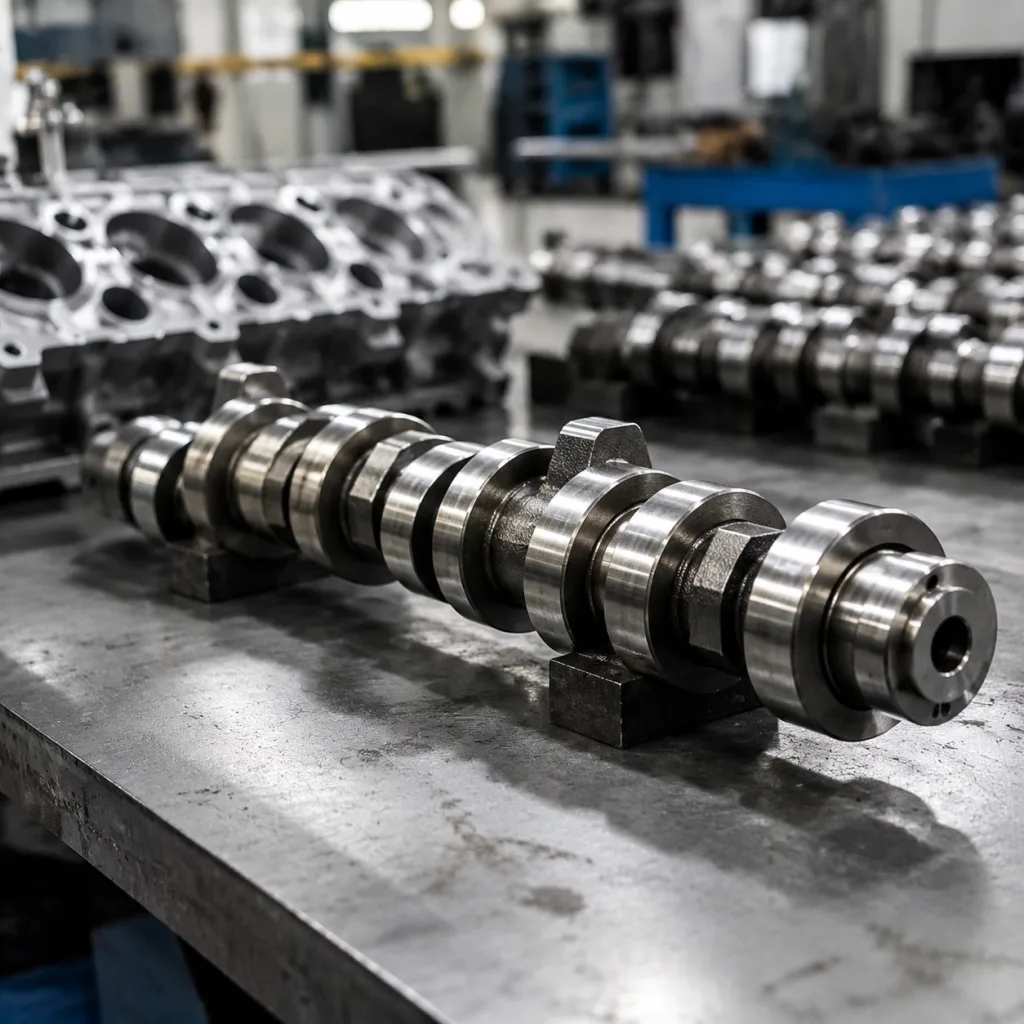
Camshaft seat replacement is not a catalogue swap. The seat fixes camshaft location, supports oil-film stability, and protects valve-timing accuracy. In B2B sourcing, the costly failure is often not obvious breakage; it is a small geometry error that survives incoming inspection and appears later as noise, drag, oil-pressure loss, or premature journal wear. A centreline shift of 0.02–0.05 mm can be enough to change alignment, reduce hydrodynamic lubrication, and create repeat complaints across a repair chain. This article treats the part as a controlled engine component, not a generic repair accessory. It covers the decisions buyers need to lock down before ordering: fitment data, finished versus semi-finished bores, machining capability, surface texture, hardness, oil-feed geometry, validation tests, batch records, MOQ, lead time, and packaging. Driventus manufactures engine and powertrain components in Taizhou, Zhejiang, with exports to more than 60 countries. Our production and inspection processes are managed under IATF 16949:2016 and ISO 9001:2015 for consistent B2B supply. Driventus is an independent aftermarket manufacturer; brand names are referenced for fitment only.
Start with the failure you are trying to prevent
A camshaft seat, bearing saddle, or replaceable camshaft support surface is not just a place to hold the shaft. It controls radial clearance, journal alignment, oil delivery, and in some designs axial location. If those functions move outside the service window, the engine may still assemble, but it will not behave correctly.
That is the trap. A visually acceptable camshaft seat replacement can create a tight cam, a noisy head, low local oil pressure, or repeat wear after a few hours of operation. In overhead camshaft engines, the tolerance stack is unforgiving because the camshaft, carrier, caps, dowels, chain or belt drive, and oil galleries all interact.
For procurement teams, the first decision is functional: what condition must the supplied part control after installation and torque loading? The RFQ should state whether the bore is delivered finished, semi-finished for line boring, or oversize/undersize for repair machining. It should also identify the mating cylinder head or cam carrier, camshaft journal diameter, fastener pattern, dowel position, oil-feed path, and any thrust-control features.
As a reference only, many camshaft journal systems run with clearance in the 0.020–0.070 mm range, with service limits often below 0.10–0.15 mm depending on the engine. Roundness and cylindricity may need control within 0.005–0.015 mm on higher-risk applications. Centreline position to the datum structure is usually a critical-to-function dimension. Do not treat these figures as universal limits; confirm them against the drawing, physical sample, or service specification.
Common failure modes to screen out early:
Journal centreline height shifted after installation, for example +0.03 mm affecting chain or belt timing relationship
Oil-feed hole partially blocked or misaligned by more than 10–20% of the feed window
Clearance correct in the free state but wrong after cap torque
Bore distortion on aluminium cam carriers
Surface texture that looks smooth but cannot sustain a stable oil film
Seat hardness incompatible with the camshaft journal
Mixed-model packing where a similar-looking part is supplied under the wrong reference
For distributors with wide application coverage, cross-reference discipline matters. If a listing uses an OE-style reference such as OE 06A… or OE 11251…, use it only for identification and fitment matching, not as a claim of vehicle manufacturer approval.
Inspection map: which dimensions deserve hard controls
Camshaft seat replacement succeeds or fails on geometry. The drawing or approved sample should define the datum structure before anyone discusses price. Without agreed datums, bore position and oil-hole alignment become opinions.
A practical inspection plan should cover journal bore diameter, centreline position, bolt-hole and dowel location, oil-passage location, flatness, surface roughness, and burr condition. If the seat is line-bored after installation, define the pre-machining allowance and final bore limits. A semi-finished allowance of 0.10–0.30 mm on diameter is common in some repair processes, but the correct value depends on fixture capability, material stability, and the customer’s machining method.
Inspection item
Why it matters
Typical verification method
Journal bore diameter
Controls oil film and running clearance; typical finished-bore tolerance may be ±0.005–0.015 mm
Air gauge, bore gauge, CMM
Journal centreline position
Maintains camshaft alignment and valve-timing repeatability; often controlled within 0.02–0.05 mm to datums
CMM against defined datums
Mounting-face flatness
Prevents bore distortion under torque; common requirements are 0.02–0.05 mm depending on length
Surface plate, CMM scan
Oil-feed hole position
Prevents starvation at the journal; diameter, offset, burrs, and entry/exit condition all matter
Optical inspection, pin gauge
Bolt-hole and dowel location
Controls repeatable assembly; dowel holes normally need tighter positional control than clearance holes
CMM, functional gauge
Surface roughness
Affects break-in and wear; finished bores often target Ra 0.4–1.6 μm unless otherwise specified
Contact profilometer
Hardness and microstructure
Confirms material consistency and wear compatibility
Rockwell/Brinell test, metallography
</tr></thead><tbody> </tbody></table>For first supply, request first-article inspection on 3–5 pieces taken across different cavities, fixtures, or machining positions where relevant. Capability evidence should focus on the features that can damage the engine: bore size, bore position, oil-hole alignment, and mating-face flatness.
Serial production needs a different rhythm. A workable plan may include 100% go/no-go checks for oil holes and identification, first/last-piece inspection per machining shift, tool-change records, and AQL sampling for packaging and appearance. Critical bore dimensions should remain traceable to batch number, casting or furnace lot where applicable, machining cell, and final inspection record. Buyers can review related component families in our catalog and engine-specific listings under engine components.
Spec deep-dive: material, texture, oil path, and cleanliness
The correct material depends on the engine architecture. A replacement may be an integrated aluminium carrier feature, a cast iron support, a steel-backed insert, or a machined repair component. Each behaves differently under torque, temperature, oil pressure, and wear.
Aluminium carriers may require controlled silicon content and ageing stability. Cast iron seats require consistent graphite structure, porosity control, and machinability. Inserts introduce another question: how the insert material expands relative to the surrounding head or carrier. The cheapest material choice is rarely cheap if it changes bore shape after heat cycling.
For camshaft seat replacement programmes, buyers should define:
Aluminium alloy or cast iron grade, verified by chemical composition test and linked to heat number or melt lot where required
Hardness range suitable for the camshaft journal; aluminium carrier checks may sit around HB 70–110, while cast iron supports are typically higher depending on grade
Stress-relief or ageing process where casting, forging, or heat treatment could affect final machining stability
Burr-free oil holes and controlled chamfers, often 0.2–0.5 mm on non-sealing edges unless the drawing says otherwise
Surface texture requirements, including Ra, Rz, waviness, roundness, and cylindricity rather than visual appearance
Cleanliness controls for oil galleries, including washing, air blow, and plug protection after machining
Corrosion protection for sea freight and storage, such as VCI bag or oiled paper with desiccant for 6–12 months of indoor warehousing
Do not approve surface finish by eye. A bright, polished-looking bore can still have the wrong waviness. A visibly bored or honed surface may be acceptable if the measured values meet the drawing. Ask whether the bore is bored, reamed, honed, or line-bored in fixture; each process leaves a different texture and capability profile.
The oil path deserves the same attention as the bore. Feed holes should be deburred from entry and exit where accessible. Intersecting galleries must be cleaned so chips do not migrate into the journal on first start. If the design uses oil grooves, define groove width, depth, edge radius, and angular position. A 0.5 mm groove-location error can be more damaging than a cosmetic tool mark.
For export markets, material declarations may also be required for REACH (EC) No 1907/2006 compliance. Driventus can provide material reports, process records, and inspection documentation according to agreed customer requirements.
Validation route before the part becomes a live SKU
Treat the first camshaft seat replacement order as a launch, not as replenishment. The buyer and supplier need time for sample review, fixture confirmation, dimensional correction, and packaging approval. The scope depends on application risk, expected volume, and whether the item is from an existing catalogue or built through custom manufacturing.
A useful validation route is:
1. Drawing or sample review. Confirm datums, material, bore status, oil holes, bolt pattern, dowel location, surface finish, and inspection method. 2. Prototype or first-article machining. Produce a small batch under controlled conditions, not a one-off part made outside the intended process. 3. Fitment trial. Install on representative cylinder heads or cam carriers. Use 2–3 real assemblies if used-condition variation is expected. 4. Torque distortion check. Measure the bore before and after fastening with the specified sequence and torque. Record diameter change, roundness, and camshaft rotational drag. 5. Oil-passage verification. Check alignment and flow continuity using pin gauges, borescope inspection, air flow, or low-pressure oil flow. 6. Thermal or wear review where needed. For dissimilar materials or high-risk applications, evaluate dimensional behaviour, contact pattern, oil grade, speed, temperature, load, and run time. 7. Packaging approval. Confirm corrosion resistance, impact protection, label accuracy, and mixed-model separation.
Quality-system certification is helpful, but it is not a substitute for part validation. IATF 16949:2016 supports structured process control, traceability, nonconforming-product handling, and continual improvement. ISO 9001:2015 supports documented order review, production, inspection, and corrective action. The engine-specific checks still have to be done.
Driventus applies incoming material checks, in-process inspection, final dimensional inspection, and batch traceability through its quality system. For critical applications, PPAP-style documentation, capability studies, and control-plan reviews can be agreed before production. A typical launch file may include drawing review, process flow, control plan, FMEA summary, material report, dimensional report, roughness report, hardness result, packaging specification, and golden-sample approval. For stable serial production, customers often request Cpk targets of 1.33 or higher for critical machining features when the measurement system is suitable.
How to compare suppliers beyond the unit price
The lowest quoted price is not always the lowest cost. With camshaft seat replacement, a small saving can disappear through rework, branch returns, damaged camshafts, technician downtime, and warranty arguments. Build the comparison around landed cost and risk.
A supplier comparison should include:
Application list with engine codes or fitment references
Drawing, approved sample record, or critical-dimension report with tolerances marked
Material grade, hardness range, chemistry report, or mill certificate where needed
Bore geometry requirements: diameter, Ra/Rz, roundness, cylindricity, and centreline position
Oil-hole verification method and burr-control standard
Batch inspection report format and record-retention period
Packaging method, shelf-life protection, inner box, VCI, desiccant, and carton drop resistance
MOQ, sample lead time, trial-order lead time, and serial-production lead time
Traceability format on part, inner box, and outer carton, including batch code, part number, and barcode
MOQ should reflect the process. Catalogue replenishment for existing items may be possible from 100–300 pieces per part number if tooling and fixtures already exist. New machined or cast applications often require 500–1,000 pieces to absorb fixture setup, programming, inspection, and packaging development. Prototype or validation samples may be quoted as 5–30 pieces at a higher unit price because CNC setup, CMM programming, and engineering review are not spread over production volume.
Lead time follows the same logic. Stocked or repeat items can often be planned for dispatch within 2–4 weeks after order confirmation and payment terms. New development usually needs 1–2 weeks for drawing or sample review, 3–6 weeks for tooling or fixture preparation, 2–3 weeks for sample machining and inspection, and 4–8 weeks for first mass production after approval. Add sea freight and customs time separately.
For repair chains, keep safety stock. A minor casting, heat-treatment, or machining delay can affect many branches at once. For wholesalers, warehouse efficiency also matters: mixed-model consolidation, barcode labelling, and durable cartons can reduce handling errors as much as good machining reduces installation complaints.
Driventus supplies aftermarket camshaft and engine components for B2B customers in Europe, the UK, North America, Australia, and Brazil. We can support catalogue replenishment or application-specific development, depending on volume, sample availability, and technical documentation.
Q&A for installation notes and warranty records
What should installers check before fitting the replacement? Confirm the mating surface is clean and free of raised burrs. A burr of 0.02–0.05 mm can distort the bore after torque. Oil galleries should be flushed with solvent, blown with compressed air, and visually checked or inspected by borescope where possible.
Can a correct part fail because the old camshaft was reused? Yes. Measure camshaft journal diameter before reuse, including taper, ovality, and scoring. If seizure or heavy wear occurred, check camshaft straightness as well. Excessive runout will overload a correctly machined seat.
Which assembly steps should be written into distributor or repair-chain documentation? Use the specified fastener sequence and torque from service data. Do not substitute generic torque values. Confirm free camshaft rotation before timing components are installed. Investigate any tight spot before start-up. Measure axial end float where applicable with a dial indicator, not by feel.
What matters when the seat is semi-finished? The repair note must state that final line boring or machining is required after installation. It should also define the target bore size, clearance check, and cleaning process after machining. Chips left in an oil gallery can destroy the new surface quickly.
What root causes must be corrected before release? Oil starvation, overheating, abrasive contamination, incorrect sealant use, blocked filters, and previous machining errors must be addressed. Otherwise, the new part may return with secondary damage unrelated to manufacturing quality.
What records reduce warranty disputes? Repair chains should record vehicle or application data, mileage or operating hours, oil grade, photos of the original damage, camshaft journal measurements, torque procedure, post-assembly rotation result, and oil-pressure confirmation after start-up. These records help separate manufacturing defects from installation or system failures.
Frequently asked questions
Provide application details, sample photos, critical dimensions with tolerances, material and hardness requirements, finished or semi-finished bore status, estimated annual volume, first-order quantity, destination market, packaging needs, inspection report requirements, and any OE-style reference such as OE 06A… or OE 11251… if it is already used in your system.
Yes. Driventus can review customer drawings, samples, and application requirements for custom manufacturing. Feasibility depends on geometry, tooling, material, tolerance level, validation scope, inspection method, and forecast volume. For new development, sample and fixture lead time is normally separated from mass-production lead time.
No. IATF 16949:2016 is an automotive quality management standard. It does not imply approval or endorsement by any vehicle manufacturer. Driventus is an independent aftermarket manufacturer; brand names are referenced for fitment only.
For drawings, samples, batch inspection requirements, MOQ, lead time, or distributor pricing, contact Driventus to review technical feasibility and supply terms. You can [request a quote](/contact.html).