fuel rail · 2026-06-21

REACH Compliance for Fuel Rail: Practical Sourcing Checks

Fuel rail buyers in the EU and UK need more than a dimensional match. They need evidence that the component can be supplied with material declarations, controlled substance status, traceable production records, and inspection data that support REACH obligations. For procurement teams, reach compliance for fuel rail is usually a document and process question first, then a product question. The rail may be aluminium, steel, or polymer composite, but the supply file must still show what the part contains, how it was made, and whether any SVHC-related disclosure is required under REACH (EC) No 1907/2006. Driventus is an independent aftermarket manufacturer; brand names are referenced for fitment only. This article sets out a practical checklist for buyers, quality engineers, and import managers who need to reduce customs delays, supplier rework, and compliance gaps before release to production or resale.

Start with the compliance decision, not the catalogue

When buyers say they need reach compliance for fuel rail, they usually mean one of three things: the part must clear REACH documentation review, it must fit the application without engineering deviation, and it must not introduce avoidable sourcing risk at import or audit stage. Treat those as separate checks. A rail can pass fitment and still fail the compliance file.

The fastest way to separate the issues is to ask four questions up front:

  • What exact part number and revision is being sourced?
  • What homogeneous materials and surface treatments are in the rail?
  • What declaration supports the current market and application?
  • What change-control promise protects the approved file?

If the supplier cannot answer all four cleanly, pause the sourcing process. Generic statements create more work later because they leave open the common failure modes: an outdated revision, an unspecified coating, an unverified elastomer, or a declaration that does not match the shipped lot. A practical file should identify the body material, inserts, seals, brackets, and finish separately, because those elements often carry different regulatory and technical exposure.

For procurement, the decision rule is simple: approve the rail only when the declaration, the drawing revision, and the production record all point to the same part. Anything less is a documentation risk disguised as a purchase opportunity.

Supplier file checks that actually matter

Use a document-first review before placing a trial order. That keeps the question focused on evidence, not promises.

1. Confirm the exact part number, application, and revision level. 2. Request a REACH statement dated within the current purchasing cycle. 3. Ask for material breakdown by component, subassembly, and coating. 4. Verify whether any SVHC-reportable substance is present above the declaration threshold. 5. Check that test reports and declarations reference the same part code, revision, and plant. 6. Confirm shelf life or storage controls for seals and elastomers, including recommended temperature and humidity limits. 7. Keep the supplier file linked to the purchase order, incoming inspection record, and lot number. 8. Require a change-notification commitment for material, finish, tooling, or source-plant changes.

If you source multiple vehicle platforms, keep each fuel rail family separated by OE cross-reference and application notes. Mixing declarations across variants is a common cause of audit findings, especially when a supplier updates a coating, injector clip, or seal compound without changing the visible part shape.

Commercial terms belong in the same gate, not a separate conversation. Ask for MOQ, target unit price at your annual volume, and lead time for first order versus repeat order. A compliant file that arrives with a 4- to 6-week production lead time may still be preferable to a cheaper source that needs rework, but the buyer should compare landed cost, not unit price alone. For a new programme, request sample lead time separately from mass-production lead time, because those often differ by 1 to 3 weeks depending on whether the supplier has tooling already validated.

If your team works with tolerance-based approvals, define the critical dimensions before RFQ release: port centre distance, mounting hole position, injector boss alignment, line-connector angle, and sealing-face flatness. State the acceptable tolerance in the request so the supplier knows whether you need ±0.10 mm, ±0.20 mm, or another control band on the critical interfaces.

Where compliant rails still fail in service

A fuel rail can pass paperwork review and still create field problems. The usual failure modes are small, but expensive.

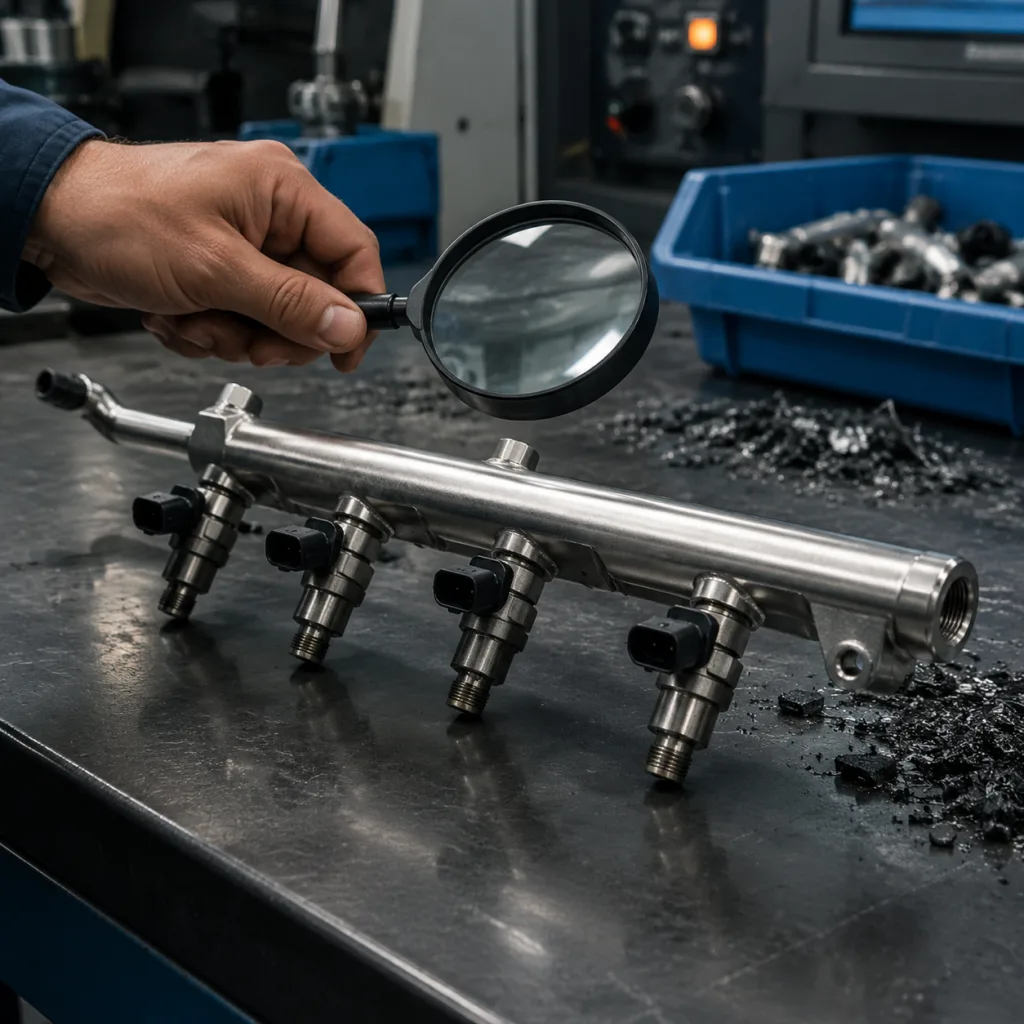
</tr></thead><tbody> </tbody></table>For direct injection and other high-pressure applications, the internal cleanliness and leak test matter as much as the declaration. Ask for the exact pressure hold condition, duration, and allowable pressure drop rather than accepting a generic pass/fail note. If the supplier quotes corrosion resistance, confirm the test method and exposure duration, especially if the rail includes coated steel brackets or plated inserts.

If fasteners or brackets are part of the assembly, request torque guidance and thread-engagement depth. Chemical compliance does not prevent a mechanical failure caused by poor engagement or bracket distortion. Buyers should define the functional acceptance criteria together with the declaration file so the release package contains both legal and engineering evidence.

Where compliant rails still fail in service

How the part should be verified on receipt

Incoming inspection is where supplier claims meet production reality. Keep it lean, but consistent.

  • First-piece dimensional report for the critical interfaces
  • Leak-test result by lot or batch
  • Visual confirmation of finish, seals, and connector integrity
  • Traceability check against the purchase order and packing label
  • Confirmation that the received revision matches the approved drawing

Where available, align the inspection plan with IATF 16949:2016 controls and the supplier’s ISO 9001:2015 system. Those standards do not replace REACH, but they improve traceability and process discipline. They also make it easier to show that the rail you received matches the lot you approved, which matters when audits ask for evidence beyond a simple declaration.

A practical acceptance plan is to check 100% of the mounting and sealing interfaces on first article, then sample production lots using a documented AQL or customer-specific control plan. If the supplier advertises a nominal pressure rating, request the exact test condition rather than accepting the marketing value; for example, define the hold test at the intended operating pressure plus a safety margin, with a stated duration and no visible seepage allowed.

If the rail uses plugs, protectors, or elastomer caps for shipping, verify that packaging preservation does not become a hidden process variable. Storage controls for seals and elastomers can affect compression set, and compression set can become a leak issue after installation. That is a sourcing problem, not just a warehouse issue.

What Driventus can put in the file

Driventus is a vertically integrated manufacturer, so compliance evidence can be linked closer to the source of the part. That matters when a buyer needs a complete file for a fuel rail programme covering multiple markets.

Support typically includes:

  • Part-level material declaration
  • Batch traceability from production to packing
  • Dimensional records for critical interfaces
  • Internal leak and fitment checks
  • Packaging and preservation controls for export
  • Change-control records for material, tooling, or finish updates

For buyers with mixed market demand, we can also support custom manufacturing through our custom manufacturing workflow. That is useful when a rail must follow a specific bracket position, port angle, coating requirement, or connector layout while still preserving compliance documentation. To see related engine parts, review our catalog and the fuel-system sections within it, then compare the compliance file against the exact application you intend to source.

On commercial terms, ask for a quote by volume break so the sourcing file and the price structure stay aligned. For example, if the planned annual requirement is 500, 2,000, or 10,000 units, the approved quote should show the unit price at each tier, the MOQ per release, and whether packaging changes at higher volumes. That makes it easier to compare sample orders with production orders and to forecast re-order timing without losing documentation control.

When lead times matter, clarify whether the clock starts at drawing approval, sample approval, or payment receipt. A supplier can technically be compliant and still miss a launch window if the buyer assumes immediate stock availability. Ask for confirmed shipment lead time, not only production lead time, and confirm whether special packaging, rust-preventive treatment, or export marking adds days to the schedule. For a new OE-reference cross-fit programme, also request whether tooling is already in place or whether a fixture update is required, because that often drives the first-order schedule more than the part itself.

What Driventus can put in the file

Common sourcing mistakes to avoid

Most compliance problems come from process gaps rather than missing intent.

  • Accepting a generic REACH statement that does not name the exact part revision
  • Ignoring coatings, adhesives, inserts, and elastomers because they are “small items”
  • Using one declaration across several OE applications
  • Skipping incoming checks after a supplier change in material, plating, or mold cavity
  • Treating a clean appearance as proof of low chemical risk
  • Approving a quote without confirming MOQ, price break, and lead time assumptions

If the rail is supplied for an OE cross-reference such as OE 06A107065, document the fitment reference clearly, but do not treat the reference as manufacturer approval. Driventus is an independent aftermarket manufacturer; brand names are referenced for fitment only. For broader process control, buyers should also review the supplier’s quality system before adding the part to approved vendor lists, and recheck the file whenever the source plant, finish, or elastomer specification changes.

A frequent commercial mistake is buying on the lowest quoted piece price while ignoring the cost of late documentation, resampling, or customs hold. Buyers should compare the full landed-cost picture: unit price, packaging, freight, import handling, inspection effort, and the time lost if the declaration must be revised. If a supplier offers a lower MOQ, confirm whether the price increases sharply at small quantities and whether the same compliance documentation applies to both pilot and production lots. That matters when you need to bridge a short-term service order before a larger release.

Another avoidable error is failing to lock the revision in writing. If a fuel rail drawing changes by even a minor detail, such as a clip offset or bracket thickness, request an updated declaration and inspection record before the next shipment leaves the factory. In regulated sourcing, the part that arrives must match both the declaration and the approved sample, not just the catalogue image.

Frequently asked questions

REACH does not use a single universal certificate format. Buyers usually need a supplier declaration, material disclosure, and any SVHC-related statement linked to the exact part revision.

Only if the materials, coatings, revision status, and subcomponents are truly identical. In practice, each variant should have its own traceable compliance file.

Ask for the part revision, material breakdown, REACH statement, test summary, MOQ, lead time, and production traceability. If needed, [request a quote](/contact.html) with the OE reference and target market.

If you need a documented supply option for EU, UK, or export programmes, send your part number, application, target market, expected annual volume, and target lead time through /contact.html and we will review the file with you.

Request a Quote
Failure mode What it looks like Why buyers miss it
Uncontrolled substitutionDifferent alloy, seal, or coating on the next lotThe part number stays the same
Poor sealing finishO-ring abrasion or micro-leak at the interfaceVisual inspection looks acceptable
Wrong connector geometryMisalignment during assemblyFit was checked on one sample only
Incomplete cleanlinessResidual particles inside the railThe rail looks clean externally
Weak traceabilityNo lot link between declaration and shipmentPaperwork is filed separately from receiving
Overstated pressure capabilityMarketing value used instead of test conditionThe quoted rating sounds sufficient