Crankshaft Renault OEM Supplier: Sourcing Guide for Buyers
When buyers search for a crankshaft Renault OEM supplier, they are usually trying to avoid three failures: a fitment miss, a quality escape, or an unreliable replenishment plan. Crankshafts are unforgiving components. Small errors in journal size, runout, balance, or heat treatment can turn into scrap at assembly or complaints in the field.
Driventus supplies crankshafts for engine programmes and aftermarket channels from our Taizhou, Zhejiang manufacturing base, supported by IATF 16949:2016 and ISO 9001:2015 systems. We help buyers who need OE number cross-reference checks, technical drawing review, packaging control, and export documentation for the EU, UK, US, Canada, Australia, and Brazil. Driventus is an independent aftermarket manufacturer; brand names are referenced for fitment only.
If you are comparing suppliers for a volume purchase, the sections below focus on the checks that actually change outcomes: what to verify, where suppliers fail, how to read the spec sheet, and what to ask before issuing a PO.
Where supplier evaluations go wrong
Most sourcing problems start with the wrong comparison. Teams often ask for a price, a lead time, and a sample photo. That is not enough for a rotating engine part.
A crankshaft should be judged on fitment, process control, and evidence. If any one of those is weak, the part can still look acceptable on paper and fail in the warehouse or on the bench.
Before approving a supplier, verify these points:
OE number cross-reference against the customer’s application list
Journal diameters, runout, fillet radii, and flange pattern
Material grade and heat-treatment route
Hardness and balance data by batch
Packaging method for corrosion protection in transit
Traceability from raw material to final carton label
Sample approval documents or PPAP-style submission where required
If the supplier cannot explain how the part is controlled from blank to packed unit, keep looking. A serious crankshaft supplier should be able to walk through the drawing, the inspection plan, and the batch records without hesitation. See our catalog for broader engine-component coverage and our quality system for audit-relevant documents.
Crankshaft specification checklist buyers can actually use
Specification sheets are most useful when they translate directly into inspection. For Renault applications, the exact values depend on engine code and OE reference, but the control points are consistent.
Item
What to confirm
Why it matters
Base material
Forged steel or cast iron, plus grade and mill certificate
Strength and machinability
Main and rod journals
Diameter, tolerance class, and surface finish
Bearing fit and oil-film stability
Runout
Total indicated runout after machining
Vibration control and assembly yield
Hardness
Heat-treated hardness range and test location
Wear resistance
Balance
Static or dynamic balance method and residual limit
NVH and durability
Oil drilling
Hole position, angle, and clearance
Lubrication reliability
Thrust face
Width and location
Axial control
Fillet radius
Radius value at each crank throw
Fatigue life
Surface protection
Anti-rust oil, VCI, or wrapped packing
Export storage protection
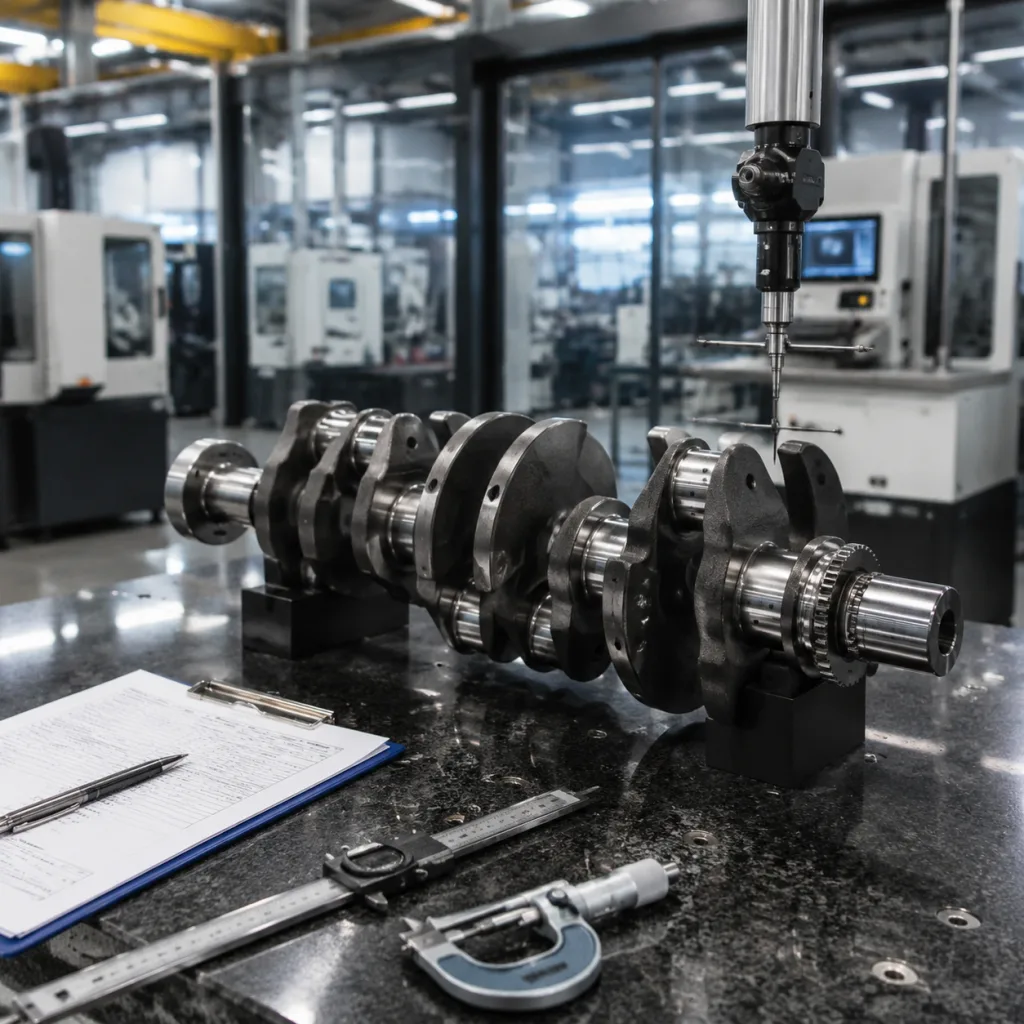
</tr></thead><tbody> </tbody></table>Buyers should also define how the measurements will be taken. A journal can be checked with micrometers or air gauges. Runout may be verified on V-blocks or dedicated fixtures. Hardness needs to be measured at the agreed location after heat treatment.
Typical procurement tolerances are often tight. Depending on the application, buyers may expect journal size control in the ±0.01 mm to ±0.03 mm range, runout at or below 0.03 mm, and a journal roughness target around Ra 0.2–0.4 μm. Final acceptance always belongs to the drawing, but those values are a useful starting point when comparing quotes.
If a program needs a controlled change to the drawing or packing format, custom manufacturing can support revised specifications under agreed tolerances.
What certification and traceability should look like in practice
A certificate on its own does not protect a production program. The real question is whether the supplier can trace a finished crankshaft back through the process chain without gaps.
Driventus operates under IATF 16949:2016 and ISO 9001:2015. In practical terms, that should mean the supplier can show:
a documented process flow and control plan
calibration records for measuring equipment
incoming material verification
first-article and batch inspection records
corrective-action handling for nonconformance
lot traceability from raw material heat number through machining, grinding, washing, and packing
When you review a supplier, ask how the records connect. A complete answer should link the forging or blank heat number, the machining lot, the heat-treatment batch, the final inspection sheet, and the carton label. If a field claim appears later, that chain should let the buyer identify the exact production day and machine group.
For regulated markets, buyers may also request REACH (EC) No 1907/2006 declarations where applicable, plus any restricted-substance confirmation required by their own compliance team. The point is not to create paperwork for its own sake. It is to make incoming approval predictable and defensible.
Lead time, MOQ, and inventory strategy: the commercial trade-off
Crankshaft sourcing is rarely won on unit price alone. A part that looks inexpensive but ships late, or requires repeated expediting, quickly becomes the most expensive option in the file.
The first commercial questions should be direct:
Is the part built from finished stock, semi-finished inventory, or make-to-order machining?
What is the MOQ by part number or family?
What is the normal lead time for samples and for bulk orders?
How many pieces are packed per carton or pallet?
Which port ships the goods, and what Incoterms are available?
Is there spare capacity for repeat orders?
What is the price break by annual volume?
The answer changes the sourcing model. Sample lots usually carry a setup premium because the costs of inspection and validation are spread across a small quantity. Repeat orders usually improve once the process is stabilized and packaging is fixed. For example, a quote may price 1–5 pieces as a sample lot, 50–100 pieces at a lower unit cost, and 300+ units at the best ex-works rate if the part is already in routine production.
Inventory strategy depends on the channel. Distributors and repair-chain buyers often need a small safety stock on fast-moving references and scheduled replenishment on slower items. OEM and Tier-1 programs usually need forecast alignment, release windows, and enough inspection capacity to absorb incoming lots without delay. If sea freight is part of the plan, ask for carton cube, gross weight, and pallet pattern so landed cost and warehouse handling time are clear before PO award.
Fitment control for Renault applications: how to avoid the wrong part
Fitment problems usually happen when the buyer relies on the vehicle nameplate instead of the engine data. That is risky. The same model line can use different crankshafts across engine codes, displacements, emissions versions, and gearbox pairings.
A proper fitment review should ask for:
engine code or VIN-based reference from the buyer’s records
OE cross-reference where a known reference already exists
bore, stroke, and journal count for multi-variant families
thrust bearing arrangement and sensor ring details if present
target drawing revision or sample photos with critical dimensions marked
A responsible supplier should say exactly what the part is: an exact replacement, an OE-equivalent, or a project-specific part built to customer drawing. Driventus verifies fitment through technical matching, drawing review, and sample comparison against the reference part when available. We do not claim vehicle manufacturer approval.
For incoming checks, a two-step method works well. First, compare the visible geometry against the old part or drawing. Second, verify the dimensions that control assembly: main bearing journal diameter, rod journal diameter, thrust width, flange bolt pattern, and any trigger-wheel or sensor features. If the part is intended for regrind or overhaul use, confirm whether undersize or oversize options are being supplied and how they are marked on the part or packaging.
Sample approval workflow: a simple way to reduce launch risk
A disciplined sample process prevents a lot of expensive confusion later. For crankshafts, the approval step should be more than a visual check.
A practical workflow looks like this:
1. Share the OE number, drawing, or reference sample. 2. Confirm the engine code and any special features. 3. Review the supplier’s technical match and tolerance sheet. 4. Request initial samples with the intended packing format. 5. Check critical dimensions on receipt. 6. Validate balance, hardness, and runout where required. 7. Seal a master sample against the approved drawing revision. 8. Release volume only after written approval.
Many buyers use a simple sample gate: three pieces for bench fit check, five pieces for dimensional validation, and one retained master sample. That is often enough to catch the common failures before the first production order.
If your team needs revisions to dimensions, marking, or packaging, keep the approval trail tied to the drawing revision. That makes later claims easier to resolve and prevents old samples from being mistaken for current production.
Frequently asked questions
Check material traceability, dimensional reports, balancing control, heat-treatment records, and export packaging. Ask for IATF 16949:2016 and ISO 9001:2015 evidence, then verify OE cross-reference and sample fitment before ordering volume. For a controlled buy, request the supplier’s inspection method, sample size, and tolerance sheet so you can compare quoted capability against your acceptance plan.
Yes. For projects that need altered journal dimensions, packaging, or inspection points, we can work from controlled drawings and agreed tolerances through our custom manufacturing process. Final approval should always follow sample confirmation. For best results, send the latest drawing revision, target annual volume, required tolerance band, and any special marking or anti-rust requirements with the RFQ.
We can provide commercial documents, packing data, material declarations, and quality records as required by the order. For regulated markets, buyers may also request REACH-related declarations and batch traceability files. If you need a pre-shipment pack, ask for the commercial invoice, packing list, certificate of origin where applicable, and the inspection report tied to the production lot.
If you are comparing sources for a crankshaft Renault OEM supplier, send your OE reference, drawing, or sample photos for review. Use our request a quote form at /contact.html.