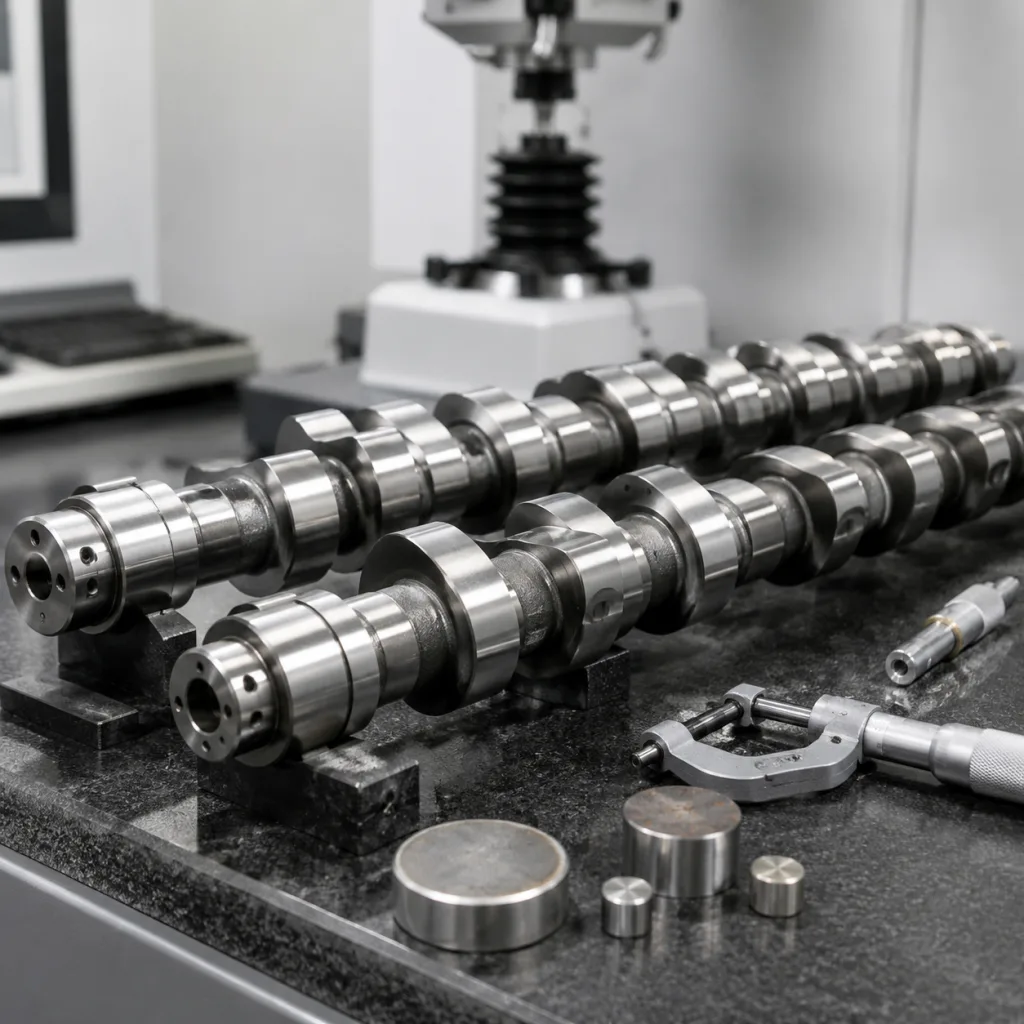
REACH compliance for camshaft sourcing is a control problem, not a certificate hunt. A camshaft is usually an article under REACH (EC) No 1907/2006, so the main question is whether the supplier can prove what went into the part, what touched the part, and what changed after approval. That means material grade, heat or casting lot traceability, surface treatment, rust prevention, VCI packaging, and any SVHC communication above 0.1% w/w all need to be tied to the same batch record. Buyers should ask for evidence early, because late changes to oils, coatings, or subcontracted treatment can affect price, MOQ, and lead time. This guide gives a buyer-focused workflow for sourcing engineers, category buyers, and import managers buying aftermarket or OE-equivalent camshafts. Driventus manufactures engine and powertrain components in Taizhou, Zhejiang, under IATF 16949:2016 and ISO 9001:2015 systems, and supports documentation review for EU, UK, US, Canada, Australia, and Brazil import programmes.
1. Start with the failure points, not the certificate
A camshaft is normally treated as an article under REACH because its function comes from shape, hardness, and geometry rather than chemical composition. That sounds simple, but it is where many sourcing files go wrong. Teams often check the base metal and stop there. The higher-risk items are usually the additives, process chemicals, and packaging materials that do not appear on a basic mill certificate.
For a camshaft programme, the common failure points are:
Base material mismatch: chilled cast iron, ductile iron, forged steel, or billet steel that does not match the approved grade.
Treatment drift: induction hardening, nitriding, phosphating, black oxide, parkerizing, or other processes added later by a subcontractor.
Residues and consumables: quench oils, machining fluids, grinding coolants, cleaning agents, and anti-corrosion oils.
Packaging changes: VCI paper, PE sleeves, cartons, inks, adhesives, desiccants, and pallet wrap.
Weak traceability: batch records that do not link the shipment back to heat number, casting lot, or process route.
That is why reach compliance for camshaft sourcing should be managed as a batch-level evidence trail. If the supplier changes the rust preventive oil, the cleaning line, or the heat-treatment subcontractor after approval, the compliance file changes too. A good supplier will be able to map the part from raw material to packed shipment and identify exactly where chemicals contact the product.
Procurement should request that map before price finalisation. It is easier to review a process flow during RFQ than to rework a launch after samples are already moving.
2. What belongs in the RFQ pack before samples start
REACH control should be written into the RFQ, not added later as a reminder email. If the buyer waits until first samples, the commercial discussion is already underway and the documentation gap becomes expensive to fix.
A useful RFQ pack for camshaft sourcing should ask for:
Item
What to verify
Why it matters
REACH declaration
Statement against REACH (EC) No 1907/2006, Candidate List review date, and 0.1% w/w basis
Confirms the supplier has screened substances
Material certificate
Grade, chemistry, heat number, casting lot, supplier name
Links the declaration to the actual batch
Surface treatment record
Nitriding, hardening, phosphating, coating, or blackening route
Flags outsourced or chemical-heavy steps
SVHC statement
Whether any Candidate List substance exceeds 0.1% w/w in the article or relevant component
Supports EU importer communication duties
SDS set
Rust inhibitors, cleaners, quench oils, VCI materials, and packaging chemicals
Exposes hidden process substances
Change-control procedure
Notice period for material, chemical, packaging, or subcontractor changes
Prevents silent substitutions
Traceability report
Batch number, drawing revision, hardness, runout, finish, and inspection results
Aligns technical and regulatory records
</tr></thead><tbody> </tbody></table>The commercial file should also say how often documents are renewed and how fast the supplier must respond to a customer query. Two to five working days is common for standard declarations. Batch-specific evidence may take longer, but it should still be defined.
Driventus keeps REACH-related declarations within the broader quality system, alongside traceability, inspection, and production records. That is the right model. A one-page statement rarely tells a buyer how the part was actually made or packed.
3. Separate the easy checks from the real risk areas
Some parts of the camshaft are straightforward to validate. Others need a deeper look.
Easier checks
Confirm the declared grade matches the drawing and purchase spec.
Tie every batch to a heat number, furnace lot, or casting lot.
Verify dimensional and hardness reports against the approved drawing.
Check whether the supplier’s declaration cites the latest ECHA Candidate List review date.
Harder checks
Outsourced heat treatment or coating.
Rust preventive oil supplied by a different vendor than the raw material.
VCI paper, bags, tapes, inks, and adhesives used in final packing.
Cleaning agents and washing lines that are invisible on a material certificate.
This is where reach compliance for camshaft programmes becomes a spec issue, not just a legal one. If the supplier changes from simple ground-and-oiled packing to VCI wrap and inhibitor paper, the chemical exposure profile changes. If a coating house is added, the supply chain now includes another set of SDS documents and change-control obligations.
Technical validation should move in parallel with compliance review. Buyers should still require the usual camshaft controls: journal diameter, lobe lift, hardness, runout, surface roughness, and magnetic particle inspection where specified. Many drawings control journal sizes to micrometre-level tolerances, runout within a few hundredths of a millimetre, and surface finish in the Ra 0.2–0.8 µm range depending on design. The exact values belong to the drawing, but the supplier should show capability before award.
The practical rule is simple: if a process can touch the part, coat the part, clean the part, or package the part, it belongs in the review file.
4. Put the obligation in the purchase spec, not in a side email
If the REACH language only lives in an email thread, it will be missed when staff change or a new buyer takes over the account. The cleaner approach is to place the requirement in the technical agreement, quality agreement, drawing note, or purchase specification.
A compact clause set can read like this:
Supplier shall declare compliance with REACH (EC) No 1907/2006 for supplied articles.
Supplier shall notify the buyer if any Candidate List SVHC exceeds 0.1% w/w in the supplied article or relevant article component.
Supplier shall review the latest ECHA Candidate List before first supply and at each update.
Supplier shall maintain traceability for raw material, treatment route, chemical inputs, and packaging inputs by batch.
Supplier shall obtain written approval before changing raw material source, foundry, coating, heat treatment, cleaning agent, rust oil, VCI packaging, or subcontractor.
Supplier shall provide supporting records within an agreed response window.
Supplier shall report any post-shipment SVHC or restricted-substance issue within 24–48 hours of discovery.
Link it to PPAP-style evidence
Where automotive approval flows are used, keep REACH declarations with material certificates, dimensional results, control plans, FMEA documents, and initial sample reports. IATF 16949:2016 and ISO 9001:2015 do not replace legal substance obligations, but they do make change control and record retrieval much easier.
This is also where commercial terms need to be realistic. A specific REACH-screened rust inhibitor or dedicated VCI pack may raise cost. MOQ can move upward when a supplier has to reserve a particular treatment batch or packing material. Lead time may also extend on first orders because the supplier must collect evidence, qualify the route, and complete sample inspection. Buyers should price that in early rather than arguing about it after award.
For new camshaft programmes or variants, Driventus can support custom manufacturing with technical files aligned to buyer drawings, samples, inspection plans, and market documentation needs.
5. Audit the process that produces the paperwork
A supplier audit should answer one question: does the paperwork reflect real production control, or is it just a declaration template?
Useful audit questions include:
Who monitors ECHA Candidate List updates?
Is review triggered by each update, annual review, engineering change, and new chemical release?
Are camshaft materials approved by grade, supplier, heat number, and treatment route?
Are quench oils, cleaners, rust preventives, and VCI materials reviewed before use?
Are SDS files current for process chemicals and packaging materials?
Is there a block on unapproved substitutions before production starts?
Can the team retrieve records by PO, batch, invoice, or shipment date?
What happens if an SVHC is identified after shipment?
How are outdated declarations removed from circulation?
A traceability drill is better than a long interview. Pick one recent camshaft shipment and ask the supplier to show the purchase order, production order, raw material certificate, treatment record, final inspection report, packing record, REACH declaration, and any related SDS references. If the supplier cannot assemble that file quickly, the problem is not just filing discipline. It means the compliance system is not connected to operations.
For distributors and wholesalers, retention matters too. Large fleet customers and Tier-1 buyers may ask for evidence years after the sale. Keep the declaration, invoice, packing list, batch reference, material certificate, and correspondence in one archive. Many buyers retain these records for at least 10 years so they can answer later claims without rebuilding the file from scratch.
Treat declarations as living documents. Update them when the Candidate List changes, when a supplier changes a process, when a new camshaft family is launched, or when packaging is revised.
6. A practical sourcing sequence for import teams
The cleanest way to reach compliance for camshaft purchasing is to build it into the sourcing workflow. For EU and UK importers, a workable sequence looks like this:
1. Define the camshaft family, drawing level, material, treatment, volume, and destination market. 2. Issue the RFQ with REACH declaration requirements and 0.1% SVHC language. 3. Ask the supplier to split pricing for tooling, samples, production units, packing, and freight where relevant. 4. Confirm certification scope, including IATF 16949:2016 and ISO 9001:2015 coverage for the manufacturing site. 5. Review material certificates, treatment descriptions, chemical inputs, packaging specification, and SVHC statements. 6. Check SDS documents for oils, cleaners, corrosion inhibitors, and VCI packaging. 7. Confirm batch traceability from raw material to finished part and shipment documents. 8. Approve first samples only after dimensional, hardness, runout, finish, and compliance records are complete. 9. Set MOQ, buffer stock, and release timing based on actual process constraints, not just target demand. 10. Archive documents by shipment and define a renewal cycle for declarations. 11. Reconfirm compliance after any material, coating, chemical, subcontractor, or packaging change.
Three timing buckets help during planning. Catalogue parts can move quickly because the process already exists. Modified variants need more sample validation and document checking. New designs take longer because tooling, pattern work, or fixture setup may be part of the launch.
That sequence reduces surprises. It also keeps environmental compliance aligned with the quality system, so buyers are not managing two separate supplier files that never match. The result is cleaner approval, fewer customs or customer delays, and more realistic negotiation on MOQ, price, and lead time.
Driventus is an independent aftermarket manufacturer; brand names are referenced for fitment only. If a buyer provides an OE-style cross-reference such as OE 06A107065 for fitment review, Driventus uses it only to identify application requirements and does not claim approval or endorsement by any vehicle manufacturer.
Frequently asked questions
No. The base metal is only one part of the review. Buyers should also check surface treatments, corrosion protection, cleaning residues, machining fluids, VCI packaging, labels, inks, and adhesives. A supplier declaration should refer to REACH (EC) No 1907/2006 and confirm the Candidate List review basis, including the 0.1% w/w SVHC threshold, not just the alloy type.
At minimum, declarations should be reviewed when the ECHA Candidate List changes, when the camshaft material or process changes, or when a new supplier, chemical, packaging material, or treatment route is introduced. Many importers also require annual renewal for active purchasing programmes so the evidence stays current and can be retrieved quickly for customer audits.
No. IATF 16949:2016 supports process control, traceability, document control, and change management, but it does not replace legal substance obligations. Procurement teams should request REACH-specific declarations and supporting material, chemical, SDS, treatment, and packaging records, especially where subcontracted processes are involved.
For camshaft sourcing with documented material traceability, REACH declarations, batch inspection records, and practical MOQ, price, and lead-time review, send drawings or application details to [request a quote](/contact.html).