Minimum Order Quantity for Cylinder Liner Sourcing
The minimum order quantity for cylinder liner supply is not a fixed sales rule. It is the point where casting batches, machining setup, honing, inspection, packaging, and export planning stop being uneconomical. For buyers, the real challenge is not finding the lowest MOQ. It is finding the smallest order that still produces stable quality, acceptable lead time, and a workable landed cost. This guide shows how to judge MOQ across wet liners, dry liners, semi-finished blanks, and custom parts. Driventus manufactures engine components in Taizhou, Zhejiang, with export supply to more than 60 countries and a quality system certified to IATF 16949:2016 and ISO 9001:2015. Driventus is an independent aftermarket manufacturer; brand names are referenced for fitment only.
Start with the real MOQ question: what makes this liner economical?
For cylinder liners, MOQ usually sits at the intersection of two different thresholds.
Commercial MOQ: the smallest quantity a supplier is willing to sell and ship.
Production MOQ: the quantity needed to cover setup, scrap allowance, inspection effort, and packing without distorting the unit price.
Those two numbers are often different. A supplier may agree to invoice 50 pieces, but still price them as if the order were much larger because the same tooling, fixtures, gauges, and packing labor must be absorbed.
The minimum order quantity for cylinder liner sourcing rises quickly when the part needs any of the following:
a new casting pattern or core box
a modified flange, groove, or port window
a special alloy or heat control
new machining fixtures or gauge blocks
tighter bore finish or roundness requirements
extra documentation such as traceability, hardness records, or material certification
If the liner already runs on existing tools and gauges, the MOQ can be relatively low. If it needs new tooling or validation, the order size has to cover that fixed work. That is why two liners that look similar on paper can have very different minimums.
What changes the number: a practical MOQ comparison
The table below is better read as a sourcing compass than a quote sheet. It shows where MOQ pressure usually comes from and what buyers should expect to see in the offer.
Sourcing case
Typical planning range
Main MOQ driver
What to watch
Catalogue liner already in production
50–300 pcs
Stock availability or scheduled runs
Confirm whether MOQ is per part number or per size family
Slow-moving aftermarket reference
30–100 pcs
Packing and inspection cost
May be bundled with other engine parts for shipment
Semi-finished liner blank
100–500 pcs
Casting batch and rough machining
Buyer handles final machining locally
Modified existing design
100–300 pcs
CNC setup and drawing control
Freeze revision before release
New custom liner
300–1,000+ pcs
Tooling, validation, and batch casting
Expect more samples and longer lead time
</tr></thead><tbody> </tbody></table>A mixed order can improve container use and freight efficiency, but it does not always reduce the MOQ for each liner reference. Each unique liner may still need its own machining setup and inspection sequence.
When comparing suppliers, ask a direct question: is the MOQ based on each reference, each bore size, each material grade, or the full shipment? That detail matters. A factory may accept a modest combined order across several similar SKUs, while one unusual liner still needs its own minimum.
A short RFQ checklist that saves weeks later
The fastest way to get a realistic minimum order quantity for cylinder liner sourcing is to submit a complete RFQ the first time. Missing data usually leads to conservative pricing, higher MOQ, or both.
Use this checklist:
1. State the liner type. Wet liner, dry liner, flanged liner, non-flanged liner, or semi-finished blank. 2. Attach dimensions. Bore, outer diameter, length, flange thickness, groove positions, chamfers, and sealing areas. 3. Define finish level. Fully finished, ready-to-hone, rough machined, or blank. 4. Confirm material. Grey cast iron, alloy cast iron, or another specified metallurgy. 5. Give demand by stage. Trial quantity, first order, and annual forecast. 6. Specify packaging. Neutral cartons, private label, palletisation, barcode labels, or bulk pack. 7. List documentation needs. Inspection report, hardness record, material certificate, packing list, and any origin documents. 8. Mention compliance needs. For EU-bound shipments, flag any material or packaging obligations relevant to REACH (EC) No 1907/2006 where applicable.
If you have OE numbers, send them in a neutral cross-reference format together with engine code and dimensions. Do not rely on part numbers alone. Fitment must still be checked against drawings or samples.
A useful RFQ also says how the part will be used: one-time replacement, distributor stock, or OEM/Tier-1 programme. The sourcing logic changes with the demand pattern. A pilot order can be small. A replenishment programme needs a more stable lot size and lead-time plan.
Where MOQ really comes from: material, machining, and finish
The minimum order quantity for cylinder liner production becomes higher whenever process risk goes up. The main technical drivers are not mysterious; they are the things that make repeatability harder.
Material and casting control
Cylinder liners are usually made from wear-resistant cast iron grades chosen for hardness, graphite structure, and thermal stability. Buyers often focus on the quoted MOQ first and the metallurgy second. That is backwards. If the material is unusual, the factory may need a dedicated melt, special heat tracking, or separate batch control.
Typical control points include:
Hardness: often around 180–240 HB for many grey cast iron liner applications, or a buyer-specific range
Wall thickness tolerance: commonly within ±0.10 to ±0.25 mm depending on design stage
Concentricity and runout: often controlled within 0.02–0.05 mm on finished parts
Defect limits: no cracks, heavy porosity, sand inclusions, or flange distortion beyond agreement
Machining and honing
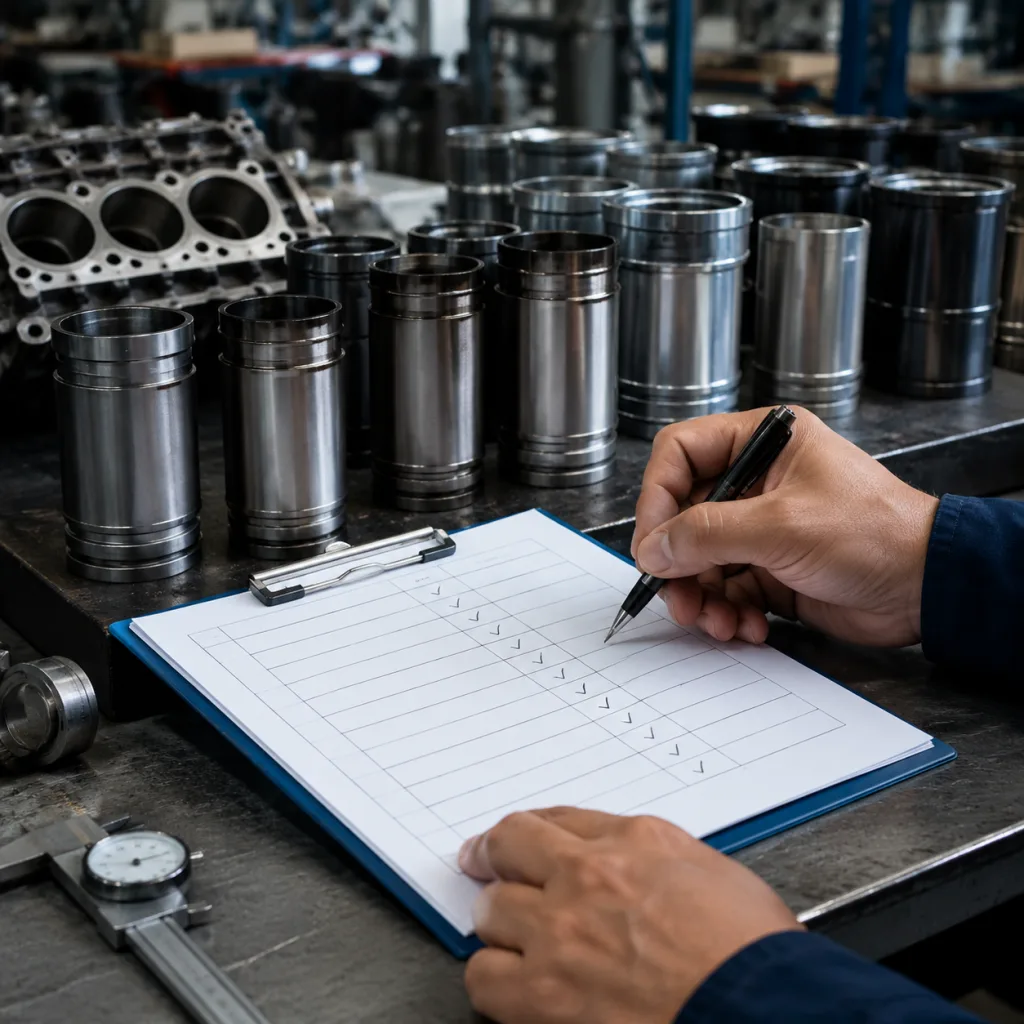
Finished liners depend on bore size, roundness, straightness, flange seating, and surface texture. A vague request for a “finished liner” is not enough if the part must run reliably in engine service.
At minimum, the RFQ should state:
bore diameter and tolerance
outer diameter and tolerance
total length and flange dimensions
groove locations and depth, if any
chamfers and edge breaks
surface roughness after honing
crosshatch angle if required
acceptance criteria for visual defects and burrs
Honing is often the hidden cost. It drives cycle time, consumables, and inspection. A finished liner with Ra 0.2–0.4 μm and tight ovality will cost more and usually needs a larger lot to make production efficient. A rough-machined blank can be ordered in smaller numbers because the supplier is doing less work per piece.
Driventus operates under a documented quality system aligned with IATF 16949:2016 and ISO 9001:2015. That does not set a universal MOQ, but it does mean process control, traceability, and corrective action are built into the supply chain. In practice, clearer technical input often lowers MOQ pressure because the supplier does not need to buffer risk with a larger lot.
How to negotiate a smaller lot without creating a bigger problem
There is a difference between a manageable trial order and an artificially tiny order that damages the process. If the lot is too small, the unit cost rises, the schedule gets longer, and quality stability can suffer because setup and inspection are spread across too few pieces.
Better negotiation levers:
Start with a pilot lot. Use it for fitment checks, installation trials, and market testing.
Share a credible forecast. A supplier is more flexible when the annual volume is visible.
Group similar SKUs. Shared material and bore range can make production more efficient.
Choose semi-finished blanks. This helps when the buyer has local machining capability.
Freeze drawings early. Late revisions are one of the fastest ways to increase MOQ.
Separate sample and production pricing. A sample is not the same as a repeat order.
This is where many buyers make a mistake: they ask for a sample price, a trial MOQ, and a mass-production quote as if all three should match. They should not. A 20-piece sample lot may include engineering attention, setup, and extra inspection that disappear in a 300-piece run. The right conversation is not “Can you make it smaller?” but “What structure gives us the smallest workable lot?”
Lead time should be discussed at the same time. Catalogue stock may ship in a few weeks. Semi-finished production often needs more time. New tooling and validation can push the schedule much longer. If the supplier offers a price break at 100, 300, and 500 pieces, ask for those breakpoints explicitly. The lowest unit price is not always the best landed-cost option.
What to send before you ask for a quote
If you want a clean answer on MOQ, send the information the factory actually needs to build the quote.
finished, semi-finished, rough-machined, or ready-to-hone condition
packaging and labelling instructions
destination port or delivery term, such as FOB Ningbo or CIF destination port
required documents: inspection report, material certificate, packing list, certificate of origin if needed
target shipment timing
For standard items, start from our catalog and confirm dimensions. For engineered parts, send a drawing or sample and request a quote with the annual volume. That gives the supplier enough data to tell you whether the minimum order quantity for cylinder liner sourcing is driven by stock, tooling, or technical risk.
Before you approve the order, confirm three things: what exactly the MOQ applies to, what documents are included, and what changes at higher quantities. That last point matters. A good quote should show where the price breaks happen and how lead time shifts at each level. Driventus is an independent aftermarket manufacturer; brand names are referenced for fitment only.
Frequently asked questions
For catalogue items already in production, planning quantities often start around 50–300 pieces per reference. Custom or newly tooled liners may require 300–1,000 pieces or more, depending on casting, tooling, machining, validation, tolerance, and documentation requirements.
Sometimes. A supplier may accept a smaller pilot lot if the buyer provides complete dimensions, confirms packaging, and shares a credible annual forecast. Unit cost is usually higher because setup, inspection, and documentation are spread across fewer parts. Semi-finished blanks can also reduce risk when the buyer has local machining capacity.
Common documents include dimensional inspection reports, material certificates, hardness records, packing lists, and traceability information. For regulated markets, buyers should also review any applicable import, material, and packaging compliance obligations such as REACH (EC) No 1907/2006 where relevant.
If you are planning a trial order or annual sourcing programme for cylinder liners, send drawings, samples, or dimensions for review. Driventus can confirm feasibility, MOQ, lead time, and documentation through /contact.html