Piston ring failure is rarely a mystery once the evidence is preserved. The usual suspects are lubrication loss, bore distortion, overheating, incorrect installation, fuel wash, contamination, unsuitable honing, or a ring set that does not match the piston groove and engine duty. For distributors, importers, and repair chains, one repeated piston ring failure piston ring complaint can quickly become warranty exposure, stock quarantine, air-freight replacements, installer disputes, and lost fleet confidence.
This article is structured as a working review path rather than a generic parts guide: what to ask before teardown, how to read failure patterns, which measurements matter, and what sourcing controls reduce repeat claims. It covers grey cast iron, ductile iron, nitrided steel, coated compression rings, and multi-piece oil control rings. As a reference only, many passenger-car rings fall into bore families from about 70 mm to 100 mm, with axial heights from roughly 1.0 mm to 3.0 mm and oil ring assemblies from 2.0 mm to 4.0 mm. The master specification is still the engine drawing, controlled sample, or approved customer data—not bore diameter alone.
Driventus manufactures engine and powertrain components in Taizhou, Zhejiang, under IATF 16949:2016 and ISO 9001:2015 controlled processes for aftermarket, OEM, and Tier-1 customers. Driventus is an independent aftermarket manufacturer; brand names and OE references are used only for fitment identification.
Start with the Claim Pattern, Not the Broken Ring
A failed ring on the bench tells only part of the story. The first decision is whether the complaint looks local, systemic, installation-related, or batch-related.
Field reports usually arrive as broad symptoms: high oil consumption, blue exhaust smoke, low compression, excessive crankcase pressure, rough running, or misfire under load. Those symptoms are useful for routing the case, but they do not prove product fault. A cracked compression ring, stuck oil control ring, glazed cylinder, worn piston groove, turbocharger oil leakage, blocked PCV system, and poor valve sealing can all create similar customer feedback.
For multi-location repair chains and distributors, the first report should be standardised. Require the installer to record:
Engine code, VIN where available, mileage, service history, and oil specification used, including viscosity and API/ACEA/OEM approval.
Cylinder compression and leak-down results for each cylinder; for claim triage, record dry and wet compression and leak-down percentage at the same regulated input pressure.
Crankcase ventilation condition, including blocked PCV systems or excessive blow-by; document manometer reading if available.
Turbocharger oil seal condition where applicable, including compressor and turbine housing oil traces.
Bore condition from borescope images before disassembly, with images at thrust and anti-thrust sides.
Whether the ring set was installed with new pistons, a freshly honed bore, a replacement liner, or an unmachined used bore.
Running-in procedure, first oil change interval, coolant temperature events, and any overheating or detonation after installation.
Pattern matters. One failed cylinder usually points toward local assembly damage, injector wash, a single-cylinder cooling or detonation event, a broken ring during installation, or bore geometry in that cylinder. Similar failures across all cylinders lean toward honing quality, oil contamination, overheating, incorrect ring specification, poor lubrication, or a batch-level dimensional issue.
Use practical triggers to move from complaint handling to measurement review: oil consumption above 0.5 L per 1,000 km soon after rebuild, leak-down above 20%, or one cylinder more than 15% lower than the others. Do not scrap returned parts before linking the claim to lot traceability. Once the evidence is thrown away, even a valid root-cause review becomes guesswork.
Failure-Mode Map: What the Evidence Usually Means
The table below is a triage map. It helps buyers decide what to measure first and what not to assume. It is not a substitute for dimensional inspection, metallurgical review, or a controlled teardown. The part drawing remains the master document; the values mentioned elsewhere in this article are only reference points.
Field symptom
Likely technical cause
Inspection point
Procurement implication
High oil consumption after short service
Oil control ring stuck, incorrect rail tension, poor bore finish, blocked drain-back
Measure bore at multiple heights and clock positions
Do not treat bore-size catalogue data as enough for approval
</tr></thead><tbody> </tbody></table>For distributor stock, compare any quarantined lot with retained samples from the same batch. Check ring free gap, radial wall thickness, axial height, face coating continuity, marking orientation, and visual defects. Common incoming-control practices include checking axial height to the drawing with 0.005 mm or 0.01 mm resolution, radial thickness with 0.01 mm resolution, and end gap in a calibrated master bore or ring gauge.
Evidence quality also matters. If the returned part was overheated, wire-brushed, solvent-cleaned, fractured during removal, or left to corrode, laboratory interpretation may be limited. State that clearly in the claim file. A weak evidence file should not be treated the same as a confirmed non-conformity.
Teardown Sequence: Measurements Before Opinions
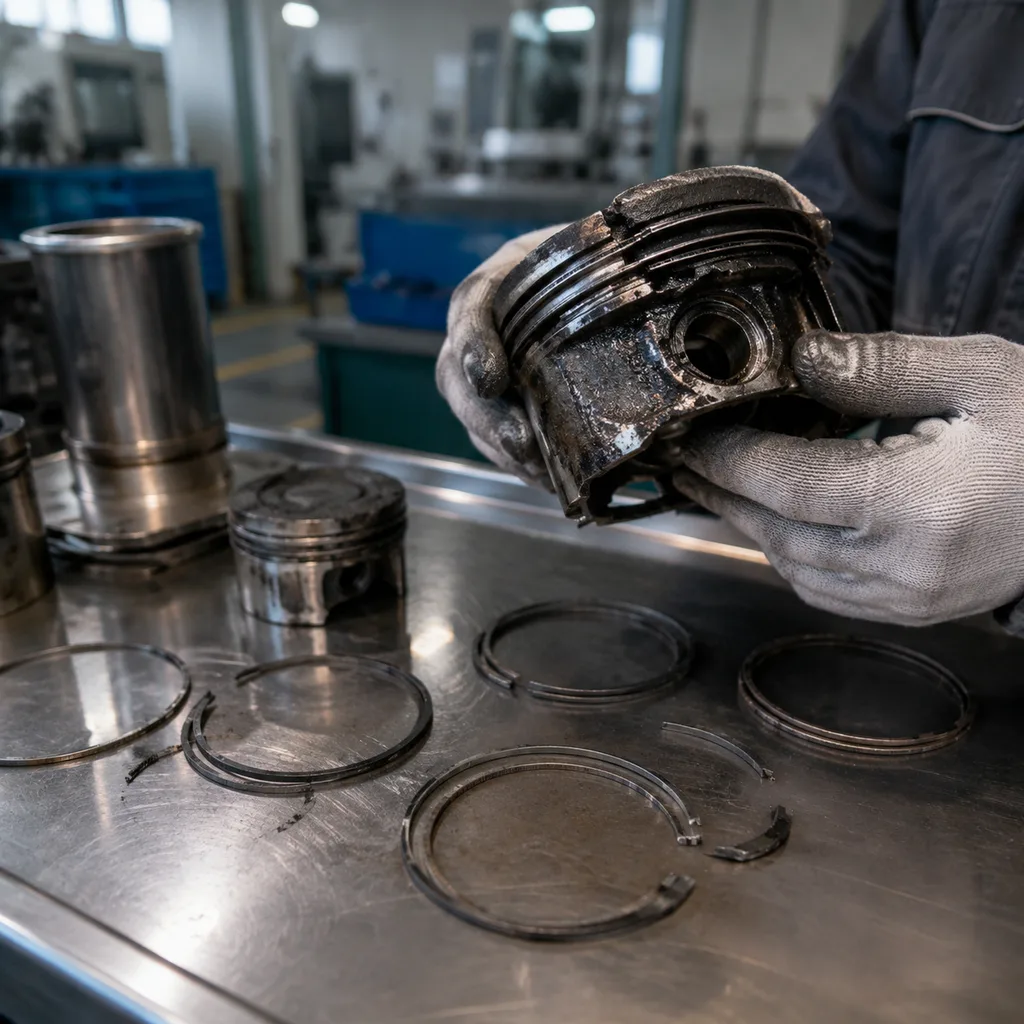
A useful teardown examines the piston, ring pack, cylinder bore, lubricant, combustion system, and nearby components together. Looking only at the broken ring is a common error. Oil starvation, bore distortion, overheating, and detonation usually leave marks on several parts at once.
Step 1: Lock the installed order
Photograph the piston and rings before cleaning. Record which ring came from which groove and cylinder. Capture top markings, ring gap positions, expander butt position, and any broken sections. Mixed or reversed evidence weakens the review.
Step 2: Measure the geometry
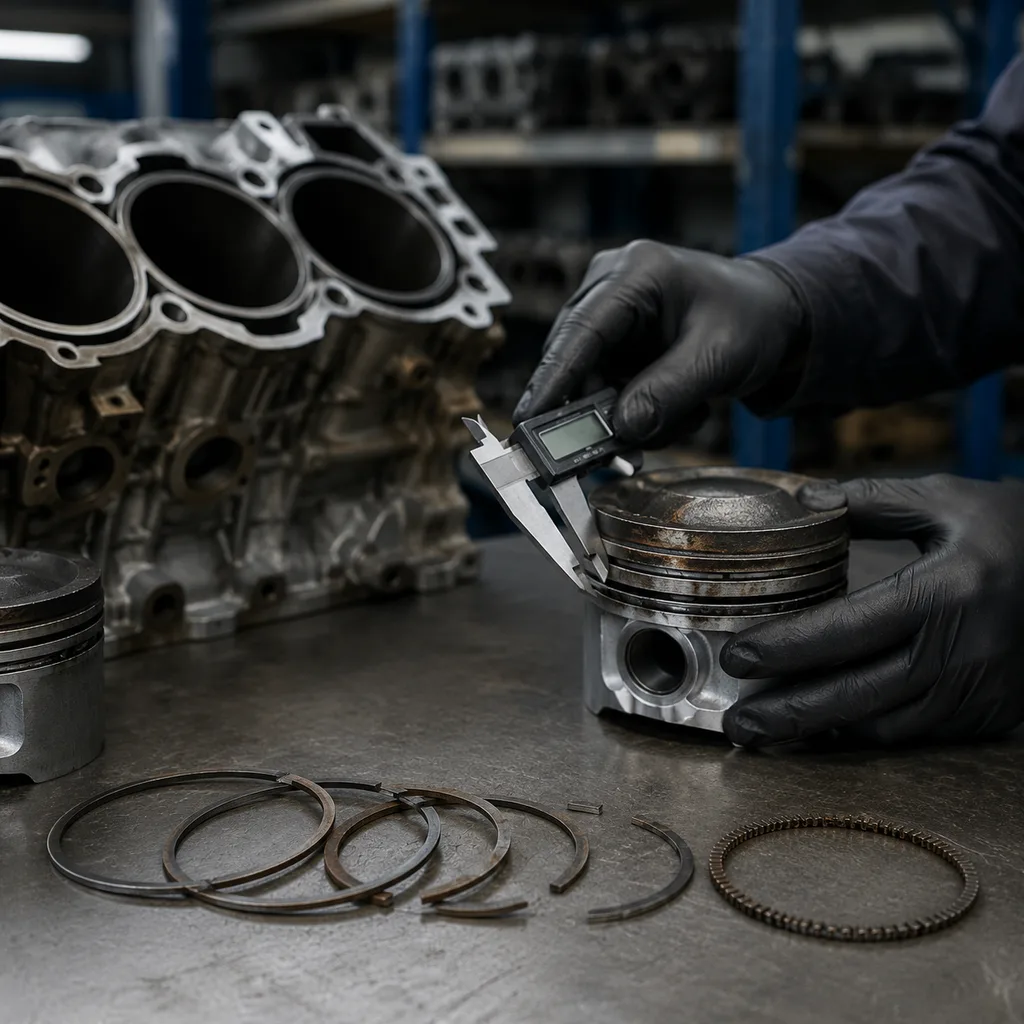
Minimum useful measurements include ring axial height, radial wall thickness, end gap in the service bore, piston groove side clearance, and cylinder bore diameter at multiple heights and clock positions. Excessive end gap may indicate bore wear rather than an undersize ring. Tight end gap can cause butt contact at operating temperature, followed by rapid fracture, scuffing, or piston land damage.
Inspection points:
Ring end gap measured squarely in the bore at top, middle, and bottom positions; use a piston crown or squaring tool so the ring is perpendicular to the bore.
Piston groove width and groove wear, measured with calibrated feeler gauges, dial indicator equipment, or a suitable measuring system.
Cylinder taper and out-of-round, not only nominal bore diameter; measure at minimum three heights and two clock positions, often thrust/anti-thrust and 90 degrees.
Ring orientation marks, top-side markings, and correct expander butt position for three-piece oil rings; do not overlap expander ends.
Coating condition on the running face, including chips, peeling, abnormal polishing, edge damage, or local scuffing.
Fracture surface appearance, separating brittle overload, fatigue, handling damage, and secondary breakage during removal.
Evidence of overheating, detonation, fuel wash, coolant entry, or oil starvation elsewhere in the engine.
Typical aftermarket references, subject to the engine specification, include compression-ring end gap around 0.20 mm to 0.50 mm on many light-vehicle bores, oil rail end gap often higher, and piston ring side clearance commonly in the 0.03 mm to 0.10 mm range. Large commercial engines and turbocharged high-output engines may require different clearances. If a supplier quotes only nominal bore size and cannot provide axial height, radial wall, free gap, face profile, and coating specification, misapplication risk rises.
Step 3: Read the surface and material evidence
A shiny, mirror-like bore can stop new rings bedding correctly. A deeply scratched bore can strip coating, disturb the oil film, and accelerate oil consumption. For nitrided or coated steel rings, face finish and edge condition are critical because small burrs or coating defects can damage the lubricant film. For cast iron rings, porosity, graphite distribution, hardness, and heat-treatment control affect strength, seating behaviour, and wear resistance.
The honing pattern deserves specific attention. Cross-hatch angle, plateau finish, and cleanliness after machining influence bedding and oil retention. Many rebuild specifications target a cross-hatch angle around 35 to 45 degrees, with plateau-honed surfaces selected by the engine programme rather than by eye. After honing, bores should be washed until a clean, oiled white cloth shows no grey abrasive residue. Leftover grit can destroy ring faces within minutes and then be mistaken for a piston ring failure piston ring material defect.
Driventus production uses incoming material checks, in-process dimensional inspection, coating checks, and lot traceability within our quality system. Test requirements vary by part family and customer specification, but the objective is consistent: dimensional conformity, controlled surface condition, and repeatable ring function in the intended engine application.
Buying Ring Sets: Specify the Ring Pack, Not Just the Bore
The buying trap is simple: two ring sets share the same bore diameter, so they are treated as interchangeable. They may not be. Axial height, radial thickness, tangential tension, face profile, coating, barrel shape, edge break, and oil ring design can all differ. Those differences affect blow-by, oil control, bedding time, emissions performance, and durability.
For distributors and wholesalers, the purchasing specification should cover more than the catalogue line. Include:
Application verification by engine code, bore size, piston groove dimensions, fuel type, aspiration system, emission level, and piston supplier.
Controlled drawings for axial height, radial thickness, coating, face profile, edge break, end gap, free gap, tangential tension, and expander design.
Defined tolerances for critical dimensions, for example drawing-specific axial height tolerance, radial thickness tolerance, ring gap range, and maximum burr or edge damage limits.
Defined acceptance criteria for visual defects, coating continuity, corrosion, burrs, rail deformation, and mixed-set prevention.
Clear lot coding on inner packaging for claim traceability, ideally linking carton, inner sleeve, production date, inspection record, and material batch.
Salt-spray or corrosion-prevention validation where humid shipping lanes or long warehousing periods are expected; agree whether neutral salt spray hours, VCI paper, oiling, or desiccant is required.
Packaging that prevents ring twist, impact damage, rail deformation, and mixed-set errors; thin oil rails should not be loose-packed.
Installation notes for ring orientation, expander position, bore preparation, lubrication during assembly, and staggered ring gaps.
Compliance declarations where required, including REACH (EC) No 1907/2006 for substances in articles supplied to EU customers.
Define the commercial path before sampling. For catalogue ring sets, buyers often request pilot lots of 100 to 500 sets per engine family before a container or blanket order. For customised bore variants, coating changes, private-label packaging, or new tooling, MOQ is usually driven by raw material size, grinding setup, coating batch size, printing plates, and inspection documentation. A practical planning range is often 500 to 2,000 sets per reference, with higher MOQ for low-volume special coatings.
Price depends on ring material, number of rings per set, coating type, inspection level, packaging, annual volume, and Incoterm. Standard stocked references may ship in 2 to 4 weeks. Customised or first-article programmes usually require 6 to 10 weeks after drawing/sample approval and packaging confirmation.
For aftermarket programmes, Driventus can supply standard piston ring ranges through our catalog and related engine parts through engine components. For buyers needing bore variants, coating changes, private-label packaging, controlled drawings, or agreed inspection reports, our engineering team supports custom manufacturing without claiming vehicle manufacturer approval or endorsement.
When an OE part-number cross-reference is required, use only verified fitment references supplied or approved by the customer data set, for example OE 06A… or OE 11251… conventions where applicable. Do not substitute a ring set based only on catalogue bore size. Piston groove design, ring pack layout, fuel system, and operating temperature range can differ even when bore diameter appears identical.
Supplier Audit Lens: Where Repeat Failures Are Prevented
Manufacturing controls cannot eliminate every service failure. They can, however, reduce preventable returns and make genuine issues easier to contain. In a piston ring programme, the audit should focus on the controls that influence sealing, wear, tension, corrosion resistance, and traceability.
Use this audit lens:
Control point
What to verify
Risk if uncontrolled
Raw material
Cast iron, ductile iron, or steel grade certification, chemistry, microstructure, and incoming checks
Variable strength, wear resistance, or spring characteristics
Ring forming and machining
Axial height, wall thickness, free gap, end gap, edge finish, twist, and flatness
Blow-by, high oil use, groove binding, installation difficulty
Heat treatment
Hardness, elastic recovery, and distortion checks where applicable
Loss of tension, poor seating, or brittle fracture
Surface treatment
Nitriding, phosphating, chrome, PVD, molybdenum, or other specified coating thickness and adhesion control
</tr></thead><tbody> </tbody></table>A robust control plan normally includes first-piece approval at each setup, patrol inspection during grinding or lapping, final dimensional inspection by AQL or agreed 100% checks for critical features, and retained samples for each batch. Ask which features are checked by attribute gauges and which are measured by variable data. For higher-risk references, request PPAP-style documentation, capability data for axial height and radial thickness, hardness results, coating thickness records, and packaging validation.
Even a simple aftermarket programme benefits from a golden-sample approval and a signed inspection checklist before mass shipment. The reason is practical: when a claim appears six months later in another market, the approved sample, drawing, and inspection record define what “correct” means.
Driventus operates under IATF 16949:2016 and ISO 9001:2015. These management standards do not guarantee that a part will never fail, but they require documented process control, corrective action, supplier management, risk-based thinking, and traceability. For buyers, that structure matters when a claim must be investigated across thousands of units in multiple markets.
For emissions-sensitive applications, ring sealing also affects oil consumption, blow-by, catalyst life, and combustion stability. Vehicle emissions regulations such as ECE R-83 define approval frameworks for vehicles, not aftermarket ring approval. Replacement component buyers should be cautious of any supplier suggesting vehicle manufacturer endorsement or regulatory approval without documented authorisation.
Warranty Q&A for Importers and Repair Chains
Warranty decisions should be consistent, fast, and evidence-based. A useful internal rule is to acknowledge the claim within 2 working days, confirm evidence completeness within 5 working days, and decide whether stock quarantine is needed before more units are released.
What should a complete claim file include?
1. Purchase order, invoice, and ring set batch code from inner and outer packaging. 2. Engine application, engine code, mileage, rebuild scope, piston part number, bore oversize if any, and installer details. 3. Photos of all rings in installed order, not only the broken part, including top marks and oil ring expander position. 4. Compression, leak-down, crankcase pressure, and oil consumption data with test conditions. 5. Measurements of bore diameter, taper, out-of-round, end gap, and groove clearance, with tool resolution and calibration status noted. 6. Photos of piston ring lands, cylinder wall, bearings, injectors, turbocharger, intake tract, and PCV system where relevant. 7. Used oil condition, oil specification, fuel dilution signs, coolant contamination evidence, and maintenance records where available. 8. Notes on honing method, abrasive grade if known, cleaning procedure, assembly lubricant, and running-in process. 9. Retained failed parts protected from further corrosion, impact, cleaning damage, or handling contamination.
When should stock be quarantined?
If multiple claims appear from the same batch, quarantine remaining stock and compare it with retained samples. If claims appear across different batches but in one engine family, first review application data, piston groove design, bore condition, honing procedure, installer training, and catalogue mapping. That distinction prevents a local installation issue from becoming a global product recall, while still allowing fast containment when a genuine product issue is found.
How should claims be classified commercially?
Classify before crediting: product non-conformity, catalogue/fitment error, installer damage, engine-system failure, or insufficient evidence. Emergency replacement cost should be agreed in the supply contract because air freight for heavy mixed parts can exceed the value of the ring sets.
For repeat programmes, define whether the supplier provides 8D reports, replacement goods, credit notes, inspection sorting, or engineering review. Set thresholds for quarantine, such as two confirmed dimensional non-conformities from the same lot.
Driventus can review samples, drawings, and claim evidence with procurement teams. For commercial programmes, minimum order quantity, target price, lead time, packaging, labelling, and inspection reports can be aligned before shipment. Buyers can request a quote with engine application data, annual volume, target market, target Incoterm, and required documentation.
Frequently asked questions
Common causes include poor lubrication, overheating, incorrect bore finish, installation damage, excessive end gap, ring butt contact, carbon sticking, fuel wash, and contamination. The correct conclusion depends on teardown evidence, bore measurements, piston groove condition, and service history.
Yes. A correct ring can fail if installed upside down, fitted into a worn or glazed bore, used with incorrect honing, exposed to fuel wash, or operated with poor lubrication. Product, installation, and engine-system evidence should be reviewed together.
Request material specification, controlled drawing or approved sample, dimensional inspection records, coating or surface treatment controls, batch traceability, packaging specification, fitment data, lead-time/MOQ confirmation, and quality certification such as IATF 16949:2016 or ISO 9001:2015 where applicable.
For piston ring sourcing, failure review, or controlled replacement programmes, share your engine application, target volume, MOQ, lead-time, and documentation requirements with Driventus. Contact our team at /contact.html