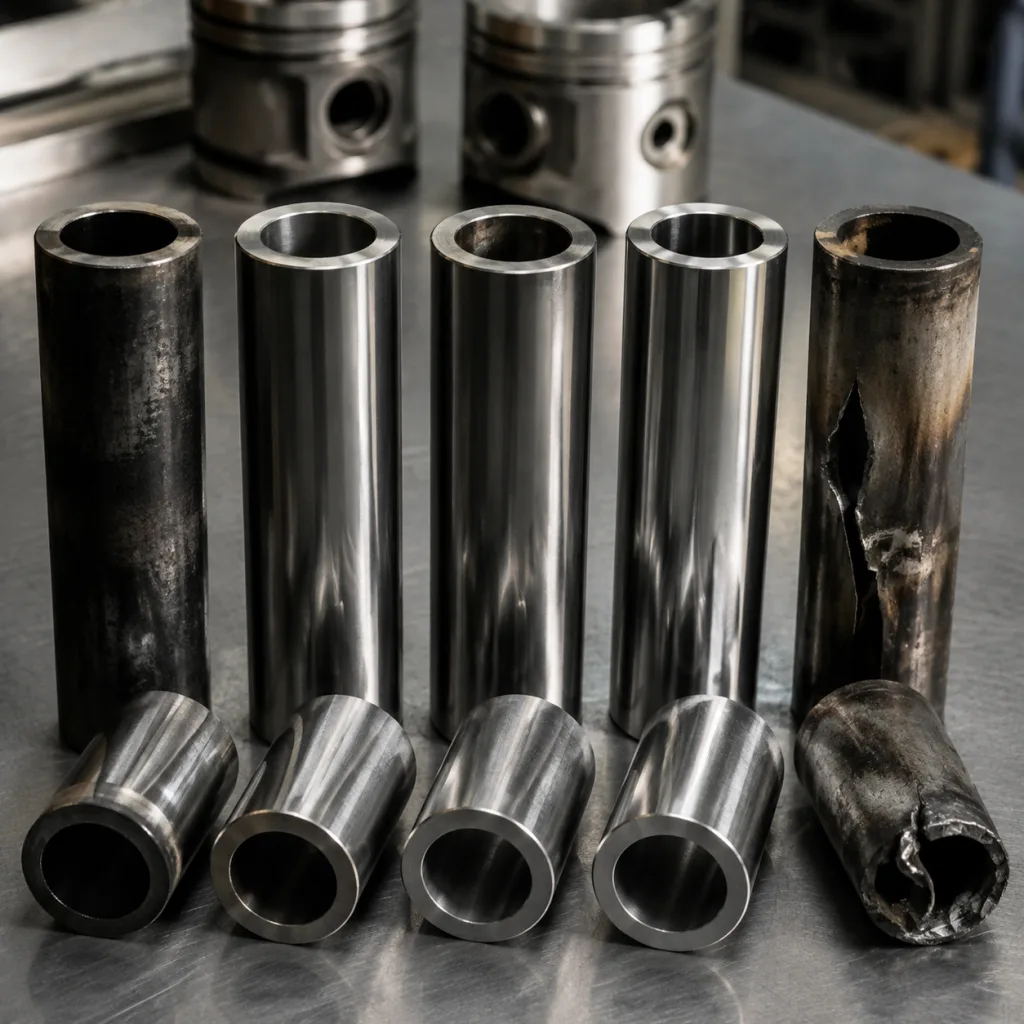
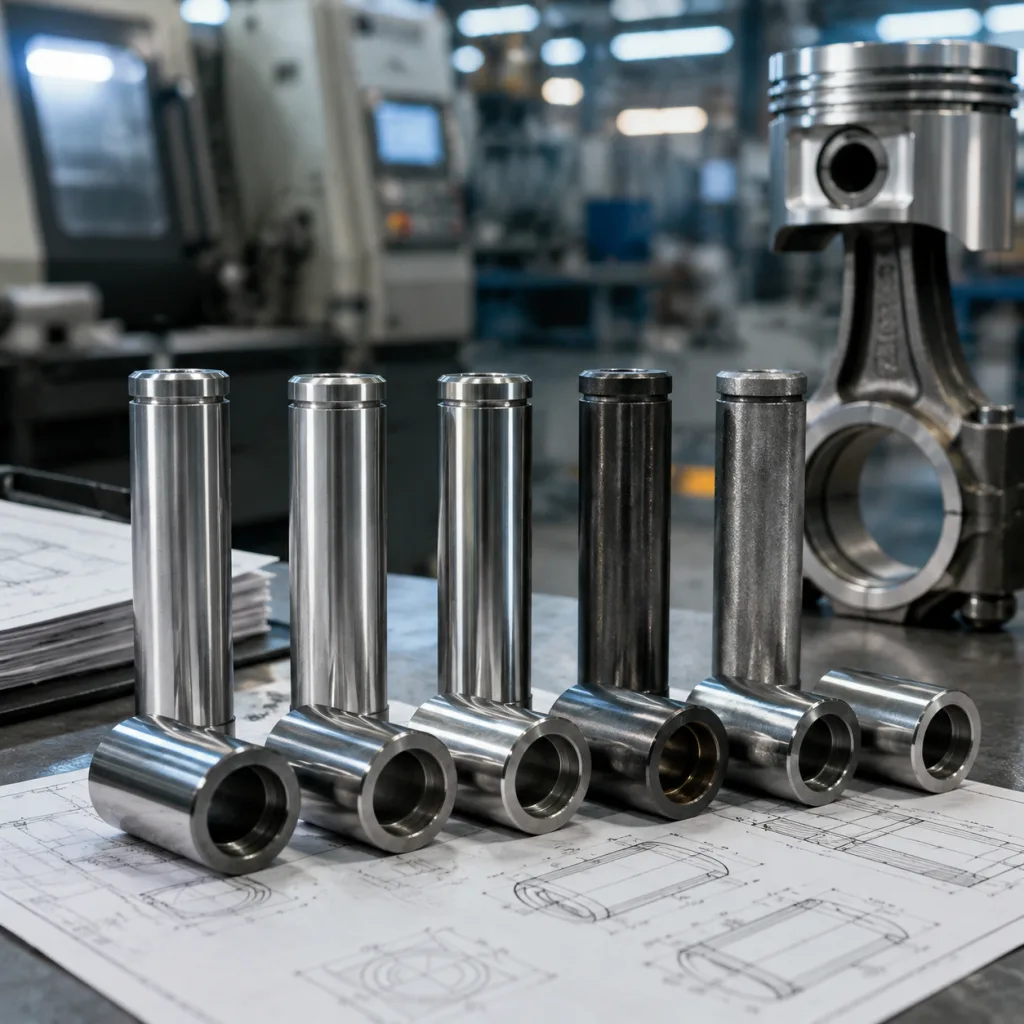
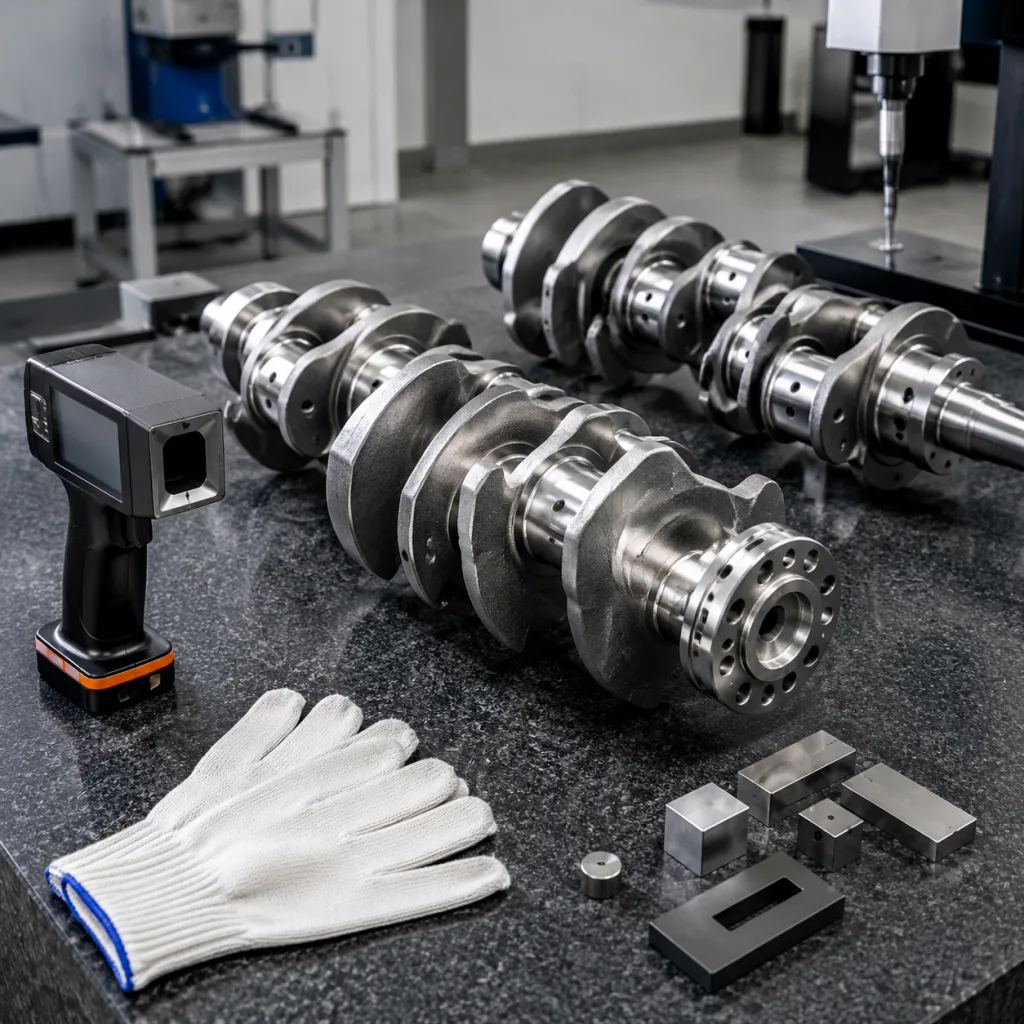
A piston pin can meet the drawing and still fail early. The weak point is often not diameter or length, but the material route behind the drawing: steel cleanliness, case depth, core toughness, heat-treatment stability, surface finish, and coating control. This piston pin material grade comparison is written for sourcing and engineering teams that need to choose between common steel grades without turning the RFQ into a lowest-price exercise. It covers how to define the duty cycle, compare steel families, test heat treatment evidence, judge surface engineering, structure procurement decisions, and request supplier data that supports repeatable production. Driventus manufactures piston pins and related engine components in Taizhou, Zhejiang, under IATF 16949:2016 and ISO 9001:2015 systems for export aftermarket, OEM, Tier-1, and repair-chain supply programmes. Driventus is an independent aftermarket manufacturer; brand names and OE-style references are used for fitment identification only.
Decision Framework: Define the Engine Duty Before Naming a Steel
Start with the operating case. Not the grade.
A pin for a naturally aspirated petrol engine does not see the same pressure, oil temperature, or sliding contact as a turbocharged diesel pin. A high-speed performance engine adds another constraint: lower mass without giving up fatigue strength or scuffing resistance. If these applications are grouped only by OD and length, the material comparison is already weak.
The technical file should define outside diameter, inner diameter or wall thickness, length, chamfers, end form, lubrication holes, and fit class. Many automotive piston pins control OD in the micron range. As reference points, OD tolerance may be around 0.005–0.015 mm, roundness around 0.002–0.006 mm, cylindricity around 0.003–0.010 mm, and length tolerance around 0.05–0.15 mm. The drawing governs, but these ranges help buyers identify quotes that are too vague or unrealistically cheap.
Before comparing material grades, confirm:
Engine type: petrol, diesel, hybrid range extender, CNG/LPG, or performance application.
Pin design: full-floating, semi-floating, or press-fit.
Bore and stroke range, peak combustion pressure, and maximum engine speed. Modern turbo petrol engines may exceed 100 bar peak cylinder pressure; light diesel applications can be materially higher.
Mating parts: piston alloy, small-end bushing material, and connecting rod design.
Oil environment: viscosity, soot loading for diesel, start-stop exposure, and cold-start conditions below -20°C where relevant.
Production assumptions: annual volume, inspection level, packaging route, corrosion protection period, and service environment.
Aftermarket programmes often use OE part-number cross-references such as OE 06A… or OE 11251… to organise fitment families. Use those references for application mapping, not as material specifications. A pin can match an OE-style size and still underperform if the steel, heat treatment, residual stress, surface roughness, or cleanliness is not controlled.
Material Grade Comparison: What Each Steel Family Really Buys You
Piston pin steel grades are chosen for hardenability, wear resistance, toughness, and dimensional stability after heat treatment. Grade names vary by national standard. In China export supply, buyers may see 20Cr, 20CrMo, 20CrMnTi, 40Cr, GCr15, or nitriding steels. Equivalent DIN, SAE/AISI, JIS, or ISO grades should be verified by chemistry and properties, not by name alone.
Material family
Example grades to verify
Where it fits
Why buyers choose it
Main risk
Typical process route
Low-carbon alloy steel, carburised
20Cr, 20CrMnTi, SAE 5120-type
High-volume passenger car and light commercial engines
Hard wear-resistant case, tough core, strong cost position at scale
Case depth, retained austenite, and distortion must be controlled
20CrMo, SCM420-type, 4140/42CrMo4-type depending on route
Turbocharged, higher-output, or higher-fatigue applications
Better hardenability and core strength
Higher material cost; wrong process route can erase the benefit
Through hardening or case hardening depending on design
Bearing-grade steel family
GCr15, SAE 52100-type
Severe sliding contact or high contact stress
High hardness potential and wear resistance
Less forgiving if toughness or cleanliness is weak
Controlled heat treatment, precision grinding, lapping or superfinishing
Medium-carbon steel
45 steel, 40Cr, SAE 1045/5140-type
Cost-sensitive, lower-load programmes
Lower raw material cost and easier machining
Limited wear resistance unless surface hardening or coating is suitable
Induction hardening, nitriding, or selected surface treatment
Nitriding steel family
38CrMoAl-type or selected Cr-Mo steels
Applications needing dimensional stability and hard surface with lower distortion
Good surface hardness with less heat-treatment distortion in many cases
Shallower hardened layer than many carburised designs
Nitriding 500–570°C, polishing, final hardness and dimensional inspection
</tr></thead><tbody> </tbody></table>The highest alloy content is not automatically the safest choice. A well-controlled carburised low-carbon alloy steel with surface hardness of 58–64 HRC, effective case depth of 0.4–1.2 mm, core hardness around 28–42 HRC, and OD roughness below Ra 0.20 µm may beat a more expensive grade with poor case-depth control or unstable grinding.
Also compare availability. Common carburising grades usually support lower MOQ and shorter lead time. Niche alloys, special bar stock, or coating routes can add 2–4 weeks and may force mill or material minimums.
Failure Modes: Heat Treatment Mistakes That Make Good Steel Fail
A steel grade is only a starting point. Piston pin durability is often decided in the furnace, quench tank, tempering cycle, and finishing line. The same nominal material can produce different field performance depending on atmosphere control, carbon potential, quench medium, load pattern, tempering temperature, grinding stock, and post-treatment inspection.
Common failure routes include:
Case depth too shallow, causing accelerated wear or subsurface fatigue.
Case depth too deep or core too hard, reducing toughness and increasing fracture risk.
Excessive retained austenite, leading to dimensional movement or unstable surface properties.
Decarburisation, intergranular oxidation, abnormal grain structure, or carbide networks.
Grinding burn after heat treatment, especially where final grinding removes too much stock or overheats the surface.
Poor batch traceability, making containment difficult after a defect is found.
The approval file should define:
Surface hardness range, normally in HRC or HV. Carburised pins are often specified around 58–64 HRC or approximately 700–820 HV.
Core hardness range at the centre section or another agreed location, often around 28–45 HRC depending on steel and duty.
Effective case depth and measurement method. Carburised designs may use 0.4–1.2 mm effective case depth at a defined hardness threshold; nitrided layers may be closer to 0.10–0.40 mm.
Total case depth if the drawing requires it.
Microstructure limits for excessive carbides, decarburisation, abnormal grain, intergranular oxidation, or soft zones.
Retained austenite limits where relevant, measured by X-ray diffraction or an agreed metallographic method.
Distortion allowance before final grinding.
Grinding allowance and finishing sequence: rough grind, fine grind, polish, lapping, and cleaning where applicable.
Traceability from raw material heat number to heat-treatment batch and finished inspection lot.
A practical launch package includes metallographic cross-sections, hardness traverse data, lot surface-hardness checks, and capability studies for key dimensions. For stable production, buyers may require Cpk ≥1.33 for OD and roundness, with stricter internal targets for safety-critical or OE programmes. Hardness checks alone are not enough.
For production supply, Driventus links incoming steel inspection, heat-treatment records, dimensional results, and final lot release within its quality system, aligned with IATF 16949:2016 and ISO 9001:2015. For regulated markets, documentation may also need to support material declarations under REACH (EC) No 1907/2006.
Spec Deep-Dive: Geometry, Roughness, and Coating Must Be Treated as One System
Material choice does not stand alone. A piston pin works under oscillating motion, high local pressure, and boundary lubrication during start-up. Too much roughness can wear the bushing or piston boss. Too little texture, when paired with the wrong coating or oil condition, can also increase adhesion or scuffing risk in some designs.
Specify the surface and geometry together:
OD tolerance and roundness. Many automotive pins require OD tolerance around 5–15 µm and roundness below 2–6 µm, but the drawing governs.
ID or wall-thickness control for weight and strength consistency. Selected lightweight pins may need wall variation within 0.03–0.08 mm.
Cylindricity and straightness over the full length.
Chamfer angle, end-face condition, and burr limits. Burrs around oil holes and chamfers should be visually absent and controlled by a defined maximum edge break.
OD surface roughness, usually Ra and sometimes Rz, Rpk, Rk, or Rvk. Common finished OD targets may be Ra 0.05–0.20 µm.
Grinding burn inspection method, such as nital etch, Barkhausen noise, or metallographic confirmation.
Cleaning standard and residual contamination limit, including particle size and mass limits per part or batch.
Coating type, thickness, adhesion, and post-coating dimensional control.
Common surface routes include phosphate treatments, DLC-type coatings, and other low-friction coatings. A manganese phosphate layer may be specified in the low-micron range for run-in and oil retention. DLC-type coatings may be specified around 1–4 µm depending on load, mating surface, and final OD tolerance.
Do not use a coating as a rescue plan for weak base material or poor grinding. Coatings work best when substrate hardness, roughness, cleanliness, and adhesion are controlled as one specification.
For supplier comparison, request samples from the same application family and inspect them under one common plan. Dimensional match can be checked against the part family in our catalog, while new dimensions, materials, coatings, or engineered variants can be reviewed through custom manufacturing.
Procurement Playbook: Nine Steps from RFQ to Stable Production
Use this sequence when preparing RFQs, approving a new supplier, or changing material on an existing piston pin programme.
1. Lock the technical baseline. Collect the drawing, application list, OE cross-reference format, mating component data, annual volume forecast, landed-cost target, and field-failure history. 2. Separate duty categories. Do not group pins only by visual similarity or OD. Split low-load replacement, turbocharged, diesel, performance, and fleet applications. 3. Shortlist material families. Compare carburised alloy steel, chromium-molybdenum steel, nitriding steel, bearing-grade steel, and other candidates against load, cost, weight, availability, and process capability. 4. Define the buying stage. A prototype quote, PPAP sample quote, first-batch quote, and annual blanket-order quote are not the same. Small runs carry setup, heat-treatment minimums, gauge costs, and documentation costs. 5. Require heat-treatment evidence. Ask for hardness profile, case-depth report, microstructure record, and furnace batch traceability. Define measurement positions and acceptance limits. 6. Control the final geometry. Confirm OD tolerance, ID or wall thickness, roundness, cylindricity, chamfer, burr limits, surface finish, and cleaning requirements. 7. Confirm surface treatment. Define phosphate, DLC-type coating, nitriding, or other surface routes, including thickness, adhesion, and inspection criteria. 8. Approve samples with data. Use dimensional reports, material certificates, hardness results, case-depth evidence, and functional testing before bulk purchase. 9. Monitor production lots. Review capability, lot traceability, packaging protection, corrosion prevention, change control, and nonconformance response.
For larger programmes, add audit questions on incoming material control, in-house or outsourced heat treatment, gauge calibration, measurement system analysis, preventive maintenance, change management, and reaction plans. IATF 16949:2016 requires structured control for automotive production and service part organisations, including risk-based thinking and documented process control. ISO 9001:2015 supports general quality management, but piston pin sourcing usually needs deeper evidence than a certificate.
As a planning guide, standard aftermarket items may be economical from around 1,000–3,000 pieces per part number if raw material and tooling are available. New drawings, special alloys, coatings, or dedicated gauges may push practical MOQ toward 5,000–20,000 pieces or require a setup charge for smaller batches. Typical timing is 7–15 days for drawing review and quotation, 20–45 days for samples depending on tooling and heat treatment, and 30–60 days for production after sample approval and deposit. Special coatings, PPAP documentation, or special steel procurement can extend the schedule.
RFQ Q&A: What to Ask Before You Trust the Quote
What should the RFQ include besides a material name?
Send a full data package. A single grade callout creates quotation gaps and later disputes.
Recommended RFQ fields include:
Application family and annual forecast by destination market, split by part number and release schedule.
Drawing with tolerances, material callout, heat treatment, and coating notes.
Acceptable equivalent standards, including chemistry limits and cleanliness requirements.
Required PPAP level or equivalent production approval documentation.
Inspection report format, critical characteristics, and sampling plan, such as 100% OD sorting, AQL sampling, or SPC for key dimensions.
Required hardness, case depth, microstructure, and surface roughness evidence.
Packaging requirement, corrosion protection period, carton and pallet limits, and transport route. Export projects often specify 6–12 months rust protection for sea freight and warehouse storage.
Compliance requirements, including REACH (EC) No 1907/2006 where relevant.
Required certificates: material certificate, hardness report, dimensional report, case-depth report, and coating report if used.
Target delivery schedule, sample quantity, production ramp-up timing, and whether partial shipments are acceptable.
Rules for engineering changes, substitute materials, supplier deviation requests, and lot segregation.
How should price be compared?
Break it down. Separate material, machining, heat treatment, coating, inspection, packaging, documentation, tooling, and gauge charges. A lower unit price may exclude metallography, DLC coating, export packaging, PPAP, or 100% sorting.
Ask each supplier to state the pricing basis: sample price, first-batch price, annual-volume price, MOQ price break, currency, Incoterms, payment terms, and validity period. A 10,000-piece quote with standard carburising cannot be compared directly with a 500-piece quote that includes PPAP Level 3, special coating, and dedicated gauge development.
What signals a weak quote?
Watch for missing case-depth data, unclear equivalent grades, no heat-treatment batch traceability, no coating thickness tolerance, generic “meet drawing” statements, or a price that ignores inspection and documentation scope.
Driventus can quote standard and engineered piston pins for aftermarket distribution, OEM/Tier-1 projects, and multi-location repair chain supply. We do not claim approval or endorsement by any vehicle manufacturer. Brand names and OE-style references are used only to identify fitment and technical equivalence requirements.
Frequently asked questions
There is no universal best grade. Carburised low-carbon alloy steel is common for high-volume engines, while chromium-molybdenum, bearing-grade, or nitriding steel families may suit higher-load, wear, or stability requirements. Selection should be based on load, heat treatment, case depth, surface finish, geometry, validation results, MOQ, and total cost.
No. Coatings can reduce friction and scuffing risk, but they depend on a stable substrate. Base material cleanliness, hardness, case depth, roundness, surface finish, and coating adhesion must still meet the drawing and application requirements.
Request a material certificate, hardness and case-depth report, dimensional inspection report, surface roughness data, coating report if applicable, and traceability by lot. For automotive programmes, ask how the supplier controls production under IATF 16949:2016 and ISO 9001:2015, and confirm sampling plan, PPAP scope, and change-control rules.
If you are comparing piston pin materials for an RFQ or supplier change, Driventus can review drawings, samples, application data, target volumes, tolerance requirements, and lead-time targets. Share your requirements or [request a quote](/contact.html).