Oil Sump Specifications: Dimensions, Materials, and Tolerances
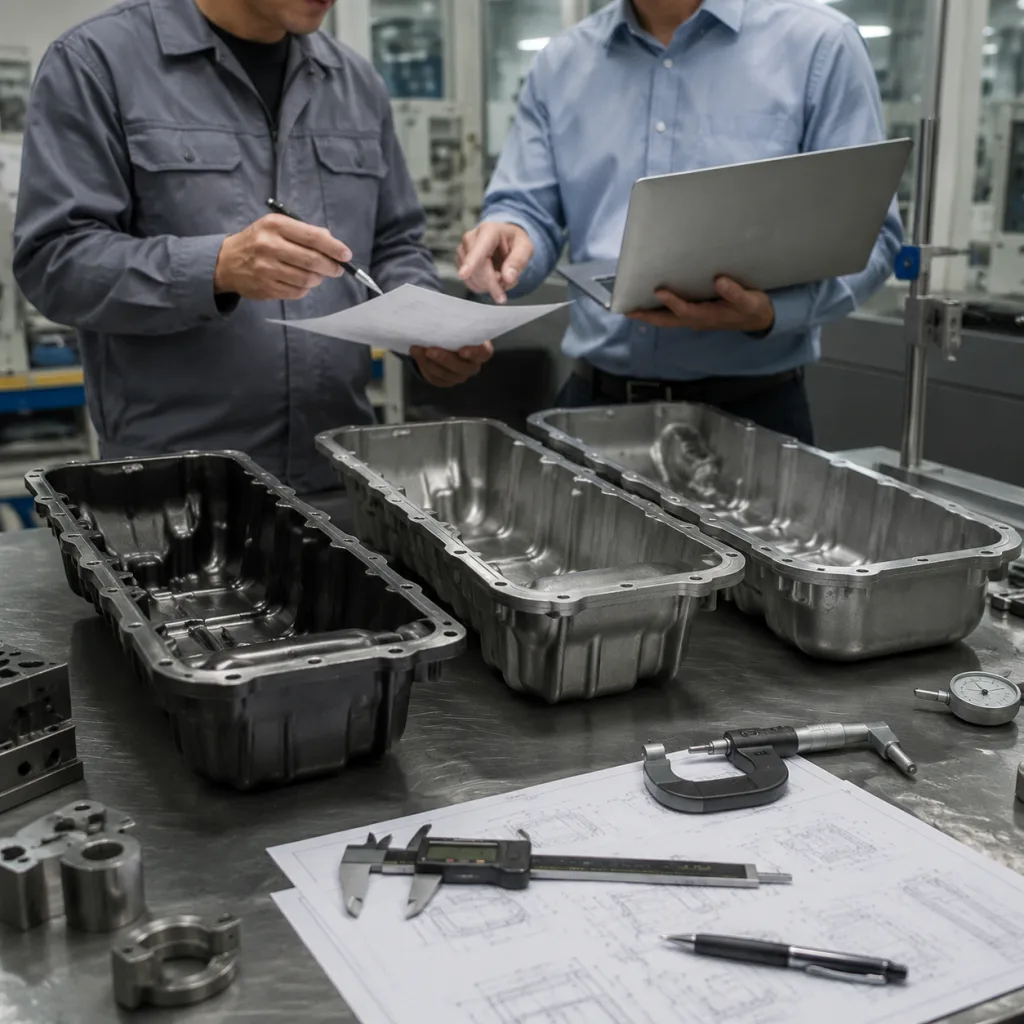
Oil sump specifications cover far more than pan depth and bolt pattern. For procurement teams, the most important controls are sealing face flatness, material grade, corrosion resistance, drain plug thread, oil capacity, and compatibility with the target engine family. Buyers should also define tolerance stack-up, inspection method, packaging, MOQ, sample cost, and lead-time expectations up front, because a sump that is dimensionally close can still fail in service if pickup clearance, flange stiffness, or thread engagement is outside control. Even small changes in stamping depth, baffle design, or pickup clearance can affect oil control, serviceability, and field performance. Driventus is an independent aftermarket manufacturer; brand names are referenced for fitment only. We supply oil sumps for aftermarket distributors, OEM and Tier-1 programmes, and repair networks, with documented production under IATF 16949:2016 and ISO 9001:2015. This article outlines the dimensions and verification points buyers should request before sample approval or bulk release, including the commercial details that affect landed cost and replenishment risk. If you are comparing replacement parts against OE 06A107065 or similar cross-reference formats, the goal is dimensional match, fitment stability, and repeatable sealing performance.
What should be included in oil sump specifications
A useful procurement specification should define the following items, not just the part name:
Application: engine family, vehicle platform, and OE cross-reference where available
Material: stamped steel, cast aluminium, or formed composite if applicable
Nominal capacity: with and without filter, if the sump is part of a service-fill calculation
Mounting pattern: bolt count, thread size, pitch, and centre-to-centre spacing
Sealing face: gasket type, RTV requirement, bead width, and flatness limit
Baffle and windage control: yes/no, position, and internal clearances
Finish: phosphate, E-coat, powder coat, or oil-resistant paint, with film-thickness target
Validation: leak test, salt spray, thermal cycling, dimensional inspection, and fitment trial
Commercial terms: MOQ, sample quantity, packaging unit, and target annual volume
For buyers issuing RFQs, these points help avoid ambiguity between a cosmetic match and a production-ready component. Include the target revision level, required PPAP or FAI output, and whether the part must ship with gasket, drain plug, or washers installed. Typical sourcing logic is to request a single sample set first, then a pilot lot of 50-300 pcs, then a production MOQ that matches carton and pallet efficiency. Driventus supports both catalogue supply and custom programmes through our catalog and custom manufacturing.
Key dimensional checks buyers should request
Oil sump parts are usually accepted or rejected on a short list of measurable features. The most common checks are listed below.
Parameter
Typical control point
Why it matters
Flange flatness
0.15 mm max over sealing face, unless drawing states otherwise
Reduces leak risk
Bolt-hole position
Within drawing tolerance, commonly ±0.20 mm
Prevents misalignment during assembly
Pan depth
Per approved sample or drawing, often checked to ±0.5 mm on high-volume parts
Affects oil volume and ground clearance
Drain plug thread
Match OE thread form, pitch, seat type, and minimum engagement length
Prevents stripping and service failures
Pickup clearance
Confirmed during engine fit validation, commonly with 5-10 mm minimum running clearance where the OE design permits
Protects against oil starvation
Overall length and width
Drawing or 3D model checked, usually within ±1.0 mm for packaging-critical features
Ensures chassis and subframe clearance
Boss height and thread depth
Verified against gauge or CMM
Supports fastener retention and sealing
</tr></thead><tbody> </tbody></table>If the part is a stamped steel sump, buyers should also ask for sheet thickness, draw depth, bead geometry, and whether the flange is locally reinforced around the bolt holes. Typical steel thickness is 1.5-2.0 mm on light-duty applications, but the buyer should specify the required nominal value and allowable variation, such as ±0.08 mm on incoming sheet. For cast aluminium versions, request wall thickness, porosity limits, machining datum definitions, and a minimum thread engagement depth, often 1.0x to 1.5x the bolt diameter depending on the design. Where the application is sensitive, the supplier should provide a first article inspection report, a measurement plan, and capability data for critical dimensions, typically targeting Cpk ≥ 1.33 on production characteristics. Buyers should also require a hard copy or PDF of the inspection report with actual values, not just pass/fail statements, from the quality system.
Materials, coatings, and sealing performance
Material choice affects impact resistance, thermal behaviour, corrosion life, and the cost-to-performance balance. Stamped steel remains common because it is economical, easy to form, and suitable for high-volume programmes. Cast aluminium is used where stiffness, heat dissipation, or underbody packaging are priorities. Polymer composite sumps are less common in the aftermarket and need tighter process control around inserts and sealing ribs.
Material selection notes
Steel: specify grade, thickness, yield strength if relevant, and coating adhesion requirements; common programme controls include 1.5 mm, 1.8 mm, or 2.0 mm nominal thickness
Aluminium: specify alloy, machining allowance, porosity control, and heat-treatment condition if applicable
Surface coating: define salt spray target, finish colour, film thickness, and oil resistance
Seal interface: state gasket material compatibility with engine oil, ATF, or synthetic blends; specify compression set and allowable squeeze range where possible
For corrosion resistance, published test references such as SAE J2527 are useful when comparing coating systems, while REACH (EC) No 1907/2006 matters for material compliance in the EU market. Buyers should ask whether the finish is validated for stone-chip exposure, oil splash, and underbody road spray, and whether the acceptance criterion is cosmetic only or functional after corrosion exposure. A practical benchmark is 240-480 hours of salt spray for painted or coated steel parts when the market requires improved corrosion life, although the final requirement should be tied to vehicle duty cycle and target region. If the part includes a gasket or RTV sealant requirement, the drawing should identify the sealant type, bead size, cure window, and maximum assembly open time rather than leaving this to the assembler. For export programmes, also confirm whether the coating survives packing oil, desiccant, and transit humidity without staining or adhesion loss.
Validation tests for production approval
Procurement teams should not approve an oil sump on dimensions alone. At minimum, request evidence of the following checks:
1. Leak test under specified air or oil pressure, with accept/reject criteria stated; many buyers specify 20-50 kPa air pressure for a submerged or soap-solution test, or a stabilized oil-fill test at room temperature 2. Thermal cycling across hot-soak and cold-start conditions, typically from -40°C to +120°C or per engine programme requirement 3. Vibration or durability simulation to confirm fastener retention and crack resistance, including baffle and drain-area integrity 4. Corrosion testing appropriate to the coating system, often salt spray or cyclic corrosion to a defined hour target 5. Torque retention on drain plug and mounting fasteners, with pre- and post-test torque values recorded 6. Fitment trial on the target engine and surrounding chassis package, including starter, subframe, steering rack, and exhaust clearance
For OE-equivalent replacement work, the validation file should show dimensional comparison against the approved sample and record any deviations. This is especially important when cross-referencing OE 06A107065-style references or other engine-family part numbers. Buyers should request the test report number, sample size, date code, and whether the test article was a production-intent part or a hand-built sample. A credible approval package usually includes 3-5 pilot parts for destructive checks plus at least one retained golden sample for future comparison. Driventus does not claim vehicle manufacturer approval or endorsement; our role is to manufacture to drawing, sample, or agreed specification.
How to compare supplier quotes fairly
Quotes for oil sump parts often look similar until the technical details are reviewed. A lower unit price may exclude machining, coating, gasket, drain plug, packaging, or inspection documentation. Compare offers on the same basis and ask for a clear price breakdown by component and process step.
Quote element
Ask for confirmation
Raw material
Grade, thickness, alloy, and material certificate availability
Machining scope
All machined faces, drilled holes, threaded features, and deburring
Coating
Type, film thickness, test standard, and rework policy
Included hardware
Drain plug, gasket, washers, sealant, or fasteners
Inspection
PPAP level, FAI, in-process checks, and CMM or gauge method
Packaging
Corrosion protection, bagging, carton spec, and pallet pattern
Lead time
Sample, pilot, and mass-production timing
MOQ
Minimum order by part number, color/finish, or packaging unit
</tr></thead><tbody> </tbody></table>Use a like-for-like landed-cost model rather than unit price alone. For example, if Supplier A quotes a lower piece price but requires separate gasket sourcing and 8-week lead time, while Supplier B includes hardware, 2-week samples, and carton labeling, the total cost and release risk may favor the higher piece price. Typical aftermarket MOQ ranges are 100-300 pcs for catalogue items and 300-1,000 pcs for custom variants, depending on tooling status, coating complexity, and carton efficiency. Sample pricing is often charged at a premium because it includes setup, inspection, and expedited handling; buyers can usually reduce sample cost by consolidating several line items into one engineering batch. For multi-location service networks, consistent packaging and barcode labelling can reduce receiving errors. For distributors, MOQ should be linked to a stable packing configuration rather than only to factory batch size. If the project includes multiple vehicle applications, our catalog can support line-item comparison, and request a quote when you need a formal technical response.
What procurement teams should ask before approval
Before placing a repeat order, confirm the following points in writing:
Does the supplier provide an engineering drawing, controlled sample, or 3D model with revision level?
Are mounting points, drain-thread details, and sealing face dimensions verified against the target engine family?
Is there evidence of leak, corrosion, torque-retention, and fitment testing with actual report numbers?
Are packaging and preservation methods suitable for export transit, humidity, and long storage?
Can the factory support engineering changes through controlled revision management and change notification?
Is the product covered by documented IATF 16949:2016 and ISO 9001:2015 processes?
What is the agreed MOQ, sample quantity, target unit price at 1k/5k/10k pcs, and forecast-based lead-time trigger?
This is the stage where many sourcing decisions fail. If the specification is incomplete, two parts that look similar on paper may differ in flange stiffness, drain location, baffle height, or pan depth. Driventus supports standard catalogue supply and custom manufacturing for programmes that require drawing-based control and repeatable inspection. Driventus is an independent aftermarket manufacturer; brand names are referenced for fitment only. For repeat orders, lock the approved sample, the packaging spec, the coating spec, and the inspection plan before issuing the blanket PO so that production, quality, and logistics teams are working from the same release basis.
Frequently asked questions
Provide the engine family, OE cross-reference if available, dimensions, material, coating, drain plug details, annual volume, target market, MOQ expectation, and required lead time. A drawing or sample speeds review and lowers the chance of a revision mismatch.
Check mounting pattern, flange geometry, pan depth, drain location, pickup clearance, sealing method, and installed clearance against the approved sample or drawing. Fitment testing should be documented with actual measurements and photos.
IATF 16949:2016 and ISO 9001:2015 are important for quality systems. REACH (EC) No 1907/2006 applies to EU chemical compliance, and SAE J2527 is often used for coating durability comparisons. Buyers may also request PPAP, FAI, and capability data on critical dimensions.
If you need a technical quotation, sample review, or drawing-based discussion, contact Driventus through our enquiry form and we will respond with the relevant specification details: /contact.html