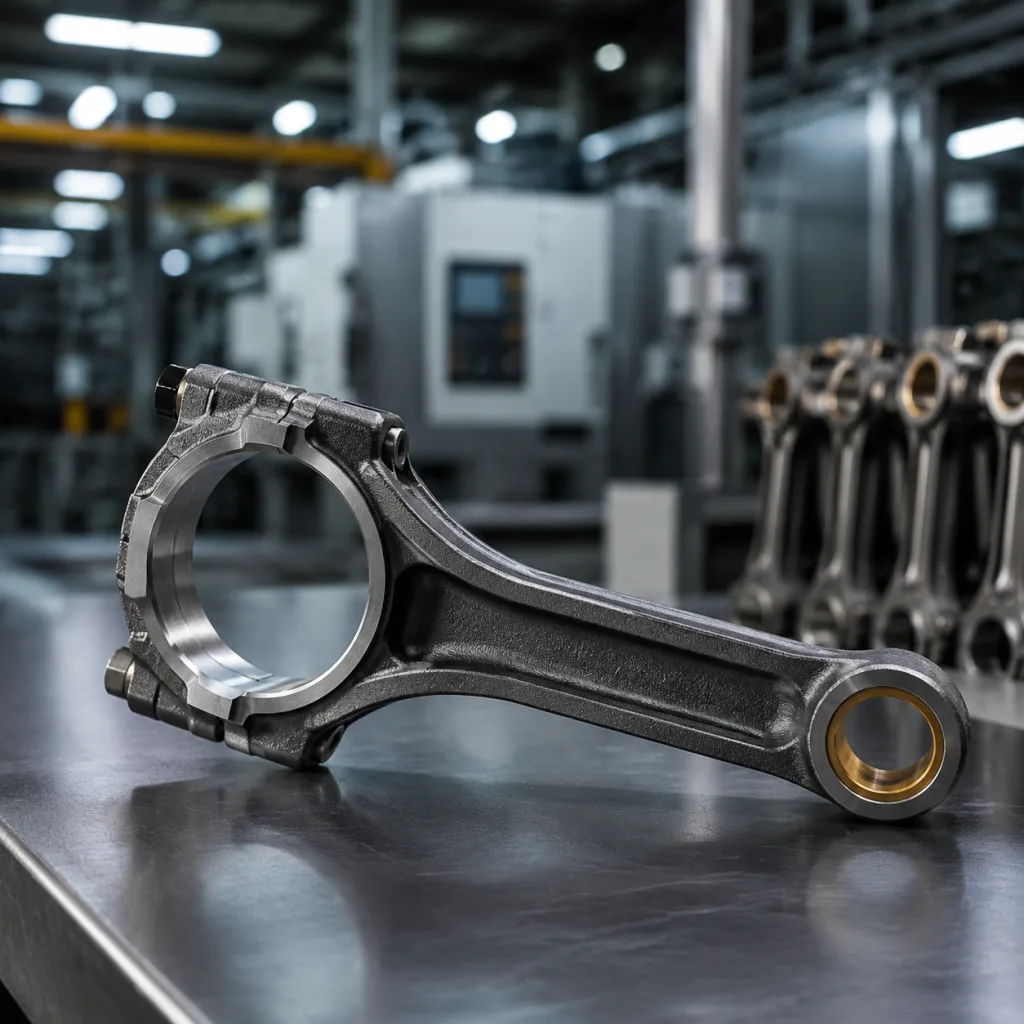
A thrust washer looks harmless in a parts bin. In a compliance file, it can be anything but simple. One part may include steel backing, copper alloy, aluminium-tin overlay, polymer coating, plating, preservative oil, VCI packaging, and printed labels. Each input can affect obligations under REACH (EC) No 1907/2006 for EU supply and UK REACH for Great Britain supply.
For procurement teams, fitment is only the first question. The washer still has to match the drawing, survive the application, and arrive with evidence that the alloy, coating, oil, and packaging have been checked against the right restricted-substance scope. This article gives buyers a practical way to manage reach compliance for thrust washer programmes without treating it as a last-minute certificate chase. It covers scope definition, SVHC thresholds, high-risk materials, supplier verification, engineering validation, RFQ content, MOQ and lead-time effects, and change control for B2B aftermarket, OE-equivalent, and custom sourcing.
Start with a sourcing boundary, not a certificate request
The fastest way to get a weak REACH answer is to ask, “Can you provide a certificate?” before defining the product. Engine thrust washers, crankshaft thrust bearings, transmission spacers, and axial locating washers can use different substrates, overlays, surface treatments, and lubricants. A single commercial part number may also have more than one material route if the supplier has not frozen the bill of materials.
Build the boundary first. For each part number and revision, confirm what is being assessed:
Drawing or dimensional specification, including nominal thickness, inner diameter, outer diameter, oil grooves, tabs, surface finish, and tolerances. Common aftermarket checks include thickness tolerance of about ±0.01–0.03 mm, ID/OD tolerance of about ±0.03–0.10 mm, and burr limits below 0.02–0.05 mm depending on application.
Material construction, such as steel-backed bronze, solid bronze, aluminium alloy, copper alloy, aluminium-tin alloy, or polymer-coated bimetal. Ask for the controlled material grade or internal material route, not only a trade name.
Coating and treatment details, including tin flash, phosphate, PTFE-based overlay, corrosion inhibitor, dry film lubricant, or assembly oil. Where relevant, specify the target coating thickness, for example tin flash around 1–5 µm or polymer overlay commonly in the 10–30 µm range.
Packaging materials in direct contact with the part, including VCI paper, plastic bags, labels, cartons, and anti-rust media. Confirm whether the washer is supplied dry, lightly oiled, or sealed in VCI.
Intended market: EU, Great Britain, Northern Ireland, US, Canada, Australia, Brazil, or mixed export. EU and UK declarations should reference the Candidate List version or assessment date.
Annual volume, launch date, and supply model: aftermarket distribution, OEM service, or Tier-1 assembly. MOQ is usually driven by strip material, coating batch size, stamping die setup, and packaging print quantity. Standard catalog items may be 100–500 sets; custom washer routes often require 1,000–5,000 pieces or more.
This scope matters because a declaration for “bearing products” may not cover a washer with a different overlay or preservative. A drawing revision change can also introduce a new coating supplier or lubricant without changing the commercial name.
Buyers can review standard thrust washer ranges in our catalog and use the same data fields when preparing an RFQ. For non-standard axial bearing geometry, request custom manufacturing with a controlled drawing revision rather than sourcing against a sample only.
Driventus is an independent aftermarket manufacturer; brand names are referenced for fitment only.
Decision framework: when does a thrust washer trigger REACH work?
REACH (EC) No 1907/2006 regulates chemicals placed on the EU market. Finished automotive components such as thrust washers are normally treated as articles. The procurement task is to determine whether any Substance of Very High Concern (SVHC) on the Candidate List is present above 0.1% weight by weight in the article, and whether any Annex XVII restrictions apply to the materials, coatings, or associated chemicals.
Do not average the risk across a carton. Under the EU “once an article, always an article” principle, the 0.1% threshold is assessed at article level, not only across the total shipment. For a washer kit, consider each washer, spacer, bag, label, insert, or other article in the saleable package. If one 8 g washer contains an SVHC above 0.1% w/w, that is more than 8 mg per washer article and may trigger communication duties even if the full boxed kit remains below 0.1% by total package weight.
Use this table as a buying decision framework rather than a paperwork checklist.
Compliance question
Buyer decision
Evidence to request
Is the current SVHC Candidate List covered?
Check against the list in force at order and shipment; refresh after ECHA updates, usually twice per year
Supplier declaration by part number, material revision, and assessment date
Is any SVHC above 0.1% w/w in an article?
Apply the threshold to each article, not only the shipment total
Material composition statement or targeted test report where risk exists
Could Annex XVII restrictions apply?
Review lead, cadmium, nickel release, PAHs, chromium VI, and other relevant substances based on material, coating, oil, and packaging
Test report, coating declaration, SDS information for supplied chemicals, or process chemistry statement
Is downstream communication required?
Confirm how SVHC information will be passed to EU/UK importers and customers where required
Article 33 statement, product data pack, or importer procedure
Is SCIP relevant for EU supply?
Assess whether SCIP database notification is needed when an article contains Candidate List SVHCs above 0.1% w/w
Supplier data sufficient for importer or assembler notification, where applicable
Can the supplier change inputs without warning?
Make material, coating, preservative, and packaging changes declaration-triggering events
PPAP-style change notice or documented supplier engineering change process
</tr></thead><tbody> </tbody></table>REACH compliance for thrust washer procurement is therefore a controlled data process linked to material revisions, coating suppliers, packaging choices, and shipment timing. A general company letter with no part numbers, no date, no signature authority, and no reference to the current Candidate List is weak evidence. A stronger declaration names the part number or family, drawing revision, substrate, coating route, packaging scope, assessment date, applicable regulation, and whether any SVHC above 0.1% w/w is known or intentionally present.
Failure modes: where thrust washer compliance files usually break
Most sourcing failures do not come from the washer body alone. They come from unexamined inputs: alloying elements, plating chemistry, polymer additives, pigments, corrosion protection fluids, and packaging materials. In crankshaft and transmission applications, substitution is not always easy because temperature, oil compatibility, fatigue resistance, and wear behaviour restrict the material choices. Check the risk before approving price, sample, or production release.
Watch for these common failure modes:
Lead described too loosely: Some legacy bronze or overlay systems use lead for conformability, embeddability, and seizure resistance. Ask whether the alloy is lead-free, low-lead, or leaded, and whether any restriction, exemption, or customer-specific allowance applies to the target market. Do not accept “lead free” unless it is defined: no intentional addition, below 0.1% w/w, or below a customer limit such as 1,000 ppm.
Cadmium or chromium VI hidden in surface treatment: Cadmium and hexavalent chromium should be specifically excluded from plating, passivation, pigments, and anti-corrosion systems unless a lawful and fully documented use is identified. XRF screening can flag cadmium and total chromium, but chromium VI often requires a specific wet-chemistry or surface test.
Nickel treated as irrelevant: Nickel may appear in engineered surfaces or intermediate layers. In many enclosed engine applications, prolonged consumer skin contact is not the main use case, but documentation should still identify the layer and confirm whether any restriction is triggered.
Polymer overlays assessed like metal parts: PTFE and other polymer overlays can contain resins, fillers, pigments, curing chemistry, or processing aids that are invisible to heavy-metal screening. Organic substances cannot be cleared by XRF alone. Overlay changes can also alter friction, oil retention, and running-in behaviour.
Black plastics and rubber ignored: Packaging, seals, caps, bands, or polymer components supplied with the washer may fall under PAH restrictions or customer restricted-substance lists. Recycled black plastics and rubber are worth extra attention.
Oils and VCI media missing from the review: Anti-rust oils, volatile corrosion inhibitor papers, and treated bags are often selected late. They may contain reportable substances or require safety data information when supplied separately as chemical mixtures. Ask for the oil or VCI product name, supplier code, SDS where applicable, and confirmation that production shipments will use the same media.
Also check the contractual regulatory scope. UK REACH may apply for Great Britain supply. EU End-of-Life Vehicles Directive 2000/53/EC may matter for vehicle material restrictions. RoHS is not normally the primary framework for engine thrust washers, but some customers still request it for internal restricted-substance reporting.
Quality certifications such as IATF 16949:2016 and ISO 9001:2015 do not replace chemical compliance. They do, however, indicate whether the supplier can control material changes through a documented system. Driventus publishes more information about its quality system for buyer review.
Supplier verification sequence: five checks before PO release
Treat verification as a release gate, not a document hunt after production. The sequence below helps buyers separate usable evidence from sales paperwork.
1. Send a part-specific compliance request
Provide the part number, drawing revision, target market, annual quantity, and expected start of production. Ask for a REACH declaration that identifies the product family, material route, and date of assessment. If the washer is supplied as a kit, include every washer, spacer, sleeve, bag, label, carton insert, and preservative in the saleable package. Set a realistic response deadline: five working days for standard catalog parts, or 10–15 working days where a new material or coating route must be checked.
2. Lock the controlled material route
The supplier should identify the substrate and overlay family without disclosing proprietary percentages beyond what is necessary for compliance review. A useful statement might say steel-backed copper alloy with lead-free polymer overlay, or aluminium-tin alloy without intentionally added cadmium or hexavalent chromium. If the product uses an OE cross-reference format such as OE 06A… or OE 11251…, treat that only as fitment information. It is not evidence of manufacturer approval or chemical conformity.
3. Match tests to the actual risk
For high-risk materials, request recent third-party laboratory data or internal XRF screening supported by periodic external verification. The method matters. XRF can screen heavy metals, but it does not fully characterise organic additives in coatings, oils, VCI media, or plastic packaging. Where polymer overlays, anti-rust oils, or treated packaging are material to the risk assessment, supplier formulation declarations or targeted laboratory methods may be needed. Many buyers accept third-party reports less than 12 months old for stable materials, but request new tests after formulation changes, new coating suppliers, or a new Candidate List entry affecting the material family.
4. Make change control contractual
Require written notice before any change to alloy supplier, coating formulation, heat treatment, lubricant, preservative, packaging, subcontractor, or production site. Link this requirement to the supplier’s IATF 16949:2016 or ISO 9001:2015 process where applicable. The purchase agreement should state that chemical compliance documentation must be refreshed when a controlled input changes. For custom parts, build in time: a material or coating change may require 2–4 weeks for document refresh and sample checks, and 4–8 weeks if new lab testing, tooling adjustment, or customer PPAP approval is required.
5. Archive evidence by shipment
Store declarations, test reports, drawings, invoices, packing lists, and batch or lot records together. If regulators, customs brokers, or downstream customers request evidence later, part-level traceability is more useful than a generic annual certificate. For EU importers or assemblers, keep data in a format that supports downstream communication and any SCIP-related assessment. A practical file name includes part number, drawing revision, supplier lot, shipment date, and declaration date.
Engineering trade-off: a compliant washer still has to work
Removing a restricted substance is not automatically an upgrade. A washer that clears the compliance file can still fail on axial load, oil film stability, wear, or end-play control. Validate engineering performance at the same time as the chemical review, especially when moving away from a legacy leaded alloy, metallic overlay, or proven coating system.
Focus the technical review on the features that can change when material or coating changes:
Thickness tolerance and parallelism, measured across multiple circumferential positions. For many engine thrust washers, thickness spread must be tight enough to maintain crankshaft end play; buyers commonly specify ±0.01–0.03 mm or a matched-set requirement where applicable.
Flatness and burr control at oil grooves, tabs, chamfers, and edges. Burrs above about 0.03–0.05 mm can create assembly scratches or false end-play readings in sensitive applications.
Surface roughness suitable for the mating crankshaft, housing, or transmission face. Ask whether Ra, Rz, or another parameter is controlled, and confirm the measurement direction and sampling points.
Hardness and microstructure checks for metallic systems. Certificates should identify the test scale and location, not just state “qualified”.
Bond strength, coating thickness, or adhesion for polymer and overlay layers. For coated washers, request cross-section thickness data or process capability where the coating is a special characteristic.
Oil compatibility after thermal ageing and exposure to relevant lubricant chemistry. A practical validation may include elevated-temperature immersion followed by visual inspection, adhesion check, thickness change, and friction or wear comparison.
Wear, friction, and seizure resistance under representative axial load, speed, and temperature. If a full rig test is not available for aftermarket sourcing, agree an equivalent comparison to the approved sample or legacy construction.
Corrosion resistance after storage, handling, and sea freight exposure. Packaging validation should reflect the real route: domestic trucking, container shipment, humidity exposure, and warehouse time.
Cleanliness, debris control, and packaging integrity for assembly environments. Set a limit for visible particles, loose burrs, or fibre contamination if the washer goes directly to assembly.
For aftermarket importers, dimensional interchangeability, fitment coverage, packaging durability, and repeatable replenishment often matter as much as chemistry. For Tier-1 or assembly supply, the control plan should also include incoming raw material certificates, process inspection frequency, special characteristic controls, and lot traceability. REACH compliance for thrust washer programmes should sit inside APQP, PPAP, or an equivalent approval workflow rather than being handled as a separate purchasing form after commercial terms are agreed.
RFQ deep-dive: what to state so the quote is usable
A good RFQ does more than ask for price. It tells the manufacturer which material route, validation plan, and documentation package to quote. That prevents a common sourcing problem: a low-cost sample is approved, then the buyer discovers the compliance evidence does not match the target market.
Drawing, sample, controlled revision, or generic fitment reference. If only a sample is available, request reverse engineering with a measured drawing before tooling or mass production.
Target markets and required regulatory scope, including REACH (EC) No 1907/2006 and UK REACH if applicable. State whether the declaration must cover the washer only or the full retail kit including packaging.
Required declarations: SVHC, Annex XVII, RoHS if customer-specified, IMDS where required by the customer, and material safety information for oils or chemicals supplied separately.
Required quality standards: IATF 16949:2016, ISO 9001:2015, incoming inspection plan, change notification requirements, and lot traceability.
Validation requirements: dimensional report, material certificate, coating report, corrosion test, oil compatibility check, and functional wear test where applicable. Define the sample size, such as 5 pieces for first dimensional review, 30 pieces for capability study, or a customer-specific PPAP sample quantity.
Packaging and labelling requirements for distribution centres, e-commerce channels, export cartons, or assembly plants. Include the expected corrosion protection period, for example 6 or 12 months under normal warehouse storage.
Expected annual volume, MOQ preference, delivery schedule, incoterms, and phased launch requirements. Standard items may quote faster and with lower MOQ; custom parts typically need tooling, first article inspection, and material lot planning before stable unit pricing.
Evidence format needed by the importer, distributor, or downstream customer, including language, signing authority, and update frequency.
Price and lead time depend on material route, strip thickness, coating process, tolerance class, inspection level, packaging, and documentation depth. As a planning estimate, standard catalog washer quotations may be returned within 2–5 working days and ship from stock or routine production in 2–4 weeks. Custom thrust washers often require 4–8 weeks for tooling, samples, compliance review, and first production scheduling. Unit price normally improves at higher quantities because setup, testing, and packaging artwork are spread over more pieces. Still, a lower unit price is not useful if the material route cannot support REACH compliance for thrust washer import documentation.
Driventus manufactures thrust washers and related engine components in Taizhou, Zhejiang, with export experience across more than 60 countries. Procurement teams can submit drawings, samples, or application lists and request a quote for a documented compliance and manufacturing review.
Frequently asked questions
No. A useful declaration should identify the part number or product family, material revision, assessment date, applicable Candidate List status, and packaging scope. Generic company certificates are weak evidence because they may not cover the exact alloy, coating, preservative, or packaging used for the ordered washer.
XRF is useful for screening metals such as lead, cadmium, chromium, and nickel, but it does not fully identify organic substances in polymer coatings, oils, or VCI packaging. Use XRF as part of a wider evidence package that includes supplier declarations, material data, SDS information where relevant, and targeted laboratory testing.
No. IATF 16949:2016 supports process control, traceability, and change management, but REACH obligations still require substance-specific review. The strongest approach combines certified quality management with part-level material declarations, controlled supplier change notices, and shipment-level records.
If you need a documented material review for thrust washer sourcing, send the drawing, sample details, annual volume, target market, tolerance requirements, and documentation scope. Driventus can review fitment, manufacturing route, lead time, and compliance evidence through /contact.html