camshaft · 2026-06-22

Camshaft for Acura RDX Replacement: Buyer Criteria

Buying a camshaft for Acura RDX replacement is not a catalogue exercise. The shaft may be needed because of high mileage, oil starvation, lobe wear, timing-system damage, an engine rebuild, or a stocking plan for a repair network. In every case, the risk is the same: a part that appears to fit can still disturb valve timing, oil-film stability, sensor signals, noise levels, drivability, or emissions-related performance.

Procurement teams should treat the camshaft as a controlled engine-timing component. Critical dimensions are often discussed in microns, not broad machining allowances. A useful RFQ identifies the Acura RDX generation, engine code, intake or exhaust position, reference part number, expected annual demand, first order quantity, packaging format, inspection documents, and approval route. Approval may be based on a buyer sample, drawing, OE-equivalent benchmark, or PPAP-style submission.

Driventus manufactures engine and powertrain components in Taizhou, Zhejiang, and supplies B2B customers in Europe, North America, Australia, Brazil, and other markets. This article sets out how importers, distributors, and repair-chain buyers can reduce wrong-part risk when sourcing replacement camshafts for Acura RDX applications. Acura and other vehicle brand names are used only for fitment identification; Driventus is an independent aftermarket manufacturer.

Start With the Decision Gate: Is the Cross-Reference Actually Safe?

The first sourcing decision is not price. It is whether the application data is specific enough to prevent a wrong camshaft from entering the programme.

For Acura RDX applications, the replacement camshaft should be locked by engine code, model year range, market version, intake or exhaust position, valve-train design, and timing-drive configuration. Ordering by model name alone is too loose. Across generations and markets, visually similar camshafts can differ in lobe phasing, oil-feed drilling, sensor-trigger features, thrust-face geometry, or the timing interface.

A clean RFQ line should include:

  • Model year range
  • Engine displacement and engine code, where available
  • Intake or exhaust position
  • Left/right bank, if applicable
  • Target OE reference and buyer part number
  • Annual forecast and first order quantity
  • Required packaging format
  • Required inspection report or approval document

If the buyer only has a used sample, it should be cleaned, tagged by engine position, and photographed before quotation. Photos should show the timing end, sensor-trigger area, thrust face, journal layout, oil holes, grooves, threads, slots, dowels, and any position marks.

OE references should be treated as fitment cross-references, not as claims of vehicle manufacturer approval. Procurement files sometimes contain generic references from unrelated engine families, such as OE 06A… or OE 11251…. Those references should not be mixed into an Acura RDX sourcing record unless catalogue data, drawing review, and dimensional inspection confirm the match. A bad cross-reference can still produce a part that bolts in. The result may be cam/crank correlation faults, unstable idle, abnormal valve-train noise, or early lobe contact wear.

Driventus controls fitment through drawings, sample measurement records, application files, and production documentation. Buyers can review related ranges through our catalog and the engine component page at /products/engine-components.html.

Key checks before releasing a replacement SKU include:

  • Correct intake or exhaust position, with permanent marking where required
  • Confirmed engine code, model year range, and market version
  • Matching lobe count, journal count, thrust layout, and timing features
  • Journal diameter, roundness, and bearing-support dimensions, often controlled within 0.005–0.020 mm depending on feature criticality
  • Lobe lift, base circle, ramp geometry, and phase angle against an approved drawing or sample
  • Camshaft sensor trigger, phaser, sprocket, or gear interface, including keyway, dowel, slot, thread, and end-face depth
  • Oil-feed holes, grooves, end faces, and thrust faces checked by pin gauges, plug gauges, CMM, or dedicated fixtures
  • Surface treatment compatibility with the follower, rocker, or tappet design
  • Companion parts normally replaced with the camshaft, such as phasers, sprockets, rockers, followers, seals, or timing hardware

For multi-branch distributors, the safest operating rule is simple: one approved application, one internal SKU, one inspection drawing revision, and one packaging label revision. That discipline prevents warehouse substitution between shafts that look almost identical.

Specification Deep-Dive: The Dimensions That Decide Whether the Engine Runs Correctly

A replacement camshaft is a valve-timing component, not a generic machined shaft. Small changes in lobe lift, angular position, journal finish, or thrust width can change valve events and oil clearance. The workshop may see noise, fault codes, hard starting, accelerated wear, or a repeat repair.

A professional specification should define material, heat treatment, machining tolerances, surface finish, inspection method, and acceptance criteria. Depending on the original design and contact load, Driventus can manufacture camshafts from cast iron, chilled cast iron, or alloy steel. The selected route must match the functional contact pattern between the cam lobe and the follower or rocker system.

The exact values should be approved by drawing. As procurement reference points, aftermarket camshaft programmes often control lobe lift deviation at about ±0.02 mm after profile approval, journal diameter within ±0.005–0.015 mm, journal roundness at ≤0.005–0.010 mm, total runout at ≤0.03–0.05 mm, and journal surface roughness around Ra 0.2–0.4 µm where the original design requires a polished bearing surface. Lobe hardness and case depth vary by material and process; for chilled cast or induction-hardened designs, hardness mapping at the nose, flank, and base circle is more useful than one isolated reading.

</tr></thead><tbody> </tbody></table>The real sourcing question is repeatability. One good approval sample does not prove stable production. Buyers should ask which features are checked 100%, which are sampled by AQL, and which are verified by heat-treatment batch. A typical control plan may include 100% visual and timing-interface checks, first-piece and last-piece CMM checks per machining shift, hardness checks per furnace batch, and full dimensional reports for first article or pre-shipment approval.

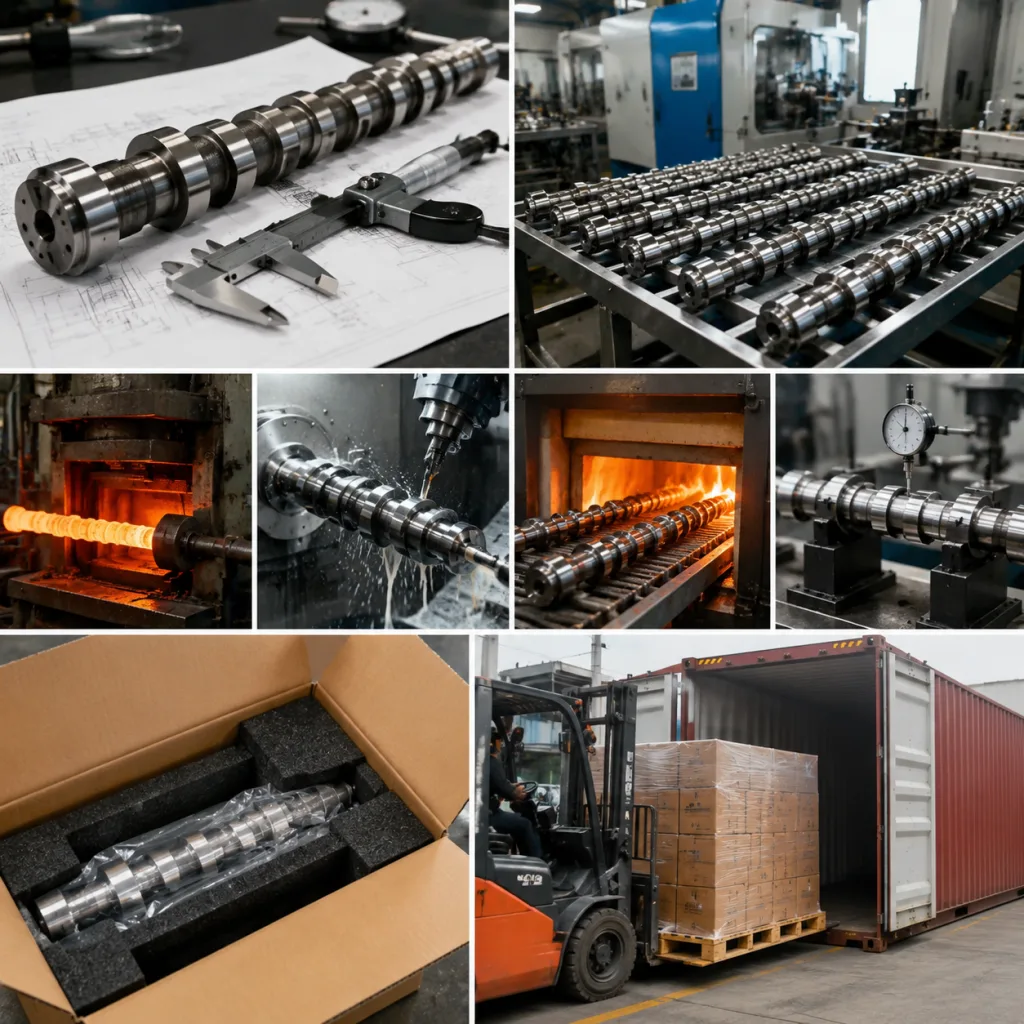
From Sample to Shipment: A Practical Validation Route

Validation should answer one question: will the camshaft perform as an OE-equivalent replacement under the agreed aftermarket specification? It should not imply vehicle manufacturer approval. It should prove that the part meets the dimensional, material, and durability targets agreed between buyer and supplier.

Driventus uses a validation approach built around sample inspection, metallurgy review, machining capability checks, and endurance-oriented tests where the customer programme requires them. Production is managed under IATF 16949:2016 and ISO 9001:2015 principles, including control plans, process audits, nonconformity handling, and corrective action procedures.

A typical new-SKU route is:

1. Confirm application data and target reference. 2. Review buyer sample, drawing, or OE-equivalent benchmark. 3. Measure critical features by 3D, CMM, profile bench, or dedicated fixtures. 4. Select material and process route. 5. Prepare tooling, fixtures, gauges, and inspection standards. 6. Produce pilot parts. 7. Validate heat treatment and machining stability. 8. Complete first article inspection. 9. Send approval samples to the buyer. 10. Confirm packaging. 11. Release controlled mass production.

Where the buyer requires PPAP-style evidence, Driventus can align the process flow, control plan, dimensional report, material report, inspection standard, packaging specification, and traceability format before the first bulk lot.

Validation items may include:

  • First article inspection against drawing, approved sample, or buyer specification
  • Chemical composition verification by casting or steel batch
  • Heat-treatment depth, hardness mapping, microstructure review, and retained furnace or induction records
  • Lobe profile measurement at defined angular increments, commonly every 1°, 2°, or 5° depending on report format
  • Journal diameter, roundness, cylindricity, and roughness inspection
  • Runout and straightness checks before release
  • Thrust face, end face, oil-feed hole, and groove measurement
  • Magnetic particle, visual, or other inspection for cracks, porosity, shrinkage, grinding burns, and casting defects
  • Cleaning and deburring verification for oil passages and machined holes
  • Packaging drop, corrosion protection, and preservation checks for export shipments
  • Lot traceability linking raw material, heat treatment, machining, surface treatment, final inspection, and carton labels

For regulated markets, documents may also need to support material compliance under REACH (EC) No 1907/2006. Vehicle emissions regulations such as ECE R-83 apply at vehicle level, but a replacement camshaft must not introduce dimensional deviations that disturb valve timing, combustion stability, or engine-management operation.

Approval format should be agreed before purchase. Existing controlled designs may allow sample development in about 30–45 days after sample or drawing confirmation. A new or modified camshaft requiring tooling, fixture build, and repeated validation may require 60–90 days before mass-production release.

From Sample to Shipment: A Practical Validation Route

Failure Modes: What Returned Camshafts Usually Reveal

Replacement demand often follows repeat workshop patterns. Importers and repair chains can use warranty reports, field returns, and service history to decide which SKUs deserve stock and which companion parts should be offered with them.

Typical failure modes include:

  • Lobe wear: Often linked to poor lubrication, contaminated oil, incorrect viscosity, long service intervals, or incompatible follower contact. Wear on the nose, ramp, or edge points to different root causes.
  • Journal scoring: Usually caused by oil starvation, abrasive debris, blocked passages, or bearing surface damage. One scored journal may indicate a localized oil-feed problem rather than a shaft-wide material issue.
  • Timing interface damage: Often follows timing chain, sprocket, actuator, or phaser failure. Dowel, slot, keyway, or bolt-face damage should trigger inspection of the mating part.
  • Runout or distortion: Can result from overheating, impact, improper storage, or severe engine failure. Long shafts need support during transport and warehousing.
  • Surface pitting or spalling: May indicate hardness problems, material defects, fatigue loading, or lubrication breakdown. Returned parts should be checked for hardness and microstructure before cause is assigned.
  • Sensor or trigger feature damage: Can create camshaft position signal errors, hard starting, drivability complaints, or diagnostic fault codes.
  • Oil-hole blockage or burrs: Can reduce lubrication to journals or followers and should be controlled in production and checked during installation.

A camshaft should rarely be treated as an isolated repair item. Workshops normally need to inspect followers, rocker arms, tappets, timing chains, guides, tensioners, oil control valves, camshaft sensors, and lubrication passages. If damaged mating parts remain in the engine, the new camshaft can fail even when it was manufactured correctly.

For distributors, the commercial lesson is to reduce avoidable returns. Position markings, clear carton labels, and application notes help prevent intake/exhaust mix-ups and wrong-variant selection. A stronger strategy is to map each camshaft SKU to recommended companion parts and warning notes, then use claim data to decide whether to stock single shafts, intake/exhaust pairs, or repair bundles for higher-volume Acura RDX engine applications.

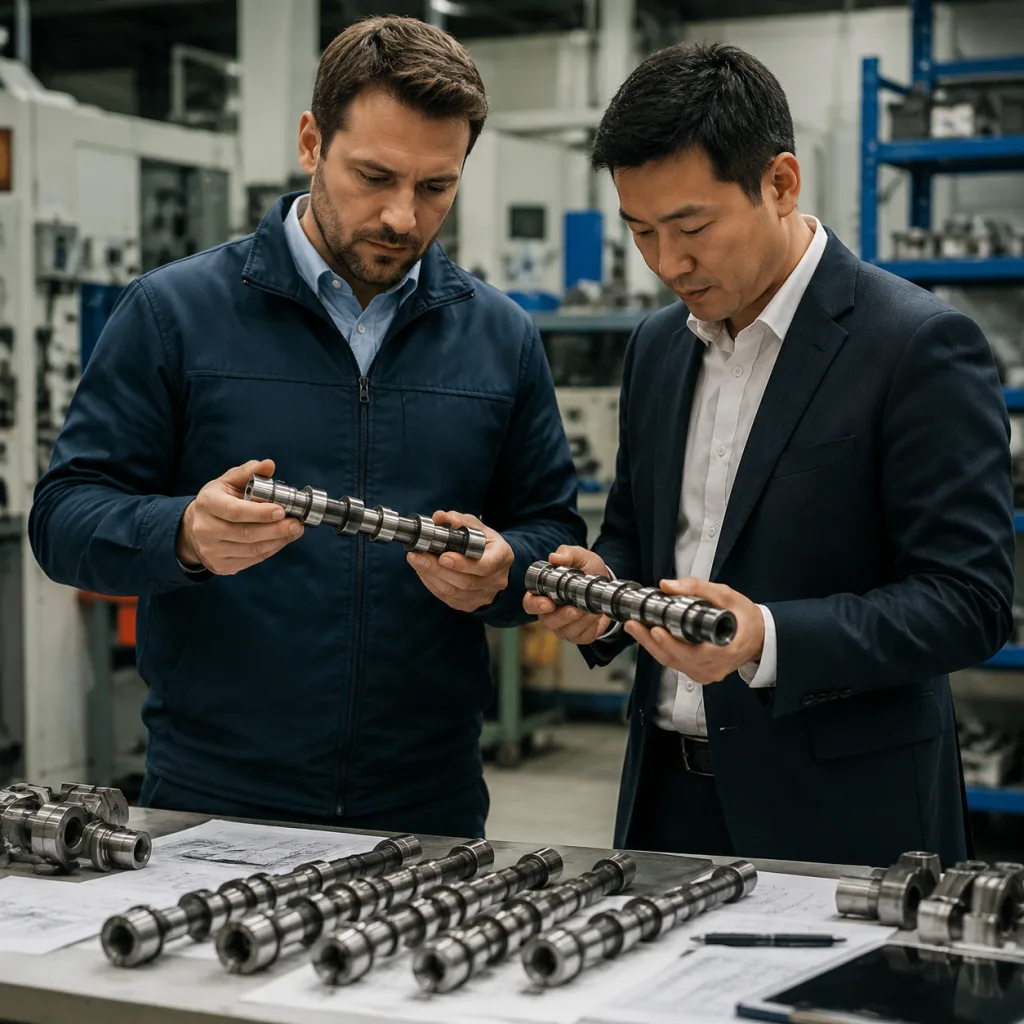
Importer Scenario: Comparing Two Suppliers Beyond Unit Price

Assume two suppliers quote the same camshaft for Acura RDX replacement. Supplier A is cheaper. Supplier B is slightly higher but provides application confirmation, dimensional reporting, batch coding, packaging control, and a defined claim process. The lower price only matters if the technical and supply risks are equivalent. Usually they are not.

A useful sourcing checklist compares evidence, not claims:

  • Application data confirmed by engine code, year range, position, and market
  • Intake/exhaust position or paired-set status clearly identified
  • Drawing, sample comparison report, or full dimensional report available
  • Control plan and inspection frequency defined for critical characteristics
  • IATF 16949:2016 and ISO 9001:2015 certification scope review through the supplier’s quality system
  • Packaging standard suitable for sea freight, air freight, warehouse storage, and workshop handling
  • Batch coding from raw material to shipment
  • Acceptance criteria for hardness, runout, lobe profile, journal finish, and surface defects
  • Corrosion protection method and shelf-life expectation, such as VCI bag, rust-preventive oil, sealed carton, or wooden case where required
  • Neutral packaging or customer packaging availability
  • MOQ, lead time, replenishment support, and forecast requirement
  • Carton labels, part numbers, and barcode formats aligned with the buyer’s system
  • Private-label or engineering-change process available through custom manufacturing

MOQ should be read as a programme cost, not just an order quantity. If tooling, gauges, and raw-material routes already exist, a lower MOQ may be possible. If a new Acura RDX camshaft for replacement requires tooling, fixtures, approval samples, artwork, or private-label cartons, the first order must usually absorb development and setup cost. As a planning reference, existing designs may support trial orders around 50–100 pcs for stock validation, while newly tooled or private-label production may require 200–500 pcs depending on complexity, material route, and packaging. Final MOQ must be confirmed by RFQ.

Lead time follows the same logic. Existing approved SKUs can move faster after deposit and packaging confirmation. New development needs time for measurement, tooling, heat-treatment trials, inspection reports, and approval samples. Buyers should separate sample lead time, mass-production lead time, and freight time.

For replenishment, a rolling 3-month forecast and agreed safety stock reduce emergency air shipments and price instability. For claims, define the evidence in advance: photos, batch code, carton label, vehicle application, engine code, installation date, failure mileage, oil condition, related parts replaced, and returned-part inspection results. This protects both sides by separating manufacturing issues from installation errors or pre-existing engine damage.

Importer Scenario: Comparing Two Suppliers Beyond Unit Price

Buyer Q&A: How Driventus Supports a Replacement Camshaft Programme

Who is Driventus?

Driventus is a vertically integrated Chinese manufacturer of engine and powertrain components, including pistons, crankshafts, gaskets, water pumps, turbochargers, and camshafts. Manufacturing is based in Taizhou, Zhejiang, with exports to more than 60 countries.

What can Driventus support for a camshaft for Acura RDX replacement programme?

Driventus can support standard aftermarket supply or engineered projects based on buyer samples, drawings, target specifications, and application lists. The process normally begins with application confirmation, OE-equivalent sample review, and dimensional benchmarking. After quotation, approval samples and inspection reports can be prepared before bulk production.

What does the project flow look like?

A typical flow is RFQ review, technical confirmation of material and process route, sample or drawing measurement, pilot production, first article inspection, buyer sample approval, packaging confirmation, mass production, final inspection, and shipment release. For repeat programmes, Driventus can maintain batch coding, retained inspection records, and stable carton label formats so each shipment can be linked to purchase orders, warehouse receipts, and later claim reviews.

What support is normally included?

  • Application and fitment confirmation before quotation
  • Sample, drawing, or benchmark review
  • Material and heat-treatment documentation where required
  • First article or pre-shipment inspection reporting
  • Neutral, Driventus, or customer-specified packaging options
  • Export documentation and batch traceability for distributor records
  • MOQ and lead-time planning based on existing tooling, new tooling, or private-label requirements
  • Consolidated shipment planning with related engine components where commercial quantities allow

What should buyers send for the fastest quotation?

Send the target application list, OE references used for cross-reference, photos or samples if available, expected annual demand, first order quantity, destination port, packaging requirements, certification or document requirements, and any tolerance or hardness specification already used in the purchasing standard.

Driventus is an independent aftermarket manufacturer. Brand names are referenced for fitment only. No statement in this article should be read as approval, endorsement, or supply authorization by any vehicle manufacturer.

Frequently asked questions

Confirm engine code, model year range, market version, intake or exhaust position, timing interface, lobe count, sensor features, oil-feed details and journal dimensions. Request a dimensional report, approved sample comparison or drawing-based inspection before bulk release.

Yes. Driventus can discuss neutral packaging, customer packaging and custom manufacturing requirements for qualified B2B programmes, subject to MOQ, technical review, application confirmation and agreed inspection criteria. MOQ depends on tooling status, package format and forecast volume.

No. Driventus is an independent aftermarket manufacturer; brand names are referenced for fitment identification only. Replacement parts are supplied to agreed aftermarket specifications, not as vehicle manufacturer-endorsed components.

For Acura RDX camshaft sourcing, sample validation or distributor pricing, send your application list, OE cross-references, target quantities, packaging needs and inspection requirements to [request a quote](/contact.html).

Request a Quote
Requirement Procurement check Typical validation method
Lobe lift and profileMatch OE-equivalent valve motion, base circle, and ramp design; define deviation from the master curveCMM, cam profile bench, or profile measurement at fixed angular increments
Angular positionMaintain correct valve timing between lobes and reference features; agree phase tolerance before tooling releaseRotary fixture, CMM, profile bench, or timing master comparison
Journal diameterMaintain oil clearance and bearing support; record all journals, not only end journalsMicrometer, air gauge, or CMM
Roundness and cylindricityAvoid uneven oil film and localized loadingCMM, roundness tester, or air gauge
RunoutReduce vibration, seal issues, and uneven bearing loadV-block and dial indicator, centre fixture, or CMM
Surface hardnessResist lobe and journal wear; define scale and test locationRockwell, Brinell, or microhardness test with hardness map
Surface roughnessSupport lubrication and bedding-in; define Ra/Rz by featureContact profilometer
Timing interfaceMatch sprocket, phaser, gear, or trigger location, including bolt thread, dowel, and end-face datumFixture inspection, thread gauge, CMM, and sample comparison
Oil-feed featuresConfirm hole, groove, and passage position; verify burr removalVisual check, pin gauge, borescope, and dimensional inspection
Material traceabilityLink raw material, casting, heat treatment, machining, and final lotMill certificate, casting record, furnace chart, and heat-treatment record