Turbo gasket kits fail in expensive places. The turbine side sees exhaust temperatures that can exceed 750–950°C. Oil feed and return joints handle hot lubricant. Water-cooled applications add glycol coolant, while the turbocharger, manifold, and exhaust system add vibration and thermal cycling. A small mismatch can become boost loss, oil seepage, exhaust blow-by, overheating, noise, installation delay, or a repeat warranty claim.
For importers, distributors, and repair-chain buyers, the question is not whether a kit looks acceptable in a catalogue photo. The question is how to verify turbo gasket kit quality in a way that can be repeated across suppliers, shipments, and private-label programmes. That requires a controlled BOM, material evidence by sealing position, dimensional inspection, process traceability, fitment testing, packaging checks, and a commercial comparison that explains MOQ, price, and lead time. Driventus is an independent aftermarket manufacturer; brand names are referenced for fitment only.
Decision point: what exactly is inside the kit?
Start by freezing the kit definition. Not the catalogue image. Not an informal parts list. A controlled bill of materials.
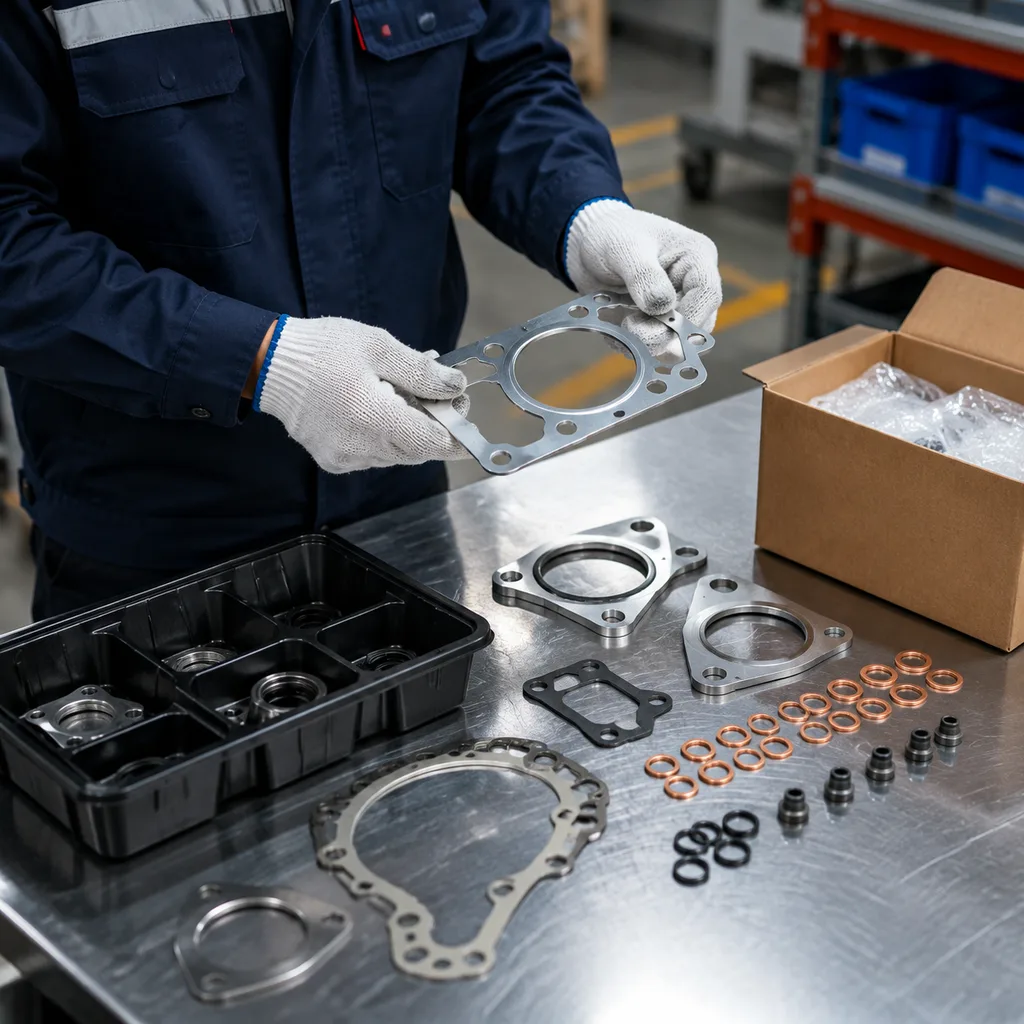
A turbo gasket kit may include turbine inlet and outlet gaskets, compressor-side O-rings, oil feed sealing washers, oil return gaskets, coolant sealing rings, studs, nuts, and sometimes actuator, EGR, or downpipe-related seals. Two kits can look almost identical and still differ in thickness by 0.10–0.30 mm, port shape, washer dimensions, elastomer compound, coating, or hardware count.
A useful BOM should specify:
Application range, engine code, turbo model, and production year range where available
OE part-number cross-reference format, such as OE 06A… or OE 11251… when applicable
Gasket position: turbine inlet, turbine outlet, oil feed, oil return, coolant, compressor, or accessory seal
Material and construction: MLS, graphite composite, embossed stainless steel, copper washer, FKM O-ring, EPDM seal where specified, or fibre gasket
Quantity per kit and any included studs, nuts, washers, clips, plugs, or instruction sheets
Nominal dimensions: thickness, port size, bolt-hole diameter, washer ID/OD, O-ring ID and cross-section
Drawing revision, approved sample date, inspection standard, and approved packaging version
Unit pack method, label format, barcode, carton quantity, and export carton specification
This decision removes a common sourcing trap: comparing two quotations for different products under the same commercial reference. A lower price may simply exclude sealing washers, mounting hardware, or accessory gaskets that installers expect to find in the box.
MOQ also becomes easier to interpret once the BOM is fixed. New references are usually constrained by tooling setup, stamping changeover, gasket sheet or coil minimums, elastomer moulding batches, and packaging print quantities. A supplier may accept 300–500 sets for a trial order if tooling already exists and neutral packing is used. Private-label printed boxes may require 1,000–3,000 sets or a mixed-SKU packaging MOQ.
Lead time follows the same logic. Existing-tool neutral-pack production may run 25–40 days after sample approval. New tooling, artwork, and first-article approval can push the first order to 45–75 days. If the kit is part of a private-label programme, lock the BOM before artwork, barcode assignment, and carton planning.
Spec deep-dive: match each material to heat, oil, coolant, and clamp load
A turbo gasket kit is not one material problem. It is several sealing problems packed into one box.
The turbine side needs heat resistance and stability through thermal cycling. Oil and coolant circuits need fluid compatibility, compression control, and ageing resistance. Hardware must survive installation torque and service temperature. A material that works in one position may be wrong in another.
Ask for material declarations or certificates by component, not only for the assembled kit. For export to the EU and UK, buyers commonly request restricted-substance declarations aligned with REACH (EC) No 1907/2006. For production control, supplier management should sit within a documented quality system such as IATF 16949:2016 and ISO 9001:2015.
Kit component
Common material
Practical specification to confirm
Typical risk if incorrect
Turbine inlet gasket
Embossed stainless steel or MLS
Stainless grade, layer count, thickness often 0.25–1.20 mm, emboss height, flatness
Exhaust blow-by, loss of clamp load
Turbine outlet gasket
Stainless steel, graphite composite, or MLS
Port alignment, coating condition, heat resistance above turbine outlet exposure
</tr></thead><tbody> </tbody></table>Reject vague wording such as “high quality steel” or “good rubber.” It is not evidence.
Elastomers need particular attention. FKM is often selected where oil and heat resistance matter. EPDM is common in coolant service but is generally not suitable for petroleum oil exposure. NBR may work in some air-side or moderate-temperature oil-side positions, but it should not be substituted for FKM in high-heat oil exposure without validation.
Useful approval data includes:
Elastomer Shore A hardness
Compression set after heat ageing
Tensile and elongation values
Fluid immersion results
Washer hardness and material certificate
Stainless steel grade and thickness
Coating thickness or adhesion where coatings are used
Copper washer annealing consistency where soft sealing is required
MLS or stamped gasket emboss height and coating condition
The key is position-based verification. Material approval must connect each part to the surface it seals, the fluid or gas it contacts, and the temperature range it will see.
Failure mode check: measure the features that actually cause leaks
Overall shape is only a first screen. Many bad gaskets look correct until they are bolted to a flange.
Small dimensional errors can shift flow paths, reduce sealing width, move a bead too close to a port edge, or interfere with clamping. On a turbine flange or oil feed joint, a 0.20 mm error may matter more than a 2.00 mm difference on a non-functional external tab.
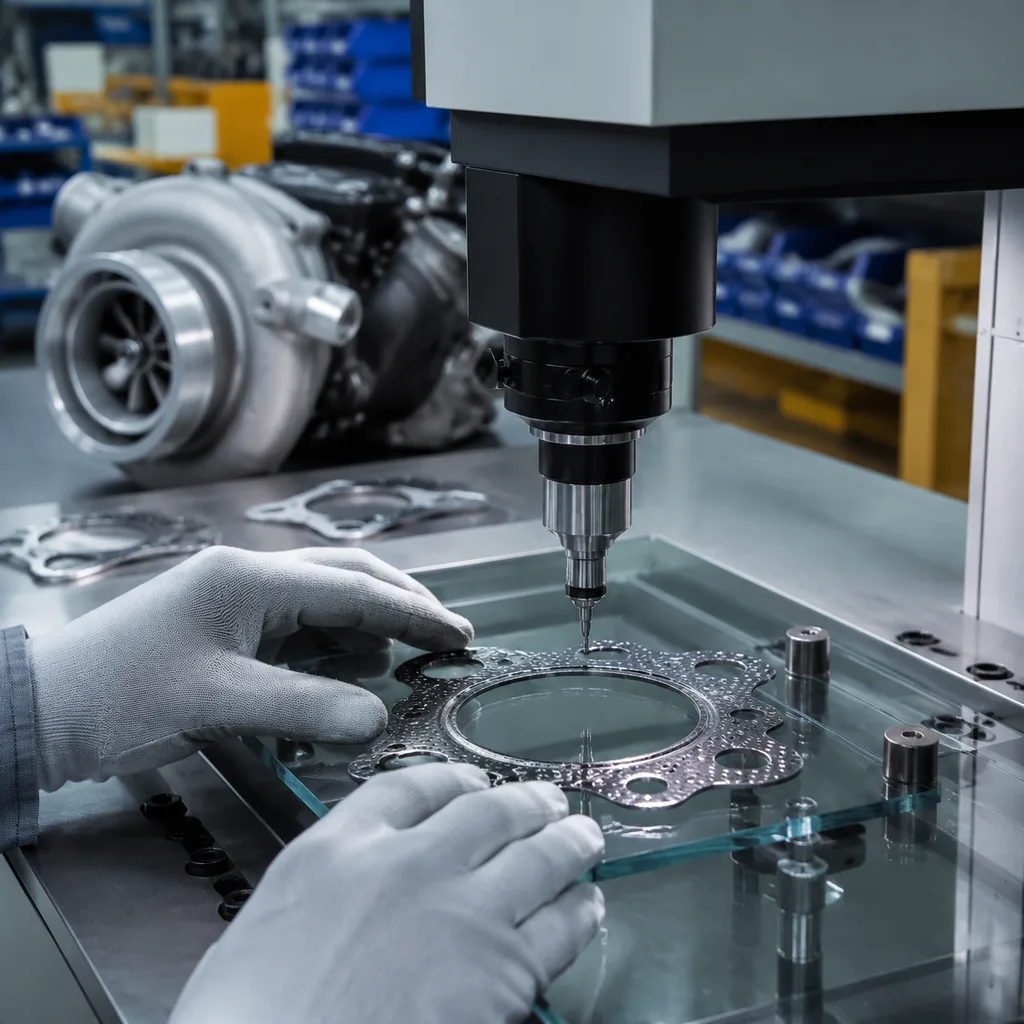
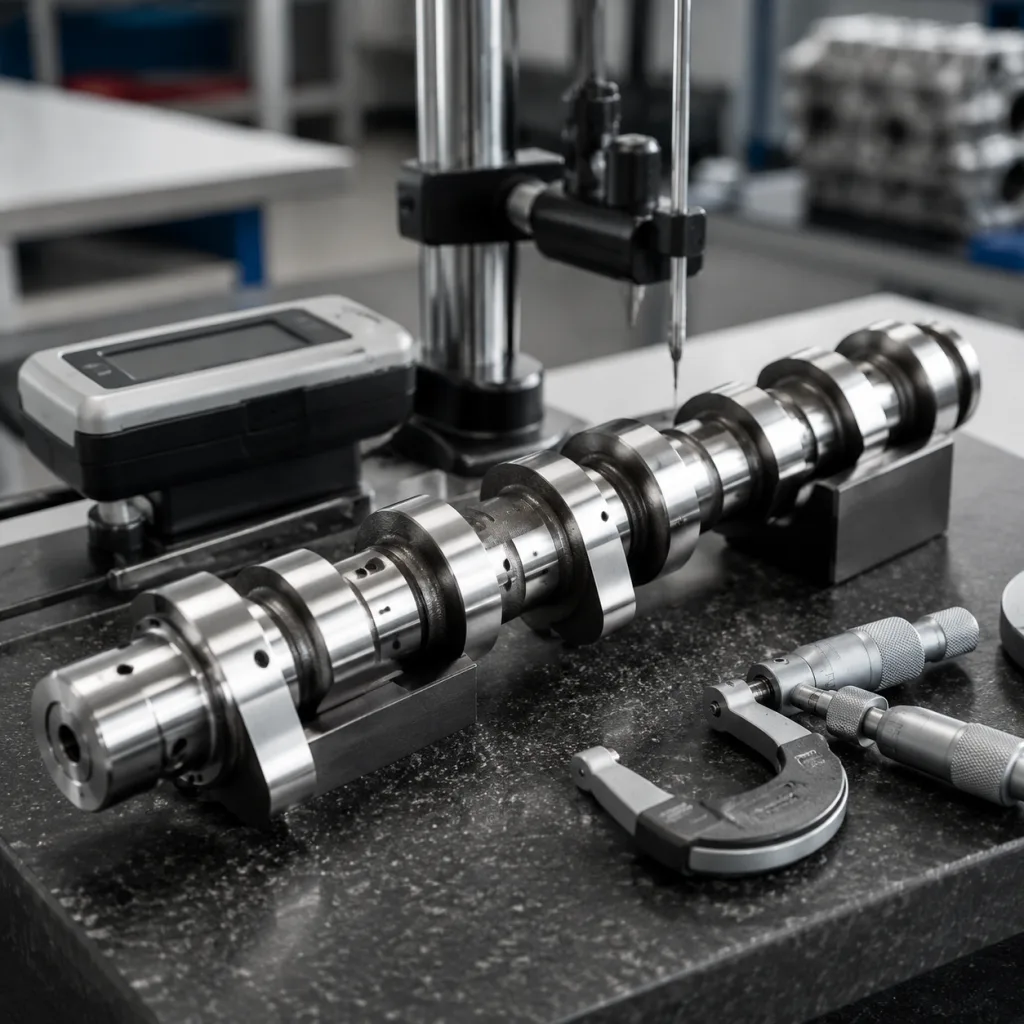
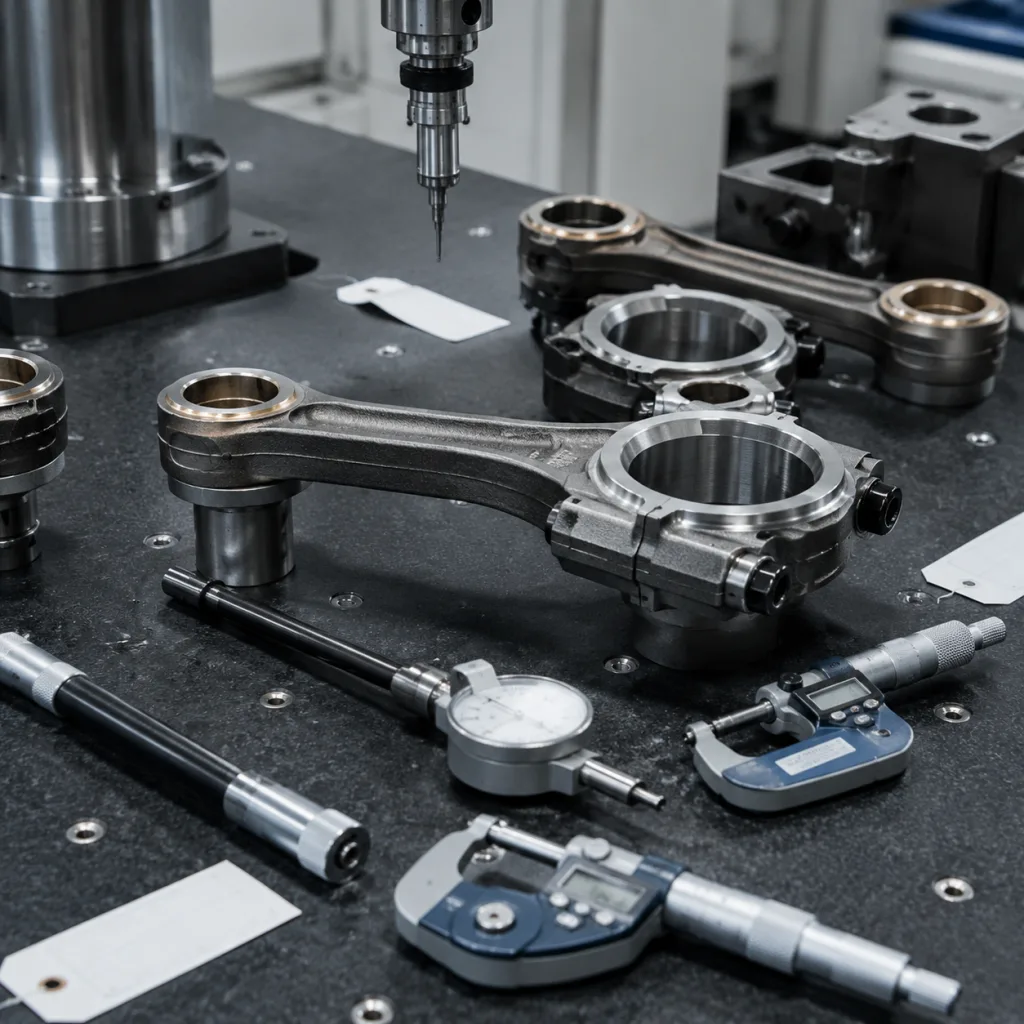
For first articles, many buyers inspect 5–10 complete kits per reference and record every critical feature. For routine incoming inspection, an AQL plan such as ISO 2859-1 may be used, with tighter acceptance for critical sealing dimensions than for cosmetic packaging issues. A flatbed scanner or profile overlay helps with outline comparison, but final approval should use the right tools: vernier callipers, micrometers, pin gauges, thread gauges, contour measurement, optical inspection, CMM, or dedicated fixtures.
Key dimensions to verify
Bolt-hole centre distance and hole diameter
Port opening width, height, radius, and location
Overall thickness and thickness variation across the sealing area
Emboss height on MLS or stamped stainless gaskets
Sealing bead position relative to the port edge and bolt holes
Flatness after stamping, coating, cleaning, or packing
Washer inner diameter, outer diameter, thickness, and burr condition
O-ring cross-section, inner diameter, surface finish, and elasticity
Stud length, thread pitch, thread engagement, and coating coverage
Clearance around locating features, tabs, and flange edges
Separate critical sealing features from low-risk outline features. If an OE drawing or customer drawing is available, use it. If no drawing exists, buyers can start from controlled sample-based targets such as:
Gasket thickness: ±0.05 mm for thin metal parts where function requires it
Bolt-hole diameter: ±0.10 mm
Bolt-hole centre distance: ±0.15 mm
Port profile: ±0.20 mm
Washer ID/OD: ±0.10 mm
Washer thickness: ±0.05 mm
O-ring cross-section: ±0.08 mm
Thread pitch for supplied studs or nuts: 100% gauge verification
These are not universal design limits. Adjust them by application, material, drawing requirement, and supplier process capability.
The inspection system matters as much as the tolerance. Callipers and micrometers should be calibrated. Gauges should be identified. Reports should show nominal value, tolerance, actual readings, sample size, inspector, date, and lot number.
Where no customer drawing exists, Driventus builds inspection plans from approved samples, fixture data, application fitment confirmation, and production capability checks. For buyers reviewing our catalog, dimensional matching should be confirmed against the intended engine and turbo family, not only against the commercial kit number or a cross-reference list.
Factory audit angle: can the supplier repeat the approved sample?
A good sample is not enough. The real purchasing risk is repeatability.
The factory must be able to maintain approved material, tooling condition, stamping accuracy, coating quality, cleaning level, and packing sequence across batches. Quality often drifts after tooling wear, raw-material substitution, operator change, or packaging line shortcuts.
Use these audit questions to test control, not sales confidence:
Is the factory certified to IATF 16949:2016 and ISO 9001:2015, and is the certificate scope relevant to engine, sealing, or powertrain components?
Are incoming raw materials inspected and recorded by heat, batch, coil, sheet, compound, or lot number?
Are stamping dies, cutting tools, moulds, and fixtures maintained on a documented schedule based on shot count, stroke count, or production hours?
Are first-piece, in-process, and last-piece inspections recorded for each production run?
Are coating thickness, adhesion, curing condition, and surface defects checked where coatings are used?
Are elastomer mixing, moulding, curing, trimming, and post-cure conditions recorded when rubber seals are included?
Are mixed parts prevented through line clearance, visual controls, weighing, barcode scanning, colour-coded bins, or batch separation?
Can each packed kit be traced back to production date, operator, inspection record, material batch, and packing log?
Is there a formal process for nonconforming material, corrective action, and customer complaint feedback?
A strong audit follows one recent lot from raw material receipt to finished carton. Confirm that the material certificate matches the coil or batch actually used. Check that first-piece inspection covers critical dimensions. Verify that in-process checks were done at a defined frequency, such as every 1–2 hours or every 500–1,000 pieces. Match the final packing record to the quantity shipped.
If a supplier cannot link a finished kit to component batches, quarantine and recall control will be weak.
Driventus manufactures engine and powertrain components in Taizhou, Zhejiang, with export supply to more than 60 countries. Our quality system is structured around IATF 16949:2016 and ISO 9001:2015 requirements, including documented inspection, nonconforming material control, corrective action, and batch traceability.
For distributors, traceability is financial protection. A lot-coded kit allows stock to be isolated by shipment, production date, or component batch instead of withdrawing every similar reference from inventory. It also gives repair networks clear instructions when a production lot needs inspection, replacement, or technical review.
Pre-release scenario: test the kit like an installer and shipper will handle it
A kit can pass material review and still fail in the field because it is hard to install, packed incorrectly, bent in transit, or contaminated before use.
For new sourcing projects, request pre-shipment samples made from production tooling and normal production materials. Prototype samples are useful during development, but they may not represent mass-production stamping, coating, cleaning, and packing conditions.
A procurement approval file should include sample inspection results, photographs, BOM confirmation, packing approval, fitment notes, and installation cautions.
Recommended pre-release checklist:
Confirm each gasket seats correctly on a reference turbocharger, manifold, oil line, coolant line, or flange
Check that bolt holes align without forcing, filing, or bending the part
Verify sealing width is not reduced by port mismatch or bead misplacement
Inspect embossed beads for crushing, scratches, corrosion, coating damage, or breaks
Check washers for burrs, dents, cracks, and inconsistent annealing colour where relevant
Confirm O-rings are free from cuts, mould flash, hardening, flattening, swelling, or contamination
Verify hardware threads with a gauge or mating nut and check coating coverage
Confirm kit contents against the BOM by two-person check, weighing method, barcode control, or packing fixture
Inspect bag sealing, label accuracy, barcode readability, country-of-origin marking, and carton strength
Conduct transit simulation, drop handling, or compression checks for export shipments when required
Fitment checks should use a real flange, master fixture, or approved reference turbocharger. Judging by eye is not enough. The gasket should drop over studs or bolts without side loading, and the sealing bead should remain fully supported by the mating face.
If the kit includes studs and nuts, verify thread pitch, free-running assembly, and basic torque suitability against the intended service procedure. If it includes O-rings, check installed compression and confirm that the seal does not twist, pinch, or extrude during assembly.
Packaging deserves the same discipline. Thin metal gaskets can bend during ocean freight. Elastomer seals can be damaged by oil, solvents, ozone, excessive heat, or direct sunlight. Loose hardware can scratch coated gaskets if the inner pack is not separated.
For export programmes, define bag thickness, desiccant use where needed, inner-card support for thin gaskets, hardware separation, carton burst strength, pallet height, and label durability. Typical checks include master carton drop testing, compression review for stacked pallets, barcode scan testing, and confirmation that the kit count remains correct after vibration or handling.
For high-volume distributor programmes, carton design should match warehouse handling, pallet pattern, shelf presentation, and private-label requirements. Where buyers need application-specific kit composition, labelling, barcoding, or private packaging, Driventus supports custom manufacturing for B2B programmes.
Comparison framework: score suppliers before the first large PO
Unit price is only one line in the decision. For turbo gasket kits, the cheaper supplier can become the expensive supplier if material control, fitment, traceability, or packing is weak.
Use a scorecard before supplier approval, then update it after trial orders, incoming inspection, and customer feedback.
Evaluation item
Weight
Evidence to request
Material conformity
20%
Material certificates, REACH declaration, coating data, elastomer compound confirmation
Dimensional capability
20%
Inspection report, gauge list, sample measurements, tolerance plan
MOQ, lead time, shipment record, documentation speed, aftersales response
</tr></thead><tbody> </tbody></table>For commercial execution, compare suppliers using identical assumptions. Confirm whether the quotation covers complete kits or partial kits, neutral packing or private label, existing tooling or new tooling, EXW/FOB/CIF terms, standard cartons or custom cartons, and whether inspection reports are included.
MOQ should be tied to a real constraint: raw material minimum, tooling setup, packaging print run, or production scheduling. If the MOQ is high, negotiate a mixed-reference order, neutral-pack first shipment, shared packaging platform, or staged release after sample approval.
Price differences should be explainable. MLS or embossed stainless gaskets, FKM seals, heat-resistant hardware, controlled coating, and separated inner packaging usually cost more than basic fibre parts and bulk-packed hardware. A very low quote should trigger direct questions about steel grade, thickness, rubber compound, omitted washers, coating shortcuts, inspection frequency, and warranty handling.
Lead time should be broken into stages:
Sample lead time
Tooling lead time, if required
Mass-production time
Packaging artwork approval
Pre-shipment inspection window
Sailing or airfreight schedule
For a new supplier, do not place the first production order solely on catalogue images or quoted cross-references. Ask for production samples, measure the components, review process documents, and confirm how the factory handles nonconforming material. A supplier that can explain its inspection method, show batch records, and respond clearly to technical questions usually presents lower long-term risk than one that only repeats broad quality claims.
Driventus is an independent aftermarket manufacturer; brand names are referenced for fitment only. For buyers building a multi-reference turbo programme, the same verification method can be applied across gasket kits, mounting kits, and related engine components.
Frequently asked questions
Start with kit content, material type, and critical dimensions. Confirm the BOM, inspect bolt holes and port geometry, and compare production samples against an approved reference. Then review certificates, batch traceability, fitment checks, and packing controls before order release.
Request material certificates, inspection reports, REACH (EC) No 1907/2006 declaration where applicable, IATF 16949:2016 or ISO 9001:2015 certificate, packing specification, and lot traceability records. For custom or private-label programmes, also request a control plan, approved sample report, and packaging approval record.
Yes, but only when gasket geometry, material, thickness, sealing bead position, and hardware match the relevant turbocharger and engine interfaces. Cross-reference lists should be verified by sample measurement and fitment checks, not by commercial part number alone.
If you are qualifying a turbo gasket kit supplier or building a private-label programme, Driventus can review drawings, samples, kit content, inspection requirements, MOQ, lead time, and packaging specifications. To discuss documentation and quotation details, [request a quote](/contact.html)