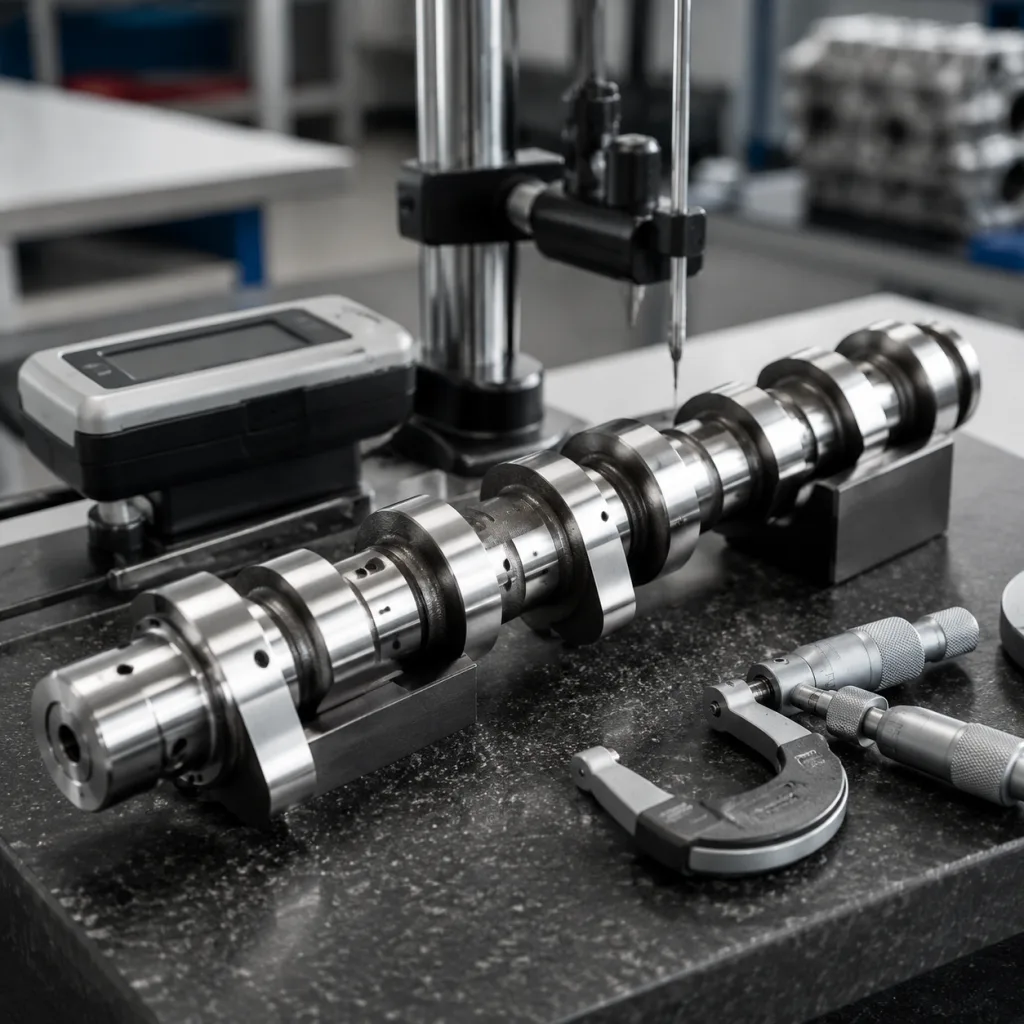
Connecting Rod for Honda Accord Aftermarket Replacement
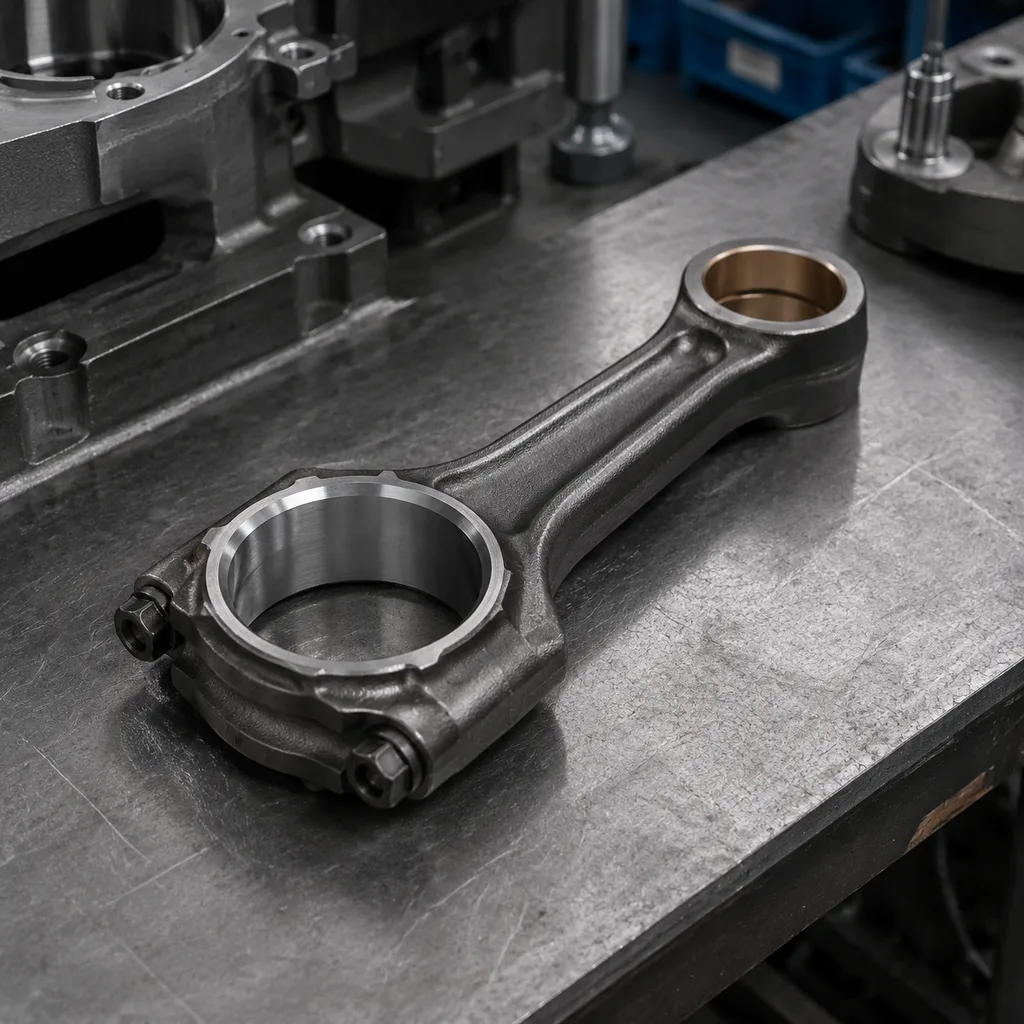
A connecting rod for Honda Accord aftermarket replacement is not a “model-name” purchase. It is an engine-code, bore-geometry, bolt-clamp, and bearing-interface purchase. Two rods can look interchangeable on a catalogue page and still differ enough to create bearing wipe, pin noise, low oil pressure, vibration, or early fatigue failure.
For B2B buyers, the useful question is simple: what must be locked before price is compared? Start with centre-to-centre length, big-end housing bore, small-end pin or bush bore, rod widths, cap location, bolt specification, mass range, and traceability. Then connect those requirements to MOQ, lead time, validation cost, and packaging. A stock OE-equivalent rod with standard inspection is one programme. A private-label, weight-matched, fatigue-validated set is another.
As a working baseline, critical dimensions are often controlled in the 0.005–0.025 mm range depending on the feature, engine family, drawing, and inspection method. Big-end roundness, taper, bolt tightening condition, surface finish, and set weight spread should be written into the control plan, not handled as assumptions.
This guide explains how Driventus approaches OE-equivalent aftermarket connecting rod supply for Honda Accord applications. It is written for importers, distributors, repair-chain buyers, and technical sourcing teams. It covers application identification, dimensional verification, materials, forging and heat treatment, validation, packaging, MOQ and lead-time planning, and buyer-side controls. Driventus is an independent aftermarket manufacturer; Honda and other brand names are referenced only to identify vehicle fitment.
Start With the Engine Code, Not the Accord Badge
The Accord name covers many petrol and hybrid engine families across global markets, including F-series, H-series, K-series, J-series, and later market-specific variants. The same broad description—such as “Accord 2.4” or “Accord 3.0”—can hide different crankpin diameters, piston pin sizes, rod lengths, bearing widths, cap designs, and bolt specifications.
That is the first sourcing failure mode. Buyers quote by vehicle name. Suppliers match to a broad catalogue line. The sample installs. Then field problems appear because the bearing crush, side clearance, or pin fit is wrong for that engine variant.
A safer RFQ identifies the rod by engine code, displacement, model year range, destination market, crankpin diameter, piston pin diameter, bearing shell style, rod width, and bolt specification. Cross-reference numbers can help with search and inventory planning, but they should not replace dimensional confirmation before a production order.
A practical RFQ should include at least one of these inputs:
OE sample
Approved aftermarket sample
Buyer drawing
Critical-dimension sheet
Controlled interchange file with engine-code detail
Minimum fitment data to collect before quotation:
Item
Buyer should provide or approve
Why it affects supply
Engine code and displacement
Exact code, market, year range
Prevents mixing similar Accord applications
Centre-to-centre length
Nominal value and tolerance, often controlled within ±0.02 mm or tighter by drawing
Controls piston deck position and compression relationship
Big-end housing bore
Bore diameter after bolts are tightened to spec
Determines bearing crush and oil clearance
Small-end bore or bush bore
Pin diameter, floating/press-fit condition, bush material if used
Controls piston pin clearance and noise
Big-end width
Nominal width and side-clearance target
Affects crankshaft side clearance
Bolt specification
Thread, under-head length, shank diameter, grade, torque or torque-angle method
Determines clamp load and bore stability
Set requirement
Single rod, 4-cylinder set, 6-cylinder set, weight-matched set
Affects balancing, packing, price, and inspection time
</tr></thead><tbody> </tbody></table>Driventus reviews application data and customer samples where available. Fitment references may include generic OE-style identifiers supplied by the buyer, but we do not claim vehicle manufacturer approval, endorsement, or supply through the original vehicle maker.
Before issuing a purchase order, procurement teams should confirm:
Engine code, displacement, market, and model year
Big-end housing bore, bearing width, and bearing locating feature
Small-end bore diameter, pin fit, and bush material where applicable
Centre distance between crankpin and piston pin axes
Rod and cap joint type: cracked cap, machined split line, dowel location, or serrated face
Bolt thread, grade, shank diameter, tightening method, and replacement requirement
Big-end and small-end width for side clearance and piston guidance
Per-cylinder mass matching requirement for single repairs or complete engine sets
Failure Modes That Point Back to Dimensional Control
A connecting rod lives through alternating tensile and compressive loads while holding the bearing and piston pin in alignment. That is why a rod can be “close enough” on a bench and still unsafe in an engine. The critical issue is not only nominal size. It is geometry after forging, heat treatment, cap machining, bolt installation, boring, honing, cleaning, and final tightening.
The most common symptoms have traceable causes:
Bearing wipe can point to big-end bore distortion, poor roundness, incorrect housing bore, or wrong bearing crush.
Low oil pressure can follow excessive bearing clearance or bore instability.
Piston slap or pin noise can come from small-end bore error, bush movement, or poor surface finish.
Vibration can result from loose mass grouping or end-balance variation.
Cap fretting can indicate weak clamp load, joint-face inconsistency, or cap/rod mismatch.
Early fatigue failure can relate to material, heat treatment, surface defects, machining marks, or bolt performance.
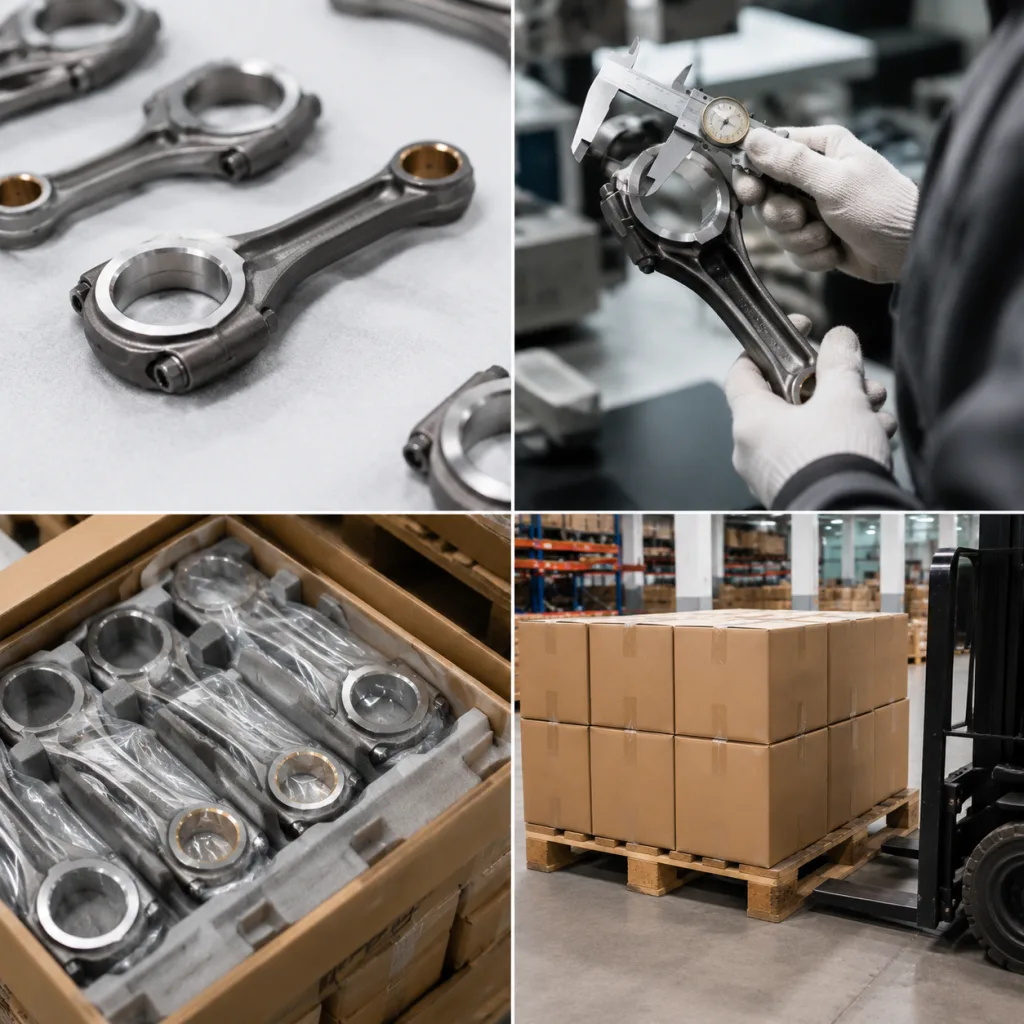
Typical inspection points are shown below. Final values depend on engine family, buyer drawing, approved sample, and agreed tolerance plan. Buyers should ask for numeric limits, not a vague “standard tolerance” statement.
Control point
Typical control target for OE-equivalent aftermarket supply
Typical inspection method
Centre-to-centre length
Commonly ±0.015–0.025 mm, or per drawing
CMM or dedicated rod gauge
Big-end housing bore
Commonly ±0.005–0.012 mm after specified bolt tightening
Air gauge, 3-point bore gauge, roundness check
Big-end bore roundness/taper
Often ≤0.005–0.010 mm depending on diameter and bearing design
Air gauge, form tester, bore map at 0°/90°
Small-end bore
Commonly ±0.006–0.015 mm depending on pin and bush design
Plug gauge, bore gauge, surface finish check
Small-end bush interference
Typically controlled by drawing; retention/push-out test if required
OD/ID measurement and press-fit verification
Big-end width
Commonly ±0.02–0.05 mm
Micrometer and parallelism check
Rod twist and bend
Commonly controlled within 0.03–0.05 mm per 100 mm, or per fixture standard
Rod alignment fixture
Cap joint alignment
No visible step; bore verified after full torque
Assembly gauge and bore verification
Weight grouping
Typical set spread 2–5 g total mass; tighter by request
Precision scale and end-to-end balance check
Surface finish
Bearing bore commonly Ra 0.2–0.4 µm; pin bore per drawing
Roughness tester
</tr></thead><tbody> </tbody></table>Big-end bore inspection deserves special treatment. A single diameter reading is not enough. The supplier should define the torque condition used during measurement: new bolts, agreed torque or torque-plus-angle sequence, and specified lubricant condition if clamp load is sensitive. Roundness, cylindricity, taper, and surface finish must remain stable under that condition.
Small-end geometry is equally important. Incorrect clearance can create cold-start rattle, pin/bush wear, or piston skirt loading. If the design uses a bronze bush, both bore finish and bush retention matter.
Driventus normally treats the following as critical-to-quality characteristics: big-end housing bore, roundness, centre distance, small-end bore, rod width, bolt thread quality, cap/rod pairing, and mass group. These are checked at first article, after tool change, during in-process sampling, and at final inspection. For higher-risk programmes, big-end bore, thread, cap matching, and marking can be set as 100% checks while non-critical features follow the agreed AQL plan.
For private-label programmes, Driventus can define tolerance bands by customer drawing, approved sample reverse engineering, or an agreed control plan. Typical production control includes first-article inspection, in-process bore checks, final dimensional reports, batch traceability, and retention of inspection records. The process is managed under our quality system, aligned with IATF 16949:2016 and ISO 9001:2015.
Material and Process Choices: What Changes, What Must Not
Material selection is not a cosmetic choice. Replacement connecting rods for Accord-type passenger car engines may use forged steel, powder metal, or, in some older designs, cast steel. The correct route depends on the OE-style design, loading, cap construction, cost target, and buyer specification.
Driventus does not substitute material classes without buyer agreement. Density, grain flow, fatigue strength, machinability, fracture-split behaviour, and clamp stability can all change when the material or process changes.
Common procurement specification items include:
Material grade or equivalent mechanical property range, such as C70S6, 40Cr, 42CrMo, 35CrMo, powder-forged steel, or the buyer’s specified equivalent where applicable
Forged, powder metal, cast, or machined construction as required by the application
Heat treatment process, hardness range, and case or core requirements where applicable
Shot peening requirement for fatigue resistance, including intensity and coverage if specified
Surface finish requirement at parting faces, bearing bore, and pin bore
Bush material and interference fit if the small end uses a bronze bush
Rod bolt material, proof load, tightening specification, and replacement policy
Marking, lot identification, and anti-mixing controls for caps and rods
For forged steel rods, controlled grain flow around the big end and small end can improve fatigue resistance compared with an uncontrolled machined blank. A typical route is billet cutting, heating, multi-stage forging, trimming, normalising or quenching and tempering where required, shot blasting, rough machining, cap separation or split machining, bolt installation, finish boring and honing, small-end boring or bushing, washing, rust prevention, and final inspection.
Several process windows can move the final part out of control: forging temperature, die wear, heat-treatment lot variation, machining tool life, honing condition, and bolt tightening method. A good quotation should make clear which of these are controlled and recorded.
Cap design also changes the control plan. For cracked-cap rods, the fracture surface is the alignment system. Caps must not be mixed, polished smooth, or interchanged. For machined split rods, dowels, serrations, or joint-face condition control repeatable cap location during bearing installation. Driventus uses cap/rod identification, fixture controls, and anti-mixing procedures where the design requires matched parts.
Heat treatment must match the material and target properties. Excessive hardness can increase brittleness. Insufficient hardness or poor microstructure can reduce fatigue life. Buyers should ask for hardness checks by heat-treatment lot, heat or batch identification, and metallurgical evidence when order volume or warranty exposure justifies it. Depending on material and drawing, typical hardness targets may fall around 22–35 HRC, but the approved specification overrides any generic catalogue value.
Rod bolts need a separate line in the RFQ. A rod can pass dimensional inspection and still fail if the bolt loses clamp load, has poor thread rolling, or is tightened by the wrong method. Specify whether bolts are included, reusable or torque-to-yield, pre-installed or packed separately, the lubricant condition, and whether proof-load or clamp-load verification is required.
Environmental and substance compliance can also be part of the buyer file. When requested, material declarations can be prepared for REACH (EC) No 1907/2006 and other market access requirements, subject to the agreed documentation scope.
Build a Validation Package Around the Buyer’s Risk
Not every order needs the same validation file. A catalogue replenishment with an approved history may need dimensional reporting and material confirmation. A new private-label programme may need sample approval, fatigue evidence, packaging review, and tighter launch inspection. The mistake is treating both cases the same.
A dimensional match is necessary, but it does not prove durability for a rotating engine component. Driventus defines validation according to the application, order volume, customer risk level, and available reference data. The package may include laboratory testing, process capability review, sample engine-fit verification, and production inspection reporting.
A practical validation package can include:
Chemical composition verification by heat or batch using spectrometer or mill certificate cross-check
Hardness testing after heat treatment, with recorded test locations and lot numbers
Metallographic inspection for grain structure, inclusions, decarburisation, and heat-treatment condition
Magnetic particle inspection for surface cracks, where specified, especially after forging and cap processing
Big-end bore roundness and cylindricity after bolt tightening to the agreed torque or torque-angle process
Small-end bore size, bush retention, pin clearance, and surface finish checks
Bolt proof-load, clamp-load, thread gauge, or torque-angle verification
Fatigue testing on selected development samples, with load level and cycle target agreed before testing
Coating, oiling, and corrosion-prevention checks for stocked parts
Salt spray testing for coated or packed parts when required by the buyer, commonly 24–96 hours depending on the packaging target
Packaging drop, carton strength, pallet stability, and export corrosion-prevention review
Mass consistency should not be left until complaints arrive. A single replacement rod must be compatible with the remaining rods in the engine within the customer’s service tolerance. A complete 4-cylinder or 6-cylinder set should be weight-grouped or end-balanced to reduce vibration risk. Typical aftermarket commercial limits are 2–5 g total rod mass spread within a set. Premium programmes can request tighter big-end and small-end end-balance limits, but that adds inspection and sorting cost.
For launch approval, buyers can request a PPAP-style file or a simpler aftermarket approval pack. A practical file may include drawing/specification confirmation, material certificate, heat-treatment report, first-article inspection report, capability data for critical bores, photos of markings and packaging, and a retained golden sample. For ongoing lots, documentation can be scaled down to material lot, inspection summary, and packing list traceability unless the buyer requires full shipment-by-shipment reporting.
Field-return data can make validation more precise. Bearing wipe may point to big-end bore distortion or oil-clearance issues. Cap fretting may point to clamp load or joint-face repeatability. Pin-end noise may point to small-end clearance, bush retention, or surface finish. Driventus can compare those symptoms against inspection results before changing the drawing, material, bolt, or machining route.
For private drawings, special markings, or non-standard rod bolts, see our custom manufacturing capability.
A Distributor’s Buying Framework: Price, MOQ, Lead Time, and Control
Procurement teams usually compare unit price and lead time first. For a connecting rod, that is too narrow. The better comparison is total sourcing risk: application clarity, bore control, bolt consistency, batch traceability, packaging discipline, documentation level, and claim-handling evidence.
Use this buying framework before comparing supplier prices:
1. Confirm application data by engine code, market, and model year, not only by vehicle model. 2. Request a marked drawing, approved sample report, or critical-dimension report before mass order. 3. Define whether rods are sold individually, in repair quantities, or as weight-matched 4-cylinder or 6-cylinder engine sets. 4. Specify whether rod bolts are included, pre-installed, torqued for inspection only, or packed separately. 5. Agree preservation oil, VCI bag or paper, carton strength, pallet labelling, and warehouse shelf-life expectations. Normal sealed export packaging is often planned around 6–12 months of storage. 6. Require batch traceability from steel heat or material lot to final inspection lot. 7. Define AQL or 100% inspection points for critical bores, threads, joint faces, cap matching, and markings. 8. Confirm claim-handling evidence requirements before first shipment, including photos, measurements, engine data, oil/bearing condition, mileage, and returned samples where possible. 9. Control catalogue descriptions and interchange references to avoid mixing similar engine variants. 10. Lock the change-control rule: no material, bolt, heat-treatment, machining, or packaging change without buyer notice and approval for controlled programmes.
MOQ follows the process, not a generic number. For existing catalogue items, MOQ is usually driven by current stock, packaging format, and whether the buyer accepts standard inspection documents. For private-label or controlled-specification orders, MOQ is driven by forging batch size, heat-treatment lot size, machining setup, printed packaging, and sorting requirements.
As a practical B2B planning guide, small stock replenishment may start from mixed-carton quantities if inventory is available. Private-label production is commonly planned around 100–300 pieces per part number. New tooling or special forging routes may require 500–1,000+ pieces or an agreed tooling contribution. Exact MOQ is confirmed after application review.
Price should be broken down by specification. Unit cost is affected by material route, rod bolt specification, bush requirement, bore tolerance, 100% inspection, set balancing, validation tests, documentation level, and packaging. A standard individually packed rod with routine inspection will not price the same as a weight-matched set with full dimensional reports and branded cartons.
To avoid unrealistic quotations, buyers should separate:
Target annual volume
First-order quantity
Required documentation
Packaging type
Destination market
Warranty or claim expectations
Stocked item versus new production
For importers serving the EU, UK, US, Canada, Australia, Brazil, and other repair markets, documentation should be consistent across shipments. Driventus exports engine and powertrain components to 60+ countries from Taizhou, Zhejiang, and can support distributor packaging, neutral cartons, or buyer-specified labels where legally permitted.
A connecting rod for Honda Accord aftermarket replacement should be purchased with a control plan, not only a catalogue description. Clear sourcing requirements reduce fitment disputes, warranty exposure, warehouse stock segregation problems, and the risk of mixing visually similar parts across multiple applications.
What Happens After You Send Driventus an RFQ?
A useful RFQ does not need to be long. It needs to be specific. Engine code, model year range, sample or drawing status, destination market, expected annual volume, first-order quantity, packaging preference, and required inspection documents are enough to start a technical review.
Driventus manufactures engine and powertrain components including pistons, crankshafts, gaskets, water pumps, turbochargers, and connecting rods. For Honda Accord replacement applications, our role is to supply parts that match the agreed aftermarket specification, application scope, and inspection requirements. We do not state or imply approval by Honda or any vehicle manufacturer.
A typical project flow is:
Buyer provides the application list, engine code, sample, drawing, or target interchange data
Engineering team reviews dimensions, material, process route, tooling status, and validation needs
Quotation is built around existing stock or production route, MOQ, inspection level, packaging, and target shipment terms
Sample parts are produced or selected from existing production for approval
First-article inspection report is issued for critical dimensions and agreed characteristics
Buyer confirms packaging, marking, order quantity, shipment schedule, and documentation format
Mass production follows the approved control plan, traceability method, and inspection record format
In-process checks cover forging/heat-treatment lot, cap pairing, bolt condition, bore machining, cleaning, and anti-rust treatment
Final packing and export checks are completed according to the agreed delivery terms
Lead time depends on the sourcing model. If established catalogue parts are in stock and standard cartons are accepted, shipment preparation can often be planned in 7–15 days after order confirmation and payment/document approval. For normal production without new tooling, buyers should usually plan 30–60 days depending on batch size and machining capacity. For new tooling, revised specifications, special bolts, or validation testing, the timeline should include tooling, sample production, buyer approval, and testing. A 60–120 day planning range is more realistic before stable mass supply.
Driventus can support several sourcing models:
Standard aftermarket catalogue supply
Neutral-pack distributor supply
Buyer-labelled programmes where legally permitted
Controlled private specification with agreed drawings and inspection reports
For each model, the buyer should state destination market, annual demand, first-order quantity, service or warranty expectation, packaging preference, and required certificates or reports.
Procurement teams can request a quote with engine code, model year range, target annual volume, first-order quantity, sample or drawing status, destination market, packaging preference, and any required test documents. The more complete the technical file, the faster Driventus can confirm fitment risk, MOQ, price level, and lead time.
Driventus is an independent aftermarket manufacturer; brand names are referenced for fitment only.
Frequently asked questions
Specify engine code, displacement, market, model year range, big-end housing bore, small-end bore or bush bore, centre-to-centre length, big-end and small-end width, bolt details, bearing style, cap design, and whether the part is supplied individually or as a weight-matched set. If available, provide a sample or drawing for verification.
For stocked catalogue rods, small replenishment quantities may be possible and shipment preparation can often be planned in 7–15 days. Private-label or controlled-specification production is commonly planned around 100–300 pieces per part number, while new tooling or special forging routes may require 500–1,000+ pieces or tooling support. Normal production lead time is often 30–60 days; new tooling or validation programmes may require 60–120 days.
Yes. Driventus can support neutral or buyer-specified packaging, application mapping, and agreed markings where legally permitted. Private-label supply should include approved drawings, inspection criteria, packaging specifications, documentation needs, traceability requirements, MOQ agreement, and change-control rules.
No. Driventus is an independent aftermarket manufacturer; brand names are referenced for fitment only. Parts are produced to the agreed aftermarket specification and quality controls, not under vehicle manufacturer endorsement.
If you are comparing a connecting rod for Honda Accord aftermarket replacement, send the engine code, sample or drawing, destination market, first-order quantity, target annual volume, packaging preference, and required inspection documents for review. Start a technical sourcing discussion at /contact.html