camshaft · 2026-06-19

Camshaft for Mini Countryman OE Equivalent Sourcing

Sourcing a camshaft for Mini Countryman OE equivalent programs is where catalogue data, machining discipline, and warranty economics meet. A shaft can look right and still be wrong: a trigger edge shifted by a fraction of a degree, a journal ground outside the cap’s oil-film range, or an intake/exhaust mix-up can turn a low-cost purchase into labour claims and returns.

For importers, repair-chain buyers, and aftermarket distributors, the starting point is not the vehicle name alone. Confirm the engine code, build range, position, VIN-derived application data where available, and OE reference format before discussing price. Then define the commercial boundary: annual forecast, MOQ by part number, EXW or FOB target, first-article documentation, repeat-order lead time, packaging, and private-label requirements.

Driventus manufactures camshafts for aftermarket and private-label programs in Taizhou, Zhejiang, with IATF 16949:2016 and ISO 9001:2015 aligned process controls. Driventus is an independent aftermarket manufacturer; brand names are referenced for fitment only. The sections below show how to judge OE-equivalence, where sourcing programs fail, and what to lock down before releasing volume orders.

Decision framework: what counts as OE-equivalent, and what does not

OE-equivalent means functional interchangeability with the original application. It does not mean vehicle manufacturer approval, endorsement, or permission to use protected brand claims. For a Mini Countryman replacement camshaft, the practical question is simple: can the installer fit the part using normal procedures, with no machining, calibration change, or workaround?

The answer depends on the exact application. Countryman variants can differ by engine family, emissions calibration, production range, and market. Intake and exhaust shafts may also differ in ways that are not obvious from photos: phaser interface, sensor trigger pattern, thrust location, oil gallery design, lobe profile, and locating datum.

Use this decision sequence before treating any part as interchangeable:

1. Confirm the application boundary. Match engine code, production years, position, and OE-style reference where available. 2. Separate intake from exhaust. Do not assume a mirrored or visually similar shaft shares the same timing relationship. 3. Define one part number as one controlled geometry. Avoid grouping “similar” shafts unless the drawing and fitment data prove it. 4. Check the timing system interfaces. VVT phaser, sprocket, sensor trigger, keyway, locating pin, seal land, threaded end, and oil feed must match. 5. Validate the wear system. Material, lobe hardness, journal finish, and surface treatment must suit the follower design and lubrication conditions. 6. Agree the traceability level. A bulk aftermarket program should link raw material heat number, machining lot, heat-treatment lot, inspection record, and carton label.

Core OE-equivalence criteria normally include overall length, journal diameters, thrust face location, cam lobe lift, base circle, opening and closing angle, sensor trigger edge position, VVT interface geometry, surface roughness, hardness range, and batch identification. Program limits are set by drawing and application risk; for example, lift may be controlled around ±0.02 mm and phasing around ±0.5° where the engine requires tight timing control.

Where a buyer supplies an OE cross-reference, catalogue number, or sample, Driventus reviews the dimensional and functional requirements before quoting. Application data can also be checked through our catalog, including related parts in engine components.

Failure modes: small measurement errors that become expensive returns

Most camshaft sourcing problems do not start with a visibly broken part. They start with a shaft that passes a casual visual check but fails in the engine. A tight journal causes oil-film problems. A trigger wheel edge is slightly off. A lobe profile is close enough to look correct, but not close enough for stable valve timing.

For repair chains, these defects become labour claims. For distributors, they become catalogue disputes, technical calls, and inventory quarantine. The prevention method is not complicated: drawing-based control, first-article approval, and batch inspection on the characteristics that actually affect fit and function.

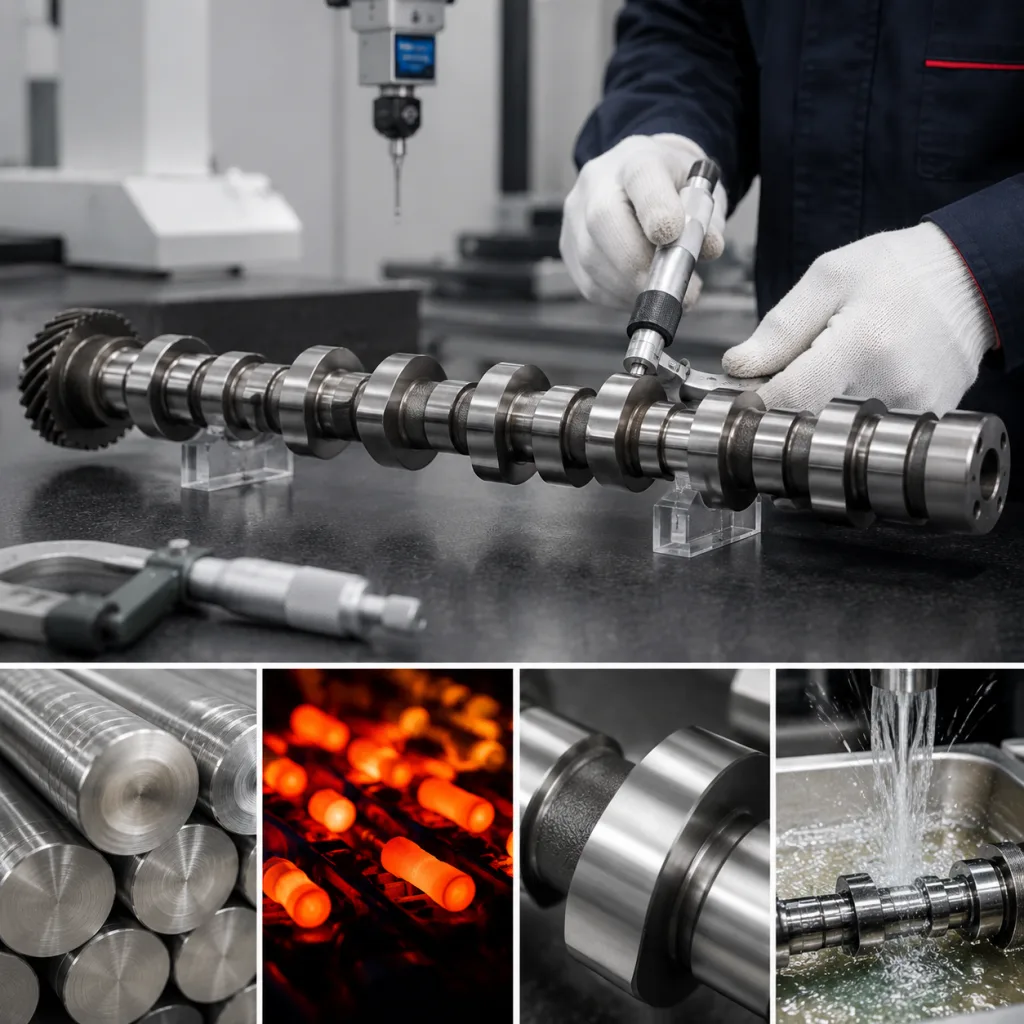
For a new part number, buyers should ask for 3 to 5 sample pieces measured against the full drawing before approving production. Driventus applies process controls under our quality system, with records for material, machining, heat treatment, straightening, grinding, washing, and final inspection.

</tr></thead><tbody> </tbody></table>Before confirming tooling or a first shipment, request the control plan and inspection report format. This lets your incoming quality team compare supplier data with its own limits. If you use AQL sampling, the purchase specification should identify critical characteristics and state whether timing, journal, or trigger-position defects are zero-acceptance items.

Spec deep-dive: material, heat treatment, finish, and cleanliness

Material choice is not a contest to find the hardest possible shaft. It is a compatibility decision. Mini Countryman replacement camshafts may be produced from chilled cast iron, ductile iron, or alloy steel depending on engine design, follower contact stress, oil-film conditions, and whether the part uses integral or assembled features.

A useful specification should answer four questions: what carries the load, what resists wear, what protects the oil system, and what survives storage?

  • Material route. Chilled cast iron or alloy steel should be selected to match the original wear pairing and lubrication regime.
  • Hardness control. Lobes and journals need controlled hardness after heat treatment or surface hardening. Typical lobe hardness windows may sit around 50–60 HRC or equivalent, but the approved drawing and process route should govern.
  • Microstructure stability. For new or higher-risk programs, add metallographic checks to confirm chilled depth, case depth, or core condition where relevant.
  • Lobe geometry after grinding. Taper, crown, edge break, base circle, and surface finish affect follower life.
  • Oil passage cleanliness. Blocked galleries, burrs, or abrasive residue can damage a technically correct part after installation.
  • Deburring and washing. Edges, oil holes, threads, and slots should be checked after machining and before anti-rust treatment.
  • Corrosion protection. VCI, oil film, sealed bags, sleeves, or trays should protect the camshaft through 60–120 days of sea freight, customs clearance, and warehouse storage.

Driventus can support standard aftermarket supply and custom manufacturing where buyers need a private drawing, special marking, application consolidation, or defined packaging specification. Material declarations and restricted substance controls can be aligned with REACH (EC) No 1907/2006 when required for EU distribution.

One caution: even a correctly made camshaft can fail early if the installation environment is wrong. Contaminated oil, damaged followers, blocked oil feeds, reused timing components, incorrect torque sequence, or wrong camshaft locking tools can all create failures that look like part defects. For North American and European programs, review surface durability together with oil specification, follower design, and installation instructions.

Spec deep-dive: material, heat treatment, finish, and cleanliness

Step-by-step release gate before the first volume order

Do not approve engineering, packaging, and commercial release from one attractive sample photo. Split the project into gates. This is especially important when the part is reverse-developed from a sample, the annual volume is high, or the customer has significant warranty exposure.

A practical release path looks like this:

1. Application confirmation. Verify engine code, position, build range, OE reference, market, and supersession notes. 2. Drawing or sample review. Confirm critical dimensions, timing datum, phaser interface, trigger pattern, and oil-feed features. 3. First-article production. Produce samples using the intended material and process route, not a shortcut prototype route unless clearly declared. 4. Dimensional approval. Measure 3 to 5 pieces against the full drawing, including all critical characteristics. 5. Material and surface approval. Review chemical composition where available, hardness, roughness, heat-treatment records, and visual condition. 6. Functional risk review. Check runout, cam profile, timing reference, oil holes, seal land, threads, locating pin, and thrust face. 7. Packaging approval. Confirm label format, anti-rust method, carton strength, pallet limit, and transport assumptions. 8. Commercial release. Only then confirm MOQ, price, lead time, document package, and repeat-order rules.

Typical validation documents include:

  • Sample-to-drawing dimensional report for 3 to 5 pieces.
  • Material certificate, chemical composition record where available, and hardness report.
  • Cam profile data for intake or exhaust position, including lift curve and angular datum.
  • Runout and straightness report after final grinding and after stress relief or straightening where applicable.
  • Surface roughness report on journals, lobes, thrust face, and seal running area if present.
  • Visual inspection for pores, cracks, bruising, burrs, rust, blocked oil holes, and handling marks.
  • Packaging drop or transport review using export carton weight, pallet stacking, and humidity assumptions where required.
  • Traceability label confirmation with part number, lot number, quantity, production date, and country-of-origin marking where required.

For higher-risk projects, additional validation may include bench rotation, wear observation, oil-flow checks, magnetic particle inspection, salt-spray review for packaging, or engine-fit validation by the customer’s technical partner. Emissions-related performance should not be altered by the replacement part. For regulated markets, buyers should ensure distribution and installation practices remain consistent with local rules, including UNECE emissions frameworks such as ECE R-83 where applicable.

Driventus does not claim approval by Mini or any vehicle manufacturer. The release objective is aftermarket interchangeability based on controlled engineering data and repeatable production.

Scenario check: why a Countryman enquiry needs more than model year

Scenario: a buyer sends a photo, says “Mini Countryman camshaft, 2013–2016,” and asks for price. That enquiry is not ready for production quotation. It may be enough to start a conversation, but not enough to prevent mis-supply.

Countryman applications span multiple engines and market specifications. A part listed only by model year can be wrong even if the shaft looks similar. The differences may sit in the phaser mount, sensor trigger, lobe profile, oil feed, or intake/exhaust position.

A stronger enquiry includes at least three data points: engine code, build year range, and OE reference where available. For catalogue development, add position, VVT type, sensor trigger style, and supersession notes from the buyer’s system.

Recommended enquiry data:

  • Vehicle model and generation.
  • Engine displacement and engine code.
  • Intake or exhaust camshaft position.
  • VVT or non-VVT configuration, including phaser interface details if known.
  • OE reference, aftermarket interchange, or buyer SKU already used in the buyer’s system.
  • Required annual volume, first-order quantity, and destination market.
  • Packaging format: neutral, distributor brand, repair-chain label, or bulk service pack.
  • Compliance and documentation needs for EU, UK, US, Canada, Australia, Brazil, or other destination markets.

Driventus maintains application records for common aftermarket programs, but each new camshaft enquiry is still checked against customer data. When a customer sends only photos, we normally request a physical sample or complete dimensional data before confirming production feasibility.

Buyers can start from our catalog and then send a cross-reference list for review. For mixed engine-component programs, combining camshafts with gaskets, timing components, water pumps, or related parts may simplify consolidation and shipping. A clean cross-reference file should include one row per SKU, with OE number, engine code, position, years, target market, packaging code, MOQ expectation, and annual forecast.

Scenario check: why a Countryman enquiry needs more than model year

Supplier comparison: what matters after the unit price

A camshaft quote is not just a price per piece. The real cost includes catalogue accuracy, incoming inspection time, field return rate, technical support, warehouse disruption, and warranty handling. A cheap shaft with weak fitment data can be expensive. An over-engineered project can also be expensive if tooling, MOQ, or documentation requirements exceed the business case.

When comparing suppliers, use a scorecard rather than a price-only ranking:

Risk point What can go wrong in the field Buyer-ready target to define Typical inspection method
Journal diameter and roundnessTight fit, low oil film, noise, seizure, or cap damageDiameter tolerance often ±0.005–0.010 mm; roundness commonly ≤0.005 mm when specifiedMicrometer, air gauge, roundness tester
Total runoutDifficult installation, abnormal rotation, uneven wearCommon receiving limit ≤0.03 mm; tighter limits can be agreed for long shaftsV-block or centre measurement
Lobe lift and base circlePower loss, rough running, valve-train wear, timing deviationLift commonly controlled within ±0.02 mm; base circle by drawing datumCam profile measuring equipment
Lobe phasing angleIncorrect valve events even when timing tools are used correctlyOften ±0.5° to ±1.0° depending on datum and engineIndexing fixture, CMM where required
Thrust face width and positionAxial movement, cap wear, timing instabilityAxial location by drawing, frequently within ±0.03–0.05 mmVernier, height gauge, fixture check
Sensor trigger positionCam/crank correlation codes, no-start, unstable idleEdge-to-datum angle controlled by application requirement, not visual alignmentDedicated timing reference fixture
Surface roughnessAccelerated follower or journal wearJournals and lobes commonly Ra 0.2–0.8 µm depending on material and follower designRoughness tester

</tr></thead><tbody> </tbody></table>Price should be read against material route, machining cycle time, grinding time, heat-treatment batch size, inspection frequency, packaging, and documentation level. A low-MOQ launch order often carries a higher unit price because fixture setup, first-article inspection, and small-batch heat treatment are spread over fewer pieces. Buyers can reduce cost by grouping compatible SKUs, approving standard export packaging, and issuing 3- to 6-month rolling forecasts.

Repair chains usually care most about repeatable installation and low labour-claim exposure. Distributors usually care most about catalogue discipline, cross-reference accuracy, availability, and packaging resilience. Both need a camshaft that arrives protected, fits without modification, and maintains correct timing signal behaviour.

To discuss an active sourcing case, share your application list, annual forecast, target MOQ, target price level, required documents, and inspection requirements through request a quote. Driventus can review feasibility, tooling status, documentation needs, sample lead time, repeat-order lead time, and consolidation options before a formal quotation.

Frequently asked questions

Yes. Send the OE-style reference, engine code, production range, and whether the part is intake or exhaust. We will confirm fitment feasibility against available drawings, samples, or development requirements before quoting.

No. OE-equivalent means the aftermarket part is designed for functional interchangeability with the original application. Driventus is an independent aftermarket manufacturer; brand names are referenced for fitment only.

Typical documents include dimensional inspection reports, material and hardness records, surface roughness data, batch traceability, and packing specifications. Additional validation can be agreed during sample approval.

If you are sourcing a camshaft for Mini Countryman OE equivalent programs, send your cross-reference list, target volumes, MOQ expectations, price target, lead-time needs, and documentation requirements. Driventus will review the application and respond with a practical supply route at /contact.html

Request a Quote
Evaluation area What to ask Why it matters
Certification and process controlIs the production route aligned with IATF 16949:2016 and ISO 9001:2015?Reduces variation and improves record discipline
Manufacturing routeAre machining, grinding, straightening, washing, and final inspection controlled in-house or by qualified partners?Clarifies responsibility for critical dimensions
Sample lead timeWhat is realistic for first articles?Available drawings may take 20–35 days; reverse engineering, tooling, or fixtures may take 45–70 days
TraceabilityCan the supplier isolate raw material, heat-treatment, grinding, and packing records by lot?Essential for containment and recall decisions
DocumentationAre dimensional reports, hardness data, roughness data, packing list, and label proof available before shipment?Prevents surprises at receiving inspection
MOQ and mixed ordersWhat is the minimum by SKU, and can compatible SKUs be consolidated?Common aftermarket planning starts around 100–300 pieces per SKU, with exceptions for slow movers
PackagingAre VCI bags, oil film, sleeves, trays, cartons, and pallet limits defined?Prevents rust, impact damage, and warehouse complaints
Private labelCan the supplier mark and pack to your brand without misleading vehicle-brand claims?Supports channel strategy while avoiding improper branding