cylinder sleeve · 2026-06-07

How to Verify Cylinder Sleeve Quality: Buyer Checklist

Cylinder sleeves are not commodity parts when an engine depends on stable bore geometry, reliable sealing, and long wear life. Procurement and quality teams need a repeatable method to verify incoming stock before it moves into assembly, machining, kitting, or warehouse release. The checklist below explains how to verify cylinder sleeve quality through measurable controls: material and cast structure, OD and ID tolerances, wall thickness, surface finish, hardness, packaging condition, and documentation. It also covers traceability, because an otherwise correct sleeve can still be rejected if the lot number, test report, or certificate does not match the shipment. Driventus is an independent aftermarket manufacturer; brand names and OE references are used only for fitment identification. Use this guide to screen suppliers, evaluate sample lots, and build a clear acceptance plan for aftermarket, OEM, distributor, and repair-chain cylinder sleeve purchases.

Start with the part specification and traceability

Before inspection begins, confirm exactly what has been ordered and what standard the parts must meet. A cylinder sleeve may be supplied as dry, wet, flanged, or flange-less, and each design has different requirements for dimensional control, sealing, installation load, and machining allowance.

Check the purchase order, drawing package, and supplier paperwork for:

  • Material designation, alloy family, or casting specification
  • Sleeve type, engine application, and installation position
  • OE 06A107065 or another cross-reference only when the buyer has already specified it
  • Nominal bore, outside diameter, overall length, flange height, and wall thickness
  • Machining allowance and final-honing requirement, if applicable
  • Heat-treatment condition or stress-relief process, when required
  • Lot number, carton label, inspection report, and test certificate reference

A reliable supplier should provide batch-level traceability and retain records under a recognised quality management system such as IATF 16949:2016 or ISO 9001:2015. For imported components, confirm REACH (EC) No 1907/2006 compliance where material declarations are required by your market or customer contract.

Traceability should connect the physical part, package label, inspection record, and production batch. If a supplier cannot link the submitted sample to an actual production lot, treat it as a presentation sample only. Do not approve it as a release sample for repeat purchasing or production use.

Verify dimensions with calibrated measurement tools

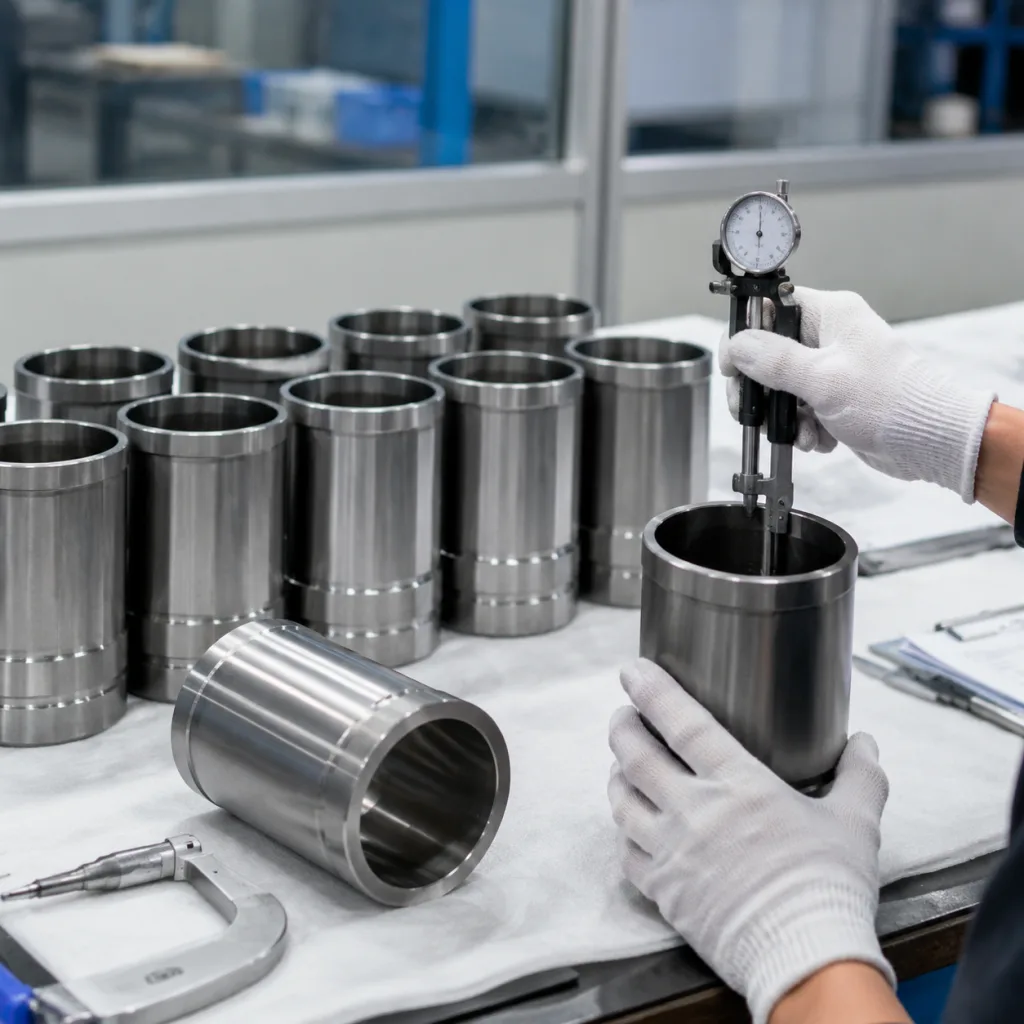
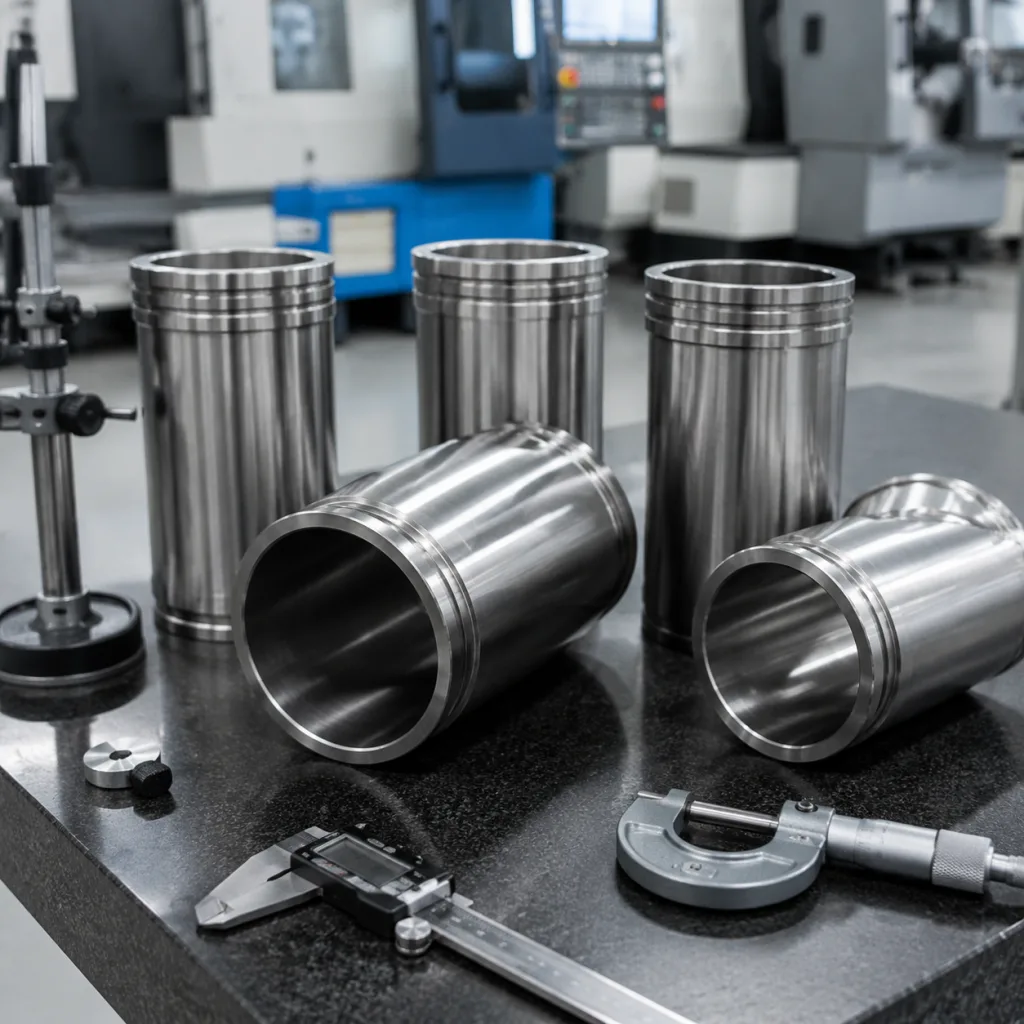
Dimensional control is usually the first physical step when deciding how to verify cylinder sleeve quality. Use calibrated micrometers, bore gauges, height gauges, plug gauges where appropriate, and a clean surface plate. Measurement tools should have current calibration status, and the inspection method should be consistent from lot to lot.

Measure at a minimum of three sleeve positions: top, middle, and bottom. At each position, repeat checks at 0°, 90°, 180°, and 270° to identify ovality, taper, and local distortion. For flanged sleeves, measure the flange face, flange height, and seating surfaces separately because small errors there can create deck-height or sealing problems.

</tr></thead><tbody> </tbody></table>Acceptance criteria should be written into the control plan, drawing, or purchase specification rather than handled by verbal agreement. If the application is close-tolerance, ask for a first article inspection report with actual measured values, not only pass/fail statements. For machining-sensitive programs, the supplier should define how the sleeve is intended to be installed, bored, and honed, then align the inspection method with that process in the same way it would be managed in OEM or Tier-1 supply.

Inspect material structure, hardness, and heat treatment

A sleeve can meet the drawing dimensions and still fail early if the material is inconsistent. For cast-iron sleeves, inspect for a uniform grey cast structure, clean machined edges, absence of visible porosity at the bore, and no cracks caused by handling or machining. For alloy, ductile iron, or specialty sleeves, request the exact metallurgy and the process route used, including casting, heat treatment, stress relief, and final machining sequence where relevant.

Hardness should be checked with a method suitable for the material and section thickness. The inspection plan should state the hardness scale, sample count, test locations, and allowed variation across the batch. A large hardness spread may indicate inconsistent casting, incorrect heat treatment, local overheating during machining, or mixed parts from different production runs.

Ask for these documents when verifying material quality:

  • Material certificate or chemical composition report
  • Hardness test results by lot
  • Heat-treatment or stress-relief record, if applicable
  • Microstructure or metallographic report for development and approval samples
  • Nonconformance history or corrective action records for repeated supply programs

If a supplier claims compliance with a technical standard, the claim should be supported by actual test data rather than a label on the carton. For durability-related applications, some buyers also request wear testing, thermal-cycle data, or system-level environmental validation aligned with recognised methods when those tests are relevant to the engine program. The goal is to confirm that the sleeve has the right material behaviour, not merely that it has the right shape.

Check surface finish, roundness, and visual defects

Surface quality directly affects ring sealing, oil retention, break-in behaviour, and long-term wear. Inspect the bore and outside surface under consistent lighting, and clean the sleeve before judging the finish. If the application requires a defined finish, use a profilometer and record roughness values rather than relying on touch or visual appearance alone.

Look for these defects during visual and tactile inspection:

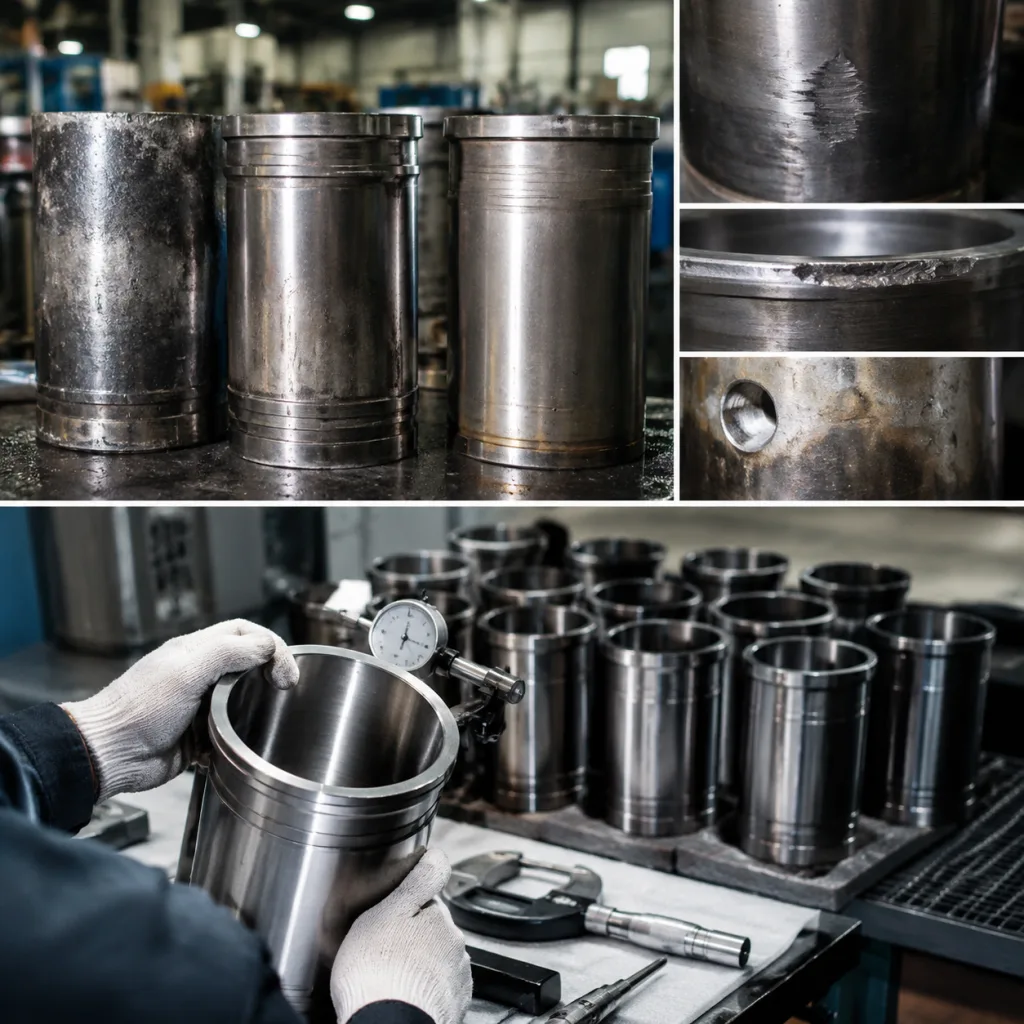
  • Scratches, grooves, chatter, or heavy tool marks on the bore
  • Chipping at the top edge, bottom edge, or flange
  • Porosity, sand inclusion, shrink marks, or exposed casting defects
  • Burrs on ports, oil holes, chamfers, and lead-in areas
  • Rust, staining, contamination, or inadequate preservative coating
  • Handling dents, flange bruising, or impact marks from bulk packing

Roundness and straightness should be measured on the same sample set used for dimensional checks. If the sleeve is intended for a bored block, minor deviations can increase after press-fit, thermal exposure, and final machining. Wet sleeves also require careful attention to sealing surfaces and flange areas because surface flaws may affect coolant sealing as well as bore performance.

Ask whether the product has been validated for the target installation method and whether the bore is supplied as semi-finished, pre-finished, or ready for final honing. That distinction is important. A sleeve designed for subsequent boring and honing should not be judged by the same surface-finish expectations as a finished service sleeve, and a claimed “ready to use” sleeve should have measurable finish and geometry data to support the claim.

Review packaging, corrosion protection, and incoming inspection controls

Good sleeves can become unusable before they reach the production line if packaging is weak. Packaging should prevent metal-to-metal contact, flange and edge damage, moisture ingress, and mixed-lot confusion. Each sleeve should be protected with an oil film, VCI material, or another corrosion inhibitor suitable for the transit time, storage period, and destination climate.

A practical incoming inspection process should include:

1. Verify carton count and label details against the purchase order. 2. Check traceability codes against shipment documents and test reports. 3. Confirm that the packaging prevents movement and impact damage. 4. Open a statistically valid sample set based on lot size and risk level. 5. Record dimensional, visual, hardness, and surface-finish results as required. 6. Quarantine mixed lots, rusted parts, damaged sleeves, or unlabeled units. 7. Notify the supplier with photos and measured data when nonconforming parts are found.

For distributors and repair chains, consistency matters as much as the quality of an individual sample. Ask whether the supplier can maintain the same material source, casting route, machining process, and inspection plan across repeat orders. Also confirm whether engineering or process changes require written approval before shipment.

Driventus supports our catalog, quality system, and custom manufacturing for buyers who need matched specifications across multi-location supply programs.

Build a supplier scorecard for repeat purchases

The best way to verify cylinder sleeve quality over time is to score every lot against the same criteria. A structured scorecard reduces subjective purchasing decisions and helps separate a polished sample from reliable production capability. It also gives purchasing, engineering, and quality teams a shared record when discussing supplier approval or corrective action.

Suggested scorecard fields:

  • Dimensional conformance: pass/fail plus actual OD, ID, length, wall thickness, and flange values
  • Material documentation: complete, incomplete, or inconsistent with the shipment
  • Hardness spread: within limit or outside limit by lot
  • Surface finish and visual quality: acceptable, conditional, or reject
  • Roundness, taper, and concentricity: within drawing or control-plan limits
  • Packaging and corrosion protection: acceptable or nonconforming
  • Traceability: carton, certificate, and lot codes fully matched or not matched
  • Response time for documents: under 24 hours, delayed, or unresolved
  • Corrective action quality: complete root cause and prevention plan or only a temporary response

Use the scorecard to compare suppliers on total risk, not only on unit price. A low-cost sleeve that requires rework, extra inspection, or frequent claims can become more expensive than a controlled part with stable documentation and repeatable measurements.

When an application needs tighter tolerances, alternate machining allowances, a specific hardness range, or a special alloy route, specify it early and lock it into the drawing, purchase order, and inspection plan. For sourcing support, request a quote with your target dimensions, annual volume, required documents, and application details.

Frequently asked questions

At minimum, ask for a packing list, lot traceability, material certificate, and dimensional or hardness report when those items are part of the agreed specification. For regulated supply chains, keep the file aligned with ISO 9001:2015 or IATF 16949:2016 record requirements.

Yes. A sleeve may look clean and still fail on OD, ID, roundness, taper, wall thickness, hardness, surface finish, or traceability. Visual inspection is important, but it is only one part of the acceptance plan.

Start with a controlled sample lot, require a first article inspection report, verify measurements with calibrated tools, and review material and process-control documents. Then check repeatability on a second production lot before releasing volume orders.

If you need controlled dimensions, traceable lots, or application-specific sleeve builds, send your drawing or target specification and we will review it with you. Start here: /contact.html

Request a Quote
Check What to measure Why it matters
Outside diameterMultiple points around the sleeveConfirms press fit, slip fit, or flange seat control
Inside diameterMultiple depths and anglesConfirms machining allowance and final bore potential
Length / heightEnd-to-end length and flange dimensionsHelps prevent deck mismatch and sealing issues
Wall thicknessMinimum thickness at critical zonesLow thickness increases distortion and cracking risk
ConcentricityID-to-OD relationshipAffects roundness after installation and machining
Chamfers and edgesEntry radii, lead-in areas, and flange edgesReduces installation damage and burr-related failures