How to Diagnose Turbo Lag: Tests, Causes, and Fixes
Turbo lag is the delay between a throttle or torque request and a measurable rise in boost pressure. Some delay is normal, because exhaust mass flow and temperature have to build before the turbine can accelerate the compressor. It becomes a fault when response is slower than expected for the same engine specification, changes from one drive cycle to the next, or appears with underboost DTCs, smoke, limp mode, unusual noise, oil carryover, or excessive exhaust backpressure.
For procurement teams, distributors, remanufacturing programmes, and workshop networks, the real question is not simply whether the vehicle feels slow. The better question is which system is out of specification: intake sealing, charge-air leakage, exhaust energy, aftertreatment restriction, boost actuator travel, sensor accuracy, lubrication supply, variable-geometry movement, or turbocharger rotating assembly condition. Misdiagnosis leads to unnecessary turbo replacements, repeat repairs, chargebacks, avoidable warranty returns, and poor stocking decisions.
This guide explains how to diagnose turbo lag with a repeatable process: confirm the symptom under load, pressure-test the intake and charge-air path, check exhaust and aftertreatment restriction, validate actuator and boost-control operation, compare requested versus actual boost on live scan data, inspect the turbocharger mechanically, and decide whether to repair, replace, or validate further. Driventus is an independent aftermarket manufacturer; brand names and OE references are used only for fitment identification. Our catalog, quality system, custom manufacturing, and request-a-quote links are included where relevant for sourcing and programme support.
What turbo lag looks like in the field
Turbo lag is commonly described as slow acceleration, weak low-to-mid-range torque, delayed boost rise, or a pause between accelerator input and vehicle response. It is usually easiest to reproduce during a steady roll-on in third or fourth gear from about 1,500 to 2,500 rpm on many passenger diesel and downsized gasoline applications. That operating window creates enough load to request boost while keeping engine speed low enough for spool and actuator problems to show clearly.
Normal response varies by engine displacement, turbo frame size, turbine A/R, variable-geometry or wastegate strategy, transmission shift logic, emissions calibration, ambient conditions, altitude, and exhaust aftertreatment state. For diagnosis, avoid judging the part by feel alone. Use a scan log or data logger to compare accelerator position, engine speed, requested boost, actual MAP/boost, MAF, actuator command, and actuator feedback. A useful road-load log records the same gear, starting rpm, throttle angle or pedal percentage, coolant temperature, intake air temperature, and vehicle load on every run.
Common field symptoms
Boost pressure rises late after a stable throttle or torque request
Actual boost remains below requested boost during a loaded acceleration test
Poor torque between approximately 1,500 and 2,500 rpm, depending on engine calibration
Excess black smoke on diesel applications, indicating air-fuel imbalance or EGR/boost control error
Hissing under load from charge-air leakage, often near intercooler joints or hose cuffs
Whistling, siren-like noise, or compressor contact noise from the turbocharger area
DTCs related to underboost, overboost, MAP, MAF, EGR, DPF differential pressure, or actuator position
Limp-home mode after sustained load, hill climbing, towing, or high boost demand
Oil pooling in charge pipes, blue smoke, or elevated oil consumption when sealing or bearing systems are compromised
Response changes after hot soak, cold start, stop-start operation, or repeated short-trip use
The first diagnostic decision is to separate an expected calibration characteristic from a fault. Compare the vehicle with the same engine code and software level where possible, or use service information for boost targets and actuator behaviour. A small delay on a large fixed-geometry turbocharger may be normal; a 300 to 500 mbar boost deficit under commanded load, repeated underboost DTCs, or a slow actual-boost trace while actuator duty is high is not normal unless the vehicle is intentionally torque-limited by another strategy.
For B2B sourcing, this distinction matters. A calibration-related complaint does not require a turbocharger. A split 50 mm charge hose may only require a duct, clamp, or seal kit. A vacuum reservoir or pressure converter fault may require boost-control parts. A worn center housing rotating assembly, damaged compressor wheel, seized variable-nozzle ring, or non-serviceable electronic actuator fault may justify turbocharger replacement. Accurate symptom classification reduces no-fault-found returns and improves first-time repair rate.
Start with the simplest causes first
Before replacing a turbocharger, verify that the engine can supply exhaust energy to the turbine and receive sealed, metered air from the compressor. Many vehicles diagnosed as having turbo lag actually have charge-air leakage, intake restriction, exhaust leakage before the turbine, excessive aftertreatment backpressure, vacuum loss, actuator-control faults, or inaccurate sensor inputs.
Begin with a visual inspection, then use pressure, smoke, vacuum, and backpressure tests. Oil mist around charge-air joints is a useful leak indicator because crankcase ventilation normally carries some oil vapour through the intake tract. A light film is common; wet joints, oil streaking, or dirt accumulation around a coupler often indicate a leak path. On many light-duty systems, charge-air pressure testing at approximately 0.5 to 1.5 bar above atmospheric pressure is sufficient to expose split hoses, intercooler end-tank cracks, or poor clamp seating, but the exact pressure must not exceed the vehicle manufacturer's procedure.
Inspection point
What to check
Typical result if faulty
Air filter and airbox
Incorrect filter, blocked snorkel, collapsed element, water damage, poor lid sealing
MAF lower than expected, slow compressor flow, poor high-load response
Compressor inlet ducting
Split inlet hose, loose clamp, soft hose collapse under suction, unmetered air after MAF
Slow spool, unstable MAF signal, compressor noise
Intercooler and charge pipes
Cracked plastic pipe, split rubber hose, damaged O-ring, loose V-band or T-bolt clamp, leaking end tank
Low actual boost, hissing under load, high turbo duty command
Incorrect load calculation and wrong boost request
</tr></thead><tbody> </tbody></table>If the vehicle uses a variable-geometry turbocharger, carbon-restricted vane movement is a frequent cause of low-rpm lag. The compressor wheel and shaft may feel acceptable, but the nozzle ring may not close quickly enough to increase turbine velocity at low engine speed. A hand check is not enough on electronically controlled units; use a scan tool or actuator tester to compare commanded position, actual position, sweep range, and response time against service data.
On gasoline direct-injection engines, intake valve deposits can reduce cylinder filling and imitate turbo lag. On diesel engines, EGR valves stuck open, intake throttle faults, DPF loading, or excessive exhaust backpressure can alter air mass and turbine energy enough to mislead the diagnosis. Always validate the surrounding system before condemning the turbocharger. A new turbo installed into a leaking intercooler, blocked DPF, restricted oil feed, or contaminated lubrication circuit may fail quickly and may not be accepted as a warrantable component failure.
Use scan data to separate airflow faults from control faults
Live data is the fastest way to decide whether turbo lag comes from air leakage, restriction, exhaust energy loss, boost-control error, sensor drift, or mechanical turbo response. Record data under load, not only at idle. Idle MAP, MAF, and actuator values can look normal even when the vehicle cannot build boost during a road-load event.
Perform a controlled test where safe and legal. Use the same gear and starting rpm for repeatability, apply a steady throttle input, and log until the engine reaches the normal boost range or the fault appears. Avoid full-load testing if there is compressor noise, metal contact, heavy smoke, oil pressure concern, active limp mode, or suspected overspeed. Save stored DTCs, pending codes, and freeze-frame data before clearing faults; freeze-frame often identifies the engine speed, load, boost pressure, temperature, and actuator state at the fault moment.
Data to log
Accelerator pedal position and throttle plate angle where applicable
Engine speed, calculated load, torque request, and injected fuel quantity on diesel systems
Requested boost or target manifold pressure
Actual MAP and calculated boost pressure, corrected for barometric pressure
Barometric pressure or altitude compensation value
MAF in g/s or calculated air mass per stroke, depending on scan tool format
Wastegate duty cycle, variable-vane command, actuator position feedback, or electronic actuator percentage
Intake air temperature and charge-air temperature after the intercooler where available
EGR command and feedback, especially on diesel engines
DPF differential pressure, catalyst pressure, or exhaust backpressure where available
Fuel rail pressure and torque-limit status if the ECU is reducing requested boost
A practical interpretation rule is simple: compare command, feedback, and result. If requested boost rises and actual boost remains low while actuator duty or vane command is high, the ECU is trying to create boost but the air/exhaust system or turbo hardware cannot respond. If requested boost stays low, the ECU may be limiting torque because of MAF plausibility, EGR, DPF loading, charge temperature, fuel pressure, knock control, transmission request, or limp-home strategy. If actual boost overshoots before power is cut, the issue is more likely vane or wastegate sticking, actuator calibration, hose routing, solenoid control, or MAP sensor accuracy than simple lag.
Interpreting common scan patterns
High requested boost, low actual boost, high control duty: check charge-air leaks, wastegate leakage, sticky vanes, actuator supply, exhaust leak before turbine, worn wheels, or excessive backpressure.
Low requested boost and low actual boost: investigate torque limitation from MAF, EGR, DPF, charge temperature, fuel pressure, throttle, or limp strategy before replacing the turbo.
Actual boost delayed but eventually reaches target: suspect carbon-restricted variable vanes, wastegate pivot leakage, slow actuator response, bearing drag, compressor/turbine damage, or low exhaust energy.
Actual boost higher than requested before a cut: inspect vane or wastegate control, solenoid venting, electronic actuator adaptation, MAP sensor offset, and hose routing.
MAF low and MAP low: inspect air filter, airbox, compressor inlet, MAF sensor, and intake restrictions.
MAP low with plausible MAF: pressure-test the charge-air system after the compressor and inspect intercooler leakage.
High DPF differential pressure with slow boost: correct aftertreatment restriction before fitting a replacement turbocharger.
Use manufacturer service data for numeric thresholds because boost targets vary widely by engine code and software. As a general diagnostic indicator, a repeated boost error of roughly 200 to 300 mbar or more under stable load is usually worth investigating, and many ECUs will set underboost or overboost DTCs when deviation exceeds calibrated limits for a set time. For B2B warranty files, attach the scan report, DTC list, freeze-frame, test conditions, pressure-test result, actuator test result, and before/after logs. Emissions-related diagnostic work should remain aligned with the vehicle calibration and applicable regulations, including ECE R-83 where relevant. Supply-chain documentation for components should also consider REACH (EC) No 1907/2006 requirements.
When the turbo itself is the cause
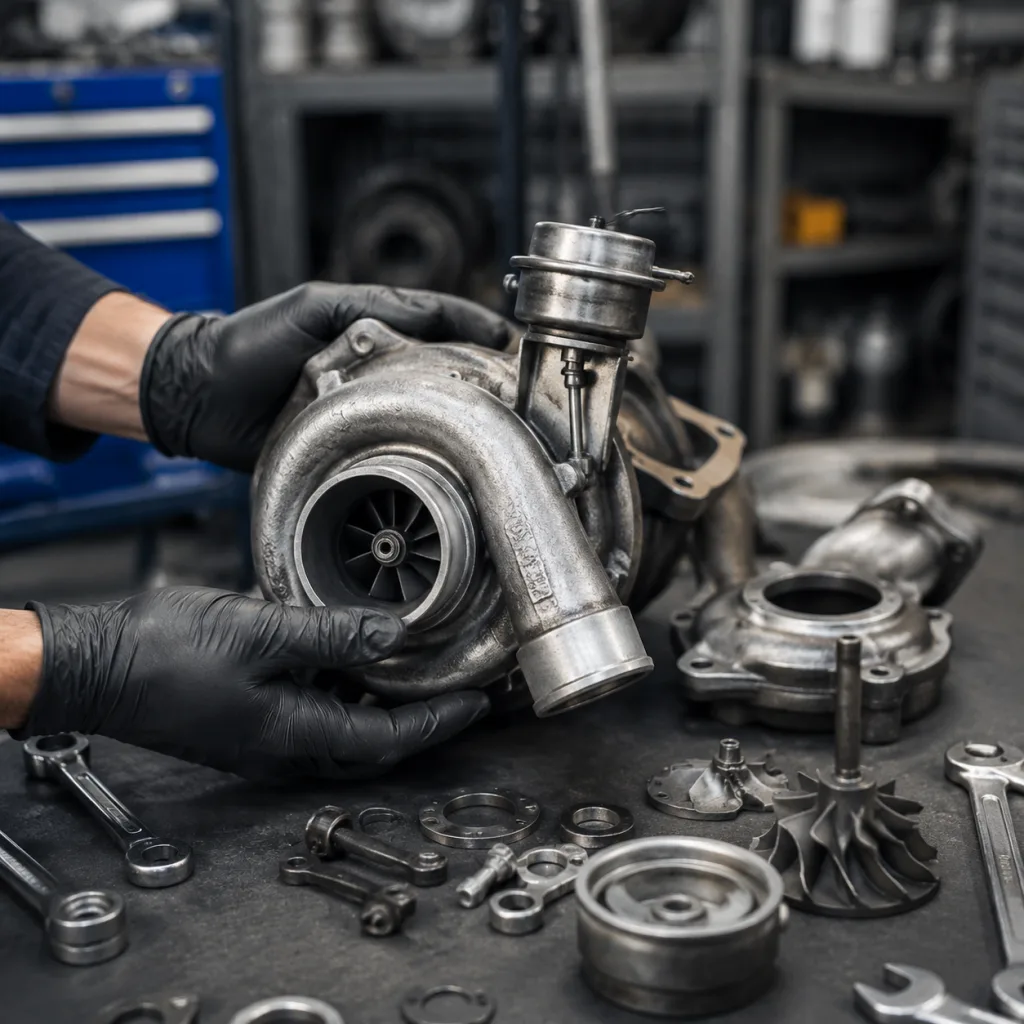
If the intake path, charge-air system, exhaust path, aftertreatment, sensors, and control circuits are within specification, inspect the turbocharger directly. A turbocharger can cause lag when the rotating assembly has excessive drag, when the compressor or turbine wheel is damaged, when a wastegate does not seal, when a variable-nozzle mechanism sticks, when actuator travel is incorrect, or when lubrication failure has damaged the bearing system. The unit may still produce boost at higher rpm but respond late at low-to-mid engine speed.
Remove the compressor inlet or charge pipe as the service procedure allows. Inspect the compressor wheel, nut, blade tips, housing, oil residue, and any signs of contact. A dry-to-light oil film in the intake tract can be normal from crankcase ventilation. Heavy oil pooling, wet compressor blades, oil dripping from the housing, or oil in the intercooler requires crankcase pressure, oil drain, seal, and bearing checks. On the turbine side, inspect for cracked housings, damaged blades, loose wastegate seats, missing material, and contact marks where access allows.
Mechanical checks
1. Rotate the shaft by hand. It should turn freely without roughness, binding, scraping, or inconsistent resistance. 2. Measure axial and radial movement using the service method. Do not condemn a journal-bearing turbo by feel alone; dry radial clearance can feel noticeable before oil pressure centres the shaft. 3. Compare movement to manufacturer limits. Ball-bearing and journal-bearing units have different acceptable clearances, and axial play is generally more critical than a small amount of dry radial movement. 4. Inspect compressor and turbine blades for bent edges, erosion, cracks, foreign-object damage, or missing material. 5. Look for wheel-to-housing witness marks. Any confirmed contact indicates excessive movement, incorrect assembly, impact damage, or overspeed risk. 6. Check wastegate flap sealing, pivot wear, lever free play, actuator rod preload, and full travel on wastegate units. 7. On variable-geometry units, sweep the vane mechanism through its full range and check for carbon binding, stop-screw tampering, corrosion, or uneven travel. 8. Test vacuum, pressure, or electronic actuator response with the correct tool. Record start-of-movement point, full-stroke value, feedback percentage, and adaptation status where applicable. 9. Inspect oil feed and drain lines for coking, sludge, crushed sections, incorrect banjo bolts, blocked screens, wrong gaskets, or sealant intrusion. 10. Check for oil starvation, oil contamination, excessive crankcase pressure, blocked breather systems, restricted oil drain return, or incorrect oil grade. 11. Inspect mounting faces, gasket orientation, studs, fasteners, V-band alignment, and coolant connections on water-cooled units.
A worn bearing system can delay boost because the rotating assembly is less stable and less efficient. Excessive axial movement, compressor contact, turbine contact, or metal debris means the part should not be returned to service. Foreign-object damage can also reduce compressor efficiency even when the shaft turns freely; small blade-tip deformation changes flow and can increase noise, surge tendency, and overspeed risk.
Do not treat the turbocharger as an isolated component. Turbo bearing damage is often secondary to oil starvation, contaminated oil, incorrect oil viscosity, extended drain intervals, blocked feed lines, excessive crankcase pressure, hot shutdown, high exhaust temperature, or debris from a previous failure. If metal debris is present, the oil circuit, intake tract, intercooler, and charge pipes must be cleaned or replaced according to the service procedure. Installing a new turbo without removing contamination or correcting oil supply faults is a common cause of repeat failure.
A replacement unit or validated rebuild is appropriate when there is confirmed wheel damage, housing contact, excessive axial or radial movement beyond specification, seized or non-recoverable variable-geometry movement, non-serviceable electronic actuator failure, cracked housings, internal oil leakage caused by wear, or metal contamination. For sourcing support, see our catalog and our engine components page.
Replacement decision: repair, replace, or validate further
The correct action depends on the verified failure mode, vehicle duty cycle, warranty policy, installation risk, and availability of validated parts. A delivery fleet with high idle time, towing, mountainous operation, frequent regeneration events, or high annual mileage may need stricter installation controls and more complete associated parts than a low-mileage passenger vehicle. A distributor may also require evidence that the turbocharger is the failed component before approving a replacement or warranty return.
Use the diagnosis to choose one of three paths: repair an external fault and retest, replace a confirmed failed component, or validate further when the data is inconclusive. Do not replace a turbocharger only because boost is low. Low boost is a measured symptom; the root cause may be a 20-minute hose repair, a blocked DPF, a vacuum leak, a sensor offset, or a turbocharger failure.
Condition found
Likely action
Charge hose leak, loose clamp, damaged O-ring, or intercooler leak
Repair or replace sealing parts, pressure test, clear codes, and retest under the same load
Restricted air filter, blocked snorkel, or collapsed inlet duct
Replace defective parts and confirm MAF and boost response
MAP/MAF contamination, connector corrosion, or wiring voltage drop
Clean only where approved, replace if out of spec, repair wiring, and compare live data again
Repair line integrity and confirm actuator start point and full travel
Sticking pressure converter or boost solenoid
Test electrical and pneumatic function, replace if response or venting is incorrect
Sticky actuator or variable-vane system
Service, adapt, calibrate, or replace control parts where supported; replace turbo if mechanism is seized or worn
Exhaust leak before the turbine
Repair manifold, gasket, EGR feed, or pipe before judging turbo response
High DPF/catalyst backpressure
Correct aftertreatment restriction and regeneration faults before fitting a turbo
Oil coking or contamination at turbo center housing
Investigate lubrication system; replace turbo if bearing wear or contact is confirmed
Shaft play beyond specification, wheel damage, housing contact, cracked housing, or metal debris
Replace turbocharger and clean or replace related oil and charge-air systems
Inconclusive scan data with no physical damage
Perform pressure, smoke, vacuum, actuator, backpressure, and repeat road-load tests before ordering the turbo
</tr></thead><tbody> </tbody></table>For B2B sourcing, verify more than the casting appearance. Confirm engine code, emissions level, actuator type, electronic actuator calibration, wastegate or VGT geometry, compressor and turbine wheel specification, oil and coolant connections, sensor provisions, gasket interfaces, mounting orientation, and any required programming or adaptation. OE references such as 06A... or 11251... should be used only within validated catalogue or cross-reference data. Similar housings may differ in wheel trim, actuator stroke, stop settings, vane calibration, or emissions behaviour.
Replacement planning should include installation consumables and contamination controls. Oil feed lines should be replaced if coking, sludge, screen blockage, or heat damage is present. Oil drain lines must be unrestricted and correctly angled. Intercoolers and charge pipes may need cleaning or replacement when oil or metal debris has accumulated. Gaskets, studs, copper washers, banjo bolts, clamps, V-bands, O-rings, and coolant seals should be treated as critical installation items. After installation, prime the turbo with clean oil where required, disable fuel or ignition if the procedure calls for cranking oil pressure first, check oil pressure, verify no intake or exhaust leaks, clear codes, perform actuator adaptation if required, and road test with live boost data.
Driventus parts are produced under an IATF 16949:2016 and ISO 9001:2015 quality framework, with more detail available on our quality system. For tailored volumes, application-specific development, cross-reference validation, or supply planning, review custom manufacturing.
A practical diagnostic sequence for workshops and buyers
Use the same diagnostic sequence on every vehicle. A repeatable process reduces missed faults, limits unnecessary turbocharger returns, and gives buyers a stronger basis for sourcing and warranty decisions. The workflow should move from symptom confirmation to external-system checks, then control validation, then direct turbo inspection. This order matters because intake, exhaust, actuator, sensor, and aftertreatment faults frequently imitate turbocharger failure.
Recommended sequence
Confirm the complaint under load and record gear, rpm, pedal position, coolant temperature, intake air temperature, ambient pressure, and vehicle load.
Check stored DTCs, pending codes, freeze-frame data, and software updates before clearing anything.
Verify maintenance condition: air filter, oil level, oil grade, oil change interval, breather condition, and recent repair history.
Pressure-test or smoke-test the charge-air system when leakage is suspected; record test pressure and pressure decay.
Check exhaust leaks before the turbine and measure DPF differential pressure or exhaust backpressure where relevant.
Test vacuum or pressure supply, check valves, reservoirs, boost solenoids, hose routing, and electrical connectors.
Command the actuator through a sweep test and record start point, full travel, feedback, and adaptation results where available.
Compare requested boost and actual boost during a controlled load test using the same gear and starting rpm.
Review MAF, MAP, EGR, throttle, temperature, fuel pressure, torque limitation, and actuator data for inconsistent signals.
Inspect the turbo for shaft movement, oil carryover, wheel damage, housing contact, wastegate sealing, and vane movement.
Correct the root cause, then retest under the same conditions to verify boost response and confirm DTCs do not return.
Document failed parts, measurements, photos, scan logs, and final road-test data.
For workshop networks, the value is consistency. A technician in one branch should reach the same conclusion as a technician in another branch when given the same DTCs, pressure-test results, actuator measurements, and boost logs. For distributors and procurement teams, that consistency reduces warranty exposure because the record separates genuine component defects from installation issues, contamination, vehicle-side faults, and misapplication.
A strong B2B job record includes the customer complaint, engine code, mileage or hours, DTCs, freeze-frame, boost log, pressure-test result, actuator travel measurement, backpressure reading where applicable, photographs of damaged hoses or turbo components, oil-system findings, parts replaced, and final confirmation run. This evidence is especially important for remanufacturing programmes and warranty adjudication, where no-fault-found turbo returns can consume inspection capacity and distort demand forecasts.
The same process improves stock planning. If repeated turbo lag complaints are caused by charge-air hoses, MAP sensors, boost solenoids, actuator faults, or DPF restriction rather than turbocharger wear, inventory should include those service parts and installation kits. If confirmed turbo failures cluster around specific duty cycles, oil-feed restrictions, high-temperature applications, or contaminated engines, sourcing teams can review material specification, actuator calibration, packaging kits, and technical bulletins. If you need sourcing review, cross-reference support, or programme discussion, you can request a quote.
Frequently asked questions
Yes. A restricted, wet, collapsed, or incorrectly fitted air filter reduces compressor inlet flow and can lower MAF under load. Check the airbox, snorkel, filter seal, and inlet duct before replacing the turbocharger.
Compare requested boost, actual boost, actuator command, and actuator feedback during a load test. Then run a vacuum, pressure, or electronic sweep test. If supply, wiring, and hose routing are correct but travel is slow, incomplete, or outside specification, the actuator or vane/wastegate mechanism is suspect.
Not automatically. Some dry radial movement can be normal on journal-bearing turbos before oil pressure centres the shaft. Replace or rebuild when measured radial or axial movement exceeds the service limit, or when there is wheel contact, blade damage, metal debris, abnormal noise, or internal oil leakage caused by wear.
If you need application matching, part validation, or supply support for turbocharger programmes, contact the Driventus team and request a quote at /contact.html.