Dual Mass Flywheel Manufacturer China: B2B Sourcing Guide
Choosing a dual mass flywheel manufacturer in China is a technical sourcing decision first, a price decision second. Procurement teams need proof of torsional damping, dimensional stability, friction-surface consistency, traceable materials, and repeatable assembly. If those controls are weak, the usual failures show up fast: fitment errors, imbalance, spring-pack noise, grease leakage, and damage in transit.
Driventus Auto Parts manufactures engine and powertrain components in Taizhou, Zhejiang, and supplies B2B customers in more than 60 countries. Our dual mass flywheel programs support aftermarket distribution, private label supply, and OE-style service replacement applications. Driventus is an independent aftermarket manufacturer; brand names are referenced for fitment only.
This guide focuses on how buyers should decide, where suppliers fail, what to compare in an RFQ, and which controls matter before repeat orders begin.
Where Dual Mass Flywheels Fail in Supply Chains
A dual mass flywheel reduces torsional vibration between the engine and gearbox. That function depends on more than shape or weight. A part can look correct and still create noise, judder, or premature wear if damping, balance, or surface control is off.
The most common sourcing failures are predictable:
Wrong fitment by engine code, transmission code, bolt pattern, or sensor reference.
Excess runout or poor flatness on the mounting and friction faces.
Damping behavior that drifts from the master sample.
Grease leakage after heat soak or long transit.
Inconsistent balance results between lots.
Packaging that allows corrosion, denting, or pallet damage.
If a supplier cannot explain how it prevents those failures, the quote is not ready for approval. Buyers should treat the dual mass flywheel as a controlled functional assembly, not a generic machined part.
For catalog review and part-family planning, buyers can also check our catalog.
Spec Checklist for RFQ Comparison
A clean RFQ is the fastest way to separate a serious supplier from a price-only seller. Two quotations for the same vehicle application may hide different damping layouts, grease systems, machining tolerances, or inspection standards. The comparison only works when the specification is fixed.
</tr></thead><tbody> </tbody></table>If you have a master sample, ask the supplier to quote against its measured values, not an assumed nominal. If the application is new, request proposed limits, gauge methods, and acceptance criteria before sample signoff. That saves time later, when the order is already in motion.
Driventus supports custom manufacturing for application gaps, private label programs, and regional vehicle parc needs.
What a Capable Factory Should Prove
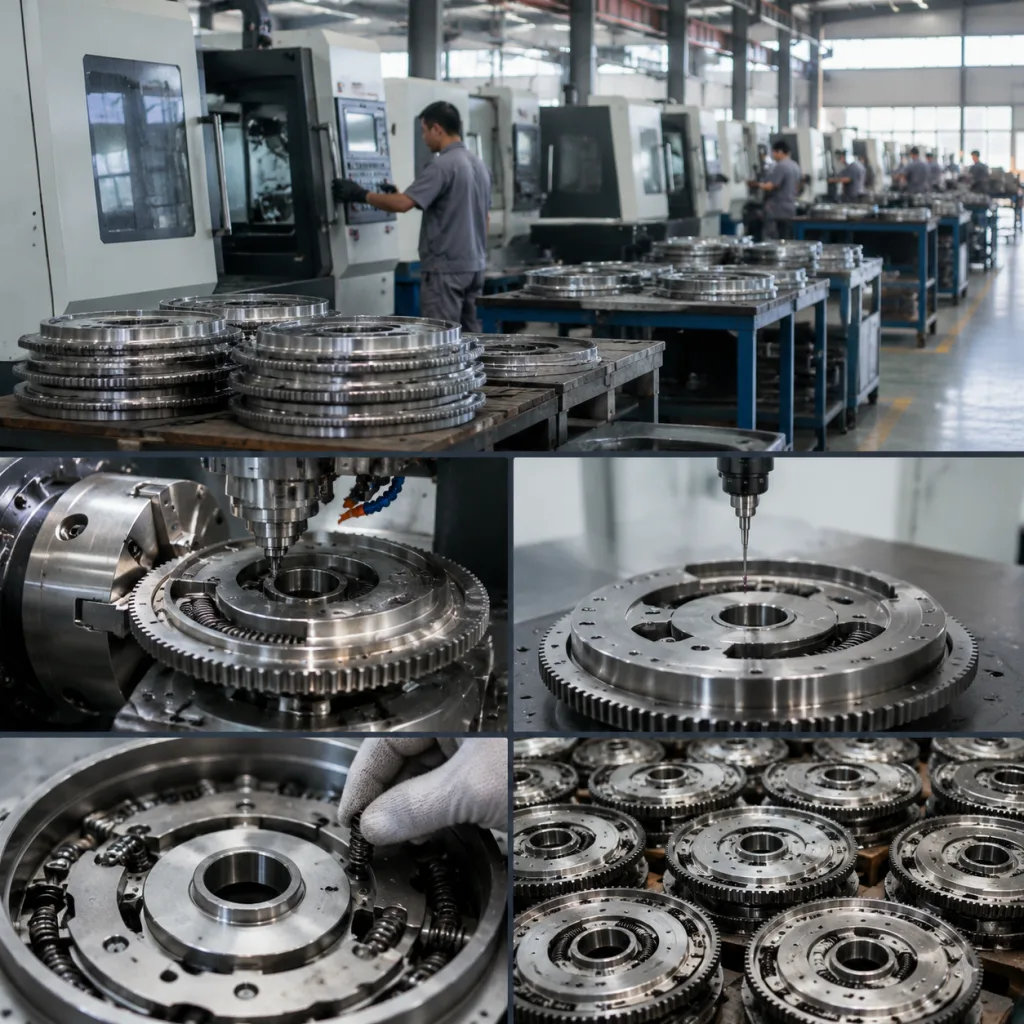
A capable dual mass flywheel manufacturer should be able to walk you through the process without hand-waving. The flow usually includes blank sourcing, CNC machining, gear ring installation, heat treatment, spring and damper assembly, greasing, riveting or fastening, runout inspection, and final balancing. Each step should have its own check point.
Ask for evidence, not general claims:
Valid IATF 16949:2016 and ISO 9001:2015 certificates with product scope.
Calibration records for CMMs, runout gauges, hardness testers, torque tools, and balancing machines.
Batch traceability from raw material or blank to packed goods.
Control plan covering critical dimensions and functional checks.
Dynamic balancing records by lot.
Warranty return analysis and corrective-action procedure.
Packaging validation for export handling where required.
For most buyers, the real test is whether the factory can tie the approved sample to production controls. If a supplier only shows a certificate wall and a polished showroom, keep digging. A serious plant should show inspection records, retention rules, and nonconformance handling.
Driventus operates under IATF 16949:2016 and ISO 9001:2015 principles, with documented incoming, in-process, and final-release controls. Procurement teams can review our quality system during supplier qualification.
How to Read MOQ and Lead Times
MOQ and lead time are not just commercial terms. They tell you how mature the part is in the factory.
Invoice, packing list, certificate of origin, inspection report
Control plan, material record, dimensional report, sample approval file
</tr></thead><tbody> </tbody></table>A lower unit price is not automatically the better deal. It may hide a larger MOQ, slower replenishment, or extra charges for packaging, inspection, and documentation. A more expensive quote can still win if it improves fill rate, reduces claims, and shortens the reorder cycle.
For recurring distributor programs, Driventus can sometimes consolidate MOQ across part numbers when the application mix is balanced. That helps when demand is spread across multiple SKUs rather than one high-runner.
Validation Testing Before Release
This is the step many buyers under-specify. Dimensional inspection alone does not prove the flywheel will perform in service. The supplier should show how it checks function after assembly, not only size after machining.
Minimum validation and control points should include:
100% visual inspection for cracks, burrs, contamination, and grease leakage.
Critical dimension checks by sampling plan or full gauge inspection.
Dynamic balancing after final assembly.
Rotational angle and torque-resistance checks against the approved master sample.
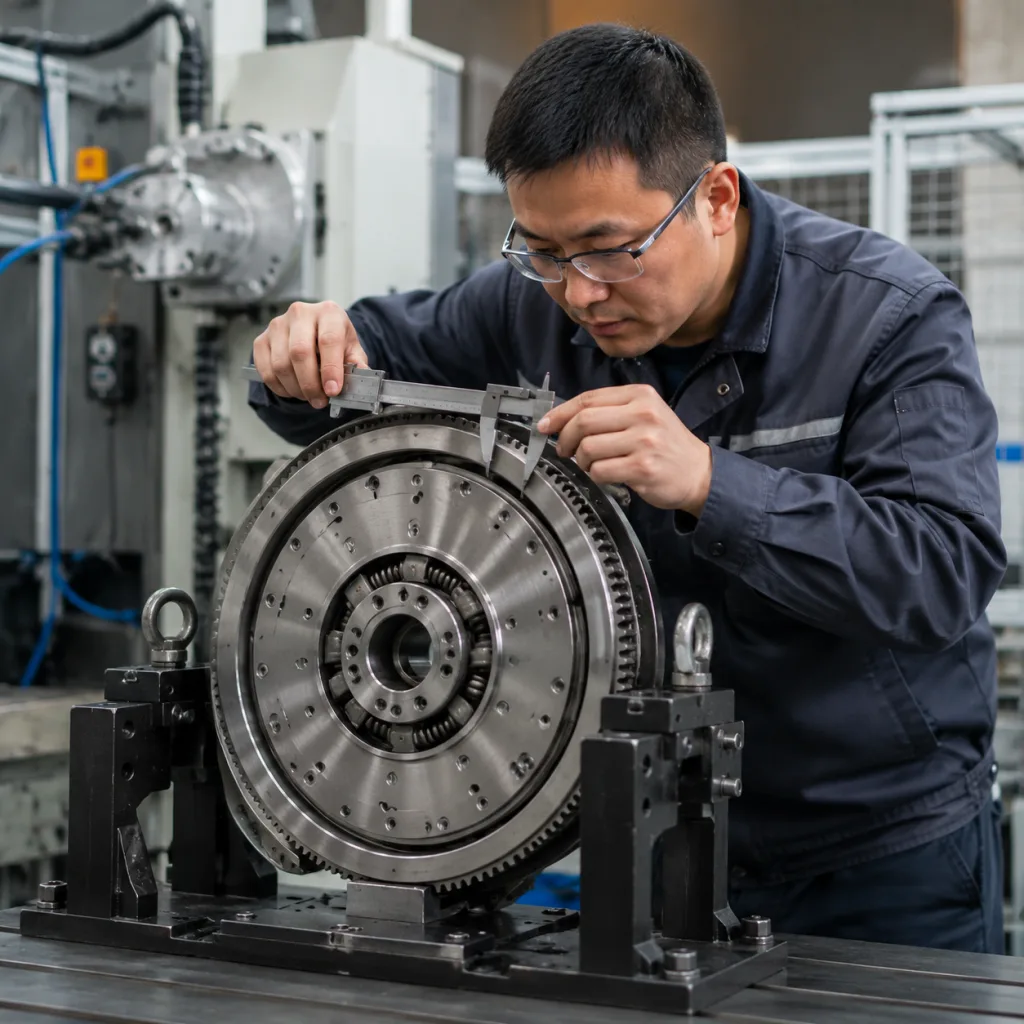
Axial and radial runout checks at defined datum points.
Hardness testing for gear teeth and friction surfaces.
Thermal cycling or endurance testing for new product introductions.
Salt spray or corrosion checks when required by the buyer spec.
The important question is how often each test runs and what the acceptance limit is. Ask for the balance limit by part number, the sample size for destructive checks if used, and the method used to detect grease loss after heat soak. If the supplier cannot put that in writing, the quotation is still preliminary.
Driventus aligns inspection with buyer risk. A distributor launching a new SKU may need sample reports and pre-shipment inspection. A program buyer may require a control plan, process flow, failure mode analysis, and ongoing performance data. The goal is consistency with the approved sample, not one lucky shipment.
Which Supplier Type Fits Your Program?
The right supplier depends on your commercial model. There is no single best answer.
Aftermarket wholesalers usually want broad coverage, neutral packaging, stable MOQ, and smooth container planning.
OEM and Tier-1 buyers focus on process capability, engineering response, and formal change control.
Repair-chain buyers care most about low complaint rates, clear fitment data, and reliable replenishment.
Use this decision filter before placing the PO:
Confirm Incoterms: EXW, FOB Ningbo or Shanghai, CIF, or DAP.
Lock payment terms, deposit percentage, and balance timing.
Review annual forecast by reference, including slow movers.
Approve label format, barcode structure, and country-of-origin marking.
Define warranty handling: photos, installation context, mileage, and batch code.
Require engineering-change notification rules.
A cheap quote can become expensive if it arrives late, misses packaging requirements, or creates claims. A higher quote can be the safer choice if it includes better documentation, cleaner export handling, and stronger replenishment performance.
Driventus is an independent aftermarket manufacturer; brand names are referenced for fitment only. If you are qualifying a dual mass flywheel manufacturer China, judge the supplier by evidence, repeatability, and response speed rather than unit price alone.
Frequently asked questions
Please provide application details, annual volume, target market, packaging requirements, and any cross-reference such as OE 06A… or OE 11251… if already used in your catalog. A sample, drawing, or detailed dimension sheet helps confirm fitment and damping design.
Yes. Driventus can support neutral packaging, distributor branding, barcode labels, pallet plans, and application labels. Artwork, carton strength, country-of-origin marking, and any regional language requirements should be approved before mass production.
Buyers should verify IATF 16949:2016 and ISO 9001:2015 certificates, calibration records, traceability procedures, inspection plans, and nonconformance controls. For EU distribution, material declaration support for REACH (EC) No 1907/2006 may also be required.
If you are qualifying a dual mass flywheel supplier for distribution, private label, or program sourcing, share your application list and target volumes. Contact Driventus to [request a quote](/contact.html)