How to Choose a Connecting Rod Supplier
Choosing a connecting rod supplier is a technical procurement decision, not just a price comparison. The rod links the piston to the crankshaft and works under repeated tensile and compressive loads, so small errors in big-end geometry, bore roundness, material strength, heat treatment or bolt clamp load can shorten engine life. Buyers should confirm manufacturing control, inspection discipline and delivery reliability before awarding volume business. This guide gives sourcing engineers, category buyers and import managers a practical sequence for evaluating suppliers for aftermarket, OEM service and repair-chain programmes. It covers certification, factory audit points, material and process checks, dimensional validation, documentation, commercial terms and risk controls. Driventus manufactures engine and powertrain components in Taizhou, Zhejiang, and supplies B2B customers in more than 60 countries. Driventus is an independent aftermarket manufacturer; brand names are referenced for fitment only.
Start with application scope and annual demand
Before sending RFQs, define the connecting rod families, engine platforms, order frequency and validation level. A supplier that can quote one forged steel rod for a low-volume rebuild programme may not be the right match for a multi-SKU distributor range or a Tier-1 service project.
Prepare a sourcing brief with:
- Engine type: gasoline, diesel, turbocharged, naturally aspirated, light-duty or heavy-duty.
- Rod construction: forged steel, cast steel, powdered metal or billet for special applications.
- Bore requirements: big-end bore, small-end bore, centre-to-centre length and wrist-pin fit.
- Bearing interface: shell width, tang location, side clearance and housing bore tolerance.
- Fastener type: cap screw, through-bolt, torque-to-yield or reusable bolt specification.
- Demand profile: first order quantity, monthly forecast, safety stock target and launch date.
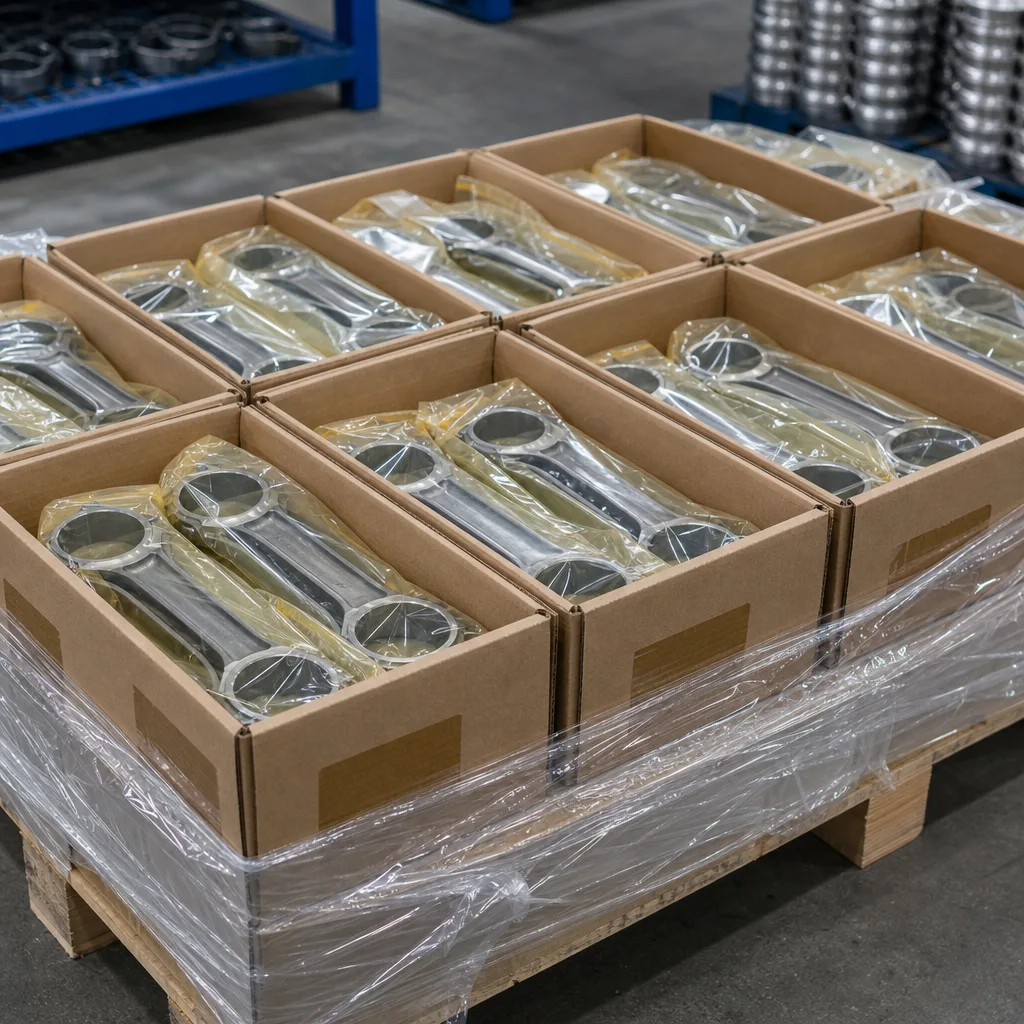
- Packaging: neutral, distributor brand, bulk, VCI protection or kit packing.
If the programme includes existing references, provide drawings, samples and OE part-number cross-references where they are relevant and legally usable. Generic fitment references such as OE 06A… or OE 11251… can help align the discussion when they are already part of your sourcing data. However, cross-reference tables should never replace dimensional and functional validation, especially where engine variants share similar part numbers but differ in pin size, bearing width or cap design.
Buyers can review our catalog for engine component categories and discuss custom manufacturing when the requirement is outside standard aftermarket coverage.
Verify certification and quality controls
A credible connecting rod manufacturer should operate a documented quality management system and be able to show that controls are used on the production floor, not only in sales files. For automotive procurement, IATF 16949:2016 is the relevant quality management standard for series automotive supply. ISO 9001:2015 provides a broader quality framework and may be acceptable for some aftermarket programmes when supported by strong audit evidence.
Ask for valid certificates, scope pages and issuing body details. Then move from paperwork to process evidence: control plans, inspection records, material certificates, gauge calibration logs, non-conformance procedures and corrective action examples. A certificate confirms the framework; the audit shows whether the framework is active.
| Verification item | What to request | Why it matters |
|---|---|---|
| IATF 16949:2016 / ISO 9001:2015 | Current certificate and scope | Confirms formal QMS coverage |
| Incoming material control | Mill certificate, chemistry and mechanical data | Reduces risk of mixed or sub-grade steel |
| Process control plan | Forging, machining, heat treatment and inspection controls | Shows how critical features are held |
| Gauge control | Calibration records for bore gauges, CMM and hardness testers | Prevents false acceptance of parts |
| Traceability | Batch number, heat number and inspection lot records | Supports containment and recall analysis |
| Corrective action | 8D or equivalent reports | Indicates problem-solving discipline |
| Criterion | Suggested weight | Evidence to review |
|---|---|---|
| Dimensional capability | 20% | CMM reports, bore data, capability studies |
| Quality system | 15% | IATF 16949:2016, ISO 9001:2015, audit results |
| Material and heat treatment control | 15% | Mill certificates, hardness records, furnace data |
| Validation testing | 15% | Fatigue, hardness, crack detection, fitment checks |
| Delivery performance | 10% | Capacity plan, lead time history, safety stock option |
| Commercial terms | 10% | MOQ, tooling, payment, warranty process |
| Engineering support | 10% | Drawing review, reverse engineering, PPAP documents |
| Compliance and packaging | 5% | REACH (EC) No 1907/2006, labelling, corrosion protection |